
 Worksheets
CH6.1-6.4 Nervous System CYU
Total questions: 30
Worksheet time: 25mins
Which of the following is not a major physiological function of the nervous system?
Sensation
Circulation
Integration
Motor response
The (a) neurons carry impulses to the (b) where (c) occurs. The signal is then carried by (d) neurons to produce an action.
During the integration stage, the nervous system:
Reacts to stimuli by producing movement
Processes incoming sensory information
Stores nutrients in the brain
Transports oxygen to nerve cells
You hear your name called and turn your head. Which neuron type initiates this motion?
Afferent
Interneuron
Efferent
Reflex neuron
The CNS includes:
Brain and spinal cord
Spinal nerves and cranial nerves
Brain and sensory receptors
Cranial nerves and motor neurons
The parietal lobe primarily controls:
Balance and coordination
Vision
Temperature, touch, and taste
Emotions and decision-making
Which part of the brain acts as the body’s “relay station”?
Hypothalamus
Thalamus
Cerebellum
Pons
The corpus callosum allows:
Communication between brain hemispheres
Hormone release into the bloodstream
Control of reflexes
Filtering of cerebrospinal fluid
If a person has trouble maintaining balance, which brain structure is most likely affected?
Cerebellum
Medulla oblongata
Frontal lobe
Temporal lobe
Which part of the brainstem regulates breathing and heart rate?
Midbrain
Pons
Medulla oblongata
Cerebrum
How many pairs of cranial nerves exist?
8
12
24
31
A patient loses their sense of smell after head trauma. Which cranial nerve was most likely damaged?
Optic (II)
Facial (VII)
Olfactory (I)
Vagus (X)
The sympathetic nervous system prepares the body by:
Slowing heart rate
Increasing digestion
Releasing adrenaline and raising BP
Promoting sleep
A student is relaxing after a stressful exam. Which system is now dominant?
Somatic nervous system
Parasympathetic nervous system
Sympathetic nervous system
Central nervous system
The “fight or flight” response describes activation of the:
Central nervous system
Parasympathetic nervous system
Somatic nervous system
Sympathetic nervous system
Glial cells differ from neurons because they:
Transmit impulses
Are conductive
Support and protect neurons
Cannot divide
A buildup of toxins or dead cells would indicate malfunction of which glial cell?
Oligodendrocyte
Microglia
Astrocyte
Ependymal cell
If a person has damage to oligodendrocytes, what would most likely occur?
Slower nerve impulse transmission
Excess cerebrospinal fluid
Loss of balance and coordination
Reduced emotional control
Gray matter primarily functions to:
Process and interpret information
Transmit signals rapidly
Store nutrients
Protect neurons from toxins
Which best explains why white matter appears white?
High number of cell bodies
Presence of cerebrospinal fluid
Dense myelin covering on axons
Large blood supply
Identify the different lobes and major structures of the brain shown in the image.
Select the region that processes visual and auditory information, controls eye movement, and muscle movements related to posture & balance.
Select the region relays motor signals from the cerebrum to the cerebellum, coordinating voluntary movements and controls
controls eye movements & facial expressions
Select the region regulates HR, BP, & breathing, controls involuntary movements such as swallowing, vomiting, coughing, & coordinates body’s response to stress through release of adrenaline & noradrenaline
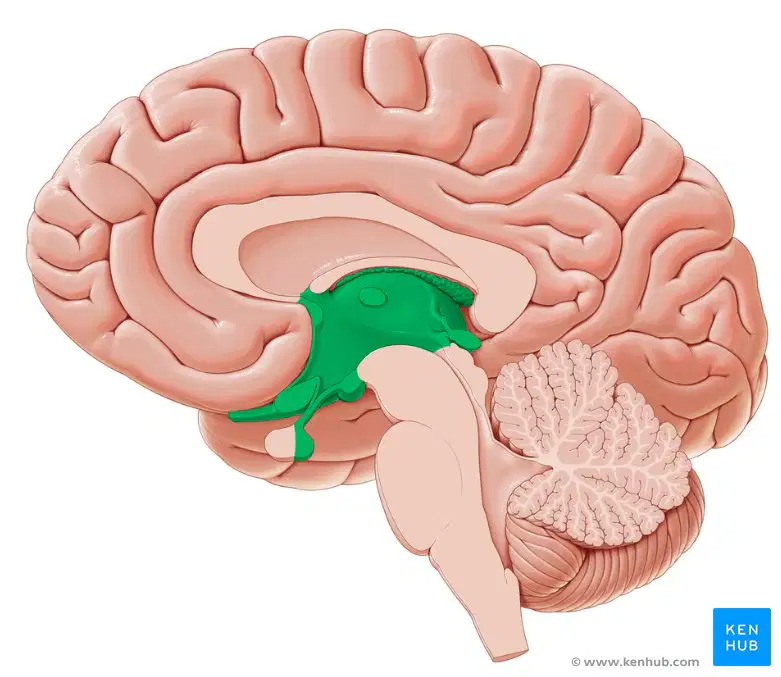
The diencephalon includes these 3 main structures and acts as a relay center and regulator for critical bodily functions.
thalamus
hypothalamus
epithalamus
corpus callosum
cerebellum
part of the nervous system that transmits impulses to and from skin and skeletal muscles
Somatic nervous system
The nervous system responsible for integrating sensory information and sending motor responses.
Central Nervous System
part of the peripheral nervous system that transmits from the central nervous system to internal organs
Autonomic nervous system
branch of the ANS that controls organs and is most active during emergencies or stress
Sympathetic nervous system
branch of the ANS that controls organs and is most active when the body is at rest
Parasympathetic nervous system
Label the cranial nerves shown in the image. Not all labels will be used.
These cranial nerves are considered sensory only:
I
II
VIII
V
VII
Match the definition with the correct glial cell:
Anchor neurons to capillaries; regulate ions and neurotransmitters
Astrocytes
Act as phagocytes to remove debris and toxins
Microglia
Form myelin sheaths around axons in the central nervous system
Oligodendrocytes
Provide structural support and insulation for neurons
Schwann cells
Line brain ventricles; produce and circulate (CSF)
Ependymal cells
Organize these autonomic system responses with the correct branch of the ANS:
pupil dilation

