
NEW
Font size
 Worksheets
DNA Replication and Basic Gene Expression
Total questions: 42
Worksheet time: 1hrs 2mins
Hannah, Maya, and Arjun are working together in a genetics lab, and they're on a mission to crack the DNA code! They discover an original DNA strand with the sequence CCT-GCA-TAC. If the team wants to figure out the sequence on the new, complementary strand, what will it be?
CCT-GCA-TAC
GGA-CGT-ATG
GGA-CGU-AUG
CCU-CGT-UAC
Aria, Daniel, and Liam are on a science adventure in biology class! Their teacher just revealed that DNA replication is "semiconservative." Can you help them figure out what this means?
Each new DNA molecule is made up of one original (parent) strand and one newly synthesized strand.
The new DNA molecule is made up of two completely new strands.
The process requires very little energy, making it "conservative."
The cell only copies half of its DNA during replication to save resources.
Evelyn, Ava, and Mason are working together in a genetics lab when they discover a mysterious DNA sample that contains 18% cytosine. After the DNA is replicated and split into two daughter cells during cell division, what will each cell's percentage of guanine be?
9%
18%
32%
82%
Charlotte, William, and Aria are in a genetics lab, and they're on a mission to help cells copy their DNA before they divide! Which of the following statements best describes what happens during DNA replication in their exciting experiment?
Part of a DNA sequence is read by RNA polymerase, which produces a complementary strand of RNA.
Messenger RNA is decoded by a ribosome to produce an amino acid chain. In the cell's cytoplasm, transfer RNA joins the messenger RNA, forming a polypeptide.
Two free-floating single strands of DNA are joined by DNA polymerase. The polymerase finds the point at which the two strands will match up into a double strand.
A double-stranded DNA molecule is unwound into two single strands. DNA polymerase matches the correct nucleotides to the single strands of DNA, which forms two new complementary strands of DNA.
Noah, Evelyn, and Elijah are working together in their biology class, diving into the mysteries of genetics! They discover a DNA sequence in a gene that reads G G A T G C C A T. When this gene is expressed during transcription, which of the following molecules could be produced?
DNA with the sequence G G A U G C C A U
mRNA with the sequence C C U A C G G U A
rRNA with the sequence G G A T G C C A T
tRNA with the sequence C C T A C G G T A
Arjun and Priya are teaming up in a genetics lab, exploring the mysteries of gene expression in human cells. As they examine the diagram, they spot something interesting happening at label A. Which of the following statements best describes and explains the process taking place at label A?
The process is transcription because double-stranded DNA is used to make a complementary single strand in the nucleus.
The process is replication because DNA is being used as a template to make a complementary single strand of RNA.
The process is translation because double-stranded DNA is used to make a complementary single strand in the cytoplasm.
The process is mutation because the bases on the new strand are not identical to the original strand.
Aiden, Mia, and Harper are on a biology adventure, trying to uncover how cells create RNA from DNA! Which of the following statements about transcription is correct?
In eukaryotes, transcription takes place in the cytoplasm with the help of ribosomes.
Helicase and DNA Polymerase break each DNA molecule into many pieces, copy the pieces, and link them back together.
An enzyme uses a DNA sequence as the template for building a molecule of RNA.
In prokaryotes, transcription takes place in the nucleus to create new DNA molecules.
Arjun, Isla, and Emma are on a biology adventure! They discover a mysterious DNA segment: A T C A G G C G T G G C. Can you help them figure out how many amino acids are coded for by this segment?
20
12
8
4
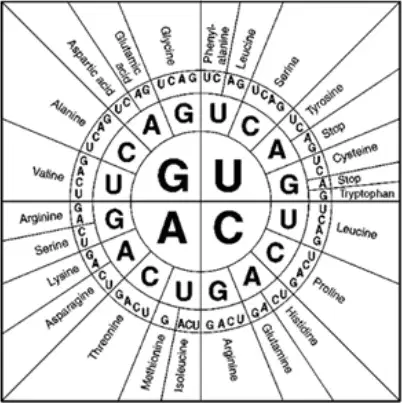
Isla, Michael, and Daniel are working together in biology class to crack a genetic code! They discover a mysterious gene with the DNA sequence TAC-TCC-GTG-ATT. Using the codon table, can you help them figure out which protein is produced from this sequence?
Asn - His - Gly - Val
Stop - His - Arg - Met
Met - Arg - His - Stop
Tyr - Ser - Val - Ile
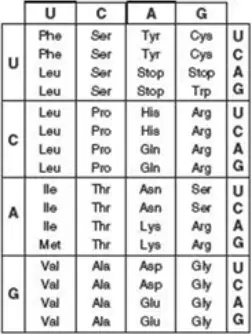
Mia, Luna, and Zoe are on a genetics adventure in their biology class! They discover a mysterious DNA segment: TAC ACA CGG AGG GTA CGC TAT. Using the codon chart, can you help them crack the code and reveal what protein sequence this DNA segment creates?
Met-Cys-Ala-Ser-His-Ala-Ile
Met-Phe-Leu-Pro-Val-Asp-Lys
Tyr-Asn-Ala-Asp-His-Ser-Ile
Tyr-Thr-Ala-His-Ser-Asp-Lys
Brody and Evelyn team up to visit a genetic counselor after discovering that a mysterious disease in Brody's family is caused by a single codon change in a gene—from GAA to GTA. The counselor challenges them: This disease is the result of which of the following?
Crossing-over
A meiosis error
Polyploidy
A mutation
Benjamin, Luna, and Grace are on a genetics adventure! They discover that mutations can happen during the cell cycle before both mitosis and meiosis. Which of the following statements about mutations is true?
Mutations in the DNA of the parent's somatic (body) cells never affect the individual in which they happen.
Mutations in the DNA of the parent's somatic (body) cells can cause the offspring to produce a protein that does not function.
A mutation in the DNA of the parent's gamete can cause the offspring's somatic (body) cells to produce a protein that does not function.
A mutation in the DNA of the parent's gamete affects the somatic (body) cells of the parent that produced the gamete.
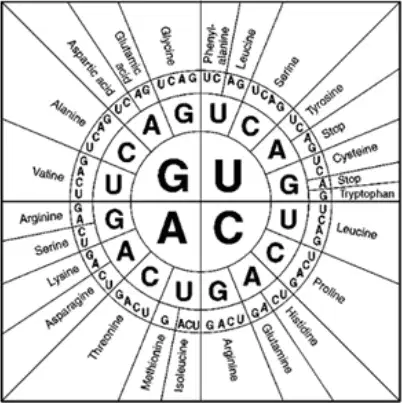
Olivia and Daniel are on a genetics adventure! While exploring a mysterious plant, they discover that a segment of its DNA has undergone a mutation: The original DNA sequence was ACG, but now it’s ACA. Using the codon chart, can you help them figure out if this mutation will cause a change in the plant’s phenotype?
No because even though the DNA sequence changed, the mRNA sequence still codes for the same amino acid, so no change in protein will occur.
No because even though the DNA sequence changed, the mRNA sequence still codes for the same amino acid, so the protein will not function properly.
Yes because the protein of the organism would change because it codes for a different amino acid.
Yes because the protein of the organism would change because any change in the DNA sequence will cause a change in the resulting protein.

Lily, Kai, and Ethan are working together in a genetics lab when they spot a mysterious change in a DNA sequence! Check out the diagram above—can you help them figure out which type of mutation they’re seeing and what effect it will have on the protein?
A completion mutation that would change only one amino acid
A frameshift mutation that would change many amino acids in the protein after the change
A substitution mutation that will prevent translation from occurring
A translocation mutation that will have no effect on protein function
Scarlett, James, and Isla are working together in their genetics lab, trying to solve a mystery about mutations! They want to discover which type of mutation would MOST LIKELY cause a dramatic change in an organism's phenotype. Which mutation should they be most worried about?
A single-base insertion at the end of the gene sequence
A single-base substitution at the end of the gene sequence
A single-base insertion at the beginning of the gene sequence
A single-base substitution at the beginning of the gene sequence
Ethan, Evelyn, and Rohan are exploring the mysteries of genetics in their science class. They discover that sometimes, changes can sneak into a DNA sequence. Which statement best describes these sneaky mutations?
Errors during protein synthesis that decrease genetic variation.
Errors during protein synthesis that increase genetic variation.
Errors during DNA replication that increase genetic variation.
Errors during DNA replication that decrease genetic variation.

Scarlett, Noah, and Maya are curious about how a tiny change in DNA can end up changing things like eye color or hair texture! They team up to create a flow chart that shows this cool journey: Change in DNA → Change in RNA → Change in protein → Change in phenotype. What would be the best title for their awesome flow chart?
The Effects of Osmosis on Phenotype
How Mutations Affect Physical Characteristics
How DNA is Replicated
The Relationship between tRNA and rRNA in Cell Processes
Emma, Benjamin, and Zoe are on a science adventure, exploring how different species manage to survive when their environment suddenly changes—like during a drought or a chilly snap! Which statement correctly explains how mutations can help a species increase its chances of survival in a changing environment?
Mutations are the cause of disease in the species.
Mutations are a source of genetic variation in the species.
Mutations are always passed on to subsequent generations of the species.
Mutations are not harmful when they occur in somatic (body) cells of the species.
James, Priya, and Abigail are teaming up for a science experiment to explore how temperature affects DNA mutations in the lab. What is a research question they could ask for their investigation?
What is the optimum pH for DNA replication enzymes?
Does DNA permanently dissolve at very high temperatures?
Do DNA replication enzymes make more errors at high temperatures?
Do high temperatures increase the amount of DNA nucleotides in a cell?
Abigail, Michael, and Evelyn are working together in their biology class. They discover that scientists can transfer genes from one organism to another, like from bacteria to plants, and the new organism can still read the genetic instructions correctly. Which statement BEST explains why this amazing genetic trick works?
All organisms pass genes to offspring through RNA.
All organisms can grow, respond to stimuli, and reproduce.
All organisms match the same codon to the same amino acid.
All organisms contain the same cell organelles as other organisms.
Chloe, Noah, and Benjamin are studying genetics together. They discover that the mRNA codon UCG codes for the amino acid serine in frogs, humans, and horses. What cool fact does this reveal to them?
A mutation in one base will always have a physical effect on the resulting protein.
The genetic code does not dictate the amino acid sequence of proteins.
The genetic code is the same for nearly all organisms.
A mutation in one base could have absolutely no physical effect on the resulting protein.
Michael, Abigail, and Grace are exploring genetics in their science club. They discover that a pig contains the mRNA sequence: UCC AGG UUA, which translates to the amino acid sequence: serine-arginine-leucine. The trio starts wondering: if the same mRNA (UCC AGG UUA) was placed in a bacteria cell, what would happen? Which of the following statements BEST describes the outcome?
It would not be translated at all because it is a different species.
It would still code for the same amino acids because the genetic code is universal.
It would code for different amino acids because bacterial DNA is not housed in a nucleus.
It would only code for two of the three amino acids because bacteria cells are much smaller.
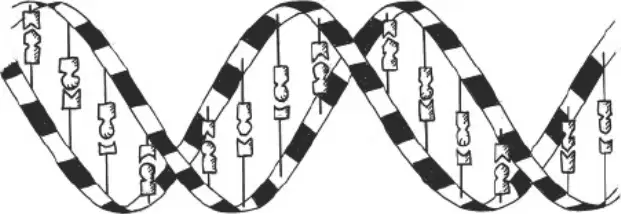
Benjamin, Grace, and Aiden are on a mission in their biology lab to crack the code of life! They’re examining a cool diagram of the DNA double helix, trying to figure out what makes up each DNA nucleotide. Can you help them discover which molecules join together to build a single DNA nucleotide?
ribose, a phosphate group, and two nitrogenous bases
ribose, two phosphate groups, and one nitrogenous base
deoxyribose, two phosphate groups, and one nitrogenous base
deoxyribose, a phosphate group, and one nitrogenous base
Liam, Olivia, and Noah are working together in a laboratory, trying to solve a scientific mystery! They want to discover which type of macromolecule is responsible for passing genetic information from one generation to the next. Using special chemical forms of phosphorus and other elements, called isotopes, they track these molecules through generations. The trio notices that the special phosphorus is passed on, which means a phosphorus-containing molecule must be the genetic material. Which macromolecule type contains phosphorus and serves as the genetic material?
Carbohydrate
Nucleic Acid
Lipid
Protein
Avery, Mason, and Anika are preparing for their biology exam and have decided to quiz each other on proteins. They come across the following statements in their notes. Can you help them figure out which statement about proteins is NOT true?
Proteins have many functions in a cell, including to regulate the rate of biochemical reactions.
Proteins are replicated in order to store and transmit genetic information across generations.
Proteins contain nitrogen as well as carbon, hydrogen, and oxygen atoms.
Amino acids are the building blocks of proteins within living organisms.
James and Luna are helping Abby in a laboratory, where they're studying some super-tough bacteria that thrive in hot springs at sizzling temperatures of 70 °C or higher! They extract special enzymes from these bacteria, like helicase and DNA polymerase, and decide to see what happens if they try to use them for DNA replication at a much cooler temperature. What do you think will happen to these enzymes when they work at the lower temperature?
The enzymes will be destroyed by lysosomes and will not copy DNA.
The enzymes will require less energy to copy DNA than they would at 70 °C.
The enzymes will copy DNA more slowly than they would at 70 °C.
The enzymes will lose their bond structure and fall apart, so no DNA will be copied.
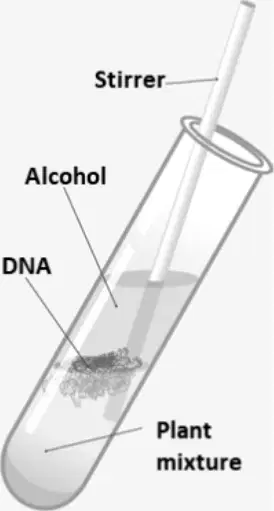
Evelyn, Abigail, and Ethan are on a mission in Biology class to discover the best way to extract DNA from a mysterious plant! Evelyn thinks adding soap will help them get more DNA because it can break up the lipids in the cell membrane and let the DNA escape. To test this, the trio crushes the plant's cells in saltwater and splits the mixture between two containers. They add soap to one container, then mix both up like mad scientists. After straining each mixture with a filter, they pour cold alcohol on top to attract the DNA. Sure enough, the soapy container produces more DNA! But here's the twist: why did they bother with the container that had no soap, even though soap worked better?
The container without soap was the dependent variable. The results of the experiment depended on the presence or absence of soap in the mixture.
The container without soap was a replicate. Replication in experiments increases the validity of the results, so two containers were used instead of just one.
The container without soap was the control group. It showed that the increase in DNA extraction was caused by the presence or absence of soap (not some other unknown factor).
The container without soap was a back-up in case the DNA extraction did not work in the container with soap. Jonathan would be able to add other chemicals to this container to test (like an acid or pH buffer) if soap was ineffective.
Lucas, Ava, and Henry are investigating how changes in DNA can impact an organism. They find a gene where a single base is deleted near the start of the sequence. What is the MOST LIKELY effect of this mutation?
It will stop the gene from being transcribed into mRNA.
It will have no effect on the protein produced.
It will only change the last amino acid in the protein.
It will cause a frameshift, changing many amino acids in the protein.
Sophia, Ethan, and Mia are decoding a DNA sequence: GTT-ACC-TGA-CAA. Using a codon chart, which amino acid sequence will be produced from this gene?
Val - Thr - Leu - Gln
Gly - Thr - Leu - Pro
Gly - Ala - Stop - His
Val - Thr - Stop - Gln
Ella, Jack, and Grace are studying how mutations can be inherited. If a mutation occurs in the DNA of a parent's gamete, what is the possible outcome for the offspring?
The offspring may inherit the mutation and it could affect their traits.
The mutation will only affect the parent and not the offspring.
The mutation will be corrected before fertilization occurs.
The offspring will always develop a genetic disorder.
Sophia, Ethan, and Mia are learning about how genetic information is passed from parents to offspring. They wonder what would happen if a mutation occurs in a parent's somatic (body) cell. Which statement best describes the outcome?
The mutation will be inherited by the offspring and affect their traits.
The mutation will be corrected during cell division.
The mutation will always cause a genetic disorder in the parent.
The mutation will only affect the parent and not be passed to the offspring.
Lucas, Ava, and Henry are studying the effects of different types of mutations. They find a gene where a single base is substituted in the middle of the sequence. What is the MOST LIKELY effect of this mutation?
It may change one amino acid in the protein, possibly affecting its function.
It will cause a frameshift, changing all amino acids after the mutation.
It will prevent the gene from being transcribed into mRNA.
It will have no effect on the protein produced.
Ella, Jack, and Grace are exploring why the genetic code is considered universal. They wonder what would happen if a gene from a jellyfish is inserted into a plant cell. Which statement BEST explains the result?
The plant cell will not be able to read the jellyfish gene because it is from a different species.
The jellyfish gene will be destroyed by the plant cell's enzymes.
The plant cell will only partially express the jellyfish gene.
The plant cell will use the same genetic code to produce the protein encoded by the jellyfish gene.
Olivia, Liam, and Harper are investigating how a substitution mutation in a DNA sequence might affect the resulting protein. If a single base is replaced in the middle of a gene, what is the MOST LIKELY outcome?
It may change one amino acid in the protein, possibly altering its function.
It will cause a frameshift, changing all amino acids after the mutation.
It will have no effect on the protein produced.
It will prevent the gene from being transcribed into mRNA.
Jackson, Ava, and Sophia are studying DNA replication in their biology class. They learn that DNA replication is described as 'semiconservative.' What does this mean for the new DNA molecules formed?
Each new DNA molecule contains one original strand and one new strand.
Each new DNA molecule is made up of two original strands.
Both strands in the new DNA molecule are newly synthesized.
DNA replication only occurs in half of the cell's chromosomes.
Ella, Mason, and Zoe are exploring how mutations can be inherited. If a mutation occurs in the DNA of a parent's gamete, what is the possible effect on the offspring?
The offspring will always develop a genetic disorder.
The mutation will only affect the parent and not the offspring.
The mutation will be corrected before fertilization occurs.
The offspring may inherit the mutation and it could affect their traits.
Lucas, Mia, and Ethan are investigating how a change in DNA can affect an organism. If a single base is substituted in the middle of a gene, which of the following is the MOST LIKELY result?
It will always result in a nonfunctional protein.
It will prevent the gene from being transcribed into mRNA.
It will cause a frameshift, changing all amino acids after the mutation.
It may change one amino acid in the protein, possibly altering its function.
Olivia, Jack, and Grace are studying how genetic information is passed on. If a mutation occurs in the DNA of a parent's gamete, what could happen to the offspring?
The offspring will always develop a genetic disorder.
The mutation will be corrected before fertilization occurs.
The mutation will only affect the parent and not the offspring.
The offspring may inherit the mutation and it could affect their traits.
Emma, Benjamin, and Zoe are exploring how mutations can help a species survive environmental changes. Which statement best explains the role of mutations in evolution?
Mutations are a source of genetic variation in the species.
Mutations are the cause of disease in the species.
Mutations prevent adaptation to new environments.
Mutations are always harmful to the species.
Ella, Jack, and Grace are investigating how a change in a single base of DNA can affect the protein produced. If a substitution occurs at the beginning of a gene, what is the MOST LIKELY result?
It will prevent the gene from being transcribed into mRNA.
It may change the first amino acid in the protein, possibly altering its function.
It will cause a frameshift, changing all amino acids after the mutation.
It will have no effect on the protein produced.
Lucas, Ava, and Henry are studying mutations in their biology class. They find a gene where a single base is inserted near the start of the sequence. What is the MOST LIKELY effect of this mutation?
It will stop the gene from being transcribed into mRNA.
It will only change the last amino acid in the protein.
It will have no effect on the protein produced.
It will cause a frameshift, changing many amino acids in the protein.
Scarlett, James, and Isla are exploring how mutations can impact an organism's traits. Which type of mutation is MOST LIKELY to cause a significant change in phenotype?
A single-base insertion at the beginning of the gene sequence
A single-base substitution at the beginning of the gene sequence
A single-base substitution at the end of the gene sequence
A single-base deletion at the beginning of the gene sequence

