
 Worksheets
Cell/Organelles Practice test
Total questions: 57
Worksheet time: 29mins
Which factor most influences the rate of diffusion across a membrane?
ATP levels
Cell size
Concentration gradient
Nucleus Size
Evaluate this historical claim: "Spontaneous generation was disproved through experiments that supported the cell theory." How would you assess this statement?
The statement is correct because experiments by scientists like Pasteur showed that microorganisms come from pre-existing microorganisms, not spontaneously
The statement is correct because cell theory states that all cells arise from pre-existing cells (the principle of biogenesis).
A biologist is studying the internal structure of mitochondria at the molecular level. She needs an image that reveals detailed internal features of the organelle. Which microscope should she select, and why?
Scanning electron microscope (SEM), because it provides detailed images of surface textures.
Transmission electron microscope (TEM), because it provides high-resolution images of internal cell structures.
Light microscope, because it allows observation of living cells in natural color.
Dissecting microscope, because it allows low magnification and depth perception.

Cyanobacteria are prokaryotic organisms commonly found in streams and ponds as chains of cells. The major parts of a cyanobacteria cell are labeled.
Which structural characteristic of a cyanobacteria cell is similar to a characteristic of a plant cell only?
ribosomes
photosynthetic membrane (contains chlorophyll)
cytoplasm
DNA
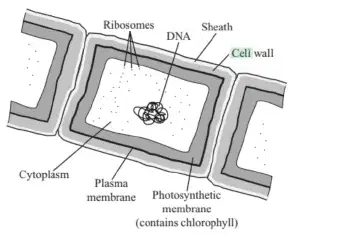
Identify one structural characteristic of a cyanobacteria cell that are different from characteristics of a plant cell.
DNA without a nucleus
ribosomes
plasma membrane.
cell wall
Which statement best explains why diffusion alone cannot meet the needs of large multicellular organisms?
Diffusion increases ATP production.
Diffusion provides energy for transport.
Diffusion requires transport proteins.
Diffusion is too slow over long distances to supply all cells efficiently.

The following picture is an image of red blood cells under a microscope.
A lab technician observes a blood sample under a microscope. The red blood cells appear shriveled and have a spiky, star-shaped appearance (crenation).
The technician is asked to identify the condition of the solution the cells were placed in.
Hypertonic; the net movement of water is out of the cells, causing them to shrink and shrivel (crenation).
Isotonic; there is no net movement of water across the cell membrane, and the cells maintain their normal shape.
Hypertonic; the net movement of water is into the cells due to the high solute concentration outside the cell.
Hypotonic; the net movement of water is into the cells by osmosis, causing them to swell and potentially lyse.
Which situation best demonstrates selective permeability?
Ions move randomly in both directions.
The cell wall blocks all materials.
The membrane allows oxygen to pass but not glucose.
Water and glucose move equally across the membrane.

Which of the following is a function of the nucleus in organism 2?
releasing usable energy
absorbing sunlight
producing food molecules
storing genetic material
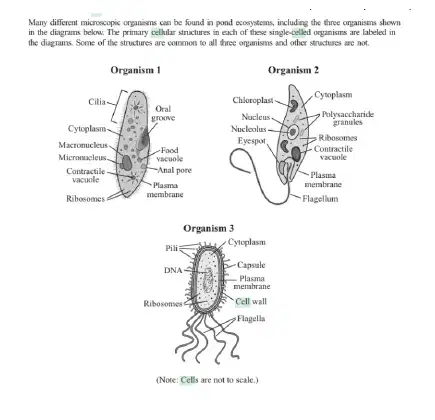
Which of the following identifies the organisms that are eukaryotic and gives the best explanation?
organisms 1, 2 and 3 because they are all single celled.
organisms 1 and 2 only, because both have a nucleus.
organisms 1, 2 and 3 because they all have ribosomes.
organisms 2 and 3 only, because both use flagella.
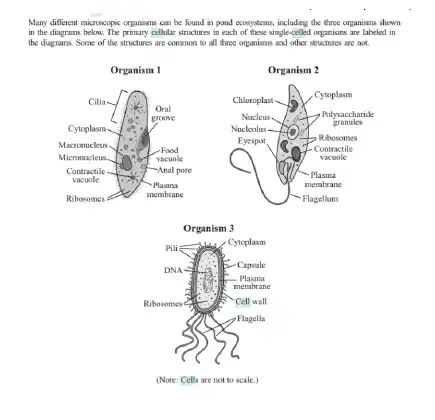
Based on the cellular structure of organism 3, which of the following is a characteristic of the organism?
It can move around in its environment.
It can conduct photosynthesis.
It can produce male and female gametes.
It can survive for long periods by storing food.
Which of the following is a prokaryotes?
Saccharomyces cerevisiae, baker’s yeast
Agricus arvensis, horse mushroom
Thiopedia rosea, purple sulfur bacterium
Rhizopus stonlonifer, bread mold fungus
Amino acids, sugars and ions move across the cell membrane. Their movement from a region of high concentration to a region of low concentration is accomplished by special proteins in the membrane. Which of the following terms applies to this type of cell transport?
facilitated diffusion
transcription
osmosis
active transport
A plant cell placed in a hypertonic salt solution shrivels and the cell membrane pulls away from the cell wall.
Active transport, because the cell uses ATP to remove water.
Facilitated diffusion, because salt ions move into the cell through carrier proteins.
Endocytosis, because the cell engulfs salt from the environment.
Osmosis, because water moves out of the cell to where solute concentration is higher.
Who is credited with coining the term "cell" after observing cork under a microscope?
Matthias Schleiden
Robert Hooke
Theodor Schwann
Anton van Leeuwenhoek
Which scenario illustrates dynamic equilibrium in cell transport?
Molecules continue to move in both directions, but overall concentration remains constant.
Water moves only into the cell.
Molecules stop moving once concentrations equalize.
Energy is required to maintain equal concentrations.
A scientist studying two unknown cells notes that one has membrane-bound organelles. Which hypothesis can be made about their evolutionary relationship?
The cell without organelles performs more specialized functions.
The simpler cell evolved from the complex one.
Both cells evolved independently from viruses.
The cell with organelles evolved later and is more complex.
A scientist observes that a certain molecule enters a cell even when its concentration inside is higher than outside. Which statement best explains this process?
The molecule moves by active transport using a protein pump and ATP.
The molecule moves by facilitated diffusion through a channel protein.
The molecule moves by simple diffusion through the lipid bilayer.
The molecule moves by osmosis through aquaporin

Which of the following cell characteristics provides evidence that this cell comes from a plant and not an animal?
a single nucleus
a large vacuole
a semipermeable cell membrane
a functional mitochondrion
Analyze this scenario: A scientist claims to have discovered a new type of living organism that does not contain cells. Based on the cell theory, what would be the most appropriate scientific response?
Assume the organism must be from another planet
Investigate the claim thoroughly, as it challenges a fundamental theory of biology
Reject the claim without investigation since it contradicts established theory
Accept the claim since scientific theories are frequently proven wrong
Why is the cell membrane often described as a “fluid mosaic”?
It is made of static phospholipid layers.
It allows all substances to pass freely.
The phospholipids and proteins move within the layer, maintaining flexibility.
It is made entirely of proteins that form a rigid surface.

The diagram below shows changes in the concentrations of sodium and potassium ions inside and outside a nerve cell. These changes prepare the nerve cell to conduct and electrical impulse.
Which of the following processes is directly responsible for these changes in the concentrations of sodium and potassium ions inside and outside the nerve cell?
enzyme activity
osmosis
active transport
transcription
Which of the following is NOT part of the cell theory?
The cell is the basic unit of structure and function in living things
All living things are composed of one or more cells
Cells contain DNA that is passed to daughter cells
Cells come from pre-existing cells
In a cell, which of the following organelles most likely contains digestive enzymes?
chloroplast
lysosome
ribosome
centriole

A cell is shown in the diagram below. Which of the following cell characteristics from the choices below, provides evidence that this cell comes from a plant and not from an animal?
a large vacuole
a functional mitochondria
a semipermeable membrane
a single nucleus
A student is examining plant and animal cells under a compound light microscope. Which of the following represents the correct sequence of components that light passes through?
*Condenser (light)
Objective lens --> specimen --> condenser--> eyepiece
eyepiece --> objective lens --> specimen --> Condenser
Specimen --> eyepiece --> condenser --> objective lens
Condenser --> specimen --> objective lens --> eyepiece
Which invention played the biggest role in the discovery of cells by early scientists?
eyeglasses
magnifying glass
lens
compound light microscope
What evidence would best support the cell theory statement that "cells come from pre-existing cells"?
Observing that larger organisms contain more cells
Watching a cell divide into two daughter cells under a microscope
Measuring the size of different types of cells
Finding that all cells contain DNA
How did the development of cell theory relate to the process of science?
It was accepted immediately without any controversy or competing theories
It required advanced technology that was only developed in the 20th century
It evolved over time as multiple scientists made observations, developed hypotheses, and tested their ideas
It was developed by a single scientist who made all the key discoveries at once

The diagram below represents Trichodina.
Trichodina is a eukaryotic organisms that attaches itself to fish and eats bacteria. Which of the following distinguishes Trichodina from all prokaryotes?
it is heterotrophic
it has a nucleus
it is unicellular
it has cytoplasm
A bacterial cell exposed to antibiotics loses its cell wall but survives. What inference can be made about its structure?
The cell wall produces energy.
The cell wall contains genetic material.
The cell cannot reproduce.
The cell wall provides protection but is not essential for basic metabolism.
If the lysosomes in an animal cell suddenly stopped functioning, what would be the most immediate effect on the cell?
The cell would accumulate waste and damaged organelles.
The cell would no longer generate energy from glucose.
The cell would lose its ability to regulate water movement.
The cell would no longer produce proteins.

A student investigates how different concentrations of salt solution affect onion cells. The percentage of cells showing plasmolysis (cell membrane pulling away from the cell wall) is recorded in the picture:
What conclusion can best be drawn from this data?
I
increasing salt concentration causes water to move into onion cells by osmosis.
Higher salt concentrations cause more water to leave the cells, resulting in plasmolysis.
Onion cells actively pump salt out of the cell to maintain homeostasis.
Plasmolysis occurs because salt enters the cells, expanding the vacuole.

The graph below compares glucose uptake over time for Sample A (normal muscle cells) and Sample B (muscle cells treated with a poison that inhibits ATP production).
Sample A shows a steady increase; Sample B remains nearly flat (very low uptake).
Which conclusion is most supported by the data?
Glucose uptake in these muscle cells requires ATP, so inhibiting ATP production prevents uptake.
Glucose transport is passive in these cells because uptake continues equally in both samples.
The poison increased membrane permeability, causing Sample B to take up more glucose.
The poison increased membrane permeability, causing Sample B to take up more glucose.
A new product claims to improve memory by exposing users to “quantum energy waves.” The company presents testimonials and images of the device in use but provides no controlled experiments or measurable data. Which statement best evaluates this claim from a scientific perspective?
It is clearly scientific because it uses technical terminology and experiments with people.
It is superficially scientific because it mimics scientific language but lacks testable evidence.
It is not scientific because all health-related claims are inherently unscientific.
It is clearly scientific because the testimonials provide observable evidence.
What is the foundational principle of Cell Theory in biology?
All living things are made of atoms
All living things are made of cells
Who observed cork under a microscope and coined the term 'cell' in 1665?
Robert Hooke
Anton van Leeuwenhoek
Matthias Schleiden
Theodor Schwann
Who stated in 1855 that all cells come from pre-existing cells?
Rudolf Virchow
Theodor Schwann
Robert Hooke
Matthias Schleiden
What is the main function of ribosomes?
Protein synthesis
DNA replication
Energy production
Cell division
True or False: The cell wall is found only in plant cells, bacteria, and fungi.
True
False
Which organelle is made of a network of membranes and is involved in protein and lipid synthesis?
Endoplasmic Reticulum (ER)
Golgi Apparatus
Mitochondria
Lysosome
What are the two main functions of the cell membrane?
Controls what enters/exits the cell; Maintains homeostasis
Synthesizes proteins; Packages cellular products
Produces energy for the cell; Stores genetic material
Provides structural support; Facilitates cell division
What is the movement of molecules from high to low concentration called?
Diffusion
Active transport
Osmosis
Filtration
What is the diffusion of water called?
Osmosis
Active transport
Diffusion
Facilitated diffusion
Which process uses proteins to move molecules down the gradient?
Facilitated Diffusion
Osmosis
Active Transport
Simple Diffusion
Which type of transport requires energy/ATP to move substances against the concentration gradient?
Active Transport
Facilitated Diffusion
Passive Transport
Osmosis
Which type of cell has a nucleus?
Prokaryotic
Eukaryotic
Which type of cell has circular, free DNA?
Prokaryotic
Eukaryotic
Which type of microscope is used to view cell surface?
Light Microscope
Scanning Electron Microscope (SEM)
Electron Microscope (TEM)
Compound Microscope
Which microscope provides very high resolution but can only be used with dead samples?
Light Microscope
Scanning Electron Microscope (SEM)
Electron Microscope (TEM)
Compound Microscope
Fill in the blank: The function of a Light Microscope is to _________.
View cells & large organelles
Weigh chemicals
Measure temperature
Mix solutions
According to the endosymbiosis theory, eukaryotic cells evolved when larger prokaryotes engulfed smaller ones, which became organelles. Name two organelles that resulted from this process.
Mitochondria and chloroplasts
Golgi apparatus and lysosomes
Nucleus and ribosomes
Endoplasmic reticulum and vacuoles
What is the difference between observation and inference?
Observation is direct measurement or noticing phenomena, while inference is a logical conclusion drawn from observation.
Observation and inference are both guesses based on data.
Observation is a guess based on previous knowledge, while inference is a direct measurement.
Observation is a logical conclusion, while inference is direct measurement or noticing phenomena.
Electron Microscope (TEM)
Electron Beam, ultra thin slices
Uses light & lenses
Multiple lenses
Electron beam scans surface
Scanning Electron Microscope (SEM)
Uses light & lenses
True
False
Lysosomes are the Vacuum of the body because they
Digest cell waste & pathogens and become the recycle center of the cell
Holds organelles, site of chemical reactions
Cell Membrane (2)
Phospholipid bilayer
Controls entry/exit of substances
Only in plant cells, bacteria, fungi

