wayground logo

Free Printable Worksheets

Font size

S
M
L
XL
Worksheets

Energy Transfers

Total questions: 61

Worksheet time: 45mins

Name
Class
Date
1.

Identify the energy transfer

a)

mechanical to sound

b)

chemical to electrical

c)

sound to mechanical

d)

thermal to sound

2.

Identify the energy transfer

a)

chemical to kinetic

b)

solar to electrical

c)

thermal to light

d)

electrical to light

3.

Identify the energy transfer

a)

chemical to light

b)

thermal to electrical

c)

chemical to heat

d)

electrical to thermal

4.

What type of energy can be sensed by the eyes?

a)

sound

b)

thermal

c)

electrical

d)

light

5.

Gloria is making a simple electrical circuit using materials that include a battery, two wires and a light bulb. She used all of the materials but the light bulb would not light up. Which is the best explanation of why the light bulb did not light up?

a)

The wire is not insulated.

b)

She needs to create a series circuit.

c)

The circuit is broken.

d)

She needs to create a parallel circuit.

6.

Electricity is needed in order for a light bulb to light up. When a lamp is plugged into the socket and turned on it will light up. Which of the following explains the energy changes that took place when the light bulb lit up?

a)

electrical > mechanical > light

b)

electrical> heat > light

c)

heat > light > electrical

d)

electrical> mechanical> chemical

7.

What is the definition of heat?

a)

hot to cold

b)

transfer of thermal energy from one object to another

c)

something hot

8.

What is collison?

a)

when an object bumps into another object

b)

transfer of energy

c)

when a lightbulb lights up

9.

What is the definition of energy?

a)

ability to do work or cause change

b)

lightning

c)

potential and kinetic energy

10.

What is the definition of sound?

a)

what you hear

b)

energy in the particles that vibrate as they pass through matter

c)

music

11.

What is an example of a conductor?

a)

plastic

b)

metal

c)

cloth

12.

What is a conductor?

a)

material that allows electric currents to flow through

b)

Material that does not allow electric currents to flow through

13.

What is an insulator?

a)

Material that does not allow electric currents to flow through

b)

material that allows electric currents to flow through

14.

In our experiment in class, what was the source?

a)

plastic

b)

lightbulb

c)

battery

d)

wire

15.
What is an electrical circuit?
a)
lets you turn the energy on and off
b)
a closed path where where electricity flows
c)
stop electricity from flowing through
16.
What is a battery?
a)
switch
b)
power source
c)
insulator
17.
What is an electrical circuit?
a)
lets you turn the energy on and off
b)
a closed path where where electricity flows
c)
stop electricity from flowing through
18.
What is a battery?
a)
switch
b)
power source
c)
insulator
19.
A complete circuit has .......
a)
a motor in it
b)
a switch in it
c)
two bulbs in it
d)
no breaks in it
20.
A student began building a circuit to light a bulb.  What else does the student need to produce light?
a)
a battery that has energy
b)
a wire that is insulated
c)
a switch that is open
d)
another bulb of the same size
21.
This circuit has a battery, buzzer, and switch.
When the switch is closed the buzzer will sound because -
a)
the switch gives energy to the battery
b)
the buzzer is made of special plastic
c)
the wires are cooled by the surrounding air
d)
electricity can flow in a complete path
22.
What kind of circuit is this?
a)
Series
b)
Consecutive
c)
Parallel
d)
Training
23.
Which of the following can work as an energy source?
a)
Battery
b)
Light bulb
c)
Wire
d)
All of them
24.
Batteries convert what type of energy into electricity?
a)
Chemical energy
b)
Mechanical energy
c)
Both
d)
Kinetic energy
25.
Which bulbs will light?
a)
1 and 2
b)
2 and 3
c)
3 and 4
d)
4 and 2
26.
Lightbulbs use electricity to make light. What else do lightbulbs often give off?
a)
Food energy
b)
Heat Energy
c)
Solar Energy
d)
Wind Energy
27.
Is the following photo of an open circuit or closed circuit? 
a)
A closed circuit which allows electricity to flow
b)
An open circuit which does not allow electricity to flow
28.
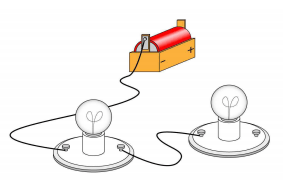
Why won’t the light bulb in the circuit pictured to the right light up?
a)
The wires from the second light bulb are not connected to the battery
b)
The wires are not connected between the light bulbs 
c)
The wires are not connected to both sides of the first light bulb
d)
The wires are too long to complete the circuit 
29.

What is one example of a load?

a)

Battery

b)

Light bulb

c)

Wire

d)

Eraser

30.

The flow of electricity is called...

a)

circuit

b)

load

c)

electrical current

d)

power source

31.

The path an electrical current follows is called

a)

circuit

b)

load

c)

power source

d)

switch

32.

The purpose of wires are to?

a)

Turn a switch on

b)

Turn off a light

c)

Carry electric current to different parts of the circuit

d)

Make a motor move

33.

Ina circuit energy flows in the shape of a ______?

a)

Square

b)

triangle

c)

Rectangle

d)

Circle

34.

If one part of the circuit is broken what will happen?

a)

The electricity will continue to flow

b)

The electricity will stop flowing

c)

The electricity will move faster

d)

The electricity will move slower

35.

The 3 components needed to complete a light circuit are? (Choose 3)

a)

Motor

b)

Light bulb

c)

Switch

d)

Wires

e)

Battery

36.
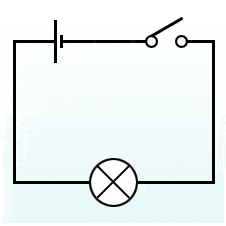
this circuit is .....?
a)
open
b)
parallel
c)
closed
d)
The cutest little circuit evah!
37.
When all parts of the circuit are connected it is a ______ circuit. 
a)
open
b)
closed
38.
When you flip a light switch on and off you are closing and opening a circuit.
a)
true
b)
false
39.
Why are metals useful for making electrical wire?
a)
Metals do not bend.
b)
Metals hold much heat.
c)
Metals are insulators.
d)
Metals are conductors.
40.
Why are metals useful for making electrical wire?
a)
Metals do not bend.
b)
Metals hold much heat.
c)
Metals are insulators.
d)
Metals are conductors.
41.
Which is NOT an insulator.
a)
Wool
b)
Plastic
c)
Copper
d)
Glass
42.
Something electricity can't move through is called a(n) ______.
a)
conductor
b)
wire
c)
shoe
d)
insulator
43.
What is a example of a conductor?
a)
wood 
b)
metal
c)
rubber
d)
rock
44.
What is a example of a insulator?
a)
metal 
b)
rubber
c)
water
45.
Water is a insulator.
a)
True
b)
False
46.
Rubber is a insulator.
a)
true
b)
false
47.
What are Conductors?
a)
A conductor is a material that allows electric charge to move through it as an electric current. Usually the charge is carried by electrons, and the conductor is a metal.
b)
an insulator
c)
an conductor 
d)
A material or an object that does not easily allow heat, electricity, light, or sound to pass through it. Air, cloth and rubber are good electrical insulators; feathers and wool make good thermal insulators. Compare conductor.
48.
What are insulators?  
a)
A conductor is a material that allows electric charge to move through it as an electric current. Usually the charge is carried by electrons, and the conductor is a metal.
b)
An object that is really, really, really, and I mean really truely, awesome.
c)
A material or an object that does not easily allow heat, electricity, light, or sound to pass through it. Air, cloth and rubber are good electrical insulators; feathers and wool make good thermal insulators. Compare conductor.
49.
A insulator does not let energy flow through easily 
a)
True 
b)
False
50.
A conductor allows energy to easily pass by.  
a)
True 
b)
False
51.
Which one is an insulator? 
a)
Silver 
b)
Copper 
c)
Mechanical pencil
d)
plastic 
52.
Which one is a conductor? 
a)
wood 
b)
iron 
c)
plastic spoon 
d)
paper 
53.
Why is electrical wiring usually covered with a layer of plastic?
a)
To help electricity flow along the wire
b)
To make it look pretty
c)
To make it safe
54.
Copper
a)
Insulator
b)
Conductor 
55.
Plastic
a)
Insulator
b)
Conductor 
56.
Water
a)
Insulator
b)
Conductor 
57.
Aluminum
a)
Insulator
b)
Conductor 
58.
Rubber
a)
Insulator
b)
Conductor 
59.

Which material is a good insulator?

a)

Iron

b)

Water

c)

Plastic

d)

Metal

60.

What is the main function of a switch in an electrical circuit?

a)

To insulate the wires

b)

To act as a load

c)

To provide energy

d)

To open or close the circuit

61.

Which of the following is necessary for electricity to flow in a circuit?

a)

Only a battery

b)

A closed path

c)

An open path

d)

Only a light bulb