
 Worksheets
Good Design - Course Schedule and Reminders
Total questions: 99
Worksheet time: 50mins
According to the course schedule, what is the lecture topic for Week 6 (October 13th)?
Good design
User testing
Prototyping
Project presentations
What is the due date for the Arduino Assignment as per the reminders section?
9pm Friday, October 17th
5pm Monday, October 20th
11am Thursday, October 16th
8pm Saturday, October 18th
Which week is dedicated to 'Intro to microcontrollers' in the course schedule?
Week 5 (October 6th)
Week 2 (September 15th)
Week 7 (October 20th)
Week 10 (November 10th)
The Peer Feedback Survey is due on Thursday, October 23rd.
True
False
Which lab topic is associated with Week 7 (October 20th)?
Ideation and design (stained glass and in-home sensor)
Design
Teamwork
Testing and presentation preparation
What is the tutorial topic for Week 2 (September 15th)?
Onshape
Fusion 360
SolidWorks
AutoCAD
What is design?
A plan complete with specifications for the construction/implementation, operation, maintenance, decommissioning of an object, environment or process.
A random sketch made without any purpose.
A type of mathematical equation used in engineering.
A list of materials required for a project.
Which of the following is NOT a design model listed in the slide?
Waterfall Model
V-Model
Toyota Lean Product Development Model
Design Thinking
Spiral Model
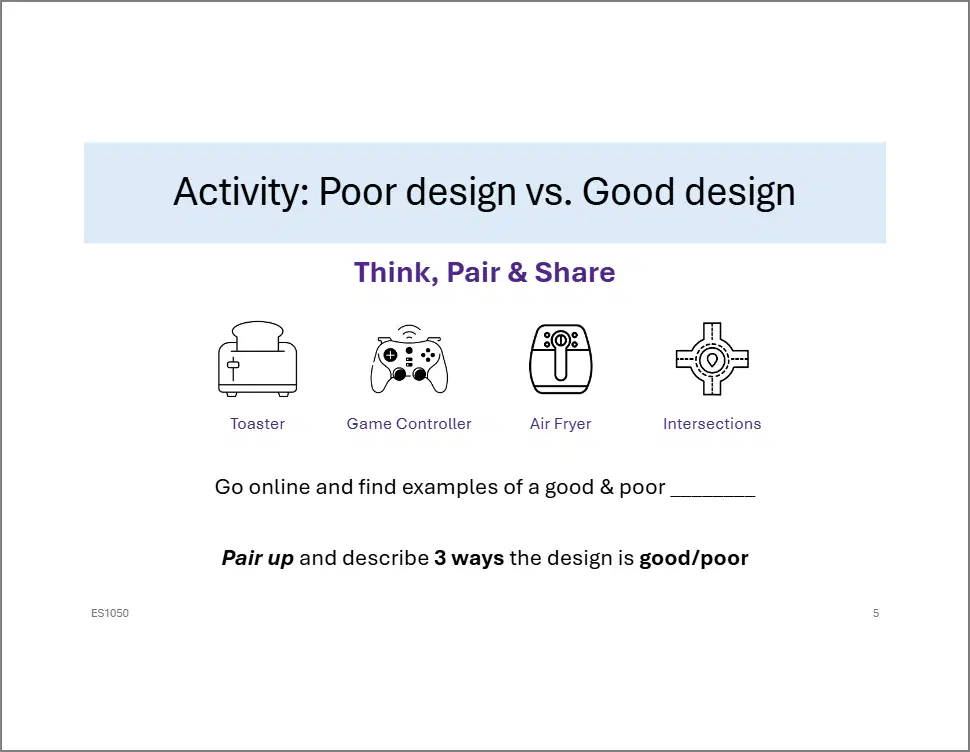
Identify which of the following is an example of a good design for a Game Controller.
A controller with ergonomic grips and responsive buttons
A controller with confusing button layout and poor grip
A controller that overheats quickly during use
A controller with buttons that frequently get stuck
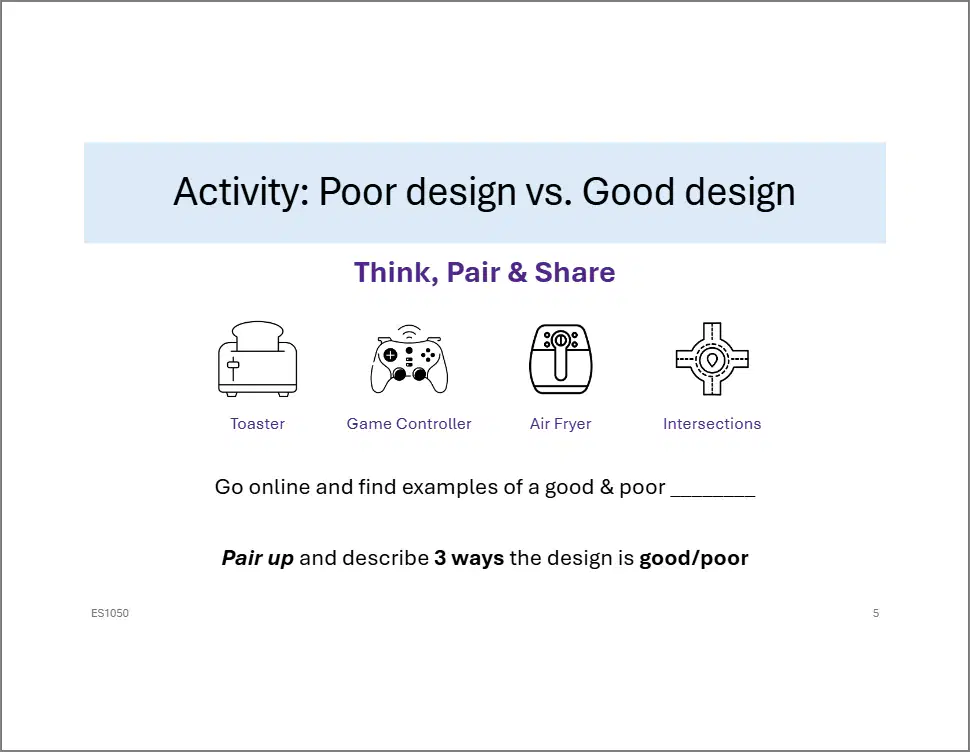
Which of the following is a good way to evaluate the design of a toaster, game controller, air fryer, or intersection?
Describe 3 ways the design is good or poor for any of the listed items.
List the price of each item.
Identify the brand of each item.
Count the number of buttons on each item.
Discussion – what makes design good? Good design is characterized by which of the following?
Functionality and aesthetics
High cost and complexity
Lack of user focus
Ignoring sustainability
According to Jared Spool, Usability Expert, "Good design, when it is done well, becomes ________".
invisible
obvious
complicated
expensive
What is the main purpose of Universal Design?
To create products only for people with disabilities
To ensure products, environments, and programs do not discriminate and benefit people regardless of abilities, needs, and cultural preferences
To make products more expensive
To ignore cultural preferences
Which of the following is NOT listed as a competitive advantage of Universal Design?
Allow people to meet their needs
Evolve to address changing needs
Age in place
Increase product cost
The United Nations Convention for the Rights of Persons with Disabilities endorses ________ as the preferred approach.
Universal Design
Segregated Education
Medical Model
Charity Model
Which Universal Design goal is described as 'Accommodating a wide range of body sizes and abilities'?
Comfort
Body fit
Awareness
Wellness
Which Universal Design goal focuses on 'Keeping demands within desirable limits of body function and perception'?
Comfort
Social integration
Personalization
Awareness
Ensuring that critical information for use is easily perceived is the goal of ________ in Universal Design.
Awareness
Tolerance
Flexibility
Simplicity
Which Universal Design goal is about 'Making methods of operation and use intuitive, clear, and unambiguous'?
Understanding
Comfort
Body fit
Cultural appropriateness
Contributing to health promotion, avoidance of disease, and protection from hazards is the goal of ________ in Universal Design.
Wellness
Accessibility
Safety
Comfort
Which Universal Design goal is described as 'Treating all groups with dignity and respect'?
Social integration
Personalization
Comfort
Body fit
Incorporating opportunities for choice and the expression of individual preferences is the goal of ________ in Universal Design.
Personalization
Standardization
Uniformity
Restriction
Which Universal Design goal is about 'Respecting and reinforcing cultural values, and the social and environmental contexts of any design project'?
Cultural appropriateness
Comfort
Body fit
Wellness
What is the principle of 'Equitable Use' in Universal Design Principles? 'Equitable Use: design that does not _______ or stigmatize any group of users.'
disadvantage
benefit
encourage
support
What does 'Flexibility in Use' mean in Universal Design Principles? 'Flexibility in Use: design that accommodates a wide range of individual _______ and abilities.'
preferences
locations
colors
sizes
What is the principle of 'Simple, Intuitive Use' in Universal Design Principles? Fill in the blank: 'Simple, Intuitive Use: use is easy to ________, regardless of the user's experience, knowledge, language skills, or current concentration level.'
understand
ignore
complicate
translate
What does 'Perceptible Information' mean in Universal Design Principles? 'Perceptible Information: the design communicates necessary information effectively to the user, regardless of ambient conditions or the user's _______ abilities.'
sensory
physical
financial
technical
What is the principle of 'Tolerance for Error' in Universal Design Principles? 'Tolerance for Error: the design minimizes hazards and the adverse consequences of accidental or _______ actions.'
unintended
planned
deliberate
expected
routine
What does 'Low Physical Effort' mean in Universal Design Principles? 'Low Physical Effort: the design can be used efficiently and comfortably, and with a minimum of _______.'
fatigue
force
time
energy
What is the principle of 'Size and Space for Approach and Use' in Universal Design Principles? 'Size and Space for Approach and Use: the design is appropriate _______ and space.'
size
color
texture
weight
Which of the following is a characteristic of Universal Design (UD)?
Conformant
Holistic
Utilitarian
Visible
Which of the following is a characteristic of Accessible Design (AD)?
Attractive
Affordable
Conformant
Flexible
Design can be accessible but not universal.
True
False
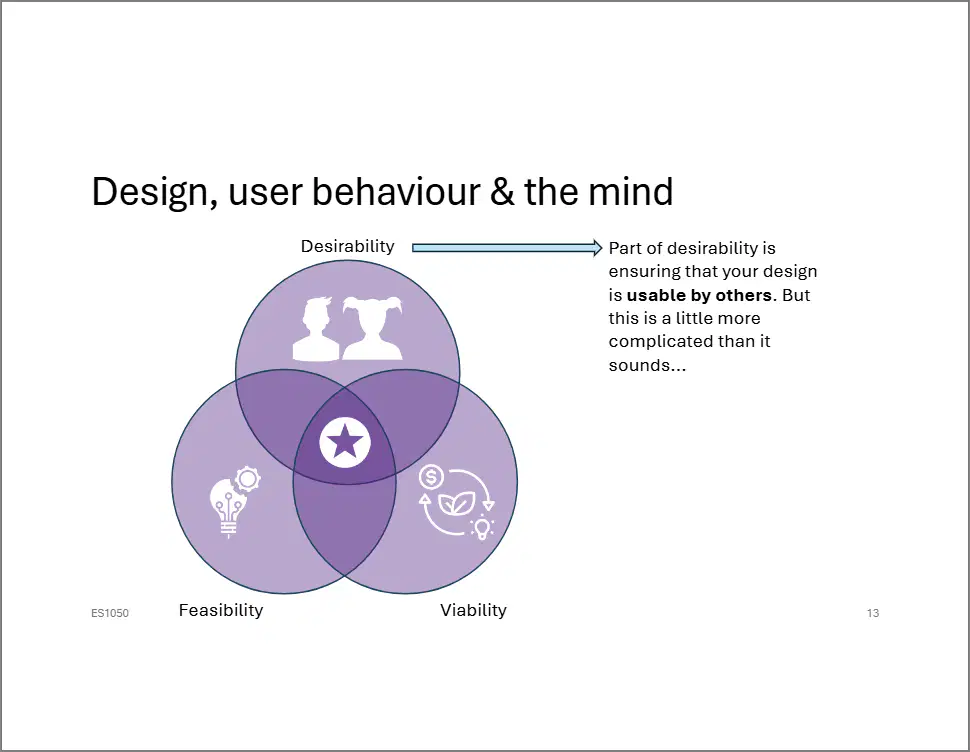
According to the diagram, which three factors are essential for design, user behaviour & the mind?
Desirability, Feasibility, Viability
Usability, Rationality, Judgement
Conscious, Subconscious, Rationality
Stakeholders, Customers, Users
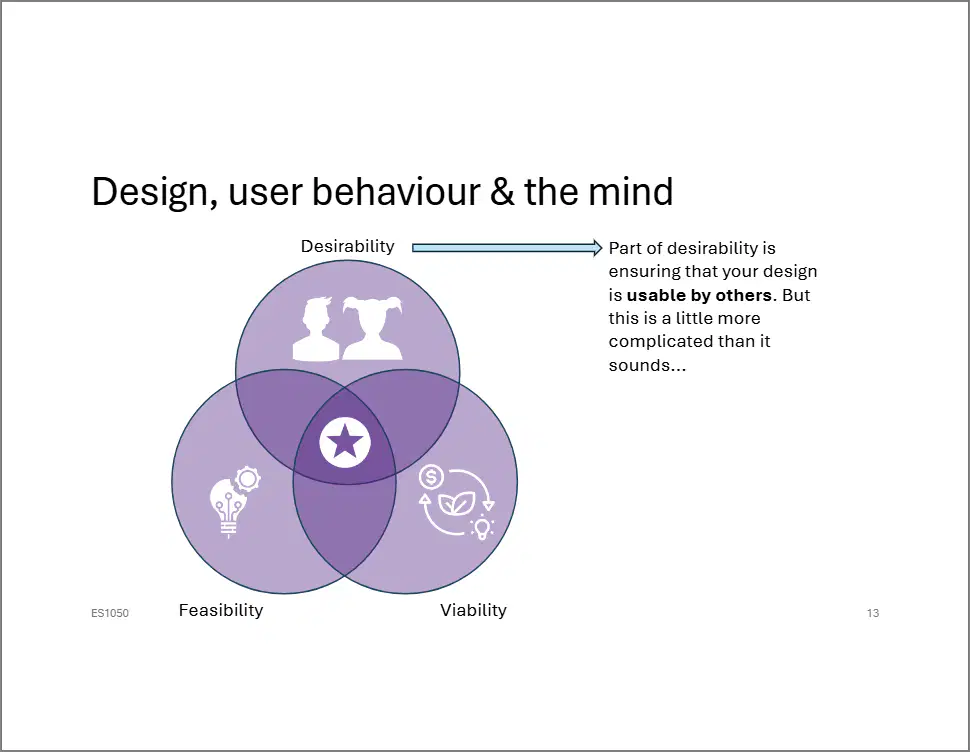
Part of desirability is ensuring that your design is ______ by others.
usable
invisible
expensive
confusing
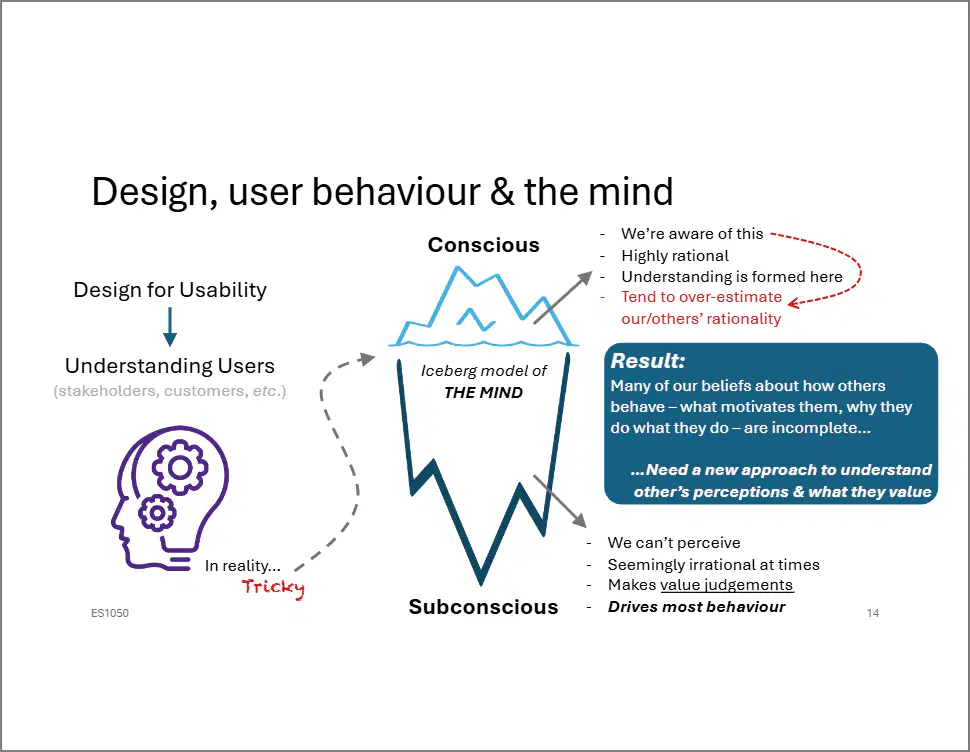
In the Iceberg model of the mind, which part is responsible for driving most behaviour?
Conscious
Subconscious
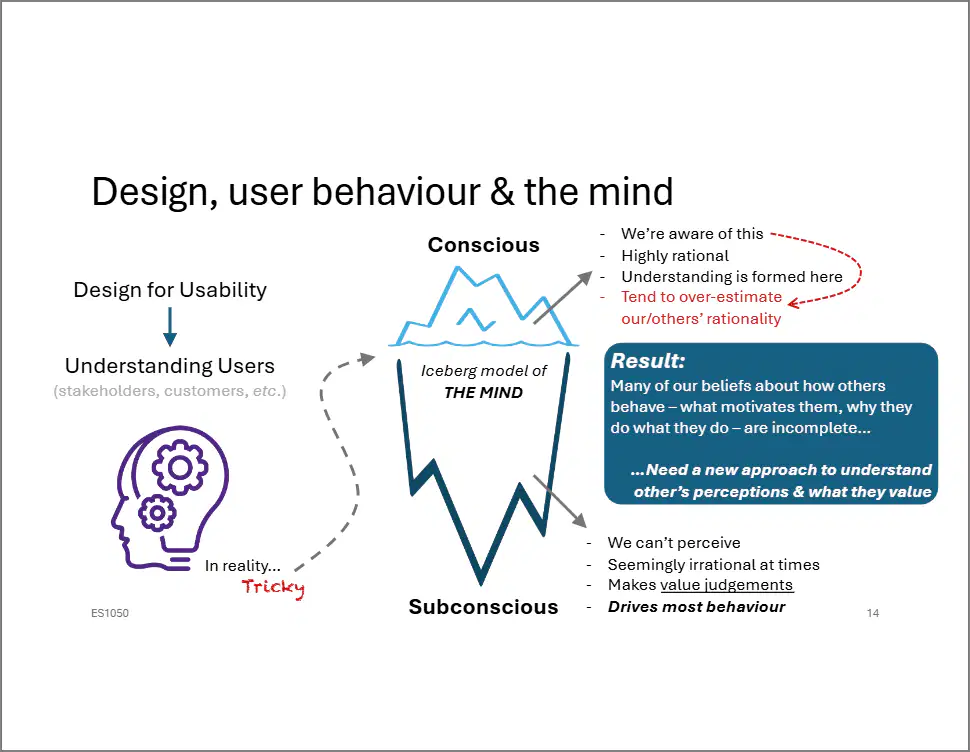
According to the slide, we tend to over-estimate our/others' rationality.
True
False
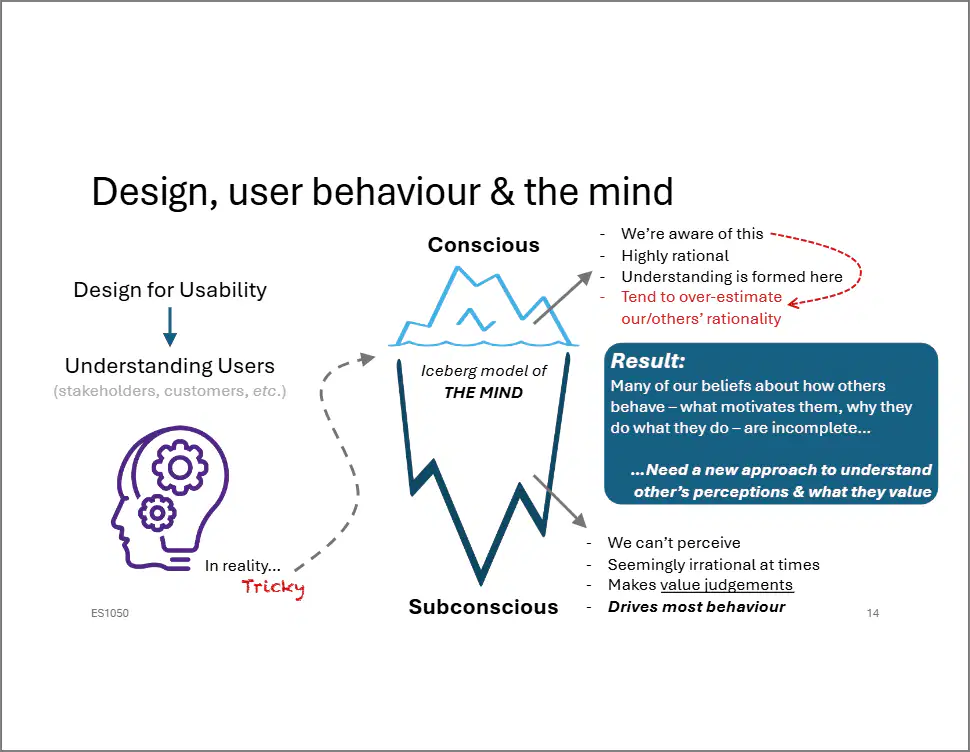
Many of our beliefs about how others behave – what motivates them, why they do what they do – are _______.
incomplete
obvious
accurate
transparent
Why do you use a _______?
object, environment, or process
tool, machine, or device
animal, plant, or mineral
color, shape, or size
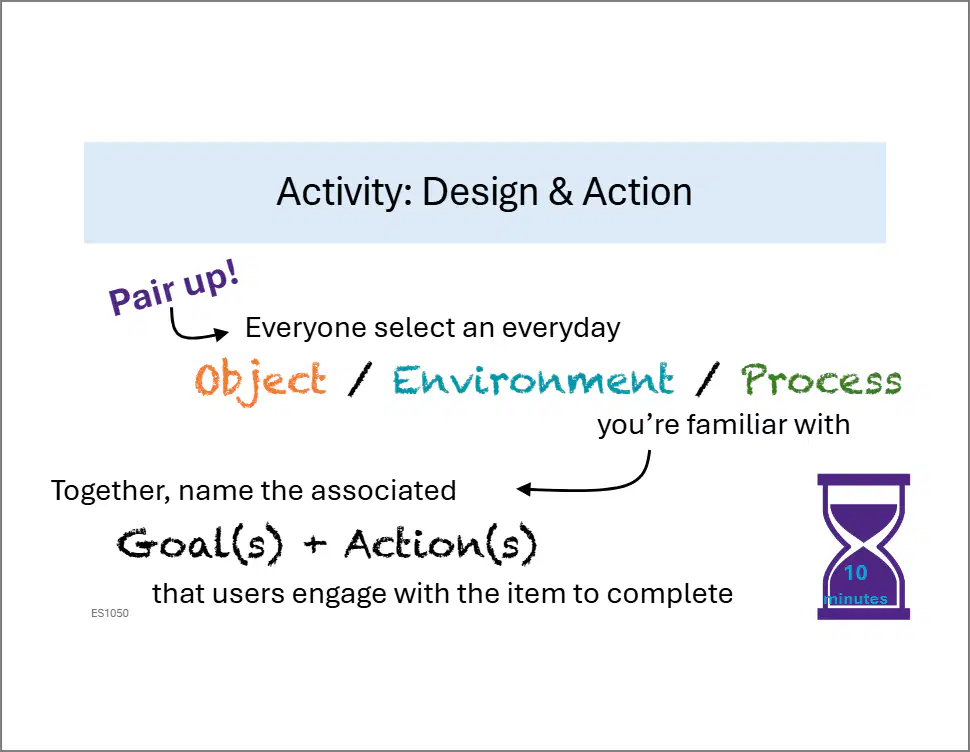
Activity: Design & Action
Pair up! Everyone select an everyday Object / Environment / Process you’re familiar with. Together, name the associated Goal(s) + Action(s) that users engage with the item to complete.
What is the main purpose of this activity?
To identify the goals and actions users engage with everyday items.
To memorize the names of everyday objects.
To list as many objects as possible without explanation.
To design a new object from scratch.
Identifying actions and goals helps in understanding the utility of a design because:
It clarifies how the design meets user needs and supports intended tasks.
It makes the design more colorful and attractive.
It increases the cost of production.
It ensures the design is only used by experts.
What is Discoverability in the context of design?
The ability to understand how an item works
The ability to uncover what actions are possible, and where and how to perform them
The ability to evaluate what happened after using an item
The ability to bridge the gulf between execution and evaluation
What does Understanding refer to in product design?
Knowing how to perform actions
Knowing what the product is supposed to do and what the controls accomplish
Knowing how to bridge the gulf of execution
Knowing how to design clues for users
Good design provides users with the clues they need to ______ how to interact with an object and the understanding of how the item works to allow them to perform the desired action.
discover
ignore
forget
avoid
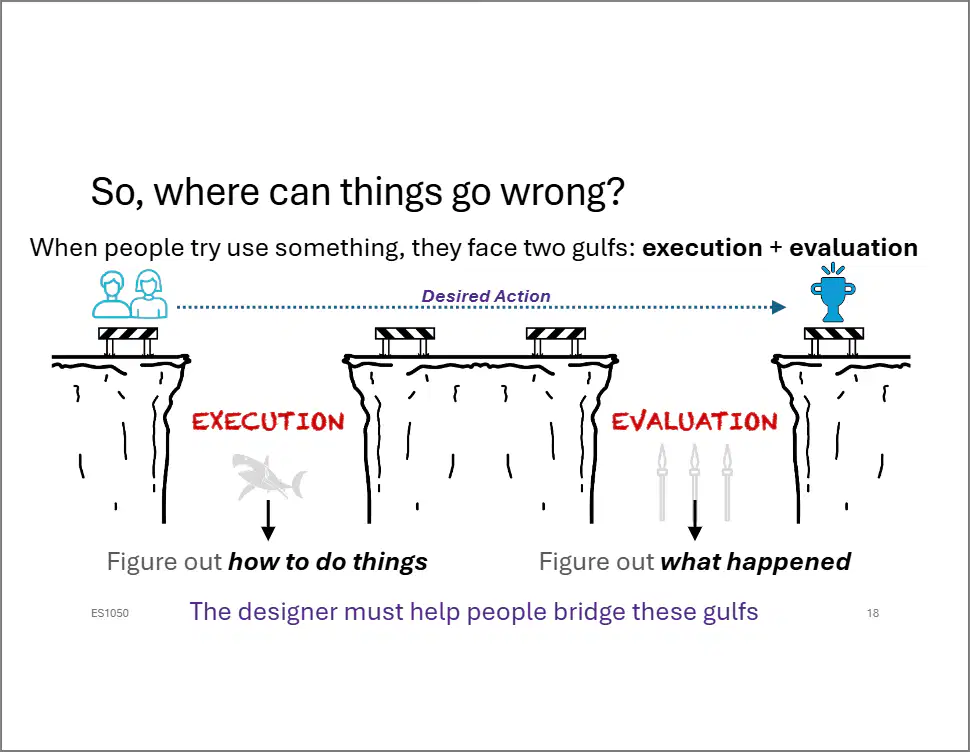
When people try to use something, they face two gulfs: execution and evaluation. What does the gulf of execution refer to?
Figuring out what happened
Figuring out how to do things
Figuring out how to design clues
Figuring out how to evaluate results
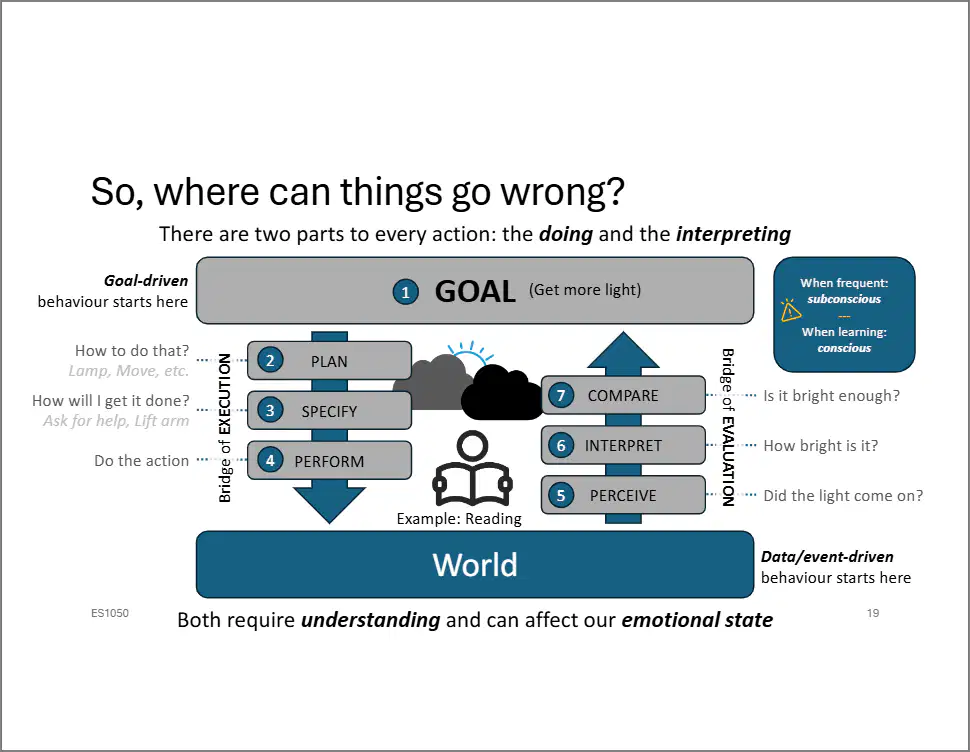
According to the diagram, what is the first step in the process of action and interpretation?
PLAN
GOAL
SPECIFY
PERFORM
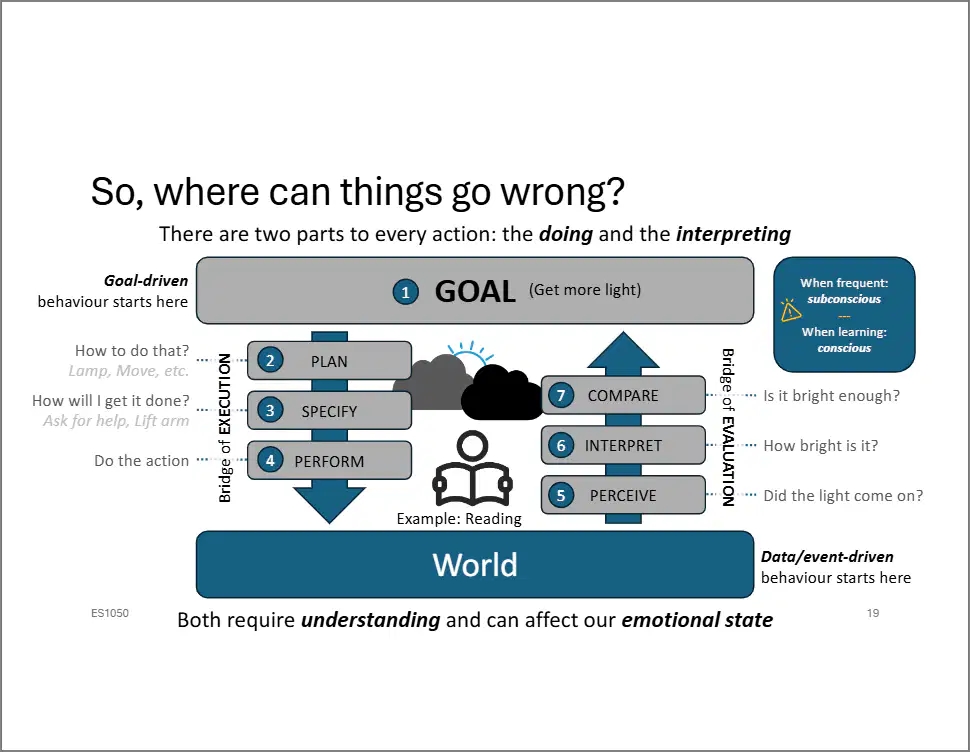
The two parts to every action are the ______ and the interpreting.
doing
thinking
planning
observing
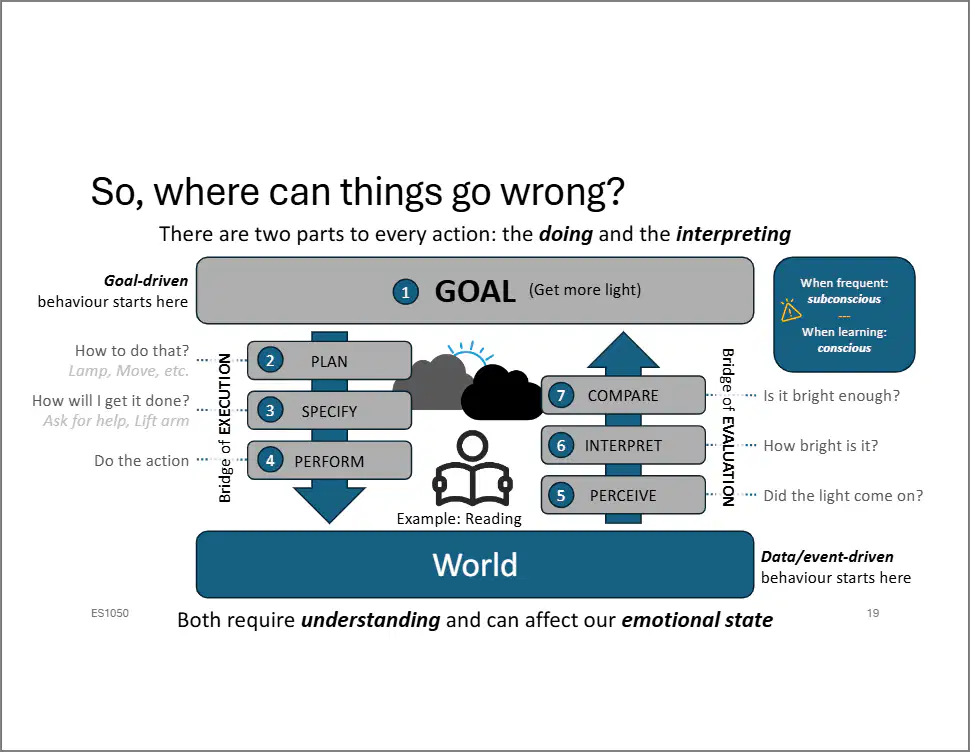
Which of the following is NOT part of the 'Bridge of Execution' in the action process?
PLAN
SPECIFY
PERFORM
COMPARE
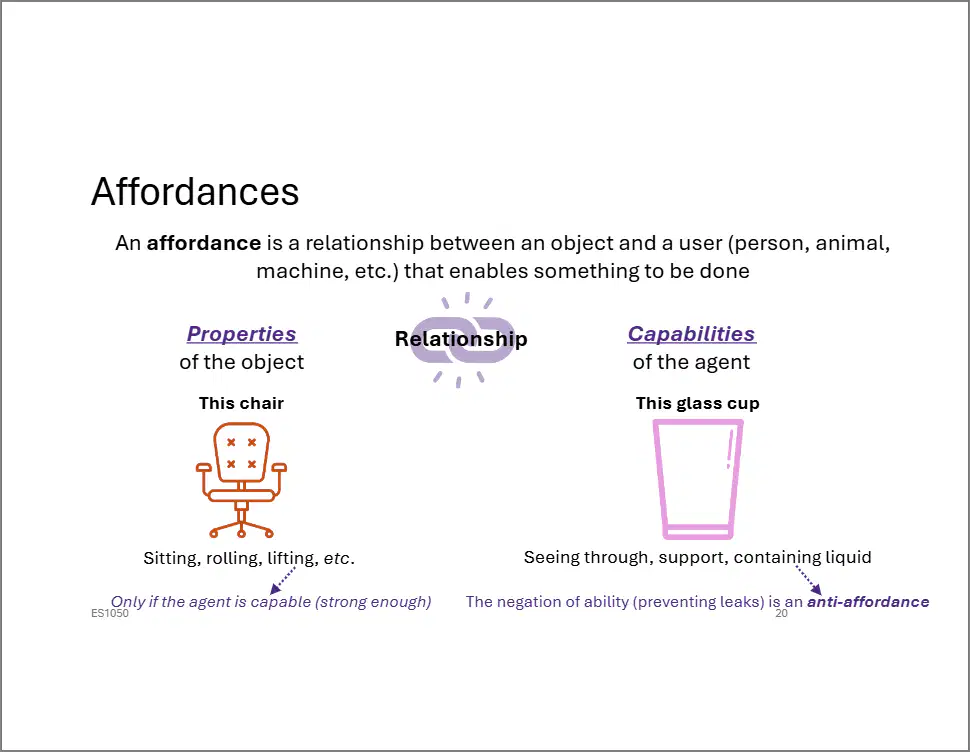
What is an affordance?
A property of an object
A capability of an agent
A relationship between an object and a user that enables something to be done
The negation of ability
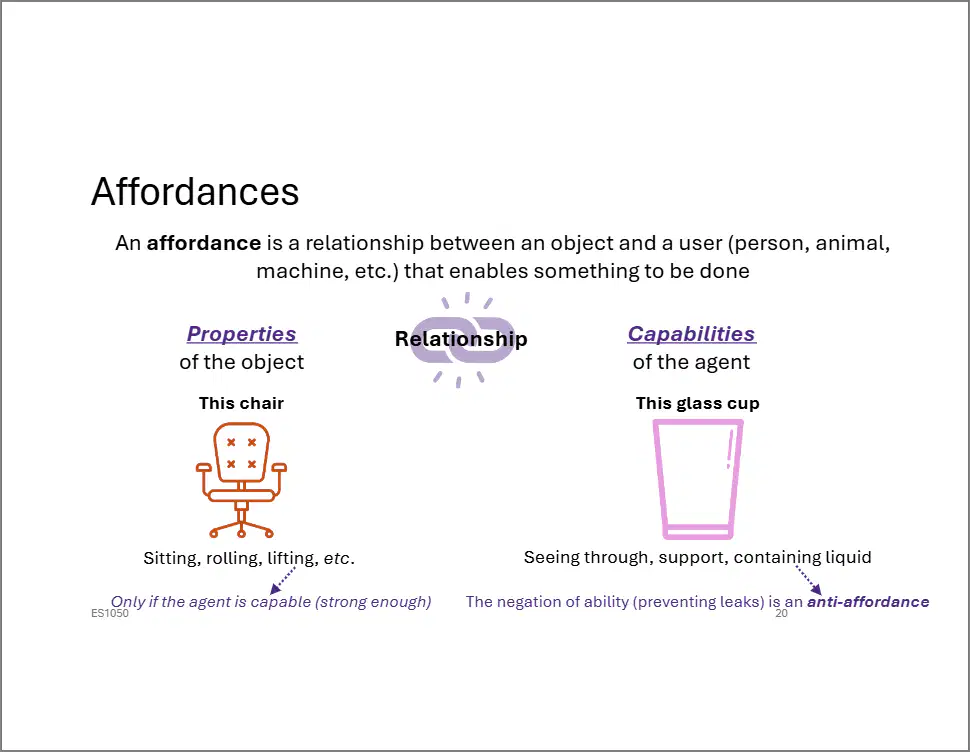
The negation of ability (preventing leaks) is an ______.
anti-affordance
affordance
constraint
permission
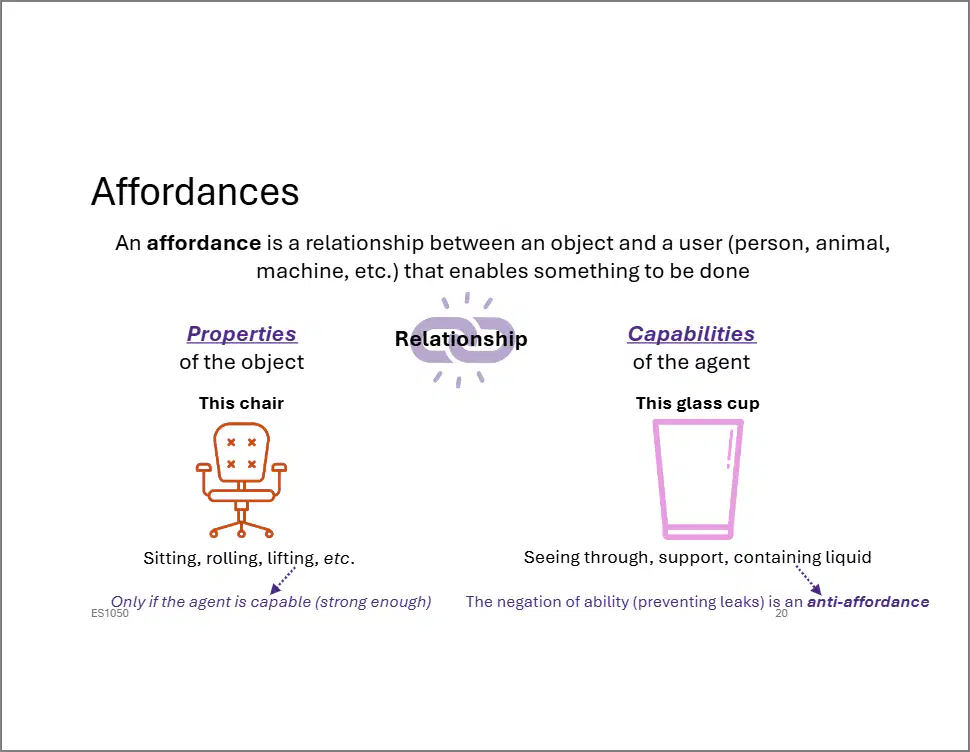
Which of the following is an example of a property of the object, according to the affordance diagram?
Sitting
Seeing through
Support
Containing liquid
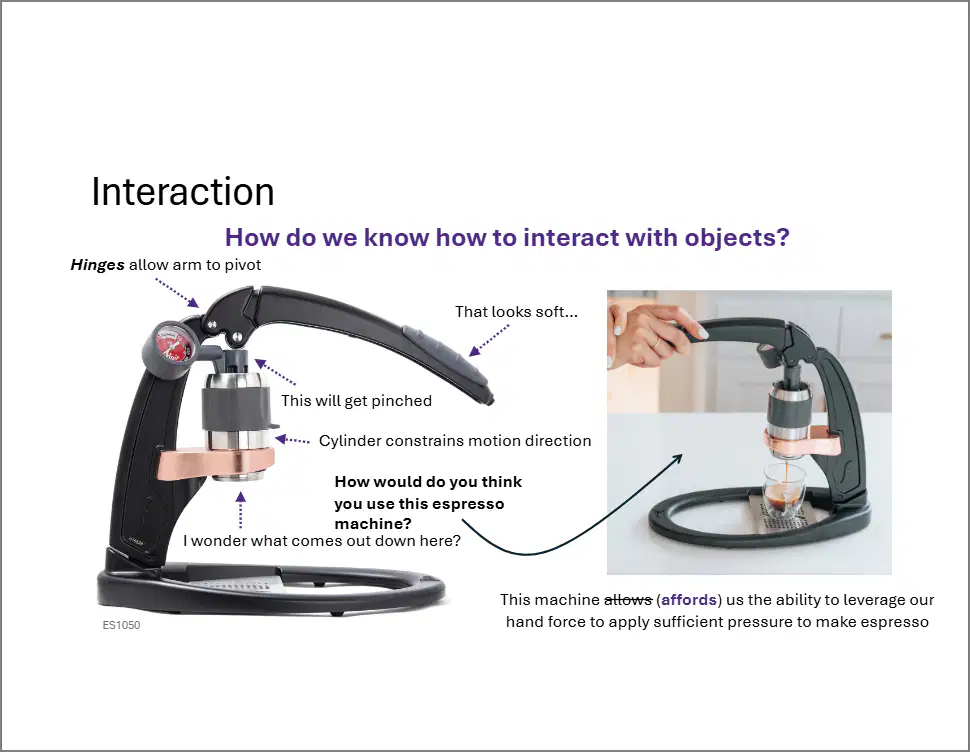
How do hinges contribute to the interaction with the espresso machine?
They allow the arm to pivot
They constrain motion direction
They apply pressure
They signify removal
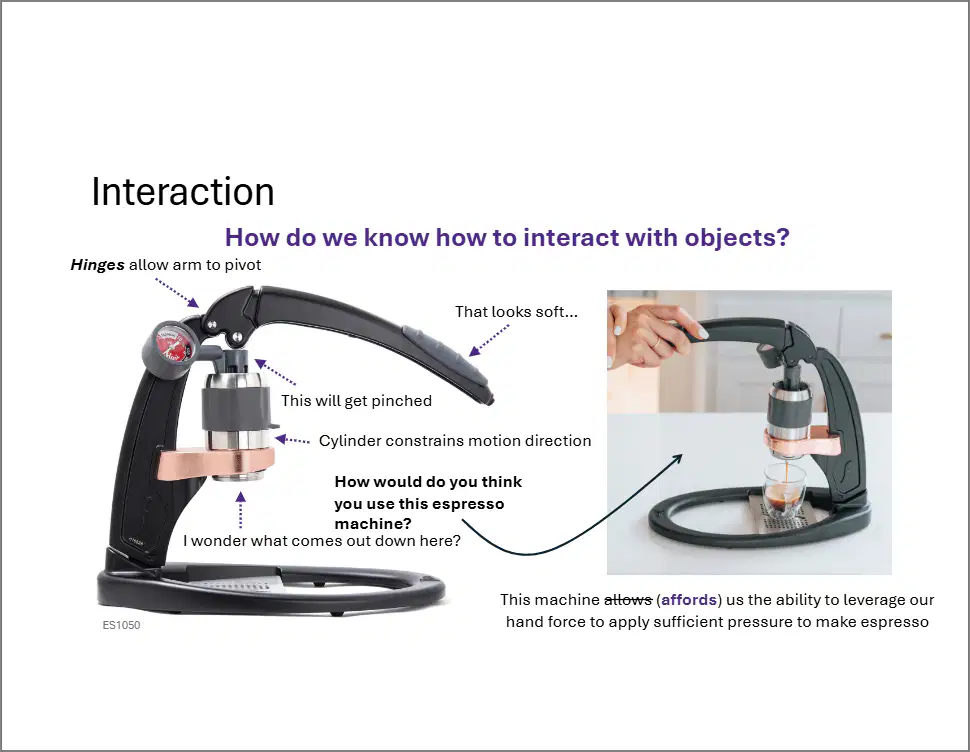
What does the cylinder in the espresso machine do according to the diagram?
Allows arm to pivot
Constrains motion direction
Signifies a push-point
Affords arm rotation
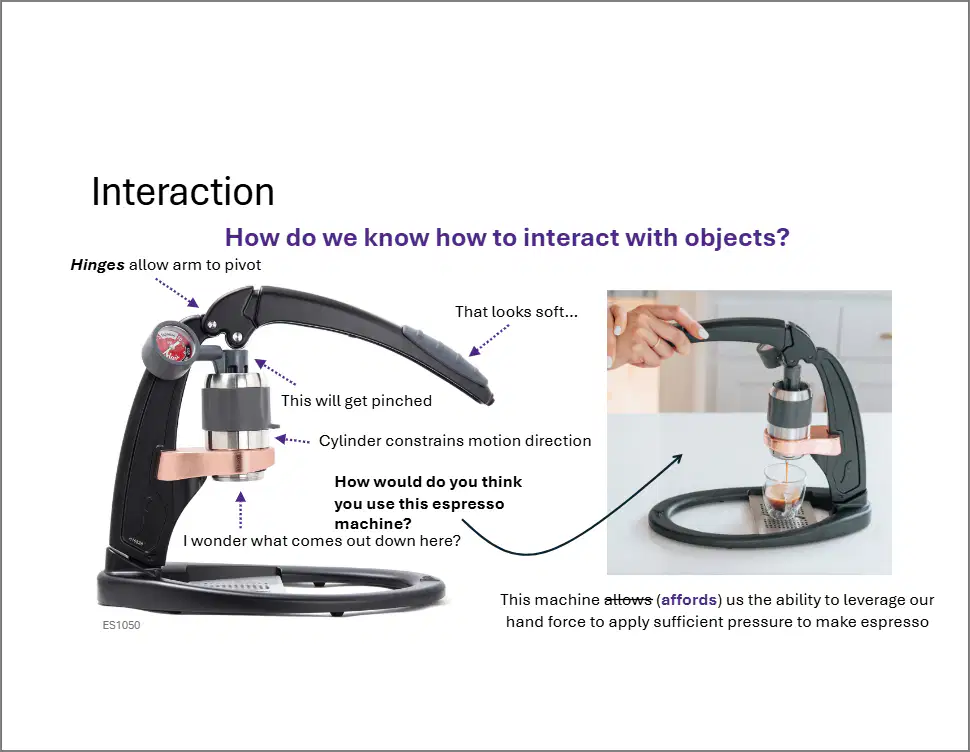
This machine allows (affords) us the ability to leverage our hand force to apply sufficient pressure to make _________
espresso
tea
lemonade
smoothies
What is the main difference between affordances and signifiers as described in the worksheet?
Affordances dictate what actions are possible, while signifiers communicate where/how the action should take place.
Affordances communicate where/how the action should take place, while signifiers dictate what actions are possible.
Affordances and signifiers both dictate what actions are possible.
Signifiers dictate what actions are possible, while affordances communicate where/how the action should take place.
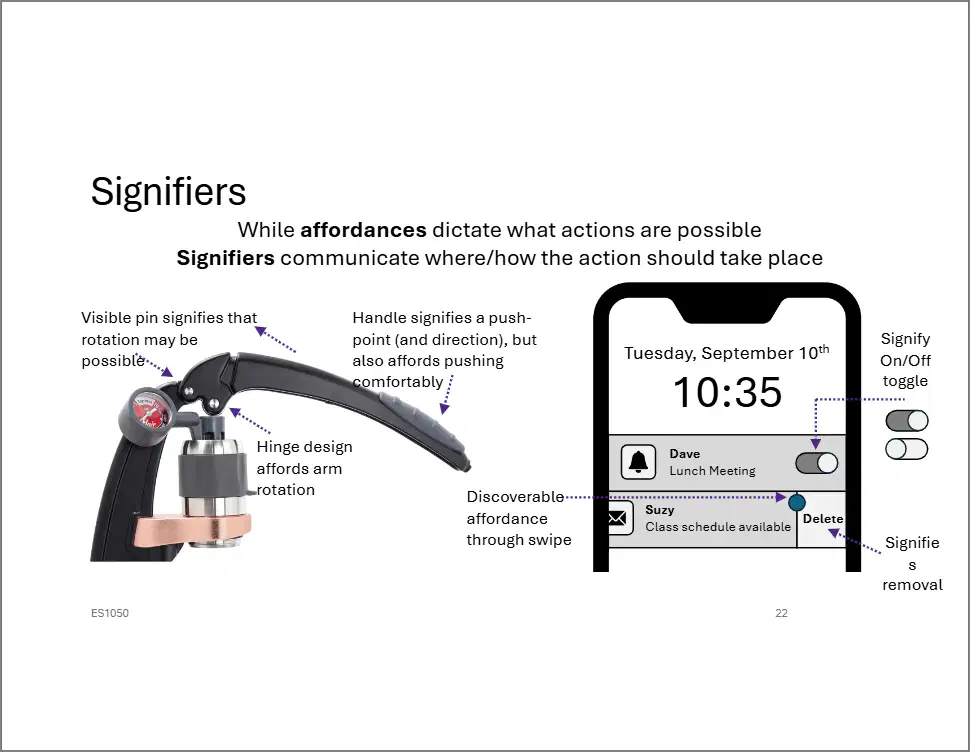
Which feature on the espresso machine signifies that rotation may be possible?
Handle
Visible pin
Cylinder
Toggle switch
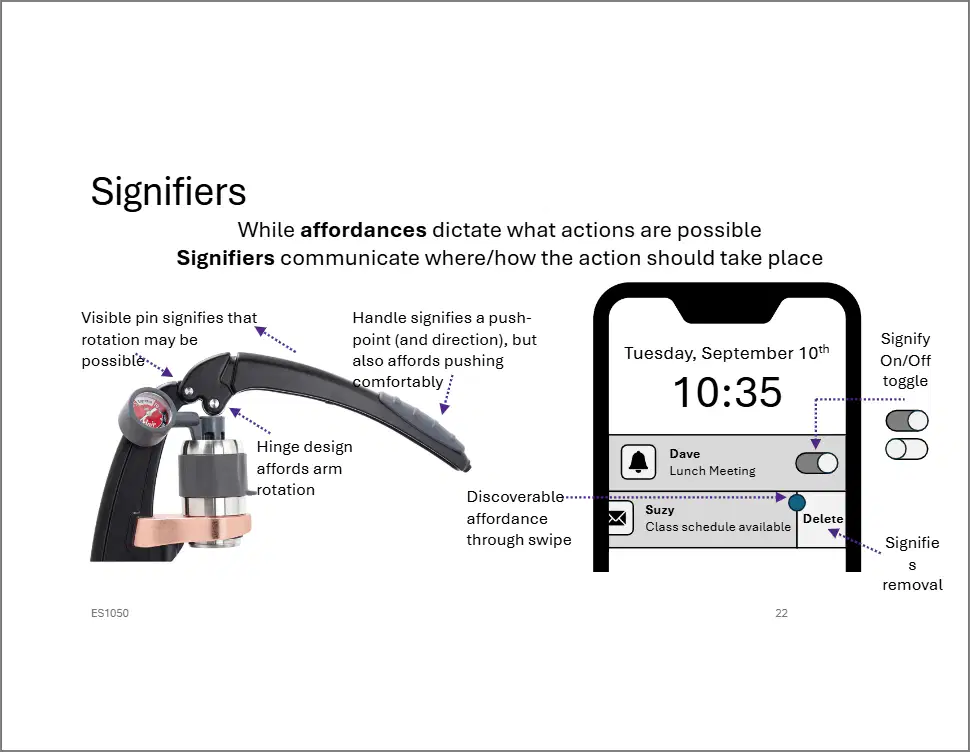
In the mobile interface example, what does the toggle switch signify?
Affords arm rotation
Signifies On/Off
Signifies removal
Signifies a push-point
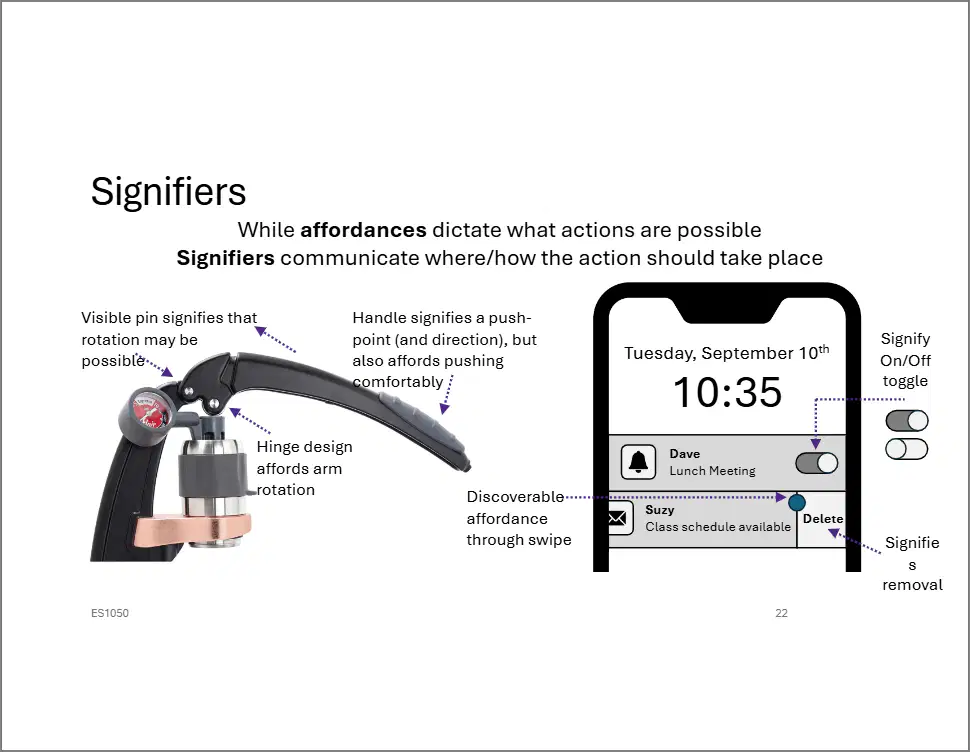
Handle signifies a ________ (and direction), but also affords pushing comfortably.
push-point
lever
knob
switch
What is the definition of 'Constraints' in engineering/design?
Limitations imposed by design on function to prevent errors
Physical objects used in construction
Tools for measuring voltage
Methods for increasing volume
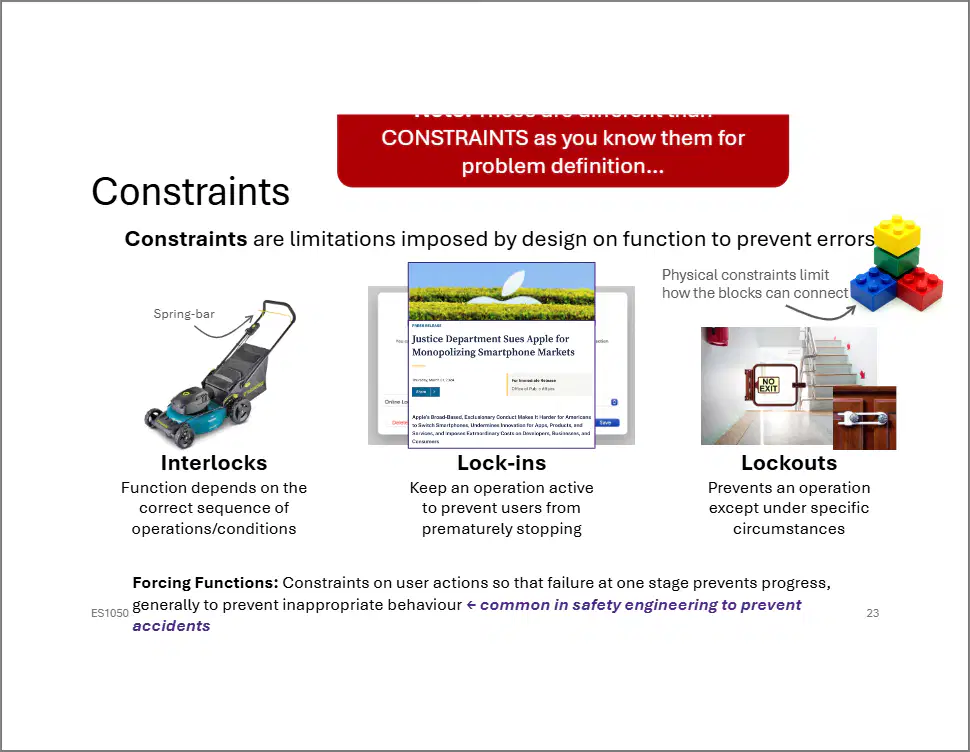
Which type of constraint depends on the correct sequence of operations/conditions?
Lock-ins
Interlocks
Lockouts
Mapping
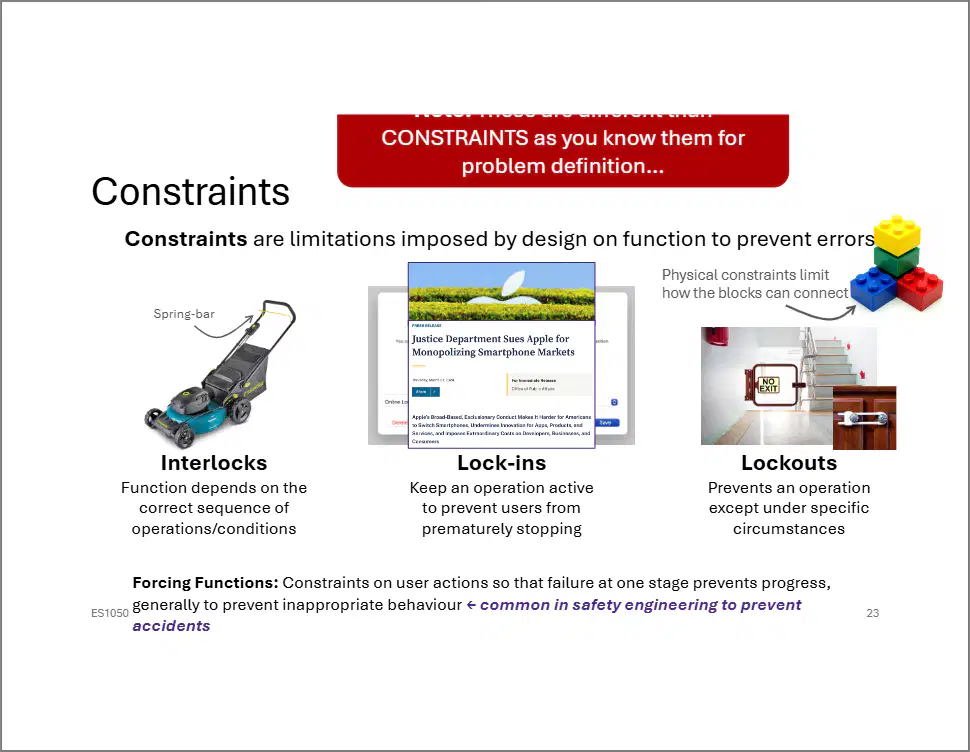
Lock-ins are constraints that keep an operation active to prevent users from _________.
prematurely stopping
starting new operations
accessing restricted areas
changing user settings
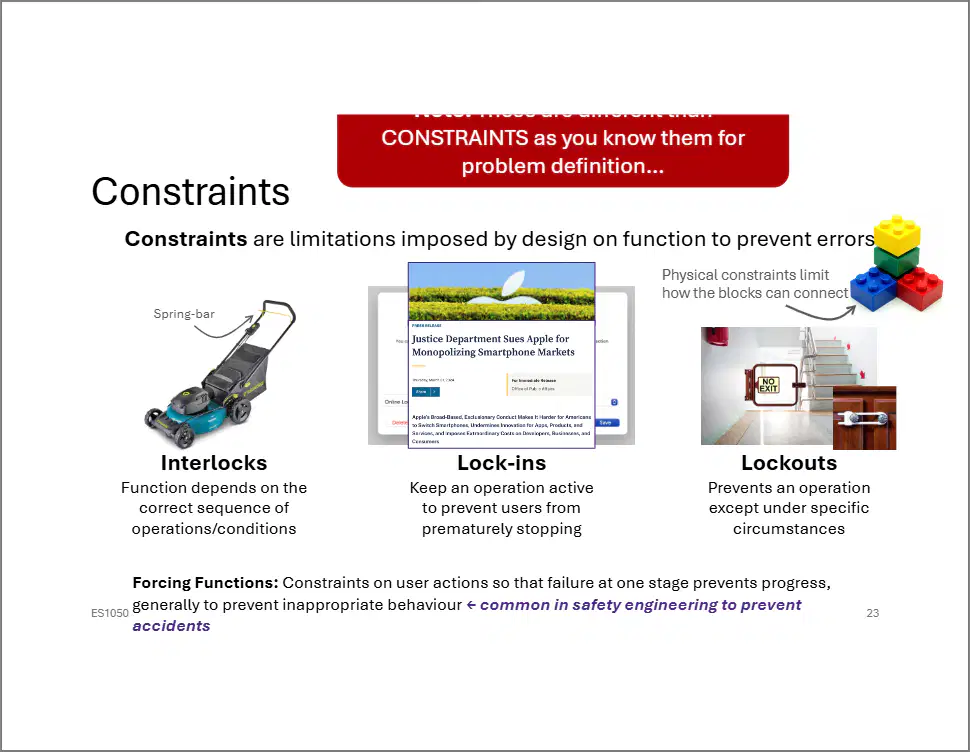
Lockouts are constraints that prevent an operation except under ________ circumstances.
specific
general
random
usual
Which of the following is a common use of forcing functions in safety engineering?
To prevent inappropriate behaviour and accidents
To increase volume
To measure resistance
To connect blocks physically
What is 'Mapping' in engineering?
A relationship that exists between two sets of things to understand consequences of actions/set-points
A method for locking operations
A type of physical constraint
A way to prevent errors

Match the following items in engineering mapping:
Varies resistance, changes voltage
1-A
map()
2-B
#
3-C
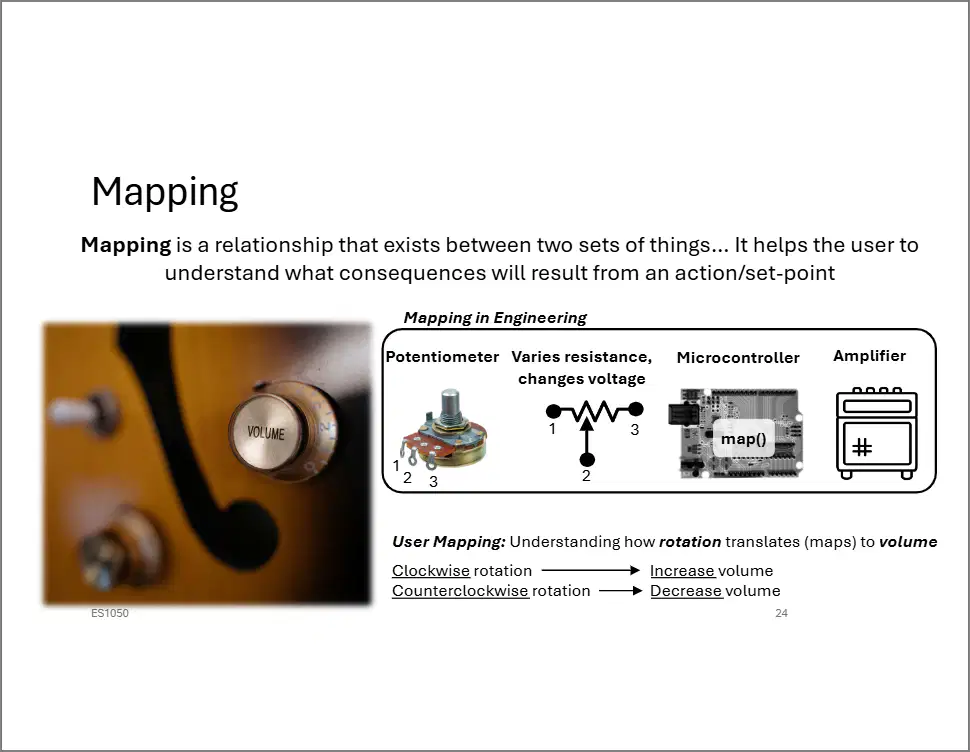
Clockwise rotation ________ volume, while counterclockwise rotation ________ volume.
increases; decreases
decreases; increases
does not affect; does not affect
increases; increases
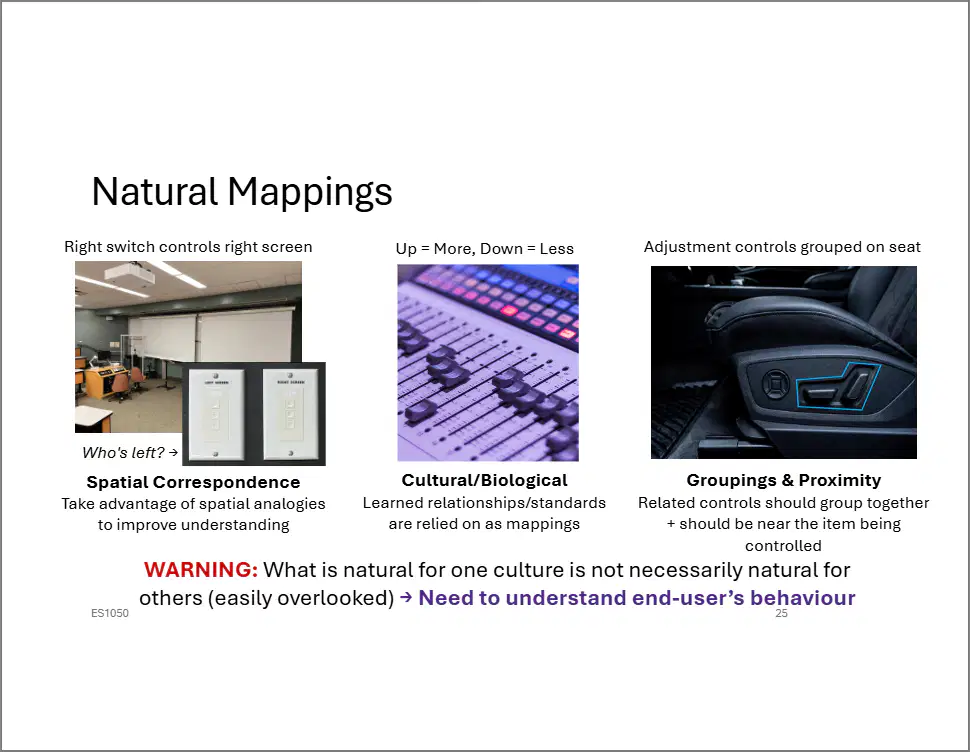
What is the concept of 'Spatial Correspondence' in natural mappings?
Using color analogies to improve understanding
Taking advantage of spatial analogies to improve understanding
Ignoring spatial relationships
Grouping unrelated controls together
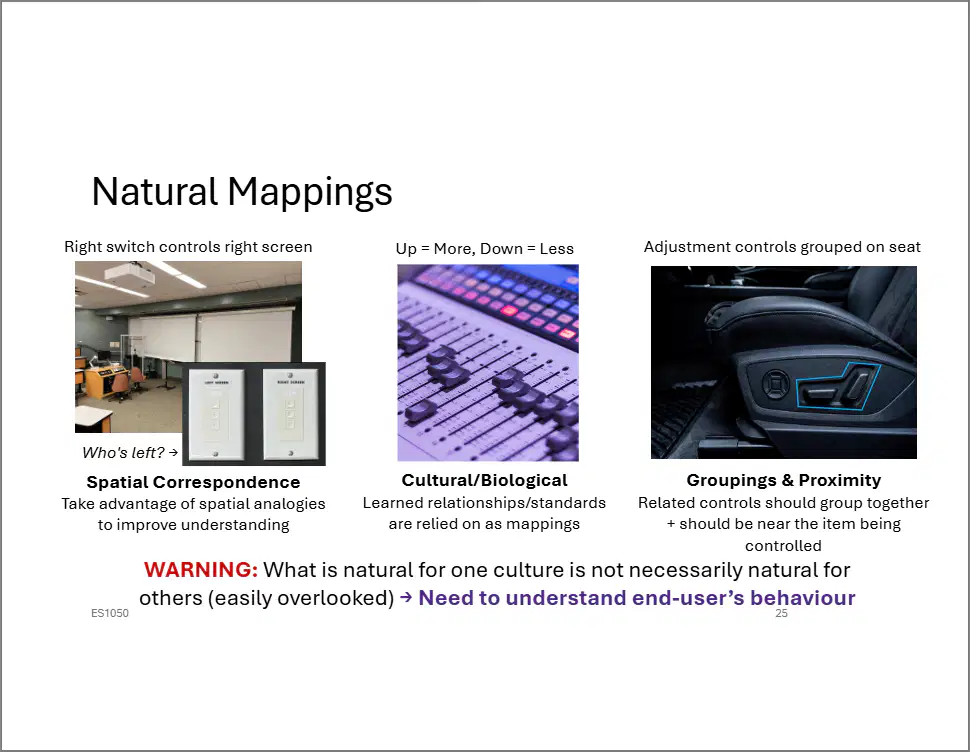
In cultural/biological mappings, learned relationships or standards are relied on as _______.
mappings
rules
habits
instincts
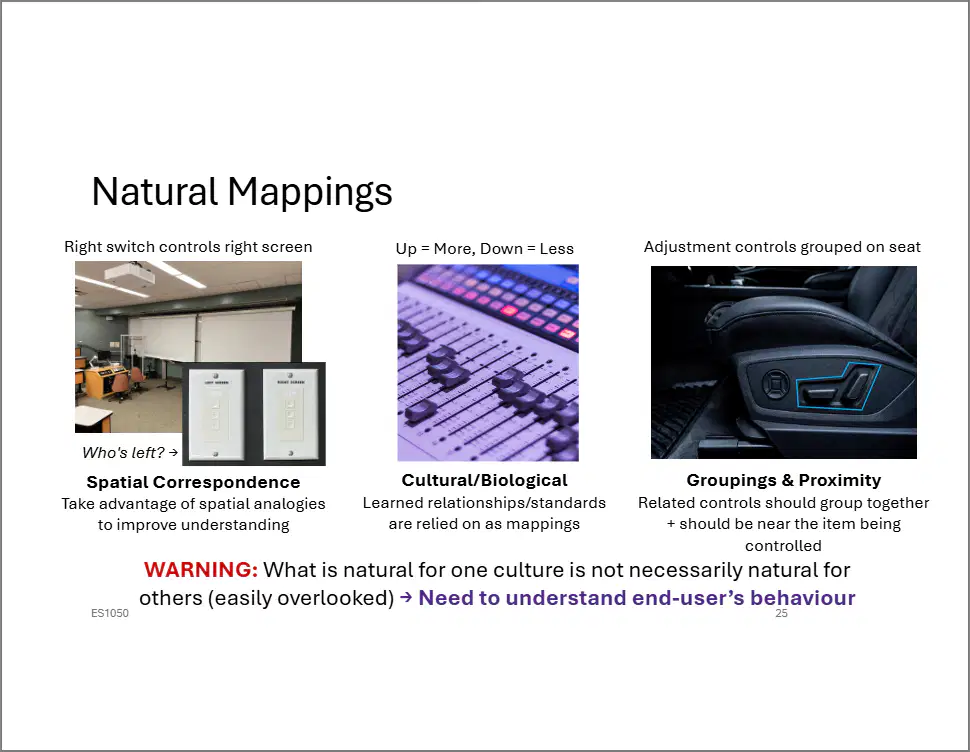
Groupings & Proximity in natural mappings suggest that related controls should group together and should be near the item being controlled.
True
False
It is important to understand end-user's behaviour when designing natural mappings because:
it helps create intuitive and user-friendly interfaces.
it allows designers to ignore user preferences.
it makes the design process more complicated.
it ensures that users will never make mistakes.
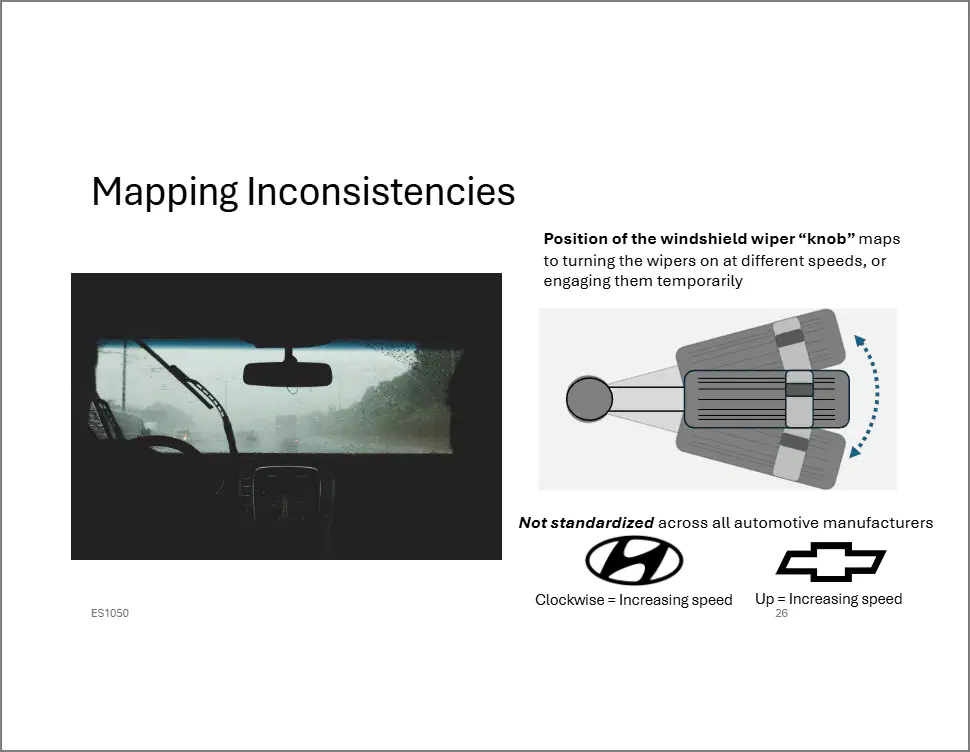
What is a mapping inconsistency related to the position of the windshield wiper 'knob' in cars?
It is standardized across all manufacturers
It maps to turning the wipers on at different speeds or engaging them temporarily, but is not standardized across all automotive manufacturers
It only controls the headlights
It is always clockwise for increasing speed
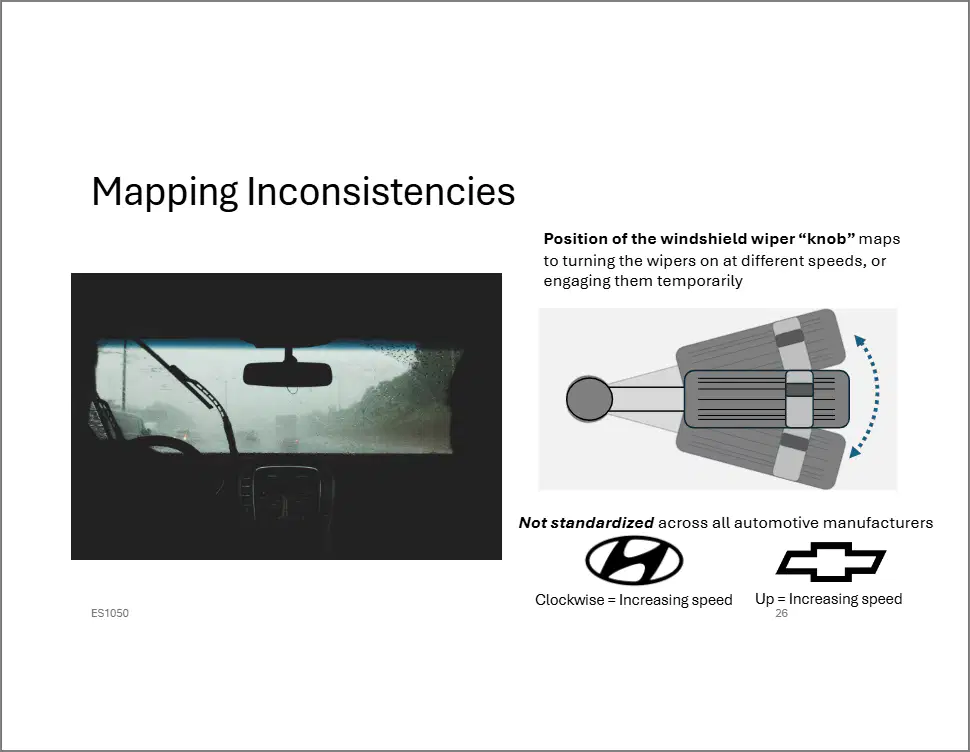
In some cars, turning the windshield wiper knob ________ increases the speed, while in others, moving it ________ increases the speed.
clockwise; up
counterclockwise; down
up; clockwise
down; counterclockwise
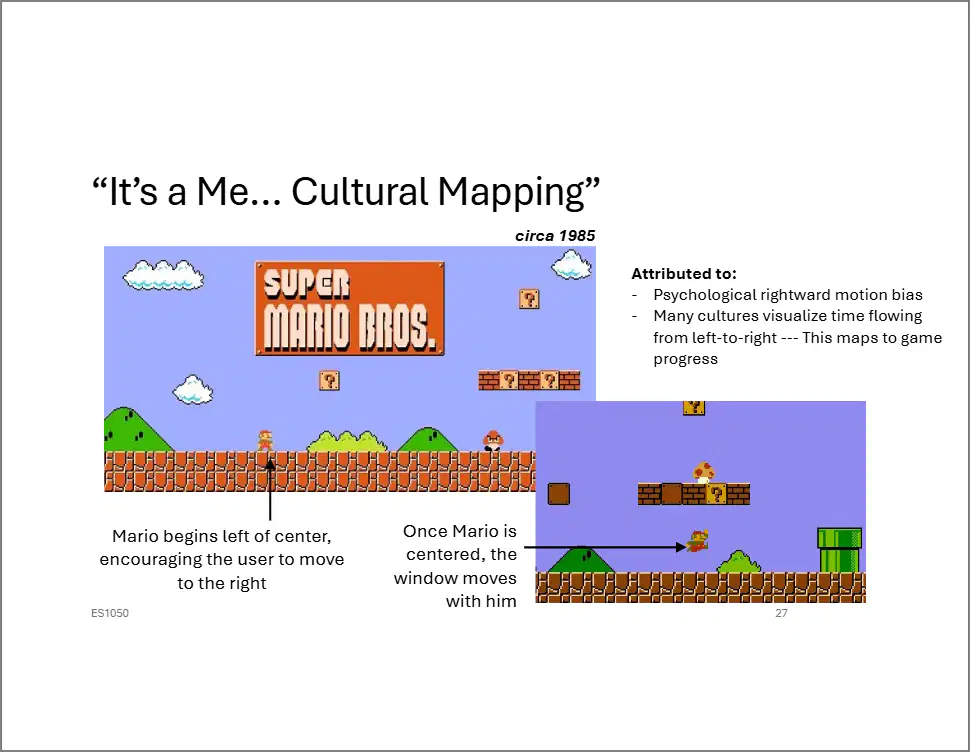
What psychological bias is attributed to the design of Mario beginning left of center in Super Mario Bros?
Leftward motion bias
Rightward motion bias
Upward motion bias
Downward motion bias
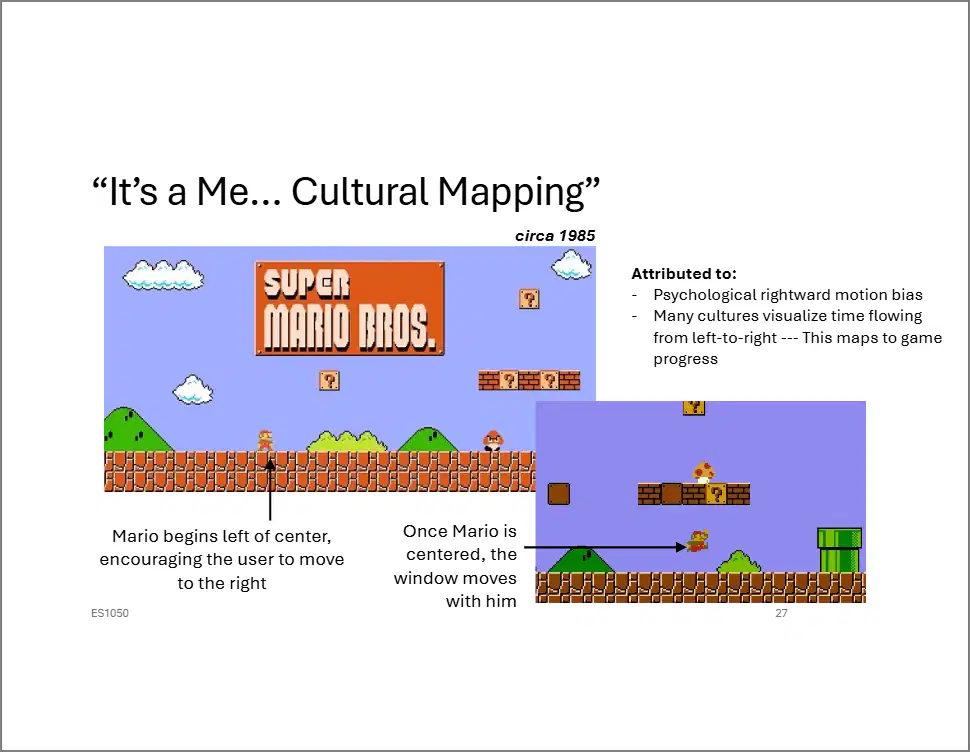
Many cultures visualize time flowing from left-to-right.
True
False
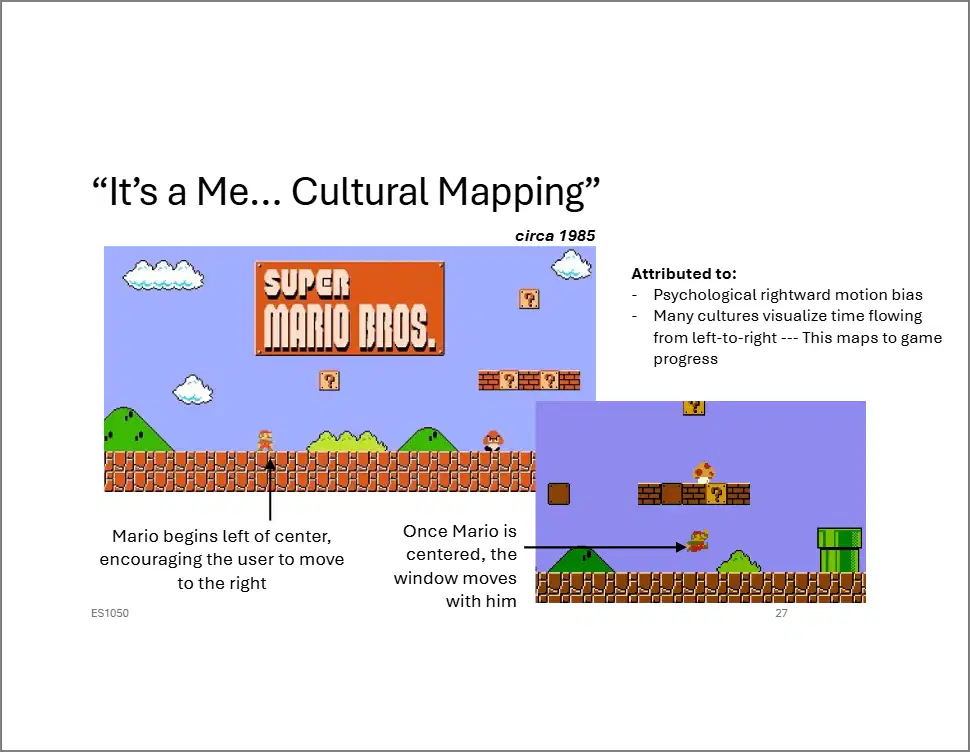
Once Mario is centered, the ______ moves with him.
window
screen
character
background
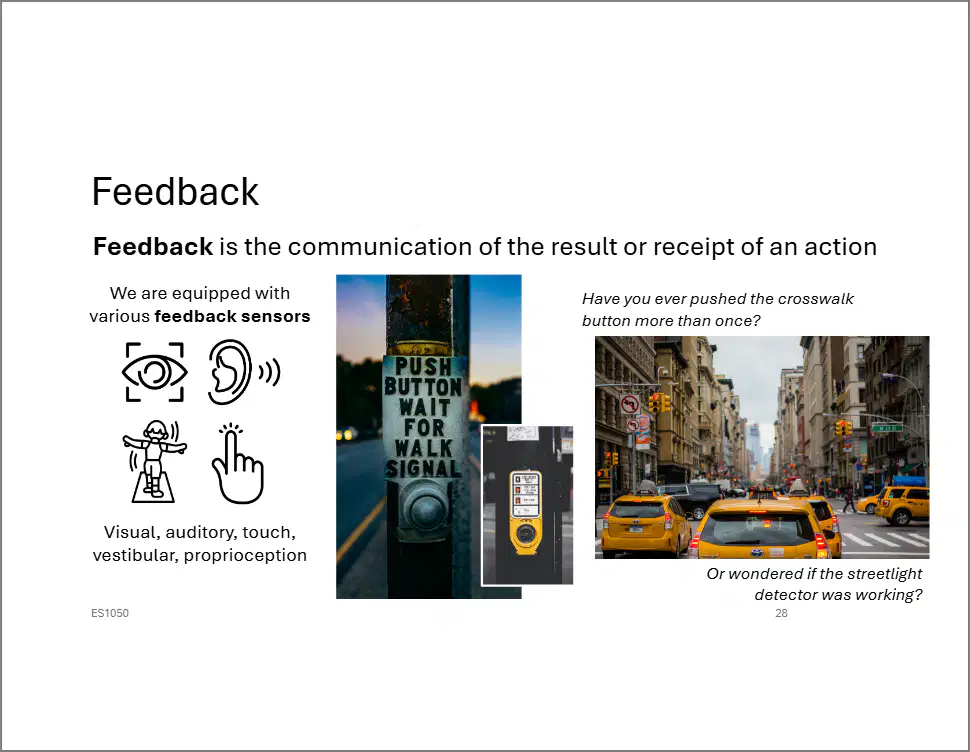
Name two types of feedback sensors humans are equipped with.
Touch and vision
Taste and smell
Hearing and balance
Temperature and humidity
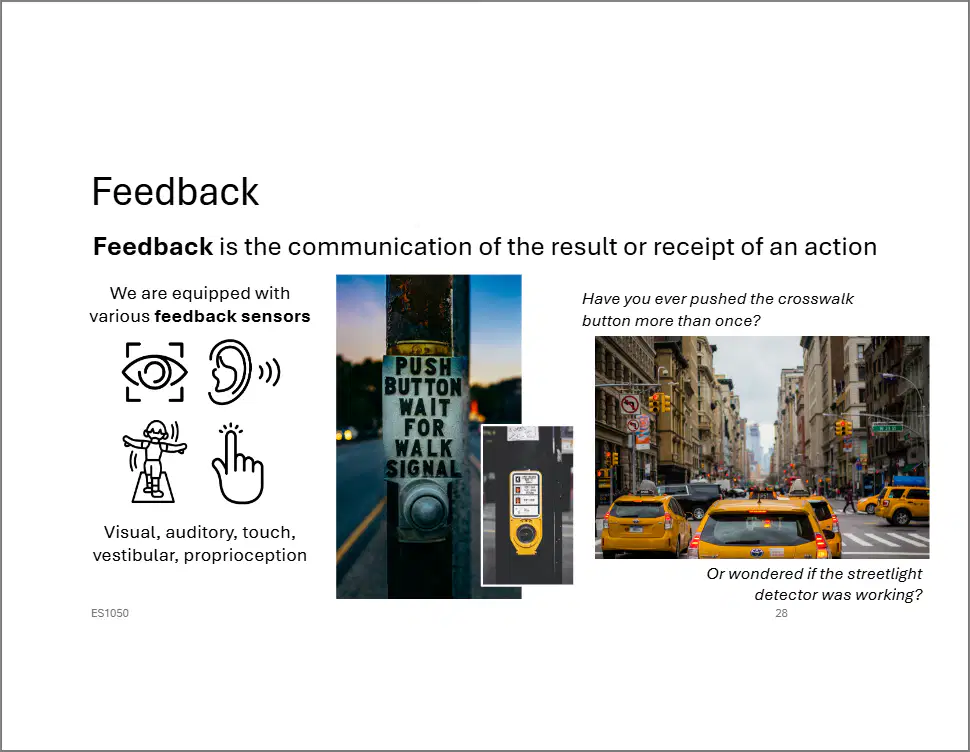
Pushing the crosswalk button more than once may indicate what about feedback in user-device interaction?
Users may not receive clear feedback that their action was registered.
Users always trust the device to work correctly.
Users are impatient and want to cross quickly.
Users know the button does not work.
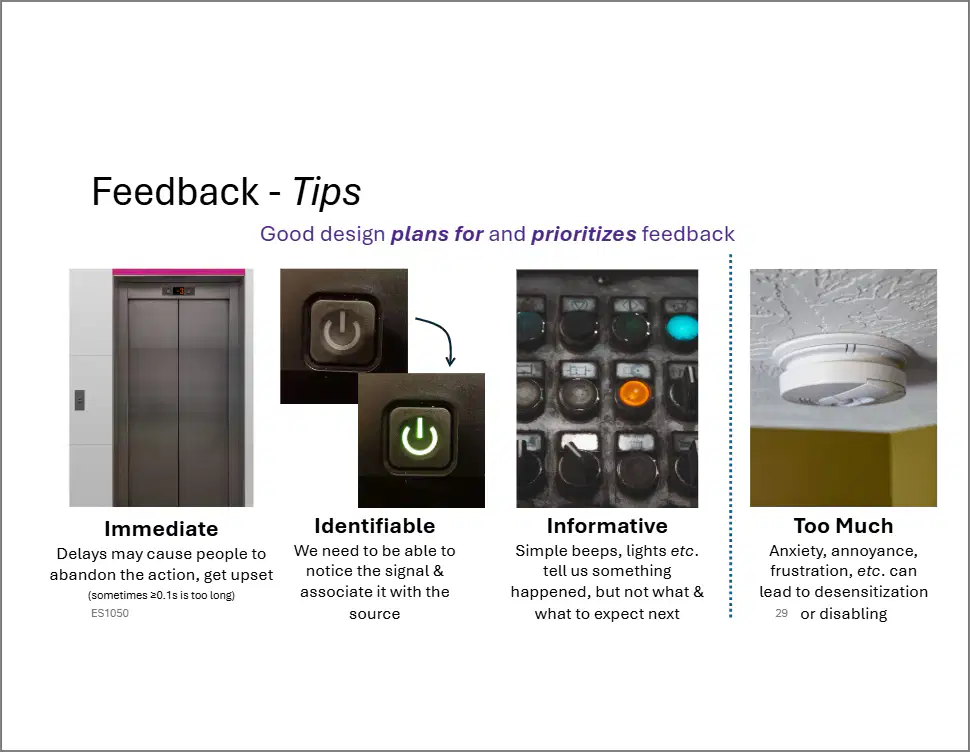
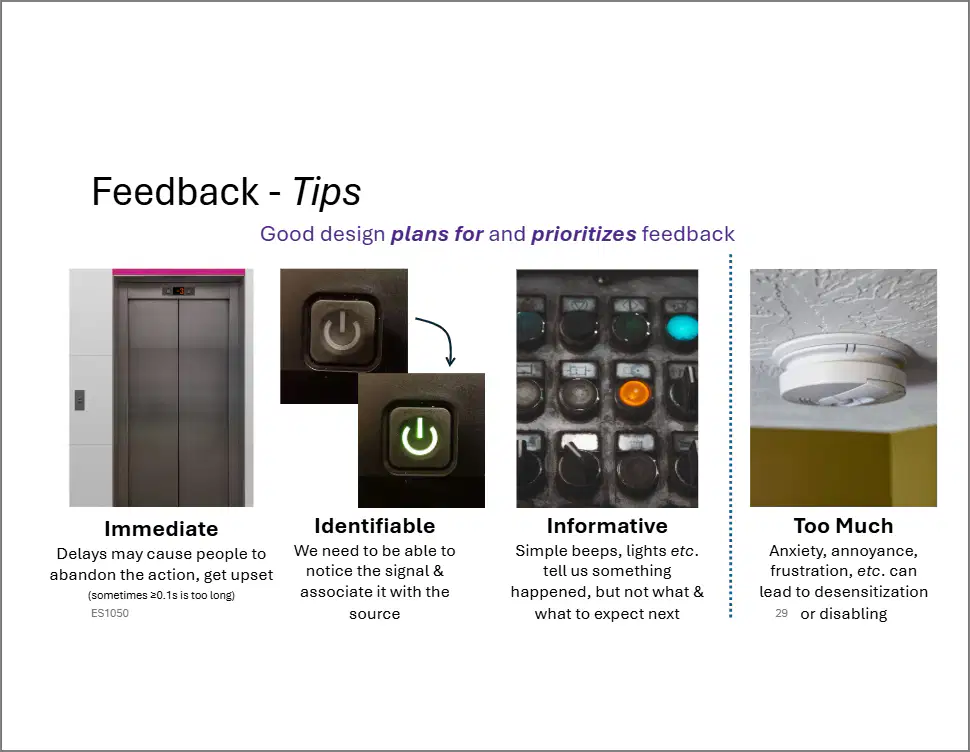
Which of the following feedback types may cause people to abandon the action and get upset due to delays?
Immediate
Identifiable
Informative
Too Much
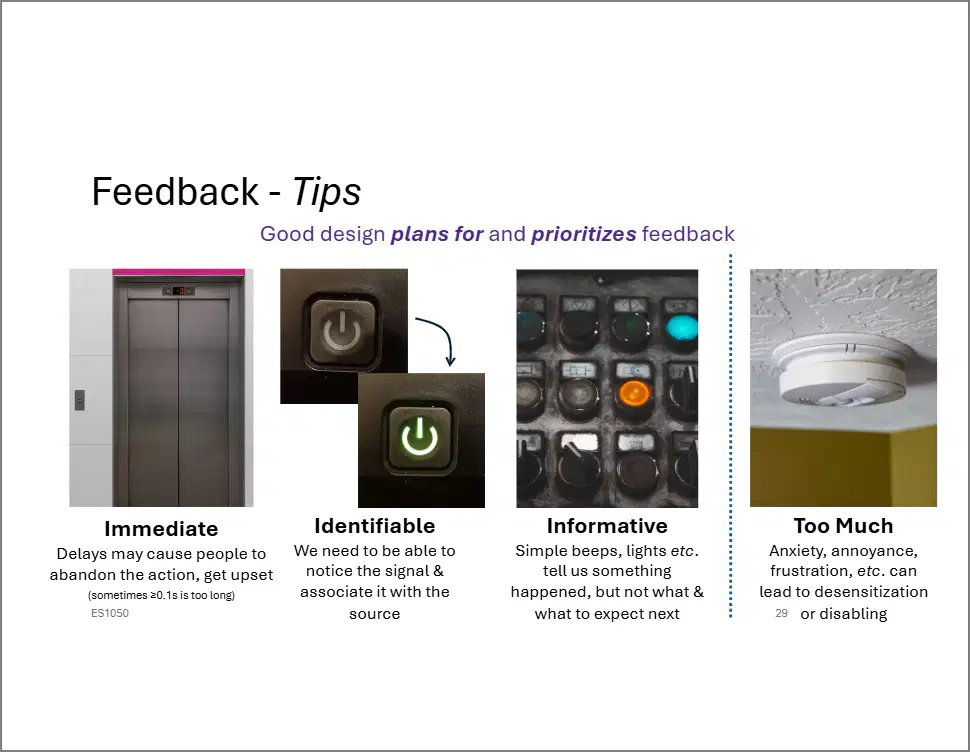
What is the main requirement for feedback to be Identifiable?
It should be immediate
We need to be able to notice the signal and associate it with the source
It should be informative
It should be too much
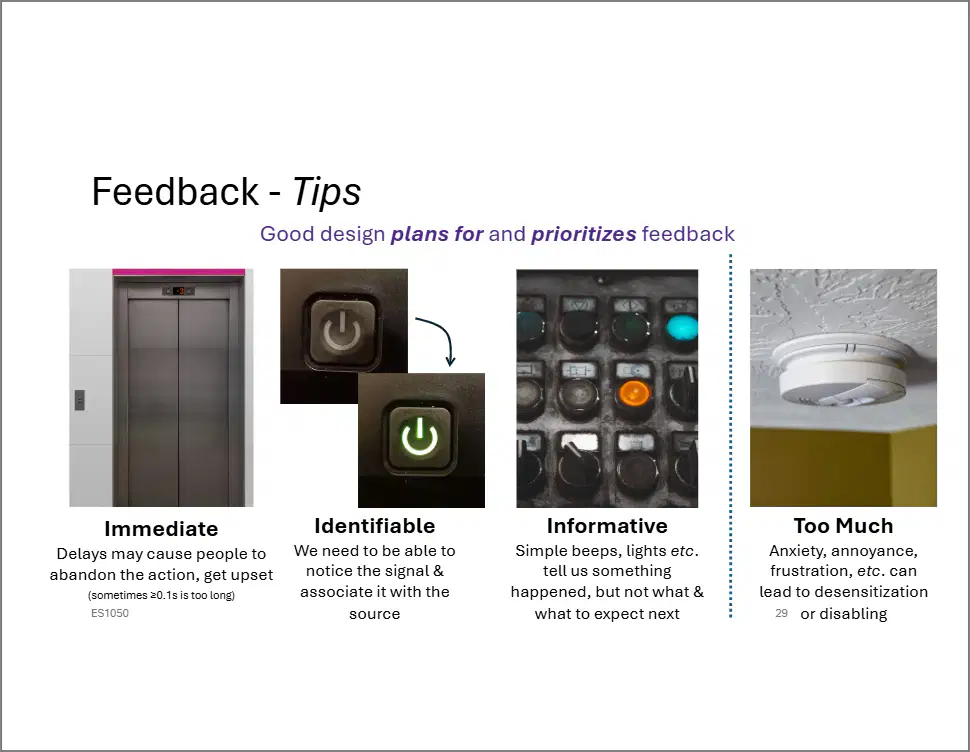
Simple beeps, lights, etc. tell us something happened, but not what and what to expect next. This type of feedback is called _________.
Informative
Descriptive
Predictive
Interactive
Anxiety, annoyance, and frustration caused by too much feedback can lead to desensitization or disabling of the feedback.
True
False
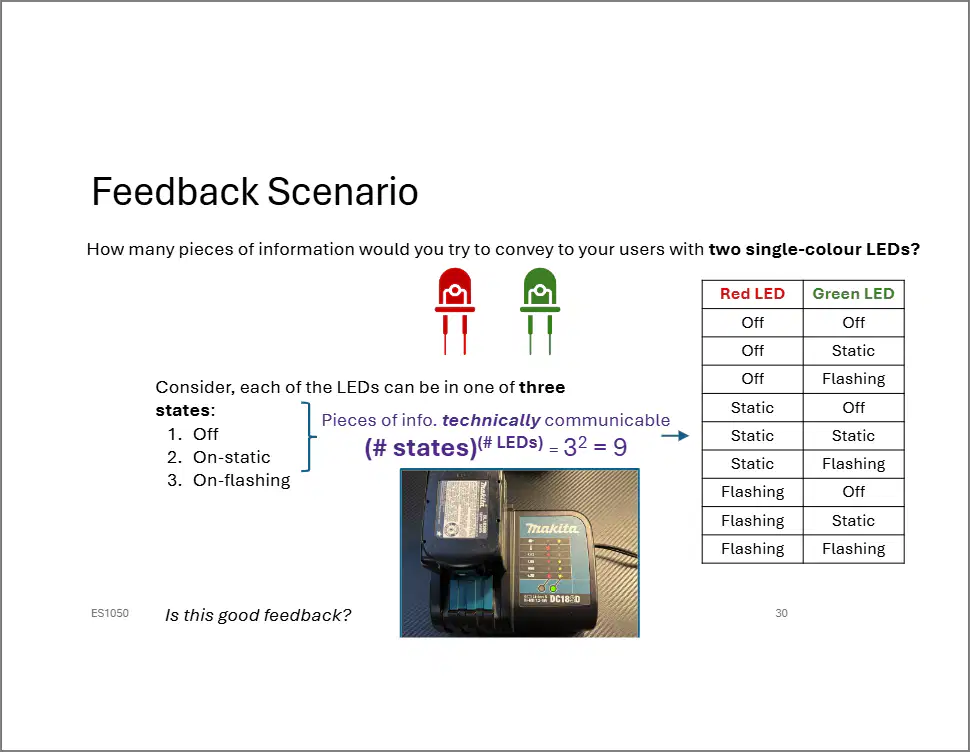
How many pieces of information can be technically communicated using two single-colour LEDs, each with three states (Off, On-static, On-flashing)?
9
6
12
8
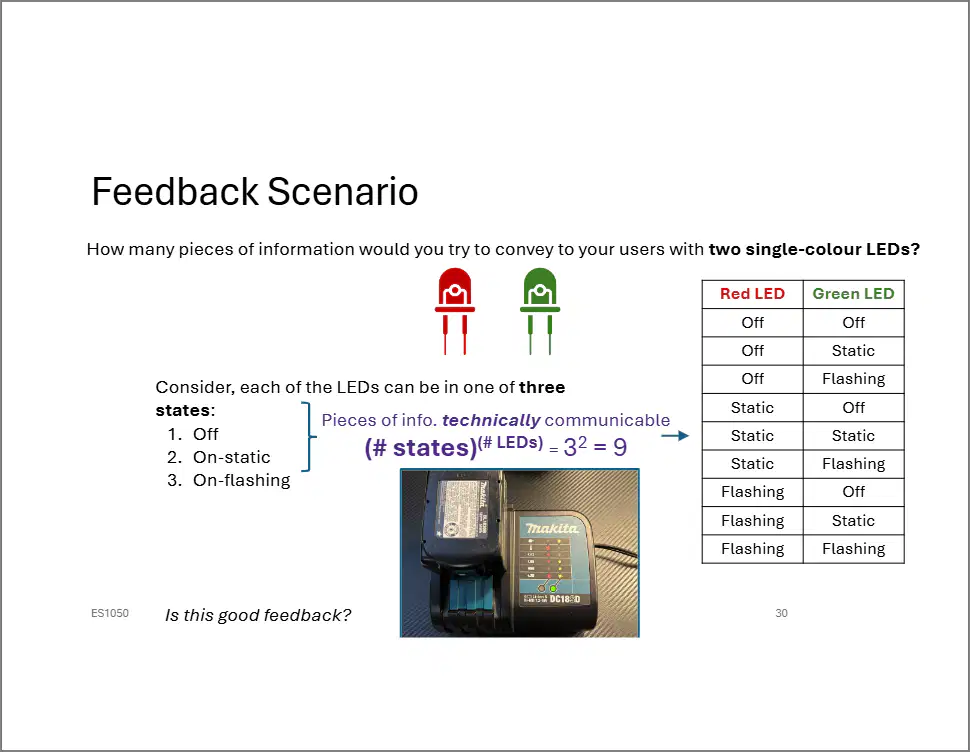
Is this good feedback? (Consider the scenario with two single-colour LEDs and 9 technically communicable states.)
Yes, it is good feedback for the scenario described.
No, it is not good feedback for the scenario described.
It depends on the type of LEDs used.
Only if more than 9 states are needed.
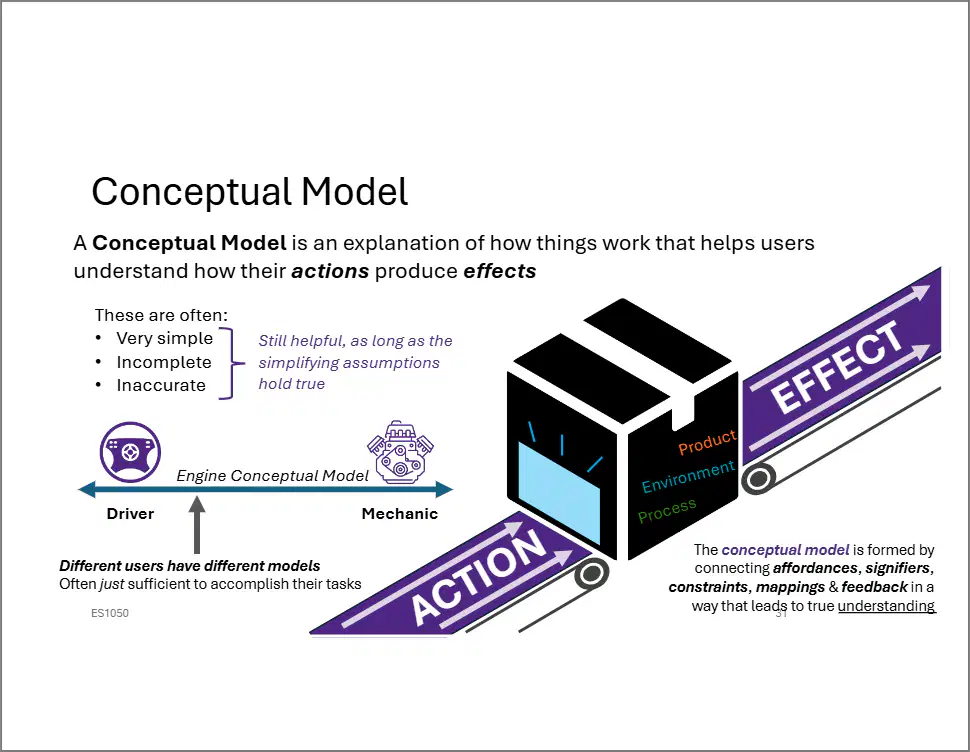
What is a Conceptual Model?
An explanation of how things work that helps users understand how their actions produce effects
A physical representation of a product
A list of instructions for using a product
A type of feedback mechanism
Conceptual models are often ________, incomplete, and inaccurate, but still helpful as long as the simplifying assumptions hold true.
very simple
very complex
always correct
fully detailed
Different users have different conceptual models, which are often just sufficient to accomplish their tasks.
True
False
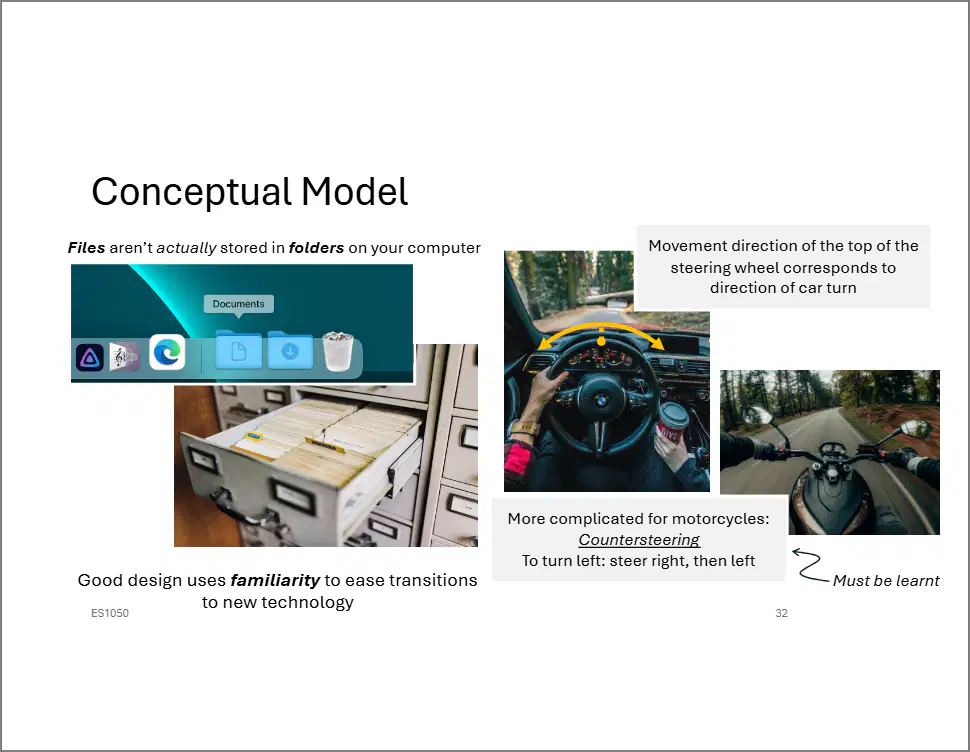
Which of the following is used in good design to ease transitions to new technology?
Complexity
Familiarity
Randomness
Inaccuracy
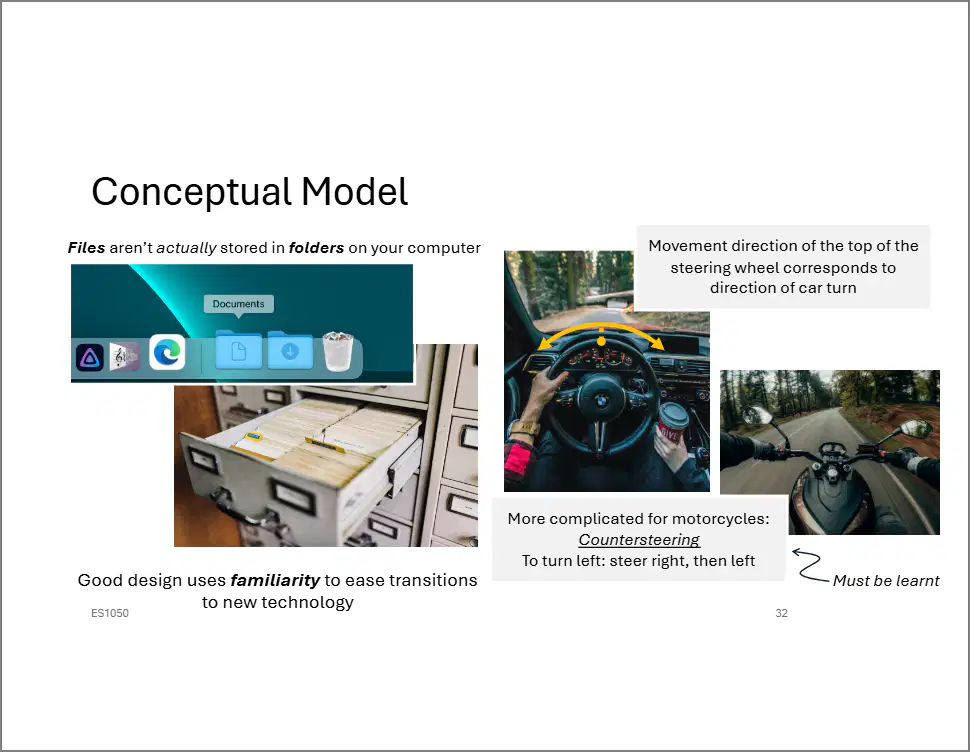
Movement direction of the top of the steering wheel corresponds to the direction of car turn. For motorcycles, to turn left you must steer ______ first, then left.
right
up
down
back
What are the three components that form our conceptual models?
Perception, Experience, Instruction
Feedback, Constraints, Mapping
Affordances, Signifiers, Feedback
Rotation, Pinch, Expansion
Good design makes use of ________, affordances, constraints, mappings & feedback to help users form usable conceptual models.
signifiers
labels
icons
instructions
What does the system image of a product represent?
The image of the system function offered by the product/environment/process.
The physical appearance of the product.
The brand logo associated with the product.
The marketing strategy used for the product.
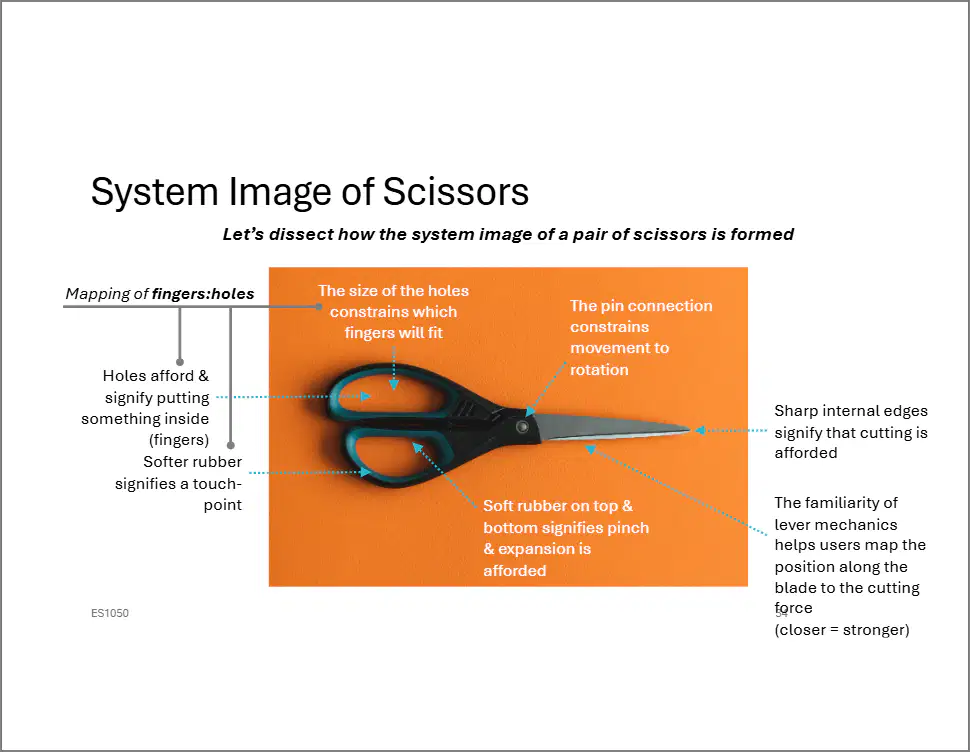
In the system image of scissors, what does the size of the holes constrain?
Which fingers will fit.
How sharp the blades are.
The color of the scissors.
The length of the blades.
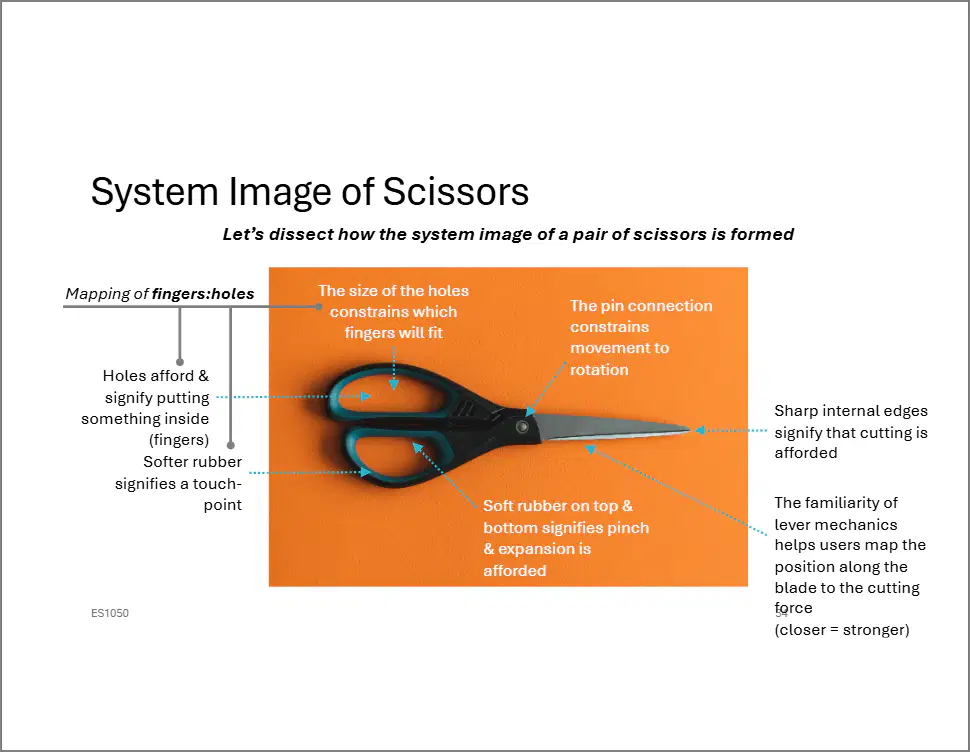
The pin connection in scissors constrains movement to rotation.
True
False
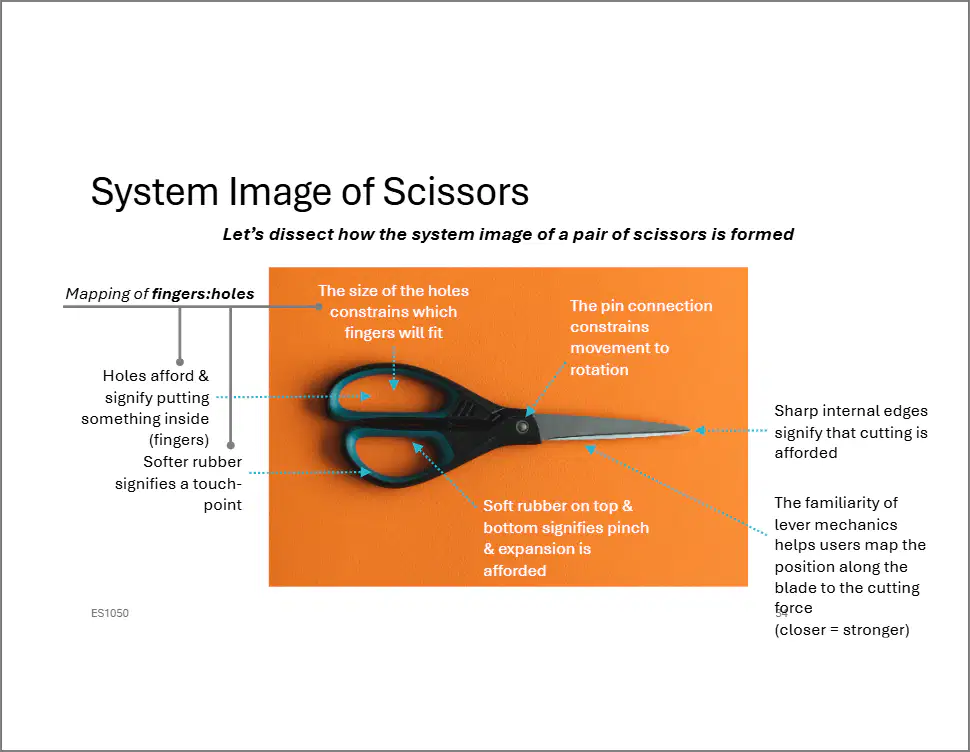
What does the soft rubber on top and bottom of the scissors signify?
Pinch & expansion is afforded.
It is for decoration only.
It helps in sharpening the blades.
It prevents the scissors from opening.
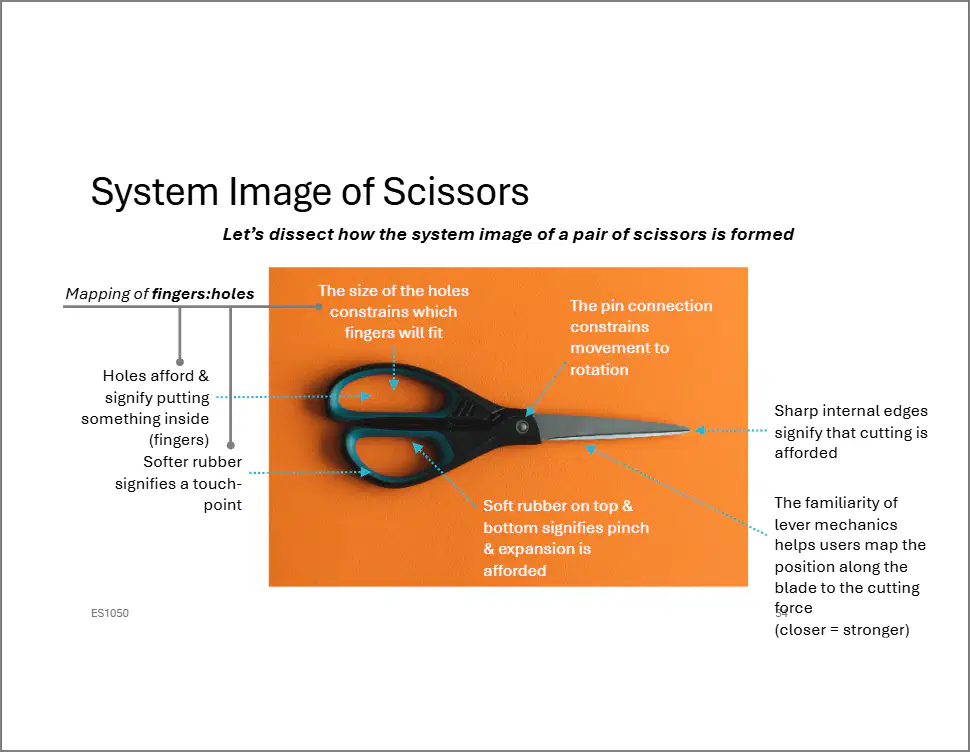
Lever mechanics help users map the position along the blade to the cutting force in scissors by:
Increasing the cutting force closer to the pivot due to greater mechanical advantage.
Decreasing the cutting force closer to the pivot due to less mechanical advantage.
Making the cutting force equal along the entire blade regardless of position.
Allowing the cutting force to be highest at the tip of the blade.
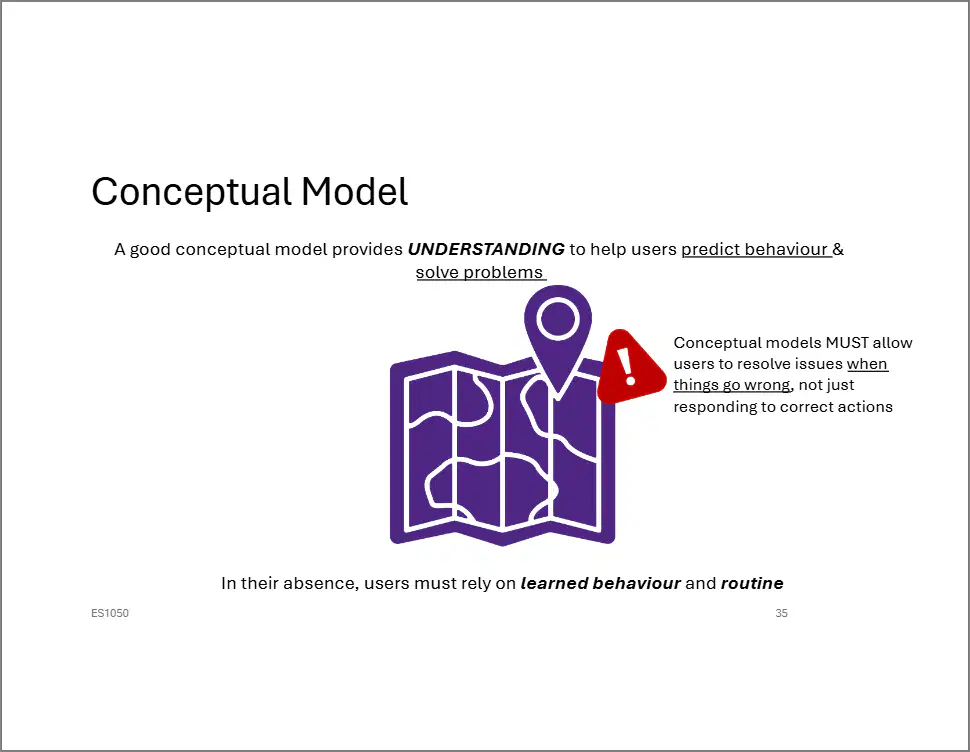
What does a good conceptual model provide to help users predict behaviour and solve problems?
Routine
Understanding
Feedback
Constraints
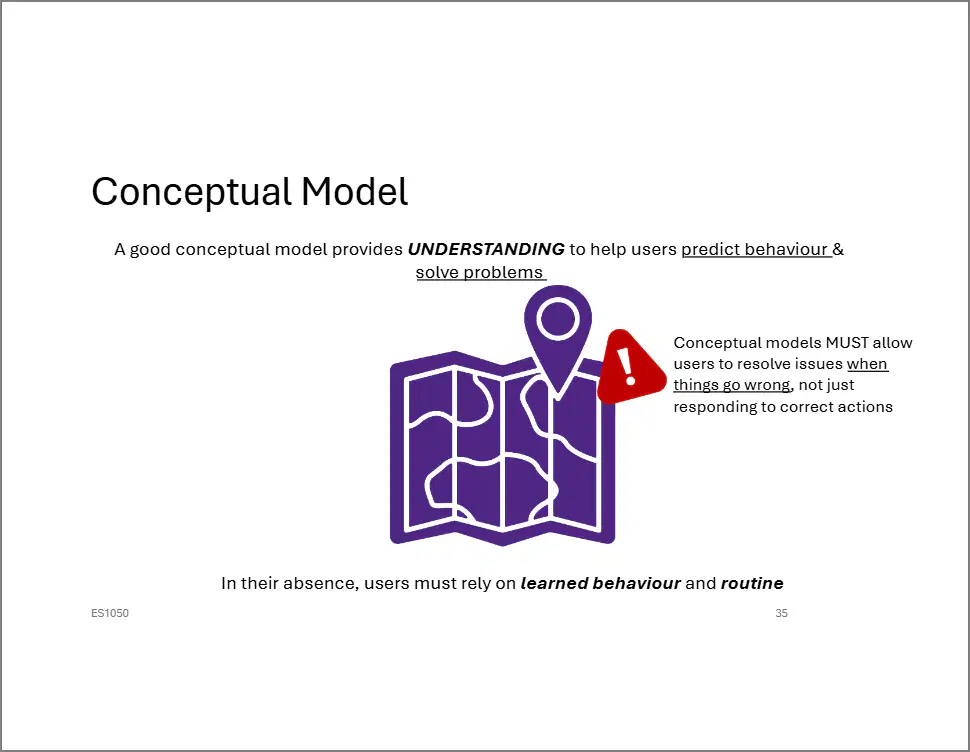
Conceptual models MUST allow users to resolve issues when ________, not just responding to correct actions.
things go wrong
everything is perfect
instructions are clear
users are experienced
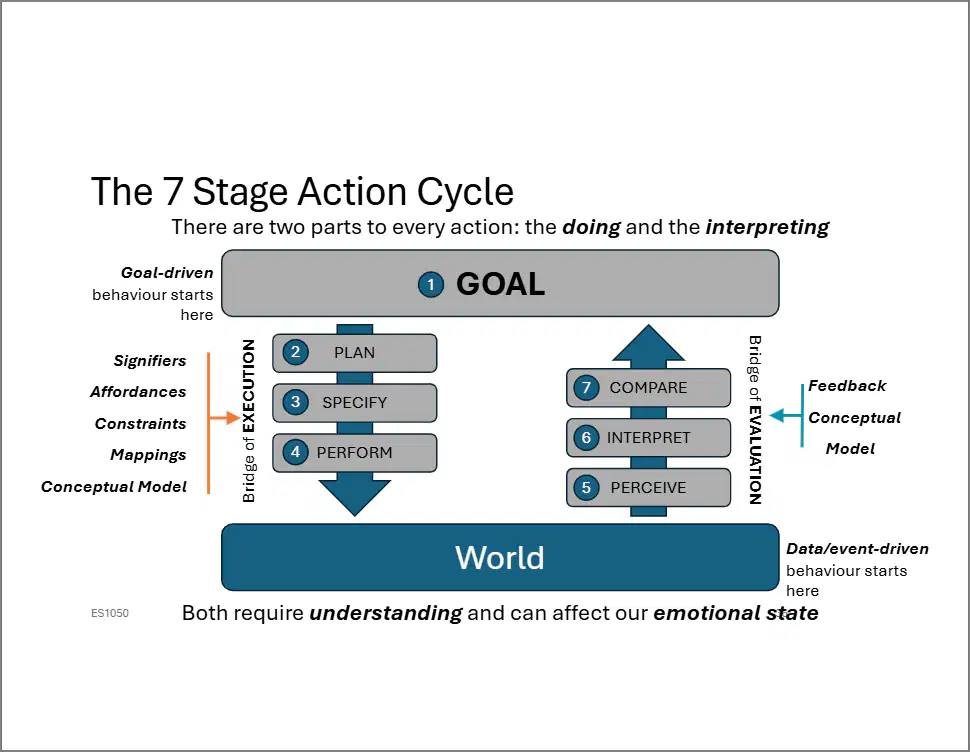
How many stages are there in the Action Cycle described in the slide?
5
6
7
8
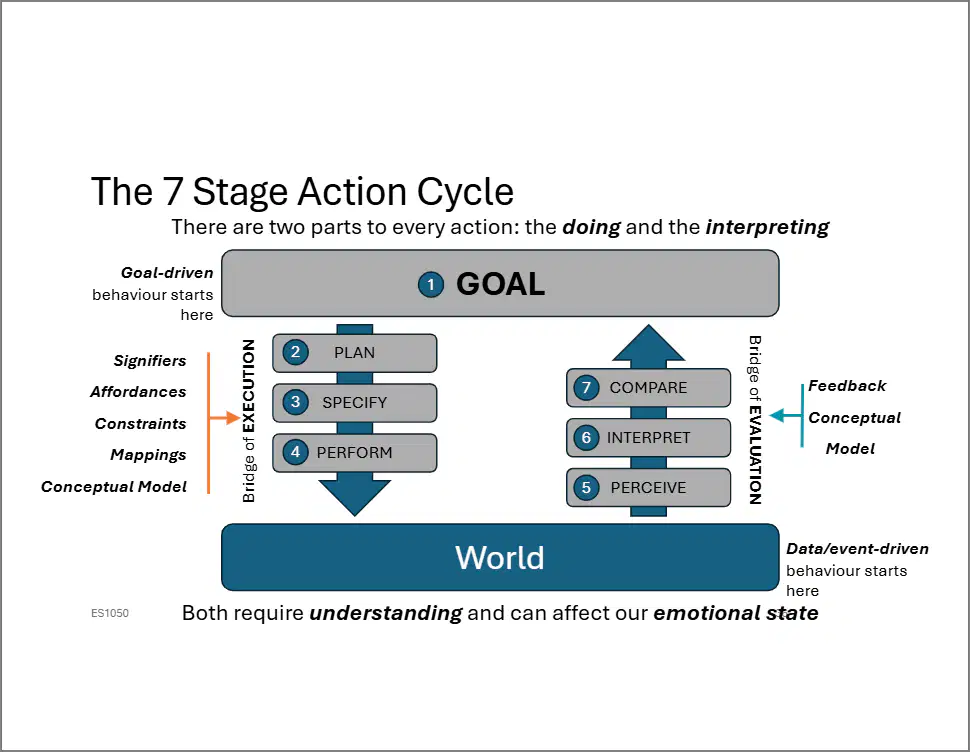
Both require ________ and can affect our emotional state.
understanding
money
strength
distance

