
 Worksheets
BTEC Business unit 2
Total questions: 102
Worksheet time: 51mins
What are start-up costs in a business context?
The money paid out by a business for the items it needs before it can begin trading.
The profits made by a business after trading.
The ongoing expenses paid after the business starts.
The money paid to employees as wages.

Which of the following is an example of a start-up cost for a new sandwich shop?
Buying and installing a sign.
Paying monthly electricity bills.
Paying employee wages.
Buying ingredients for sandwiches.
Why must businesses pay their start-up costs before they start trading?
Because they need to have the necessary items and equipment to operate.
Because they want to increase their profits.
Because they need to pay their employees first.
Because they need to pay taxes before trading.
Which of the following is NOT considered a start-up cost?
Buying a cash register.
Buying a van before starting a gardening business.
Paying wages to employees after opening.
Buying a lawnmower before starting work.
A business wants to open a new shop. Which of the following is a correct way to raise money for start-up costs?
From savings or loans.
By selling products before opening.
By collecting monthly membership fees.
By charging customers for future services.
Sarah wants to convert her garage into a commercial kitchen for her cake business. Which of the following would be a specific start-up cost for her?
Buying an oven.
Paying for cake ingredients every week.
Paying monthly utility bills.
Paying for advertising after opening.
When preparing for an online test, what is important to remember according to the learning material?
Read the question carefully and make sure your answer is specific to the context.
Always choose the first answer.
Skip questions you are unsure about.
Use only capital letters in your answers.
What are operating (running) costs in a business?
The expenses a business has in its day-to-day operations
The profits a business makes from sales
The money invested to start a business
The taxes paid at the end of the year

Which of the following is an example of a running cost for a sandwich shop?
Ingredients and staff wages
Buying new kitchen equipment
Advertising for the grand opening
Renovating the shop

Utility bills for water, gas, and electricity are considered what type of cost for a business?
Running costs
Start-up costs
Capital costs
Marketing costs
What is the main difference between running costs and start-up costs?
Running costs occur repeatedly, while start-up costs occur only before the business opens
Running costs are paid by customers, while start-up costs are paid by the owner
Running costs are for buying equipment, while start-up costs are for paying wages
Running costs are optional, while start-up costs are mandatory
Which of the following is a start-up cost for Jason’s gardening business?
Buying a lawnmower
Paying wages to an assistant
Buying diesel for the van
Utility bills
If Sarah makes celebration cakes, which of the following would be a running cost for her business?
Buying flour and sugar regularly
Purchasing a new oven before opening
Designing a logo for her shop
Decorating the shop for the grand opening
Why must Jason purchase a van before starting his gardening business?
It is a start-up cost needed before work can begin
It is a running cost that occurs regularly
It is a marketing expense
It is a tax-deductible expense
Which of the following best describes running costs?
Costs that occur again and again during business operations
Costs paid only once before the business opens
Costs related to advertising and promotion
Costs for buying land and buildings
If you are asked to identify running costs and start-up costs in an online test, what should you remember?
Start-up costs occur only before the business opens, running costs occur repeatedly
Running costs are always higher than start-up costs
Start-up costs are paid by customers, running costs by the owner
Running costs are only for utilities, start-up costs for equipment
Which of the following best describes a fixed cost in a business?
A cost that changes depending on the number of products made or sold.
A cost that stays the same no matter how many products are made or sold.
A cost that is always related to ingredients.
A cost that only applies to staff uniforms.
What is an example of a variable cost for Wendy’s hot dog business?
The pitch fee she pays.
The cost of rolls and sausages.
The cost of staff uniforms.
The rent for her stall.
Which of the following is a direct cost in a furniture factory?
The cost of staff uniforms.
The cost of wood used in production.
The cost of rent.
The cost of insurance.
Anna makes silver jewellery and sells it online. Which of the following is most likely a fixed cost for her business?
Cost of materials.
Internet access.
Postage and packing.
Commissions paid to a website.
Which cost would increase as Anna sells more jewellery online?
Rent.
Utility bills.
Postage and packing.
Insurance.
Ken makes wooden rocking horses and paints them. Which of the following is a variable cost for Ken’s business?
The cost of paint and wood.
The rent for his workshop.
The insurance for his business.
The utility bills.
Why is the cost of staff uniforms considered an indirect cost?
It is directly related to the number of products made.
It changes depending on sales.
It is independent of output.
It is a variable cost.
What is the formula to calculate total costs for a business?
Total Costs = Fixed Costs + Variable Costs
Total Costs = Variable Costs - Fixed Costs
Total Costs = Fixed Costs x Variable Costs
Total Costs = Fixed Costs / Variable Costs
If the variable cost per item is £15 and 40 items are sold, what is the total variable cost?
£600
£300
£900
£40
James makes 6 wicker chairs in February. If the variable cost per chair is £30, what are the variable costs for February?
£180
£120
£30
£6
James has fixed costs of £120 and variable costs of £180 for February. What are his total costs for February?
£300
£180
£120
£60
Variable costs change depending on which of the following?
Number of units produced or sold
The amount of fixed costs
The total profit made
The number of employees
If the cost per hot dog is 20p and 200 hot dogs are sold, what is the total variable cost?
£40
£20
£200
£400
Jenny sells 50 bracelets, with a variable cost of £15 per bracelet and fixed costs of £300. What is her total cost?
£1,050
£900
£750
£300
Explain why it is important to know both fixed and variable costs when calculating total costs for a business.
Because total costs are the sum of both, and knowing them helps in budgeting and pricing decisions.
Because fixed costs are always zero.
Because variable costs do not affect total costs.
Because only fixed costs matter in business.

What is revenue in the context of a business?
Money received by a business from selling products and services
Money spent by a business on equipment
Money borrowed by a business from a bank
Money lost due to faulty equipment

Which of the following is a source of revenue for Jim’s Computer Shop?
Sale of equipment and consumables
Advertising the shop
Paying rent for the shop
Donating to charity
What is another source of revenue for Jim’s Computer Shop besides selling equipment?
Repairing faulty equipment
Collecting items to sell
Paying rent for the shop
Advertising the shop
Jim rents out the rooms upstairs he never uses. What type of revenue does this generate?
Rent
Interest
Sale of consumables
Maintenance contracts
How does Jim earn interest as a source of revenue?
By putting money into a savings account
By selling clothes
By charging for consultations
By advertising the shop
Which of the following is a way Jim could create additional sources of revenue?
Charging extra for visiting clients to repair their computers
Advertising the shop
Paying rent for the shop
Donating to charity
Offering maintenance contracts to businesses is an example of which type of revenue source?
Additional source of revenue
Interest revenue
Rent revenue
Advertising revenue
Sam, Louise, and Sharmeen run a veterinary practice. Which of the following are two sources of revenue for their practice?
Charging for consultations and selling pet products
Advertising the practice and paying rent
Collecting donations and selling clothes
Charging for annual vaccinations and advertising
Which two of the following are sources of revenue for a charity shop?
Advertising the shop and selling clothes
Selling clothes and collecting items to sell
Donations from the public and paying rent for the shop
Collecting items to sell and advertising the shop
Why is it important for businesses to identify additional sources of revenue?
To earn as much money as possible
To reduce advertising costs
To avoid paying rent
To increase the number of employees
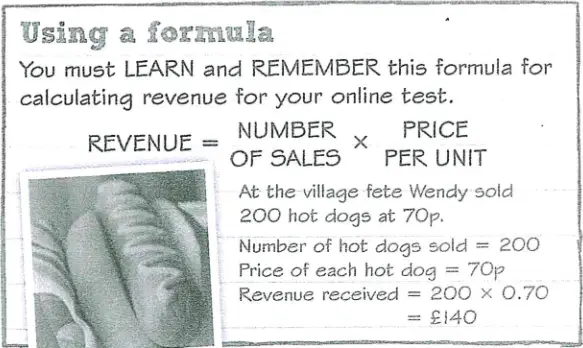
What is the formula for calculating revenue for a business?
Revenue = Number of sales × Price per unit
Revenue = Number of sales + Price per unit
Revenue = Number of sales ÷ Price per unit
Revenue = Number of sales - Price per unit
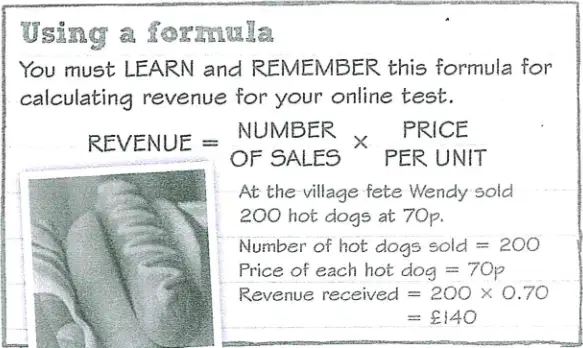
If Wendy sold 200 hot dogs at £0.70 each, what is the revenue she received from hot dogs?
£140
£70
£200
£0.70
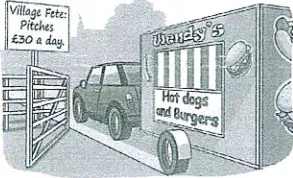
Wendy also sold 250 burgers at £1.50 each. What is the revenue received from burgers?
£375
£250
£150
£1.50
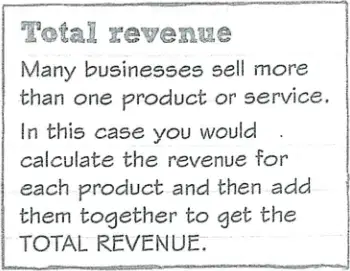
How do you calculate total revenue when a business sells more than one product?
Add the revenue from each product together
Multiply the revenue from each product together
Subtract the revenue from each product
Divide the revenue from each product
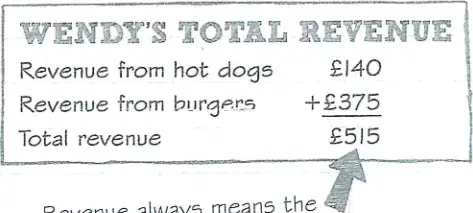
What is Wendy’s total revenue from selling hot dogs and burgers?
£515
£140
£375
£490

A small business sold 10,000 T-shirts at £15 each. What is the total revenue for the business?
£150,000
£10,000
£15,000
£1,500
A charity shop sold 1,200 books at 25p each and 500 DVDs at 20p each. What steps should you follow to calculate the total revenue?
Calculate revenue for books, calculate revenue for DVDs, add the answers together
Calculate revenue for books, subtract revenue for DVDs, multiply the answers together
Calculate revenue for books, divide revenue for DVDs, add the answers together
Calculate revenue for books, calculate revenue for DVDs, subtract the answers
Why is it important to show your working out when calculating revenue in a test?
To demonstrate how you arrived at your answer
To make the answer look longer
To avoid using a calculator
To guess the answer
If a business sells 500 items at £2 each and 300 items at £1.50 each, what is the total revenue?
£1,450
£1,000
£800
£1,250
Which of the following is an example of an overhead at Tilly's Sweet Shop?
Wages for her assistant
Stock to sell
Sales revenue
Interest on savings
What is the main difference between stock and consumables in a business context?
Stock is bought for resale, while consumables are used by the business itself
Stock is used by the business, while consumables are bought for resale
Both are used to make a product
Both are types of revenue
Which of the following would NOT be considered a type of expenditure for a business?
Sales revenue
Rent
Utility bills
Wages for assistants
If Tilly wants to sell sweets online, which additional costs might she incur?
Internet connection and website building costs
Reduced utility bills
Lower business rates
Decreased stock costs
Why is it important for businesses to calculate and record their expenditure?
To determine if they have made a profit or a loss
To increase their sales revenue
To reduce the number of employees
To avoid paying taxes
Which of the following best describes expenditure in a business?
Money the business pays out
Money the business receives
The number of products sold
The amount of stock held
A manufacturer uses sugar to make sweets. In this context, sugar is an example of:
Raw material
Consumable
Stock
Overhead
Which two of the following are items of expenditure for a greengrocer?
Stock for the shop and wages for the assistant
Sales revenue and interest on savings
Bank loan for an extension and sales revenue
Interest on savings and product sales
Lucy runs a nail bar. Which two figures show her expenditure items this month?
Rent £1,000 and Wages £1,400
Product sales £200 and Income from manicures £2,600
Rent £1,000 and Product sales £200
Wages £1,400 and Income from manicures £2,600
How might spending money on advertising help Tilly's business?
It can build awareness of her business and attract more customers
It will reduce her utility bills
It will increase her rent
It will decrease her need for stock

What is the likely purpose of the image showing different types of sweets with labels?
To illustrate examples of stock bought for resale
To show types of business rates
To demonstrate utility bills
To explain internet connection costs
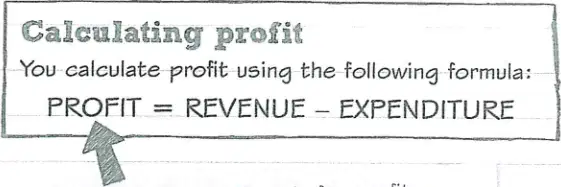
Which formula is used to calculate profit in a business?
Profit = Revenue - Expenditure
Profit = Expenditure - Revenue
Profit = Revenue + Expenditure
Profit = Revenue x Expenditure
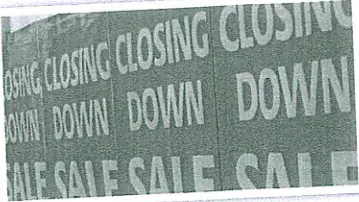
What happens when a business's expenditure is more than its revenue?
The business makes a loss
The business makes a profit
The business breaks even
The business increases its profit
Why do businesses try to increase their profits?
To grow and buy new equipment or open another outlet
To reduce their customer base
To increase their expenditure
To stop trading
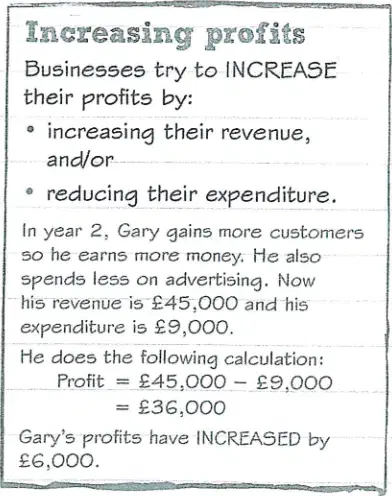
Which of the following is a way for businesses to increase their profits?
Increasing their revenue
Increasing their expenditure
Reducing their revenue
Ignoring their costs
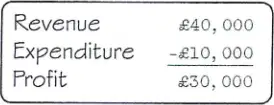
Gary is a window cleaner. Last year his revenue was £40,000 and his expenditure was £10,000. What was his profit?
£30,000
£50,000
£10,000
£40,000
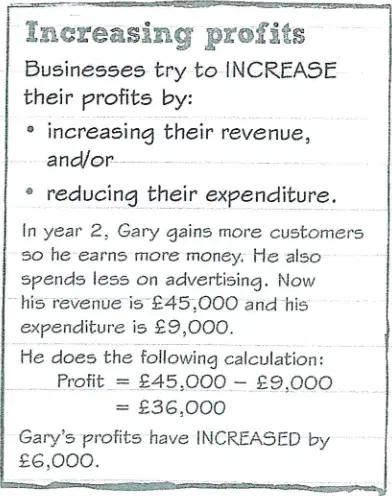
In year 2, Gary's revenue is £45,000 and his expenditure is £9,000. What is his profit for year 2?
£36,000
£54,000
£9,000
£45,000
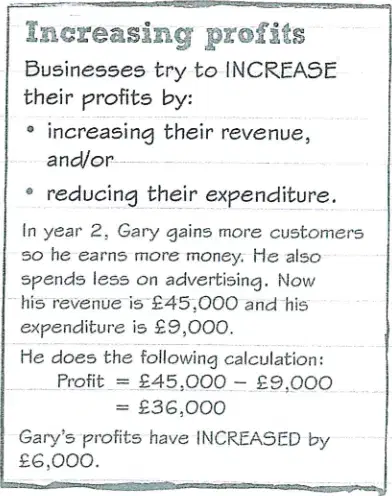
If a business wants to increase its profits, which of the following actions should it take?
Increase revenue and/or reduce expenditure
Increase both revenue and expenditure
Reduce both revenue and expenditure
Ignore revenue and expenditure
A business that makes losses often has to do which of the following?
Stop trading
Expand operations
Increase expenditure
Hire more staff
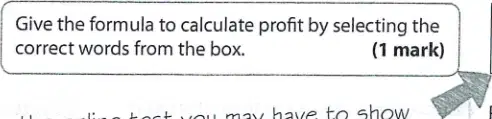
Select the correct words to complete the formula: Profit = _______ - _______.
Revenue, Expenditure
Expenditure, Revenue
Revenue, Overheads
Variable costs, Revenue
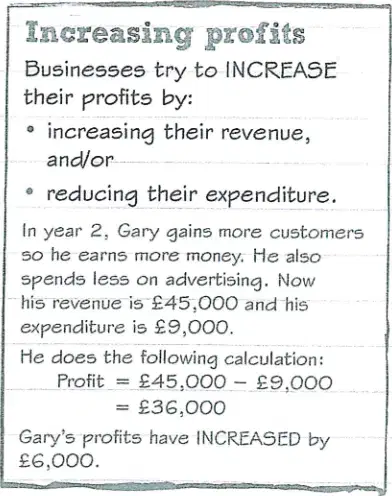
Gary’s profits increased by £6,000 in year 2 compared to last year. What reasoning supports this increase?
He gained more customers and spent less on advertising
He spent more on advertising and lost customers
He reduced his revenue and increased his expenditure
He kept his revenue and expenditure the same
What does the term 'break-even point' mean in business?
When a business has made enough money through product sales to cover the cost of making the product.
When a business makes a profit from every sale.
When a business has no costs at all.
When a business only covers its fixed costs.
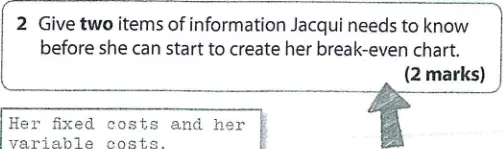
Which two items of information does Jacqui need to know before she can start to create her break-even chart?
Her fixed costs and her variable costs.
Her total revenue and her profit.
Her sales targets and her marketing budget.
Her number of employees and her rent.
On a break-even chart, what does the total costs line represent?
Fixed costs plus variable costs.
Only fixed costs.
Only variable costs.
Total revenue minus profit.
Where the total costs line crosses the total revenue line on a break-even chart, what does this show?
The break-even point.
The margin of safety.
The profit zone.
The loss zone.
What is shown by the space between costs and revenue below the break-even point?
Loss
Profit
Margin of safety
Fixed costs
What is shown by the space between costs and revenue above the break-even point?
Profit
Loss
Fixed costs
Variable costs
What does the margin of safety represent on a break-even chart?
The amount by which sales would have to fall before the break-even point is reached.
The difference between fixed and variable costs.
The total profit made by the business.
The number of units sold above the break-even point.
Why do fixed costs appear as a horizontal line on a break-even chart?
Because fixed costs do not change with output.
Because fixed costs increase with sales.
Because fixed costs decrease with output.
Because fixed costs are always zero.
How does total revenue behave on a break-even chart as the number of items sold increases?
It increases directly with the number of items sold.
It stays the same regardless of sales.
It decreases as more items are sold.
It starts at a high value and decreases.
What must a business know in addition to fixed and variable costs to calculate predicted revenue for a break-even chart?
The price it intends to charge.
The number of employees.
The amount of profit desired.
The cost of raw materials only.
Which axis on a break-even chart shows MONEY, such as costs and revenue?
The vertical axis
The diagonal axis
The horizontal axis
The curved axis
What does the horizontal axis on a break-even chart represent?
The amount of money earned
The number of items produced (units)
The profit made
The total costs
At what point on a break-even chart do the total costs and total revenue lines cross?
The margin of safety
The break-even point
The profit point
The fixed cost point
Which of the following is NOT typically shown by the lines on a break-even chart?
Fixed costs of the business
Total revenue at every level of sales
Employee satisfaction
Profit or loss that can be made
If Dev sells 200 toy boxes and his total revenue is £18,000, what is the selling price per toy box?
£90
£100
£80
£120
Dev’s fixed costs for his business are £4,000. If he sells 200 toy boxes, his total costs are £12,000. What is the variable cost for producing 200 toy boxes?
£8,000
£4,000
£12,000
£16,000
Why is it important for businesses to interpret break-even charts?
To provide financial information for decision making
To decorate their offices
To increase the number of employees
To reduce the number of products made
Which of the following is a benefit of breakeven analysis for a business?
The business knows the fixed and variable costs linked to a product.
The business does not know the costs of production.
The business may make a loss without knowing why.
The margin of safety is unknown.
What is a risk of ignoring breakeven analysis?
The business can set the optimum price for a product.
The business does not know how many items it must sell to make a profit.
The business can calculate and forecast potential sales revenue.
The business can analyse costs to see if any are too high.
Breakeven analysis is commonly used when:
A business is reviewing and analysing past performance.
A business is hiring new employees.
A business is designing a logo.
A business is choosing a location for its office.
Which of the following is NOT a benefit of breakeven analysis?
The business can set a margin of safety.
The business can calculate and forecast potential sales revenue.
The business does not know the costs of production and running costs.
The business can analyse costs to see if any are too high and can be reduced.
How does breakeven analysis help a business set realistic production targets?
By allowing the business to stock or make the most profitable goods.
By helping the business identify its customers.
By ensuring the business hires more employees.
By making the business's sales guaranteed.
A business that ignores breakeven analysis may face which of the following consequences?
The selling price may be too high, too low, or not cover costs.
The business can set the best price for a product.
The business can forecast potential sales revenue.
The business can set a margin of safety.
Why is it important for a business to set realistic production targets using breakeven analysis?
It helps the business in the long run.
It guarantees the business will make a profit.
It ensures the business will never make a loss.
It allows the business to avoid all risks.
If costs change, how can breakeven analysis help a business?
It lets the business analyse the effect on the break-even point.
It guarantees sales are always profitable.
It ensures the business never needs to review past performance.
It prevents the business from ever making a loss.
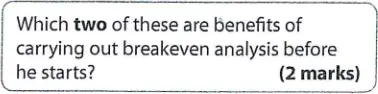
Which two of these are benefits of carrying out breakeven analysis before starting a business? (Select two)
He knows his costs.
He has identified his customers.
His sales are guaranteed.
He can set the sales price to cover costs.
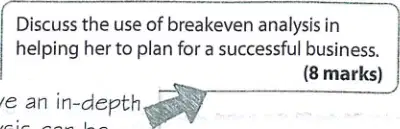
Discuss how breakeven analysis can help Salma plan for a successful business if she has a good idea for an app but would have to pay to get it developed.
By helping her understand costs, set sales targets, and determine the price needed to cover costs.
By guaranteeing her app will be successful.
By ensuring she does not need to analyse costs.
By making her app development free.
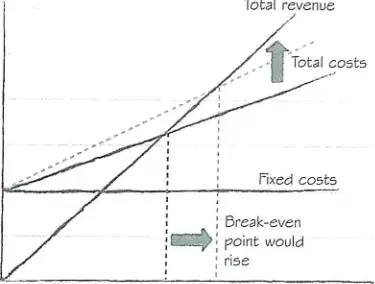
What happens to the break-even point if fixed or variable costs increase?
The break-even point decreases
The break-even point stays the same
The break-even point rises
The break-even point disappears
Identify one start-up cost for a business. Click on one of the boxes.
Salaries paid to staff in the business
Insurance costs for the business
Purchase of new machinery
Payment of telephone bills
Identify one source of revenue. Click on one of the boxes.
Sales of products to customers
Rent paid for shop premises
Money paid to suppliers
Purchase of new stock
Samia owns a shop. Select one current asset that Samia might have. Click on one of the boxes.
Shelving and storage used within the shop
Money that Samia has used to set up the shop
Businesses that Samia owes money to for her stock
Customers who owe the shop money for goods bought

