
 Worksheets
Islam and China Test Review
Total questions: 17
Worksheet time: 11mins
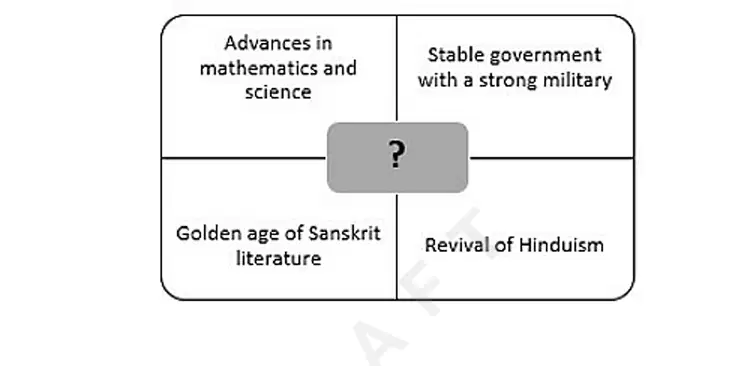
Which title best completes the diagram?
Influences of the Han Dynasty
Results of a Stable Persian Empire
Achievements during the Maurya Empire
Accomplishments during the Gupta Empire
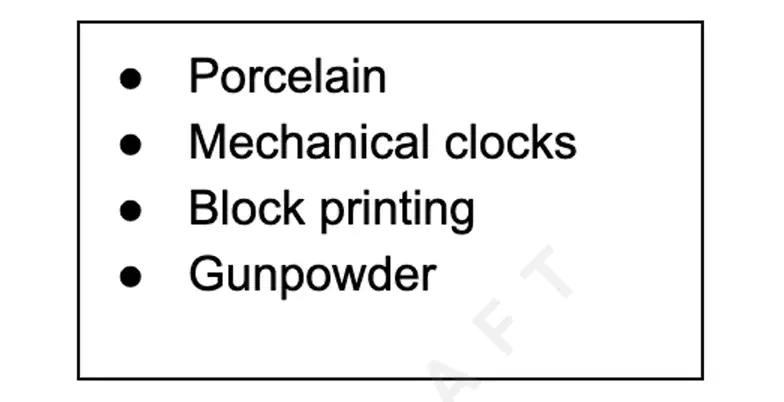
Which civilization is most closely associated with the inventions listed below?
Tang China
Song China
Byzantium Empire
Mongol Empire
What was a significant impact of the Code of Justinian?
It influenced the development of modern legal systems in Europe.
It established the first parliamentary government in Rome.
It was used to govern the Mongol Empire.
It replaced all religious laws with secular laws in Byzantium.
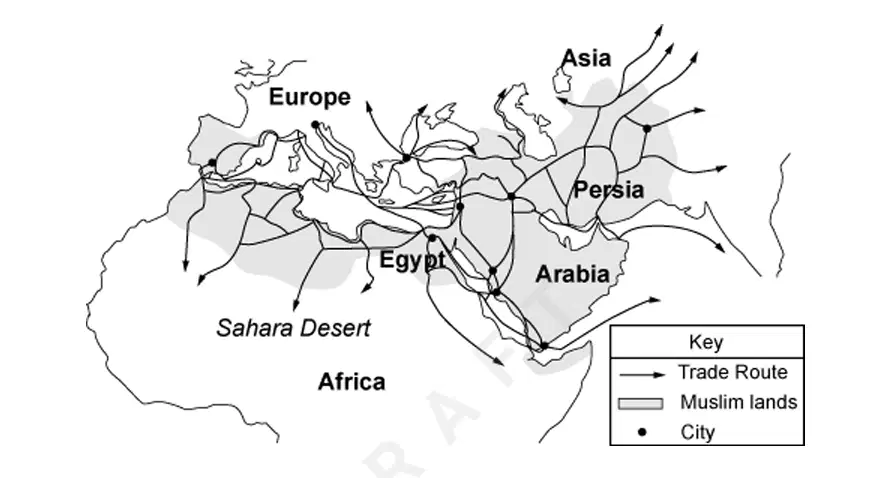
Based on the map showing the expansion of Islam, which factor most contributed to the spread of Islam across different regions?
The establishment of Islamic universities in Europe.
The use of major trade routes connecting cities in Africa, Asia, and Europe.
The isolation of Muslim communities from other cultures.
The decline of trade between Muslim and non-Muslim lands.
Which of the following accomplishments happened during the Tang and Song dynasties?
paper currency
wood block printing
both A & B
none of the above
Feudalism was the main social system in medieval Europe. There was a social hierarchy in which individuals had specific duties and powers. Who had the least amount of power?
king
lord
knight
serf
Feudalism was the main social system in medieval Europe. There was a social hierarchy in which individuals had specific duties and powers. Who had the most power?
king
lord
knight
serf
Which of the following best describes the contributions of Muslim scholars during the Golden Age of Islam?
They ignored the achievements of earlier civilizations.
They focused only on religious studies and avoided scientific inquiry.
They translated, preserved, and built upon the knowledge of ancient Greek and Roman thinkers.
They discouraged the study of philosophy and mathematics.

Part A:
The Pope of the Catholic Church has held the position of power and influence since the 4th century. Why does the Pope wield so much power?
The first Pope led Constantine to Christ.
The Pope rules over the church.
The Pope became a powerful law maker.
The Pope took over law making for Rome.

Part B:
Which statement BEST describes the evidence used to answer Part A?
it helped the Christian Church grow and gain power
the Roman Emperor Constantine converted to Christianity
the Bishop of Rome, known as the Pope, became the leader of the entire Church.
The Church also established its own laws and beliefs.

Read the passage: Roman Catholicism, a form of Christianity, developed due to various social and political factors. In ancient Rome, there was a strong Christian community. When the Roman Emperor Constantine converted to Christianity in the 4th century, it helped the Christian Church grow and gain power. The Church leaders, called bishops, became important. The Bishop of Rome, known as the Pope, became the leader of the entire Church. The Church also established its own laws and beliefs. The influence of the Roman government and administration and interactions with other Christian groups also played a role. All these factors came together over a long time to shape Roman Catholicism into the distinctive form of Christianity that it is today. This question has two parts. First, answer Part A. Then answer Part B. Part B: Which statement BEST describes the evidence used to answer Part A?
it helped the Christian Church grow and gain power
the Roman Emperor Constantine converted to Christianity
the Bishop of Rome, known as the Pope, became the leader of the entire Church.
The Church also established its own laws and beliefs.
What term describes the process by which religious beliefs and practices spread from one region to another?
Nationalism
Cultural diffusion
Monotheism
Isolationism
Which mathematical discipline, whose name is derived from Arabic, was significantly advanced by scholars during the Islamic Golden Age?
Algebra
Calculus
Geometry
Statistics
Which of the following is an example of a technological innovation introduced in China?
The catapult
Gunpowder
Irrigation
The sextant
What was a major factor that led to the division between Shi’a and Sunni Muslims?
conflict over trade routes
debate about prayer rituals
dispute over leadership succession
differences in dietary laws
In the manorial system, who typically held authority over the peasants working the land?
merchant
noble
monk
serf
Explain one economic AND one social factor that led to the development of feudalism. Choose the option that correctly pairs one economic factor with one social factor based on the scoring guide (Manorialism, Nobles, Serfs, Lords, Fiefdom, Hierarchy).

