
 Worksheets
World Religions: Vocabulary and Introduction
Total questions: 134
Worksheet time: 1hrs 7mins
Which sacred text is most closely associated with Judaism?
Qur'an
Torah
Vedas
Sunnah
The term Jewish Diaspora most directly refers to which historical or social process?
The spread of Buddhism from India to East Asia
The dispersion of Jewish people beyond their ancestral homeland
The division between Sunni and Shia Muslims
The exile of apostles from Rome
In early Christianity, who were the apostles?
Sacred Hindu hymns preserved in Sanskrit
Disciples who spread the teachings of Jesus
Scholars who compiled the Qur'an
Buddhist monks seeking nirvana
In Christian belief, what does Resurrection describe?
A cycle of rebirth governed by karma
The return of Jesus to life after death
The creation of the Vedas
The transmission of the Sunnah
Which pair is correctly matched? Select all that apply.
Qur'an — Islam's central scripture
Sunnah — Traditions about the Prophet Muhammad's practices
Vedas — Foundational texts of Hinduism
Torah — Teachings of Confucius
In Hindu and Buddhist contexts, what is dharma best described as?
Moral duty or righteous path
Liberation from the cycle of rebirth
Divine favor granted by a mandate
A collection of apostolic letters
According to South Asian religious traditions, karma most closely means which of the following?
The law of cause and effect applied to actions
A meditative state free from suffering
An oath of loyalty to a ruler
A code of filial obedience to parents
In Buddhism, nirvana refers to which idea?
The highest heaven reached after judgment
The end of suffering and release from the cycle of rebirth
A pilgrimage required once in a lifetime
The authority of apostles over a church
Which statement about the Mandate of Heaven is most accurate?
It is a Christian doctrine about salvation
It is a Confucian and Chinese political idea that rulers govern with divine approval
It is a Buddhist rule for monastic life
It is an Islamic term for lawful conduct
Filial piety in Confucian thought emphasizes which social behavior?
Devotion to scripture over family
Respect and duty toward parents and elders
Withdrawal from society to meditate
Expansion of an empire by mandate
Which items are correctly paired with their religion or tradition? Select all that apply.
Torah — Judaism
Qur'an — Christianity
Vedas — Hinduism
Sunnah — Islam
Guiding question: How have religions influenced human society? Which examples best illustrate potential influences? Select all that apply.
Legal and political ideas like the Mandate of Heaven shaping rulership
Family expectations such as filial piety guiding social behavior
Random events with no connection to beliefs or values
Missionary work by apostles spreading religious teachings
According to the passage, by 500 B.C.E., where were the roots of major world religious traditions emerging?
Only in Europe
In the Middle East, India, and China
Exclusively in Africa
In the Americas and Oceania
Which statement best defines monotheism as described in the section on Judaism?
The belief in many gods of equal power
The worship of spirits tied to local places
The belief in a single, all-powerful God
The practice of animal sacrifice to gain favor
Select the elements that the passage says world religions share in common.
They set down basic ethical principles to guide actions.
They use sacred texts and stories to teach moral values.
They require worship only at a single, local site.
They offer a message that appeals to people in different places and cultures.
Based on the text, how did world religions differ from earlier local religions?
World religions focused on ethics and could be practiced anywhere, while earlier religions centered on local rituals to appease gods.
World religions required more animal sacrifices than earlier religions.
World religions rejected sacred texts, unlike earlier religions.
World religions were limited to small communities, unlike earlier religions.
According to Jewish scripture summarized in the passage, what was the covenant between God and Abraham?
Abraham would build a temple in Mesopotamia in exchange for new laws.
God promised numerous descendants and a great nation, and Abraham promised that he and his descendants would follow God's teachings.
Abraham agreed to sacrifice his firstborn in exchange for land in Egypt.
God demanded that Abraham worship many gods to protect his family.
Which sequence best traces the identities of Abraham’s descendants as described?
Hebrews first, then Egyptians, then Jews
Israelites first, then Hebrews, then Jews
Hebrews first, later Israelites, ancestors of the Jews
Canaanites first, then Hebrews, then Israelites
Why does the passage say these faiths became world religions?
They were supported by imperial armies that enforced belief everywhere.
They were portable and could be practiced anywhere, allowing them to spread to other parts of the world.
They outlawed local customs, forcing conversion.
They promised wealth to anyone who converted immediately.

Use the image caption: Which three religions have holy sites in Jerusalem, as noted by the caption accompanying the photo?
Judaism, Christianity, and Islam
Hinduism, Buddhism, and Confucianism
Judaism, Buddhism, and Christianity
Islam, Hinduism, and Daoism
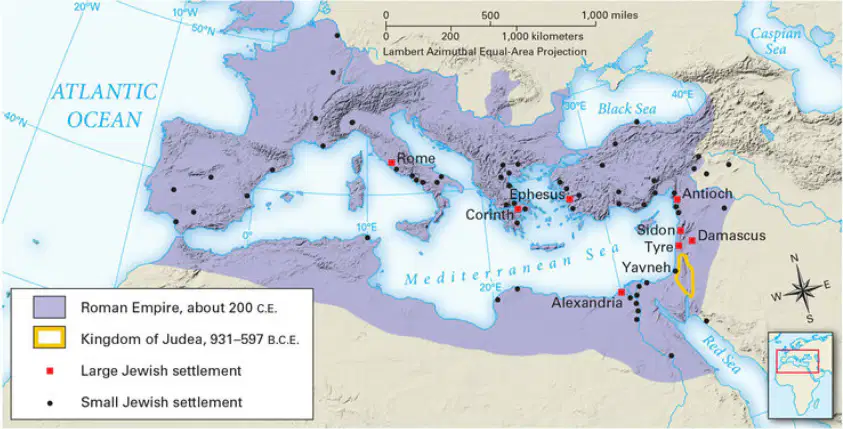
Refer to the map of the Jewish Diaspora in the Roman Empire about 200 C.E. Which statement best defines the term Diaspora as used in this context?
The rebuilding of the Temple in Jerusalem
The scattering of a people from their homeland to many places
The conversion of the Roman Empire to Judaism
The creation of a single Jewish kingdom across the Mediterranean
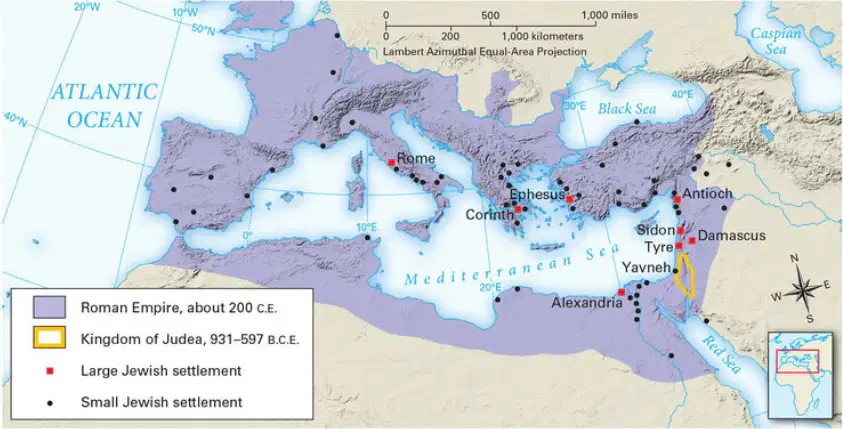
Using the map, which regions clearly had Jewish communities by about 200 C.E.? Select all that apply.
North Africa along the Mediterranean coast, including Alexandria
The Italian Peninsula around cities like Rome
Northern Scandinavia beyond the Roman frontier
The eastern Mediterranean near cities such as Antioch and Damascus

According to the map and caption, what historical developments most directly explain why Jewish settlements were spread across the Roman Empire by 200 C.E.?
Voluntary migration for trade after Rome adopted Judaism as the state religion
Military defeats and exile under empires such as the Babylonians and Romans
Peace treaties that relocated Roman citizens to Judea
Natural disasters that depopulated the Italian Peninsula
According to the Torah, which event marks Moses leading the Israelites to receive God's laws that became the basis of Judaism?
Crossing the Jordan River into Canaan
Receiving the laws at Mount Sinai, including the Ten Commandments
Building the First Temple in Jerusalem
Crowning King David as ruler of Israel

Which statement best explains the historical significance of the First Temple built by King Solomon?
It was the first synagogue used during the Diaspora.
It served as a center of worship and national identity for ancient Israel until its destruction.
It housed the complete Talmud compiled by early rabbis.
It was originally constructed by the Babylonians and later adopted by Israelites.
Place emphasis on the role of early Israelite kings: Which pairing correctly matches the king with his contribution?
Saul made Jerusalem the capital; David built the First Temple.
David united the tribes and made Jerusalem the capital; Solomon built the First Temple.
Solomon united the tribes; Saul built the First Temple.
David led the Exodus; Solomon received the Ten Commandments.
Which sequence accurately reflects major political events affecting ancient Israel and Judah?
Israel and Judah unite; Romans conquer; Assyrians exile the north.
Israel splits into Israel and Judah; Assyrians conquer Israel; Babylonians take Jerusalem and exile many Jews.
Babylonians conquer Israel; Assyrians destroy Jerusalem; Romans rebuild the Temple.
Romans create the Diaspora; Assyrians rebuild Israel; Babylonians restore the monarchy.
MSQ: According to Jewish tradition described, which factors helped preserve Judaism during and after the Babylonian exile? Select all that apply.
Writing down sacred texts that had been oral traditions
Establishing synagogues and replacing Temple sacrifices with prayers
Centralizing all worship only in Jerusalem
Teachings preserved and discussed by rabbis and sages
Which text pair forms the foundation of Jewish religious practices and ethical values?
The Mishnah and the Dead Sea Scrolls
The Hebrew Bible and the Qur'an
The Talmud together with the Hebrew Bible
The New Testament and the Torah
What is the central idea introduced by the first commandment in Judaism?
Polytheism was common and accepted among Israelites.
Monotheism: worship of only one God, with no other gods before God.
Ancestor worship as part of daily rituals.
Veneration of many spirits alongside God.
MSQ: Which of the following are ethical or moral teachings emphasized in the Torah? Select all that apply.
Honor your father and mother
Approval of stealing if for survival
Prohibitions against lying and murdering
Responsibility to serve as an example to others by living God's teachings
What does the Sabbath require according to Jewish commandments?
A monthly fast at the new moon
A yearly pilgrimage to Jerusalem
Setting aside a holy day each week for rest and prayer
Daily animal sacrifices at the Temple
How did the Jewish Diaspora contribute to the spread of Judaism's ideas?
By ending the use of sacred texts outside Israel
By forcing Jews to abandon practices such as studying the Torah
By carrying sacred texts to new communities and forming strong communities that preserved traditions
By preventing the establishment of synagogues in foreign lands
MSQ: According to the section on spread and influence, which broader world traditions or values were shaped by Jewish ideas? Select all that apply.
Development of Christianity and Islam through monotheism
Concepts of equal rights and democratic freedoms
Belief that law is unnecessary for moral life
Emphasis on rule of law, fair trials, and human rights
Which statement best summarizes how Judaism adapted to survive outside the Land of Israel?
Temple priests expanded sacrifices across the empire to replace prayer.
Rabbis and synagogues replaced Temple-centered worship, making Judaism a portable religion.
Kings centralized worship more tightly in Jerusalem to ensure uniformity.
Jews abandoned observance of the Sabbath to avoid persecution.

According to the text, what does the New Testament say happened to Jesus in the Roman-ruled province of Judea, and what symbol became important to Christians as a result?
He was exiled to Egypt; the Star of David became important
He was executed by crucifixion; the cross became important
He was crowned king; the olive branch became important
He was imprisoned for life; the fish became important
Identify the region described as the birthplace of Christianity and how the Romans referred to it.
The western Mediterranean coast, called Galilee by the Romans
The Nile delta, called Egypt by the Romans
A remote territory at the eastern end of the Mediterranean Sea, called Judea by the Romans
The Tigris-Euphrates valley, called Babylon by the Romans
Which statement best describes the religious background of the first Christians and beliefs they maintained?
They were mainly Greeks who worshipped many gods and rejected the Hebrew Bible
They were Jews who worshipped one God, cared for the needy, recognized Abraham as a prophet, and honored the Hebrew Bible
They were Romans who believed emperors were divine and ignored Jewish prophets
They were Egyptians who practiced mummification and followed the Book of the Dead
Select the statements that reflect Jesus’s core teachings as presented in the section. Choose all that apply.
God is merciful and loving
People should love God and their neighbors
Sins cannot be forgiven
Living according to God’s will brings forgiveness and relief from suffering
Who were the apostles in the early Christian movement, according to the passage?
Roman officials who protected Jesus during Passover
Twelve special disciples tasked with spreading Jesus’s message
Jewish priests who wrote the Hebrew Bible
Greek scholars who translated the New Testament
Which event is described as Jesus’s final meal with his disciples before his arrest?
The Sermon on the Mount
The Feast of Tabernacles
The Last Supper
Pentecost
Based on the sequence of events in Jerusalem, which action directly led to Jesus’s arrest?
Roman soldiers recognized Jesus during the festival
A disciple named Judas reported where Jesus could be found after he went to pray
Jesus preached to crowds in the temple for seven days
The apostles challenged Roman rule at the city gates
Why did some people begin calling Jesus the Messiah, and what does the title Christ signify in the passage?
Because he defeated Rome in battle; Christ means ‘teacher’ in Latin
Because he performed miracles and taught love; Christ means ‘savior’ in Hebrew
Because he was chosen by God to save humankind; Christ is the Greek term for ‘Messiah’ or ‘anointed one’
Because he rebuilt the temple; Christ means ‘prophet’ in Aramaic
According to Christian belief described here, what event is called the Resurrection?
Jesus’s birth in Bethlehem
Jesus rising from the dead three days after his death
Jesus’s final meal with his disciples
Jesus ascending to heaven 40 days after his resurrection
Which sequence of events is reported in the New Testament after Jesus’s crucifixion?
Jesus’s body is burned, then he appears to the Romans, then he is crowned emperor
Jesus is placed in a tomb, rises from the dead after three days, and appears to his disciples
Jesus flees the empire, forms a new army, and returns to Jerusalem
Jesus is tried by Jewish leaders, exiled to Persia, and later returns to Rome
Which statement best explains what the Resurrection meant to early Christians?
It proved Jesus was a military leader sent to defeat Rome
It showed Jesus was a holy savior and Messiah who offered entry into the Kingdom of God
It confirmed that Jesus would write the New Testament himself
It signaled the immediate end of Roman rule over Judea
Which role did Paul play in the early spread of Christianity, according to the passage?
He became emperor of Rome and established Christianity as the state religion
He was named an apostle after Jesus’s death and helped bring non-Jews into the faith
He wrote all four Gospels that form the New Testament
He organized the Roman Catholic Church during the Middle Ages
What are the two parts of the Christian Bible and how are they characterized in this text?
Old Testament: Hebrew Bible recognized as God’s word
New Testament: collection of stories and teachings by people who knew Jesus or played early roles
Book of Mormon: accounts of American prophets
Apocrypha: the official law code of the Roman Empire
Which belief defines the Trinity in Christian doctrine as summarized here?
God exists as one being with no distinct persons
God consists of the Father, the Son (Jesus), and the Holy Spirit in a union of three beings in one
God is represented only by Jesus with no other divine presence
God is an impersonal force without involvement in the world
What do Christians believe about salvation, based on this description?
God can save people from sin and grant everlasting life after death
Salvation depends on God’s grace, a gift of love and assistance that forgives sins
Salvation is reserved only for clergy and rulers
This gift is open to those who believe in Jesus and ask for God’s forgiveness
Which practices are identified as sacraments in Christian worship in this text?
Baptism, which makes a person a member of the Christian church
Holy Communion, symbolic sharing of bread and wine reflecting Jesus’s final meal
Daily fasting during summer months
Pilgrimage to Rome as a requirement for all believers
Which holidays are said to celebrate key events in Jesus’s life as described here?
Passover and Hanukkah
Christmas and Easter
Diwali and Holi
Ramadan and Eid al-Fitr
By the first century C.E., where had Christianity spread according to the passage, and how did it continue expanding in later centuries?
Across many parts of the Roman Empire by the first century C.E.
To Persia, China, and India in later centuries through missionary work
Only within Judea, with little spread beyond
Exclusively to Europe after the Middle Ages
Which statement accurately reflects how Christianity’s spread and influence interacted with local cultures and power, based on this text?
Conversion was always peaceful and never involved resistance
Missionaries sometimes adapted Christian beliefs to local traditions, such as in Latin America
Rulers have at times depended on Christian churches to gain and hold power
Christian ethics have influenced law codes and charity efforts in many countries
Refer to the described photo of an Easter Week procession in Oaxaca, Mexico. What does this visual exemplify about Christianity’s global spread and adaptation?
Christianity remained unchanged everywhere and prohibited public rituals
Christian practices in Latin America were adapted to indigenous cultures, reflecting missionary spread by Europeans
Christianity originated in Mexico and expanded to Europe from there
Public religious processions are unique to Europe and not found elsewhere
According to the passage, what does the Arabic word Islam mean?
Peace
To submit
Divine wisdom
Sacred law
Which city on the Arabian Peninsula was Muhammad’s birthplace and an important trade and religious center with the Ka'bah shrine?
Medina
Jerusalem
Mecca (Makkah)
Damascus
Select the statements that describe early events in Muhammad’s life as presented in the passage.
His uncle Abu Talib watched over him after his mother’s death.
He became a merchant after joining trading expeditions at age 12.
He first preached in Medina around 610 C.E.
An angel revealed the word of Allah to him while he was meditating in a cave.
Which development occurred by 630 C.E. according to the passage?
Muslims established Islam as the dominant faith of Arabia by retaking Mecca.
Muhammad traveled to Medina for the first time.
Islam spread to Spain and India.
The Ka'bah was built as a new shrine.
Identify the primary reason many local leaders in Mecca persecuted Muslims, based on the text.
They feared a decline in trade due to new taxes.
They saw Islam as a threat to their power and prestige.
They disagreed with the language used in the Qur'an.
They were ordered by foreign rulers to suppress new religions.
According to the passage, what do Muslims believe about the Qur’an?
It is a historical account written after Muhammad’s death.
It contains the word of God as revealed to Muhammad.
It is a collection of laws created by early caliphs.
It is a commentary on earlier scriptures only.
Use the information provided to determine where the largest populations of Muslims are mostly located today.
Western Europe and South America
Central Asia, Indonesia, the Middle East, and North Africa
North America and Oceania
Eastern Europe and East Asia
Which sequence best reflects the early expansion of Islam described in the text?
Birth in Medina → Preaching in Mecca → Migration to Damascus → Conquest of Jerusalem
Preaching in Mecca → Persecution → Migration to Medina (622) → Retaking Mecca (630)
Revelation in Jerusalem → Migration to Mecca → Establishment in Medina → Spread to India
Founding in Mecca → Immediate spread to Spain → Return to Medina → Building the Ka'bah

From the image caption and the passage, what is the central role of the book shown being read by children?
It records local trade agreements from Mecca.
It is considered by Muslims to be the word of God and is central to belief and practices.
It is a biography of Abu Talib used in schools.
It is a list of tribal laws followed in the Ka'bah.
Recall: Which statement best expresses the shahadah, the first pillar of Islam?
“There is no god but God and Muhammad is his prophet.”
“Pray five times a day at dawn, noon, mid-afternoon, sunset, and nightfall.”
“Give at least 2.5 percent of yearly surplus wealth to the needy.”
“Fast during daylight hours for the month of Ramadan.”
Skill/Concept: What practice is required by salat, the second pillar of Islam?
Making a pilgrimage to Mecca once a lifetime
Daily ritual prayer performed five times a day
Fasting during the ninth month of the Muslim calendar
Publicly declaring the oneness of God annually
Recall: According to the text, what is the minimum portion of surplus wealth Muslims are supposed to give as zakat each year?
1 percent
2.5 percent
5 percent
10 percent
Skill/Concept: Which options correctly pair a pillar with its main purpose or practice? Select all that apply.
Siyam — fasting during daylight hours in Ramadan to encourage self-control and faith
Hajj — a pilgrimage in the twelfth month that promotes fellowship and equality
Salat — giving charity to the less fortunate to share wealth
Shahadah — daily prayers conducted at a mosque only
Strategic Thinking: A student says, “Muslims must perform salat only inside a mosque.” Based on the material, what is the best evaluation of this claim?
Accurate, because the Qur'an restricts prayer to mosques
Accurate, because prayers require a congregation and imam
Inaccurate, because prayer can take place at a mosque but can be performed anywhere
Inaccurate, because salat is performed only during Ramadan
Recall: What is the Sunnah, as described in the passage?
Islamic holy law based on the Qur'an alone
The example Muhammad set, recorded in Hadith describing his actions and teachings
The annual fast undertaken by all Muslims
The pilgrimage route to the Ka'bah in Mecca
Skill/Concept: Which statement best summarizes Islam’s historical spread and influence described in the text?
It remained confined to the Arabian Peninsula and parts of North Africa
It spread across South Asia, Indonesia, Turkey, the Balkans, and along Africa’s east coast and interior, influencing culture, society, and politics
It expanded only through peaceful trade with no conflicts or missionary activity
It grew primarily in Europe and the Americas during the early centuries
Strategic Thinking: Consider shari'ah as explained in the passage. Which interpretation aligns with the text?
Shari'ah is a fixed medieval code applied fully in all Muslim countries without change
Shari'ah is Islamic law based on the Qur'an and Sunnah that guides many aspects of life and continues to develop in response to modern challenges
Shari'ah is a purely spiritual guideline with no impact on areas like finance or education
Shari'ah is a European legal tradition adopted by some Muslim rulers
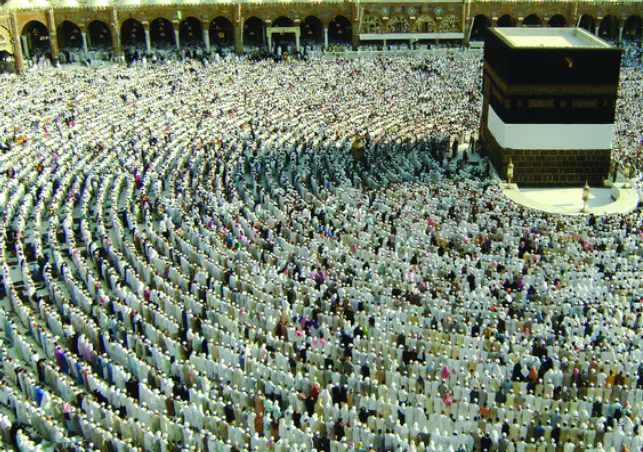
Visual analysis: Refer to the image showing thousands of pilgrims encircling the Ka'bah at the Great Mosque in Mecca. What pillar does this scene depict, and what is its encouragement to Muslims?
Siyam; to fast during the ninth month
Hajj; to undertake a pilgrimage to Mecca at least once in a lifetime
Zakat; to donate food to travelers
Salat; to pray only at the Ka'bah
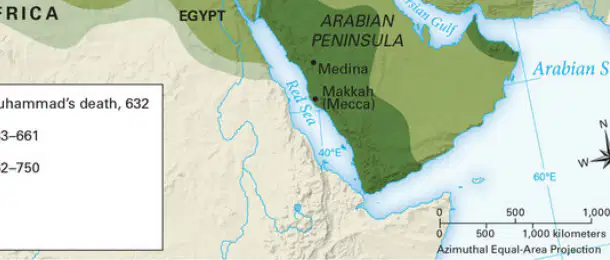
Refer to the map of “The Expansion of Islam, 632–750 C.E.” Which region was already under Islamic control at the time of Muhammad’s death in 632 C.E.?
The Iberian Peninsula (Spain)
The Arabian Peninsula around Makkah and Medina
Gaul near Tours in France
The city of Rome and central Italy

According to the caption accompanying the expansion map, how did Muslim armies typically approach conversion in newly conquered lands between 632 and 750 C.E.? Select all that apply.
They usually forced conquered peoples to convert immediately.
They continued to spread Islam through the lands they conquered.
Over time, most people in these lands converted to Islam.
Which statement best describes Hinduism as introduced in the text?
It is a recent religion confined mainly to one part of India.
It developed over thousands of years and is the third largest religion in the world.
It began in Persia and primarily influenced Middle Eastern diets.
It is influential only in religious rituals and not in arts or exercise.
Based on the description provided, which impacts are attributed to Hinduism on Indian life and beyond? Select all that apply.
Shaping diets and forms of exercise within India
Inspiring art and literatures
Having little influence on global leaders and thinkers
Spreading only within India without reaching other parts of the world
According to the text, which region is identified as the earliest area where Hinduism began before spreading throughout India?
The Indus River Valley
The Ganges Delta
The Himalayan foothills
The Deccan Plateau
Which group of people is described as entering India in the second millennium B.C.E. or earlier and bringing gods and rituals that influenced the development of Hinduism?
Dravidians
Aryans
Mauryans
Guptas
What are the Vedas described as in the passage?
A single epic poem recounting the lives of Hindu saints
A collection of sacred literature with verses, hymns, prayers, and teachings
A historical chronicle of Indian kings and battles
A philosophical treatise written by one founder
Which language is highlighted as the language in which Vedic teachings were eventually recorded after being passed down orally?
Pali
Hindi
Sanskrit
Prakrit
Which roles are attributed to Brahmins within Vedic practice, according to the text? Select all that apply.
Performing rituals to honor deities
Interpreting the Vedas and teaching their meaning
Serving as rulers who enforced Vedic law
Writing the Upanishads as government decrees
What shift in religious practice occurred sometime after 1000 B.C.E., as described in the passage?
A complete rejection of the Vedas in favor of new scriptures
An emphasis on meditation and other spiritual practices for deeper personal experience
A movement to abolish all rituals and temples
The replacement of Brahmins with elected officials
Which statement best explains the significance of the Upanishads within Hinduism, based on the passage?
They are the earliest hymns praising nature spirits
They express ideas about meditation and deeper personal religious experience found in the last book of the Vedas
They are legal codes governing social behavior
They are folk tales collected from various regions
Which concept describes the belief in one divine force that manifests in many deities, as presented in the text?
Polytheism
Dualism
Monism
Animism

In the image of the elaborately decorated temple, what idea from the text does the visual support?
Hinduism is strictly monotheistic with no deities
Hinduism is polytheistic, with worship of multiple gods and goddesses
Hinduism forbids temple decoration
Hinduism recognizes only one temple style
Which statement best summarizes Hindu beliefs about time and existence described in the passage?
Time progresses linearly from creation to end without repetition
Events repeat in a great cycle; birth, life, and death recur
Time pauses during religious festivals
Souls exist only once without change
Which pair of concepts are identified as key elements of Hindu belief alongside reincarnation?
Yoga and meditation
Dharma and karma
Bhakti and jnana
Moksha and samsara
According to the passage, what is the ultimate goal for many devout Hindus? Select all that apply.
To escape reincarnation entirely
To attain moksha, merging the soul with Brahman
To accumulate wealth through ritual offerings
To become Brahmins who interpret the Vedas
According to the section, which statement best explains why Hinduism is strongly linked to Indian culture?
It spread primarily through conquest beyond South Asia.
It did not initially spread far beyond its land of origin.
It originated outside India and later moved in.
It required centralized empires to expand widely.
Which development occurred during the medieval period and influenced Hindu society?
Temples were abandoned in favor of outdoor worship.
Hindus began focusing devotion on specific deities, forming sects.
Scriptural study was discouraged.
Pilgrimages were banned by regional rulers.
Select all features that characterized devotional worship in the sects that formed during the medieval period.
Prayers and poetry directed to a chosen deity
Devotional music and stories
Exclusive use of temporary wooden temples
Rejection of scriptural study
Which empire is noted for following Shaivism and building temples devoted to Shiva throughout its kingdom?
Maurya Empire
Gupta Empire
Chola Empire
Mughal Empire
What was a key emphasis of the Bhakti movement described in the section?
Strict adherence to caste rules over personal devotion
Personal expressions of devotion to a personal deity
Military defense of temples and holy sites
Replacing poetry with ritual sacrifices
Which statements about Meera Bai are supported by the section? Select all that apply.
She was a prominent female poet-saint associated with Bhakti.
She renounced devotion to Krishna to avoid persecution.
Her devotional songs are still read and revered today.
She was known for promoting social and spiritual equality.
How did Hindu beliefs and customs spread beyond India according to the section?
Through trade and migration, blending with local traditions in Southeast Asia
By forced conversions during colonial rule
Only via pilgrims traveling to the Ganges River
By a single central authority sending missionaries worldwide
Which statement best describes Hinduism’s global following today as presented in the section?
It has fewer than 100 million followers, mostly in Europe.
It numbers around 900 million followers, most located in South Asia.
It is primarily confined to India with no global presence.
It has over 2 billion followers worldwide.
According to the passage, what major realization led Siddhartha Gautama to leave his comfortable life in search of a greater truth?
He wished to conquer neighboring kingdoms for his family
He was shocked by the reality of poverty, disease, and death
He wanted to study the Vedas with Hindu priests
He sought to become the richest merchant in northern India
Place the following in order based on the account of Siddhartha Gautama’s path to enlightenment: 1) Years of extreme ascetic practices, 2) Decision to pursue the Middle Way, 3) Meditation under the bodhi tree, 4) Attainment of nirvana and becoming the Buddha.
1 → 2 → 3 → 4
2 → 1 → 3 → 4
1 → 3 → 2 → 4
2 → 3 → 1 → 4
Which statement best defines nirvana as described in the text?
A temporary state of joyful emotion achieved through wealth
A state of happiness and peace reached through enlightenment
A title given to royal ascetics who renounce power
A ritual practiced exclusively by monks under sacred trees
The Buddha’s Middle Way is described as a path between which two extremes?
Power and poverty
Pleasure and pain
Ignorance and knowledge
Wealth and charity
Which of the following are included in the Eightfold Path guidelines listed in the passage? Select all that apply.
Right understanding
Right conquest
Right speech
Right livelihood
Right indulgence
According to the First Noble Truth, what should a Buddhist recognize about human experience?
Suffering is present in all things, and nothing lasts forever
Suffering occurs only when people ignore karma
Suffering can be avoided through wealth and status
Suffering is caused by punishment from the gods
What is identified as the cause of suffering in the Second Noble Truth?
Ignorance of sacred rituals
Desire for pleasure, power, or possessions
Failure to meditate daily
Attachment to family lineage
A student claims: “Eliminating desire is central to ending suffering in Buddhism, and one practices this by following specific ethical and mental disciplines.” Which elements from the passage best support this claim? Select all that apply.
Third Noble Truth: Removing desire removes suffering
Fourth Noble Truth: Follow the Eightfold Path to remove desire
Right action: Do not kill, steal, lie, or hurt others
Right concentration: Focus your mind with practices such as meditation
According to Buddhist teachings, what core idea explains why the Eightfold Path is needed? Choose the best answer.
All things change, so pleasure fades and suffering follows when it is gone
Human suffering is caused only by political oppression and can be ended through laws
Material wealth guarantees lasting happiness and removes suffering
Miracles performed by holy figures permanently eliminate suffering
Which statement best describes the purpose of the Eightfold Path as presented in the section?
A set of rituals meant to gain material blessings
A way to end suffering and find peace by following the middle way
A code of laws used to govern Buddhist kingdoms
A pilgrimage route across Asia for monks
Select all developments that contributed to the early spread of Buddhism beyond India.
Missionaries and traders carried Buddhist ideas across South Asia and beyond
Emperor Ashoka helped popularize Buddhism in the 200s B.C.E.
Hinduism disappeared from India, leaving Buddhism unchallenged
Buddhist monasteries were banned throughout Asia
Where did Buddhism become the leading faith after its spread from India, according to the section?
Western Europe and North Africa
Southeast Asia, Central Asia, and China
Arabian Peninsula and East Africa
North America and Oceania
Which description correctly pairs a Buddhist branch with its regional development and emphasis?
Theravada—developed in northern Asia; embraced newer ideas
Mahayana—thrived in southern Asia; represented the most traditional style
Theravada—thrived in southern Asia; represented a more traditional style
Mahayana—developed in southern Asia; focused on strict monastic rules
Choose the statements that accurately describe how Buddhism adapted and influenced societies as it expanded.
It took on new forms by adapting to local customs and traditions
Zen Buddhism in Japan emerged from a form of Chinese Buddhism emphasizing inner peace and meditation
Chinese rulers permanently abolished Buddhism in 845 C.E., ending its growth across Asia
Monasteries promoted study and spread of Buddhist thought, influencing society and government
Which development illustrates both the growth and challenges of Buddhist institutions in Asia?
Monasteries remained small and avoided donations to prevent influence
Many monasteries became wealthy through donations, prompting a crackdown by Chinese rulers in 845 C.E.
Monasteries focused solely on agriculture and ignored religious study
Rulers across Asia universally increased monastery funding without restriction
Based on the section, what is a global indicator of Buddhism’s contemporary presence?
It is the world’s largest religion with over a billion followers
It is the fourth largest religion worldwide with about 350 million followers
It is practiced only in East Asia with a few hundred thousand adherents
It has no influence on social or political movements today

Refer to the photo caption: What commitments characterize Buddhist monastic life as described?
Renouncing worldly possessions and dedicating life to contemplation
Living according to Buddhist principles and striving to fulfill the Four Noble Truths and the Eightfold Path
Accumulating wealth to support missionary travel
Practicing non-Buddhist rituals to connect with local traditions
Reasoning with evidence: Why did Mahayana gain distinct features compared to Theravada as Buddhism spread? Use the section’s explanation to select the best-supported answer.
Mahayana leaders rejected all previous Buddhist ideas to attract rulers
It developed in northern Asia and embraced newer ideas as Buddhism adapted to local customs and traditions
Theravada forced Mahayana followers to move north, where they lost core teachings
Mahayana relied solely on trade networks and avoided monasteries

Refer to the map titled “The Spread of Buddhism.” According to the caption, where did Buddhism begin before spreading across southern Asia?
Northern India
Persia
Korea
Japan
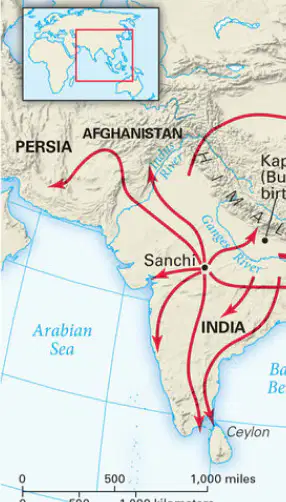
Using the map of the spread of Buddhism, which combination of factors shown or described best explains how Buddhism expanded beyond the Mauryan Empire? Select all that apply.
Imperial support by Ashoka
Buddhist missionaries traveling along routes
Exclusive practice within a single city
Traders moving across seas and land routes

Based on the mapped routes, which destination most plausibly required maritime travel from India for Buddhism to reach it?
Java
Afghanistan
Kapilavastu (Buddha’s birthplace)
Persia
According to the passage, Confucianism in China was primarily viewed as which of the following?
A religion centered on worship rituals
A philosophy and way of life that became an official faith
A legal code enforced by emperors
A military doctrine for unifying warring states
Which statement best identifies Confucius’s historical context and lifespan as described in the text?
He lived during the Han Dynasty from 206 B.C.E. to 220 C.E.
He lived around 551 to 479 B.C.E., the same era as the Buddha
He lived during the Tang Dynasty from 618 to 907 C.E.
He lived in the Song Dynasty from 960 to 1279 C.E.
Select the ideas that Confucius believed would help restore social order, based on the passage.
Reviving traditional Chinese culture and literature
Rulers governing wisely with good character
Expanding worship rituals over civic duties
Government officials serving honestly and fairly
What did many Chinese interpret civil wars and the loss of central control to mean during Confucius’s time?
That the Mandate of Heaven had been withdrawn from the ruler
That foreign invaders had conquered all of China
That Confucius supported the uprising of local lords
That heavenly spirits demanded more temple offerings
Which description best matches the Mandate of Heaven as explained in the passage?
A formal legal contract between ruler and nobles
A belief that heaven supports a ruler who governs well and withdraws support from a poor ruler
A ritual in which ancestors choose the next emperor
A military alliance among Chinese states sanctioned by priests
Based on the passage, which actions did Confucius take in pursuit of his teachings?
Held several minor government positions in Lu
Left Lu in his fifties to seek a wise ruler who would apply his ideas
Won broad official support early in his career
Continued to study and teach until his death at age 73
Why did Confucius honor traditional Chinese beliefs about gods and ancestor spirits while focusing on human society?
He denied the existence of spirits and gods entirely
He believed his teachings came from heaven but argued that understanding life and serving humanity should come before understanding death and serving spirits
He thought ancestor worship alone would solve social disorder
He sought to replace all religious practices with legal punishments
Using evidence from the passage, which outcome best captures Confucius’s legacy after his lifetime?
His ideas faded quickly due to lack of followers
His teachings gained favor after his death and profoundly impacted Chinese life
His philosophy was banned by later dynasties
His influence remained limited to the small state of Lu
Recall: According to the text, what virtue did Confucius describe as the most important, meaning “benevolence” or “humanity”?
Li
Ren
Dao
Filial piety
Recall: Which statement best reflects Confucius’s version of the Golden Rule as presented in the passage?
Always obey your elders without question.
What you do not want done to yourself, do not do to others.
People should seek wealth and power to improve society.
Heaven rewards those who fight bravely in war.
Recall: Which pair is listed among Confucianism’s five basic relationships?
Merchant and customer
Parent and child
Teacher and student
General and soldier
Skill/Concept: Which actions best demonstrate filial piety as Confucius described it? Select TWO.
Children showing respect and care for their parents
Parents setting a kind and wise example
Subjects rebelling against unjust rulers
Friends competing to gain higher status
Skill/Concept: Based on the passage, which roles have the responsibility to set a good example under Confucianism?
People in authority, such as parents and rulers
Only scholars who study the Analects
Younger siblings and friends
Merchants and artisans
Strategic Thinking: A local leader wants to reduce conflict in a community. Which policy best aligns with Confucius’s guidance for building a harmonious society?
Encourage citizens to compete for status and privilege
Require people to follow ethical guidelines that promote respect and kindness
Prioritize military training over moral education
Allow each group to treat others according to their own customs only
Strategic Thinking: A student argues that social categories in Confucianism mean some people deserve no respect. Using evidence from the passage, what is the best evaluation of this claim?
Accurate, because only rulers deserve respect
Inaccurate, because Confucius urged respect for all people even while emphasizing roles
Accurate, because Confucius valued strength over virtue
Inaccurate, because Confucianism rejects all forms of authority

Visual analysis: Look at the image of the temple described as a place where emperors and civil servants studied Confucian philosophy. What does this suggest about Confucianism’s role in government?
It had little influence on rulers or officials.
It was central enough to be studied by those who governed.
It was only practiced by commoners in rural areas.
It was forbidden in official spaces.

