
 Worksheets
Year 7 Chemistry Revision Quiz
Total questions: 90
Worksheet time: 1hrs 8mins
The three states of matter are solid, liquid, and (a) .
The particles in all matter are always moving due to the (a) they contain.
What is the relationship between energy and the movement of particles in matter?
More energy means faster particles
More energy means slower particles
Energy does not affect particle movement
Particles stop moving with more energy

Identify an example of each of the three states of matter present when the candle is burning.
Solid
The hard wax of the candle
Liquid
The melting wax
Gas
The fire/flame
Drag and drop the states of matter with the correct picture
Liquid
Solid
Gas
Why is it important to understand the different states of matter in science?
Because it helps us understand how materials behave and interact
Because it is only useful for chemists
Because it is not relevant to everyday life
Because matter never changes its state
Which state of matter has particles that are farthest apart?
Solid
Liquid
Gas
Plasma
Fill in the blank: The Greek philosopher who proposed that matter is made up of indivisible particles called 'atomos' was (a) .
According to Dalton's atomic theory, how do atoms of different elements compare to each other?
They are identical.
They are different from atoms of other elements.
They cannot combine to form compounds.
They are always heavier than atoms of hydrogen.
Which of the following are part of John Dalton's atomic theory?
Atoms can be created or destroyed.
All atoms of the same element are identical.
Atoms combine to form compounds in simple whole number ratios.
Atoms lose their identity when forming compounds.
Particles are too small to be (a) .
Which of the following are true according to the particle model?
Particles have mass.
Particles are always moving.
Particles can join to make larger particles.
Particles are visible to the naked eye.
Which statement best explains why particles move faster when it is hotter?
Because heat increases the energy of particles.
Because particles lose mass when heated.
Because forces between particles disappear when heated.
Because particles become visible when heated.
Which statement best describes the particle model of matter?
All matter is made up of atoms.
All matter is made up of particles that are always moving.
Matter is made up of molecules that never move.
Matter is made up of energy.
Select all correct statements about the kinetic theory of matter.
Particles are always moving.
Particles move slower when heated.
Kinetic energy is the energy of moving particles.
All matter is made up of particles.
The faster particles move, the more (a) energy they have.
Which state of matter has particles with the highest amount of kinetic energy?
Solid
Liquid
Gas
Plasma
Match each state of matter with the speed of diffusion that occurs in it.
Diffusion occurs fastest in solids.
Diffusion in solids
Diffusion occurs fastest in liquids.
Diffusion in liquids
Diffusion occurs fastest in gases.
Diffusion in gases
Diffusion does not occur in any state of matter.
Diffusion in all states of matter
Diffusion in liquids is (a) compared to diffusion in gases.
Tensile strength is a measure of the flexibility of the (a) between particles.
Which of the following statements best explains why a hard substance may still shatter easily?
Because hardness is not the same as strength; a hard substance can be brittle.
Because hard substances have weak forces between particles.
Because hard substances always have high melting points.
Because hard substances are always flexible.
Which of the following liquids is likely to have the highest viscosity?
Honey
Water
Engine oil
Milk
Which of the following substances can be compressed most easily?
Air
Water
Iron
Oil
Select all the properties that are affected by the density of a substance.
Ability to float
Heaviness
Number of particles
Viscosity
Objects with lower density float on liquids if the liquid has a (a) density.
Which state of matter has the highest density and why?
Solids, because particles are closely packed
Liquids, because particles can flow
Gases, because particles move freely
Solids, because particles have high energy
Gases have (a) particle energy compared to solids.
Which of the following properties are true for solids?
High particle density
Low particle energy
High chemical bond strength
Free movement
When heat is removed from matter, the particles move (a) together.
Which of the following statements best explains what happens to particles when matter is heated?
Particles move slower and stay closer together.
Particles move faster and spread apart.
Particles stop moving completely.
Particles change color.
Which of the following changes of state involve adding heat?
Melting
Condensation
Freezing
Evaporation
Which of the following statements best describes what happens to particles when heat is added?
Particles move faster and spread apart.
Particles move slower and come closer together.
Particles stop moving completely.
Particles change into a different substance.
The temperature at which a substance turns from liquid to gas is called its (a) point.
How does heating matter affect the kinetic energy of its particles?
It increases the kinetic energy of the particles.
It decreases the kinetic energy of the particles.
It has no effect on the kinetic energy of the particles.
It turns all particles into solids.

_________ particles are shown in this image
Solid
Liquid
Gas
Plasma

__________ particles are shown in this image
Solid
Liquid
Gas
Plasma

__________ particles are shown in this image
Solid
Liquid
Gas
Plasma
Solids and liquids are incompressible because
Stronger forces means that particles are closer together and can't be moved
The particles vibrate therefore can't be broken
Humans aren't strong enough to break them
Weaker forces means that particles are closer together and can't be moved
Liquids and gases spread to fill their container because
They are both compressible
The particles can move
There are large spaces between particles
Both have strong forces which allow particles to flow
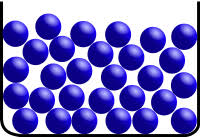
Which description best matches this particle model?
Closely packed and can't move a lot.
Particles are close together but can move a little.
Particles have lots of energy and can move around.
Kinetic energy is...
energy carried in ultraviolet waves
energy stored in food
energy in motion
energy from splitting an atom
Gas to liquid is
Condensation
sublimation
deposition
evaporation
Solid to Gas is
condensation
sublimation
evaporation
deposition
Liquid to solid is
freezing
Melting
Boiling
Steaming
Solid to a liquid is
freezing
boiling
steaming
melting
Liquid to a Gas is
Melting
evaporation
condensation
sublimation
How close together particles are is called?
Mass
Weight
Vibrate
Density
_________ particles are shown in this image
Solid
Liquid
Gas
Plasma
Diffusion occurs only in solids
True
False
Which of the following will diffuse the fastest?
A tablespoon of sugar in a glass of water
Heat through a solid piece of steel
A pinch of salt in a glass of water
The smell of bacon cooking throughout a room
What is Viscosity?
A fluids colour.
A fluids temperature.
A fluids resistance to flow.
Which of the following statements is true about liquids
Their volume is fixed and shape is fixed
Their volume is changeable, and shape is fixed
Their volume is fixed, and shape is changeable
Their volume is changeable, and shape is changeable
True or false: a solid can be compressed
True
False
The process where a solid turns into a gas is called...
Condensation
Sublimation
Evaporation
Deposition
Which state of matter has the highest density?
Solid
Liquid
Gas
When my water bottle in the freezer goes from a liquid state to a solid state, it is called (a) .
When my glass of water is sitting in the sun and disappears into a gas, it is called (a) .
My glass of ice water is sitting in the sun and has droplets of water on the outside of the glass. What is happening?
condensation
evaporating
melting
freezing

Which state of matter has molecules that slide past each other but stay close together?
They do not form a regular pattern.
solid
liquid
gas
semi-solid

At higher temperatures
particles in an object have less energy
particles in an object move faster
a gas contracts
none of the above

A gas
has a definite shape but no definite volume
has a definite volume but no definite shape
has fast-moving particles
none of the above
What are the states of matter?
solid, liquid, and juice
solid and liquid
solid and gas
solid, liquid, and gas
Which state of matter has particles that move the least/slowest?
solid
water
gas


Match the following processes with how materials change from one state of matter to another.
They gain or lose energy
Melting, freezing, evaporation, and condensation involve this change.
They break apart
This happens when chemical bonds are broken, not when changing states of matter.
The particles get stickier
This describes a process unrelated to state changes, but more to adhesives.
They are magnetised to themselves
This describes a process unrelated to state changes, but more to magnetism.
Solids and liquids are not compressible because (a) .
What is the term given to the temperature at which a solid turns into a liquid?
Boiling point
Melting point
Freezing point
Heating point
What is the term given to the temperature at which a liquid turns into a gas?
Boiling point
Melting point
Freezing point
Heating point
What is the term given to the temperature at which a liquid changes to a solid?
Melting point
Boiling point
Sublimation point
Freezing point
Define a liquid.
Not fixed shape, not fixed volume
Fixed shape, fixed volume
Found in stars
Fixed volume, not fixed shape
Which image shows particles in a solid?


Which image shows particles in a liquid?
Which image shows particles in a gas?
The particles in liquids move (a) each other.
The particles in gases are (a) apart and arranged in a random way.
The particles in gases are (a) to move in any direction.
everything is made up of (a)
Which process describes the change from liquid to solid?
Freezing
Melting
Evaporation
Sublimation
Why do gases have lower density compared to solids and liquids?
Because gas particles are heavier
Because gases are always cold
Because gas particles are far apart
Because gases have strong forces between particles
What happens to the arrangement of particles when a solid melts?
Particles form a regular pattern
Particles stop moving
Particles move further apart and can slide past each other
Particles become more closely packed
What is the process called when a gas changes directly into a solid?
Condensation
Melting
Evaporation
Deposition
Which state of matter takes the shape and volume of its container?
Liquid
Solid
Plasma
Gas
What happens to the particles in a liquid when it is cooled?
They change into gas
They stop moving completely
They move slower and come closer together
They move faster and spread apart
What property of gases allows them to fill any container completely?
Low temperature
Particles move freely and are far apart
Fixed shape
High density

