
 Worksheets
HVACR Technical Terms Quiz
Total questions: 30
Worksheet time: 15mins
What is the nominal size for copper water tubing equal to?
Outside diameter minus 1/8 inch
Inside diameter plus 1/4 inch
Outside diameter plus 1/8 inch
Inside diameter minus 1/4 inch
What is the purpose of purging ACR tubing immediately after cutting it from the coil?
To clean the tubing with water
To seal the tubing with gas
To keep the tubing clean and dry until use
To anneal the tubing
What is the purpose of annealing soft ACR tubing?
To make the tubing hard and brittle
To make the tubing soft and flexible for easy bending and flaring
To increase the tubing's diameter
To make the tubing resistant to corrosion
What is the correct procedure for annealing tubing?
Heat the tubing to a dull cherry red and allow it to cool slowly
Heat the tubing to a bright yellow and cool it rapidly
Heat the tubing to a dull cherry red and cool it rapidly
Heat the tubing to a bright yellow and allow it to cool slowly
What sizes of soft ACR tubing are most commonly used in HVACR work?
1/4" to 1/2"
3/16" to 3/4"
1/8" to 5/8"
1/2" to 1"
What is the difference between the nominal size of ACR tubing and copper water tubing?
ACR tubing's nominal size equals the outside diameter, while copper water tubing's nominal size equals the outside diameter minus 1/8"
Copper water tubing's nominal size equals the outside diameter, while ACR tubing's nominal size equals the outside diameter minus 1/8"
Both ACR tubing and copper water tubing have the same nominal size
Copper water tubing's nominal size equals the outside diameter plus 1/8"
What is the process called when soft ACR tubing is hardened by oxidation or repeated bending and hammering?
Annealing
Work hardening
Flaring
Brazing
What should be done after cutting soft ACR tubing to prevent contamination within the tubing?
Heat the tubing
Replace the cap or plug
Bend the tubing
Apply solder
What is the main characteristic of hard-drawn ACR tubing compared to soft ACR tubing?
It is more flexible
It is harder and stiffer
It has a smaller diameter
It is easier to bend
What is the minimum wall thickness of hard-drawn ACR tubing with a nominal size of 1/2 inch?
0.030 inches
0.032 inches
0.035 inches
0.040 inches
Why should hard-drawn ACR tubing not be bent?
It may crack under stress
It cannot be soldered
Flared connections cannot be used
It is too flexible
What type of tubing is commonly used in food processing and ice cream manufacturing due to its resistance to corrosion?
Aluminum tubing
Copper tubing
Stainless steel tubing
Hard-drawn ACR tubing
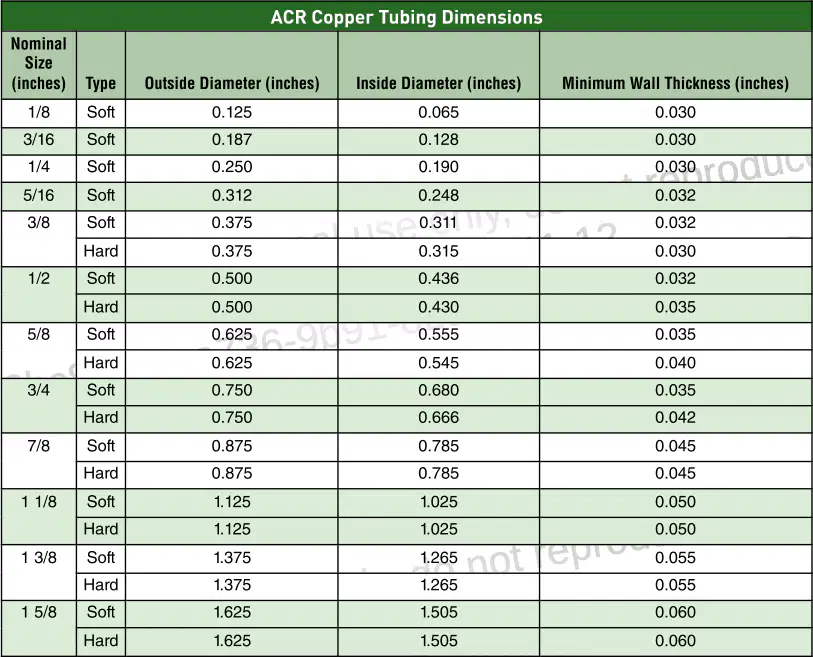
ACR Copper Tubing Dimensions table and diagram showing the size specifications for ACR tubing. Which of the following is a standard outside diameter for ACR copper tubing?
1/4 inch
3/8 inch
5/8 inch
1 inch
What is a common use of aluminum tubing in HVACR systems?
To form evaporators
To form condensers
To form water lines
To form gas lines
Why is tubing assembled or repaired using improper brazing techniques more likely to develop leaks?
It increases the strength of the tubing
It creates weak areas in the tubing or joints
It reduces vibration in the system
It improves heating and cooling cycles
Which materials are commonly used for non-refrigerant tubing and pipe in HVACR systems?
Copper, plastic, and various metals
Aluminum, steel, and rubber
Copper, rubber, and glass
Plastic, glass, and rubber
Why are neither copper water tubing nor plastic pipe suitable for circulating refrigerants in a mechanical refrigeration system?
They are too expensive
They cannot withstand high pressure
They are not compatible with refrigerants
They are prone to corrosion
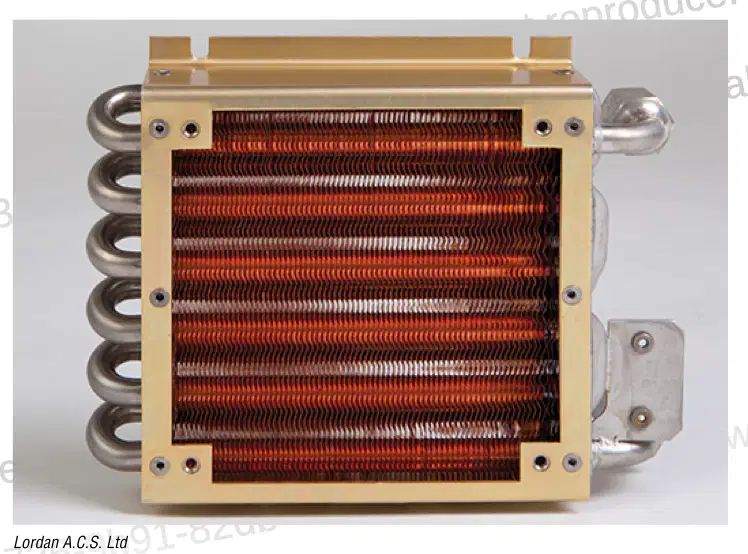
Image of stainless steel tubing bent for use as a special application cooling coil.
Stainless steel cooling coil
Copper water pipe
Plastic drainage tube
Aluminum exhaust pipe
What grades of copper water tubing are available?
Soft and hard-drawn grades
Flexible and rigid grades
Lightweight and heavy-duty grades
Coated and uncoated grades
What is the primary application of ACR tubing?
Refrigerant applications
Water applications
Gas applications
Electrical wiring
What does the letter "K" indicate in copper water tubing dimensions?
Medium wall thickness
Heavy wall thickness
Thin wall thickness
Flexible tubing
Which type of copper tubing is used where corrosion conditions are severe?
Type L
Type K
Type M
Type N
What is the minimum wall thickness of 3/4 inch Type K copper tubing?
0.035 inches
0.049 inches
0.065 inches
0.042 inches
What is a key advantage of plastic pipe over metal piping?
It is more expensive.
It is resistant to corrosion, scale, and rust.
It can circulate refrigerants.
It is heavier than metal piping.
What is the operating temperature range of ABS pipe?
-20°F to 120°F
-40°F to 180°F
0°F to 100°F
-50°F to 200°F
What does ABS stand for in ABS pipe?
Acrylonitrile-butadiene-styrene
Acrylonitrile-butadiene-silicon
Acrylonitrile-butadiene-sulfur
Acrylonitrile-butadiene-sodium

What is the recommended fitting size for copper water tubing?
Larger than the nominal size
Smaller than the nominal size
The same as the nominal size
Twice the nominal size
What is one of the key properties of PVC pipes?
Resistance to corrosion and chemical attack
High electrical conductivity
Low melting point
Brittle under pressure
Which color is typically associated with PVC plastic pipes?
White
Black
Blue
Green
PVC pipes are commonly used in which of the following applications?
Furnace exhaust applications
Electrical circuits
Food storage containers
Gasoline storage tanks

