
 Worksheets
Kuiz 5 - Topic 5
Total questions: 12
Worksheet time: 6mins
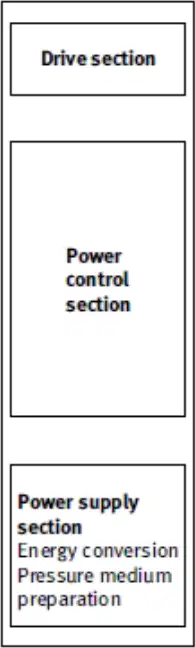
Look at the diagram of a basic hydraulic circuit with labeled sections. Which component group is responsible for converting energy and preparing the pressure medium in the circuit?
Signal control section
Power control section
Power supply section
Drive section
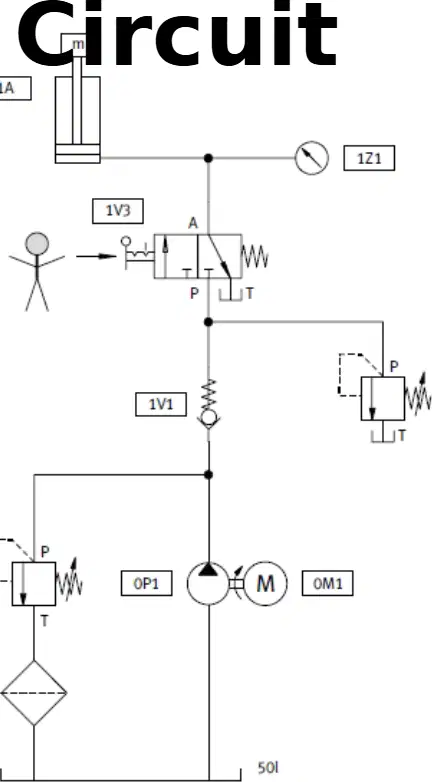
In the schematic showing a cylinder at the top, a directional control valve (labelled with ports P, T, A, B) is actuated by a human interface. Which section of the circuit does this valve primarily belong to?
Drive section
Power control section
Power supply section
Signal control section
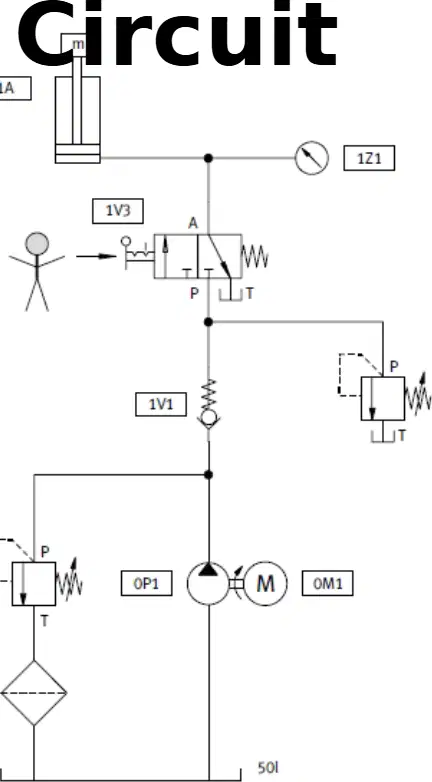
A pressure gauge and a pump driven by an electric motor (M) are shown near the reservoir in the hydraulic schematic. If the pump fails, which immediate effect is most likely on the drive section?
The cylinder will continue to operate at reduced speed using stored pressure.
The cylinder will stop moving due to loss of pressurized fluid supply.
The directional valve will switch positions automatically to compensate.
The relief valve will increase pressure to maintain motion.
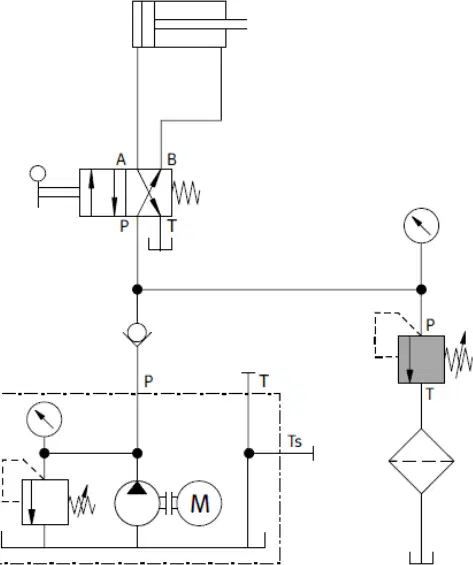
Refer to the basic hydraulic circuit diagram showing a pump (P), tank (T), motor (M), pressure gauge, a 4/2 directional control valve labeled ports P, T, A, B, and a single-acting actuator. Which component primarily directs fluid flow to either port A or B to control actuator movement?
The hydraulic pump
The pressure relief valve
The 4/2 directional control valve
The reservoir tank
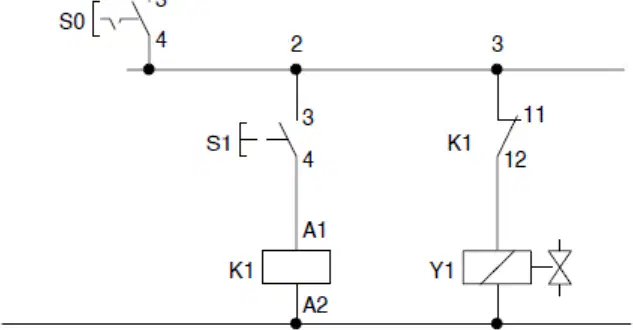
In the electrohydraulic circuit, an electrical control line labeled 24V energizes coil Y1 through relay K1. What is the most likely effect when S1 closes and K1 energizes?
The pump stops and pressure bleeds to tank
The directional valve shifts to route pressure from P to A (or B), moving the actuator
The relief valve opens to limit maximum pressure
The gauge disconnects from the circuit
Which statement best describes an advantage of an open centre hydraulic system for Grade 9 engineering applications?
It is ideal for systems operating at lower pressure and is easier to maintain
It requires a small reservoir because fluid cooling is minimal
It is only suitable for circuits driven exclusively by hydraulic motors
It is complex to configure and therefore costs more to design
In a closed centre hydraulic system, which statement best describes a key advantage noted for this basic circuit?
It is ideal for systems that operate at higher pressure.
It reduces the need for filtration due to low pressure.
It minimizes design costs compared to other circuits.
It is only suitable for low-pressure applications.
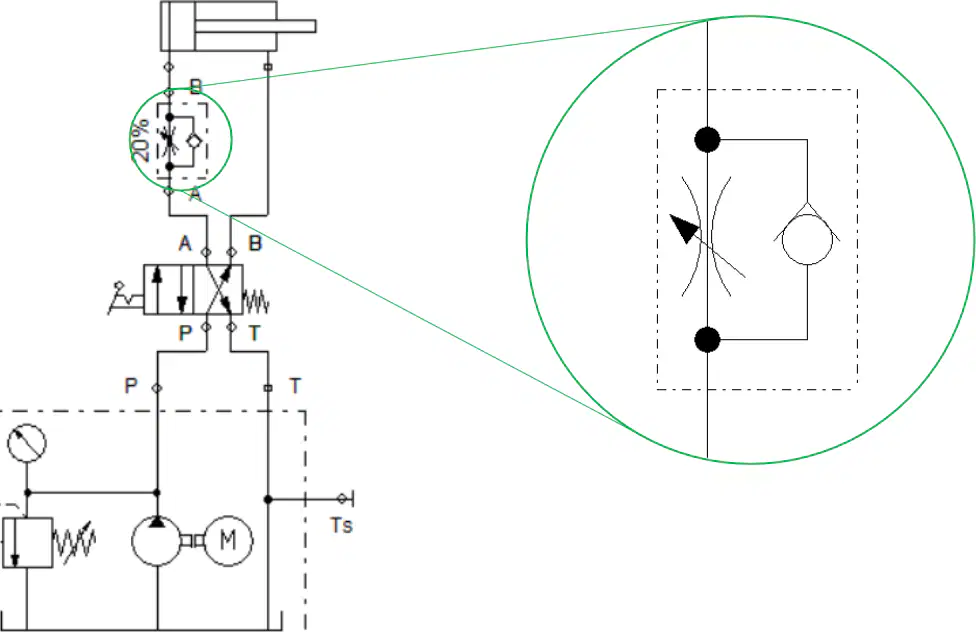
Refer to the diagram showing a cylinder with a flow control valve placed on the inlet line to port B (metering in). Which statement best describes the purpose of metering in for a hydraulic actuator?
It restricts the flow entering the actuator to control extension speed.
It restricts the flow leaving the actuator to control retraction speed.
It diverts pump flow back to tank to lower system pressure.
It opens a bypass around the directional control valve to increase speed.
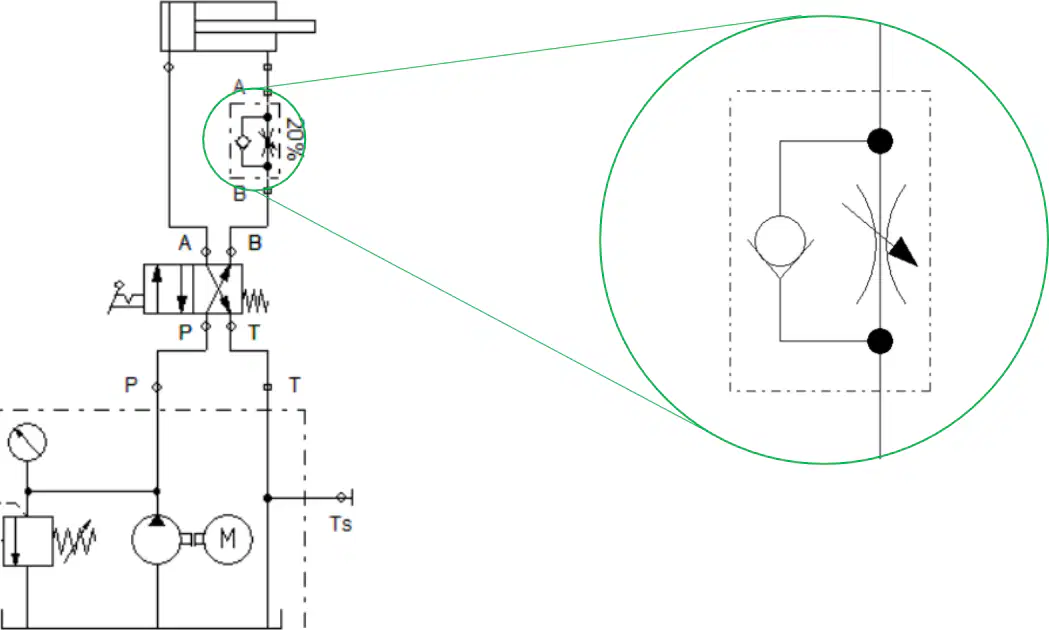
In the diagram where a flow control valve is placed on the outlet line from port A of the cylinder (metering out), what operational effect will this configuration most likely have compared to metering in?
Better control of actuator speed under varying loads by throttling the exhaust flow.
Faster actuator motion because the inlet is unrestricted.
Lower energy loss because all pump flow goes to the cylinder.
No effect on speed since flow controls only affect pressure.
A hydraulic pump normally operates at 60 bar with a bearing life of 4800 hours. Based on the described overload effects, what is the most likely bearing life if the pump is operated at 120 bar for a long period?
4800 hours, unchanged because pressure does not affect bearings
2400 hours, reduced to half due to exceeding normal pressure
9600 hours, doubled because higher pressure improves lubrication
3600 hours, slightly reduced but not halved
Which scenario best explains why cavitation develops in a hydraulic pump?
Fluid completely fills all pump chambers, keeping pressure uniform
Fluid velocity is slow and the pump inlet is clear of blockage
Fluid does not fill all pump chambers, leaving air spaces that reduce efficiency
Only high-temperature fluid is used, preventing vapor formation
According to the instructional text, which statement best describes the impact of excessive internal leakage in a hydraulic system?
It improves efficiency by cooling the fluid during operation
It reduces system efficiency and generates heat that can damage the fluid
It has no effect if external leaks are controlled
It only occurs when the system is shut down

