
 Worksheets
ECON_2105_20_MC
Total questions: 76
Worksheet time: 38mins
What is absolute advantage?
The ability to produce more of a good with fewer resources than another country
The ability to produce a good at a lower opportunity cost than another country
The ability to produce more goods than any other country
The ability to restrict imports to protect domestic industries
What is the main reason a country with absolute advantage in all goods would still engage in international trade?
To reduce production costs
To benefit from comparative advantage and maximize economic efficiency
To increase tariffs on imports
To restrict foreign competition
Which of the following statements best describes the benefit of comparative advantage and international trade?
It allows countries to consume beyond their production possibilities frontier
It ensures all countries have equal trade balances
It guarantees that all countries produce everything they need
It restricts countries from engaging in trade
If Country A can produce 10 tons of steel or 5 tons of wheat with one unit of resources, and Country B can produce 8 tons of steel or 4 tons of wheat with one unit of resources, which country has the absolute advantage in steel production?
Country A
Country B
Both have the same absolute advantage
Neither has an advantage
If Country A can produce 10 tons of steel or 5 tons of wheat with one unit of resources, and Country B can produce 8 tons of steel or 4 tons of wheat with one unit of resources, which country has the absolute advantage in wheat production?
Country A
Country B
Both have the same absolute advantage
Neither has an advantage
If Country A can produce 10 tons of steel or 5 tons of wheat with one unit of resources, and Country B can produce 8 tons of steel or 4 tons of wheat with one unit of resources, which country has the comparative advantage in steel production?
Country A
Country B
Both have the same absolute advantage
Neither has an advantage. The opportunity cost is the same
How does specialization based on comparative advantage benefit countries involved in trade?
It ensures that countries become entirely self-sufficient and do not need to trade with others.
It increases efficiency and allows countries to enjoy a greater variety of goods and services
It decreases the variety of goods available to consumers by limiting production to a narrow range of products.
It leads to higher production costs for countries as they focus on producing goods they are less efficient at producing.
Which of the following is a key factor that determines comparative advantage?
Total production capacity
The total population size of a country.
Relative opportunity costs
Currency exchange rates
How does opportunity cost relate to comparative advantage?
Comparative advantage is determined by the absolute cost of production
Comparative advantage is determined by the lower opportunity cost of production
Opportunity cost does not affect comparative advantage
Opportunity cost increases when comparative advantage is maximized
Which country should specialize in producing a good, according to the theory of comparative advantage?
The country with the higher production capacity
The country with the more advanced technology
The country with the higher population
The country with the lower opportunity cost for that good
How does absolute advantage differ from comparative advantage?
Absolute advantage considers production efficiency; comparative advantage considers opportunity cost
Absolute advantage is concerned with technical capabilities
Comparative advantage is based on production capacity
Absolute advantage is about currency strength
What is a likely outcome when countries engage in trade based on comparative advantage?
Decreased global economic output
Lower diversity of available goods
Higher prices for traded goods
Increased global economic output and welfare
Country X can produce 20 units of good A or 40 units of good B. Country Y can produce 30 units of good A or 60 units of good B. What is the opportunity cost of producing one unit of good A in Country X?
0.5 units of good B
1 unit of good B
2 units of good B
3 units of good B
Country A can produce 15 cars or 45 computers. What is the opportunity cost of producing one car in terms of computers?
3 computers
2 computers
1/5 computer
5 computers
If Country A can produce 30 units of good X or 10 units of good Y, and Country B can produce 20 units of good X or 20 units of good Y, which country has a comparative advantage in good Y?
Country A
Country B
Neither country
Both countries
Suppose Country Z can produce 100 units of good C or 200 units of good D. What is the opportunity cost of producing 1 unit of good C in terms of good D?
0.5 units of good D
1 unit of good D
2 units of good D
3 units of good D
Country M can produce 50 tons of grain or 25 tons of meat. Country N can produce 40 tons of grain or 40 tons of meat. What is the opportunity cost of producing 1 ton of grain in Country M?
2 tons of meat
1.5 tons of meat
1 ton of meat
0.5 ton of meat
What is the main reason a country with absolute advantage in all goods would still engage in international trade?
To reduce production costs
To benefit from comparative advantage and maximize economic efficiency
To increase tariffs on imports
To restrict foreign competition
Why is comparative advantage more important than absolute advantage in determining trade patterns?
Because it ensures lower production costs
Because it allows countries to specialize based on lower opportunity costs, leading to greater overall efficiency
Because it focuses solely on technology
Because it promotes protectionism
How does specialization based on comparative advantage benefit countries?
It allows countries to produce everything they consume
It leads to increased economic output and variety of goods available
It guarantees equal trade balances
It results in higher tariffs
What can a country gain by trading according to comparative advantage?
Higher production costs
Decreased efficiency in resource allocation
Reduced economic growth
Access to a wider variety of goods and services
What happens to global economic efficiency when countries trade based on comparative advantage?
It decreases
It remains unchanged
It increases, as countries specialize in producing goods with the lowest opportunity cost
It fluctuates unpredictably
What might a country risk if it decides to produce all goods domestically without engaging in trade?
Greater economic efficiency
Higher opportunity costs and less efficient resource allocation
Increased global competitiveness
Lower production costs for all goods
Country A can produce 100 units of good X or 200 units of good Y. Country B can produce 80 units of good X or 160 units of good Y. What is the opportunity cost of producing one unit of good X in Country A?
2 units of good Y
0.5 units of good Y
1 unit of good Y
1.5 units of good Y
If Country X has an opportunity cost of 4 units of good B for every unit of good A produced, and Country Y has an opportunity cost of 6 units of good B for every unit of good A produced, which country has a comparative advantage in producing good A?
Country X
Country Y
Both countries
Neither country
What is intra-industry trade?
Trade between industries in different countries
Trade that occurs under a regional trade agreement
Trade between two completely different industries
Trade of goods and services within the same industry between countries
Which of the following is a primary characteristic of intra-industry trade?
It involves countries with vastly different economic structures
It primarily occurs between countries with similar levels of development and economic size
It is limited to agricultural products
It reduces the variety of products available to consumers
What is one reason for the prevalence of intra-industry trade between similar economies?
Economies of scale and product differentiation
Differences in technology
Varying levels of natural resources
High barriers to entry in foreign markets
Which of the following industries is most likely to engage in intra-industry trade?
Wheat farming
Textile production
Coal mining
Automobile manufacturing
Why might two similar economies trade similar goods with each other?
To reduce overall production costs
To exploit absolute advantages
To offer consumers a greater variety of choices and increase market competition
To decrease overall trade volume
How does intra-industry trade benefit producers?
By decreasing market competition
By allowing producers to benefit from economies of scale
By reducing the need for innovation
By eliminating trade barriers
What is a primary benefit of reducing barriers to international trade?
Decreased global competition
Increased efficiency and specialization among trading nations
Higher production costs
Greater trade restrictions
Which of the following is a common barrier to international trade?
Free trade agreements
Tariffs and quotas
Comparative advantage
Technological innovation
What is an example of a non-tariff barrier to international trade?
Quotas
Free trade agreements
Export incentives
Safety regulations
How does international trade promote economic growth?
By creating trade deficits
By encouraging specialization and increasing market size
By limiting access to foreign goods
By reducing domestic productivity
Which of the following is a potential disadvantage of reducing trade barriers?
It can cause job displacement in industries that are less competitive internationally
It can lead to a decrease in domestic competition
It guarantees trade surpluses
It reduces consumer choice
What role do free trade agreements play in international trade?
They increase trade barriers between countries
They eliminate tariffs and quotas between member countries, promoting trade
They limit access to foreign markets
They increase government control over trade
How can reducing trade barriers lead to increased innovation?
By reducing the need for product differentiation
By increasing competition, which encourages firms to innovate to maintain market share
By decreasing the number of competitors
By eliminating the need for research and development
What is a potential benefit for developing countries that reduce trade barriers?
Access to advanced technologies and capital goods from developed countries
Higher domestic prices for goods
Reduced foreign investment
Increased tariffs on exports
Suppose a country removes a 10% tariff on imported electronics, reducing the average price from $500 to $450. Previous equilibrium quantity demanded was 100,000 units. If the price elasticity of demand is -1.2, what will be the new equilibrium quantity demanded?
100,000
120,000
115,000
112,000
Suppose a country removes a 5% tariff on imported furniture, reducing the average price from $1,000 to $950. Previous equilibrium quantity demanded was 80,000 units. If the price elasticity of demand is -0.8, what will be the new equilibrium quantity demanded?
83,200
78,800
80,000
82,000
Suppose a country imposes a 20% tariff on imported luxury watches, increasing the average price from $5,000 to $6,000. The previous equilibrium quantity demanded was 10,000 units. If the price elasticity of demand is 1.5, what will be the new equilibrium quantity demanded?
7,000
8,000
9,000
10,000
Suppose a country imposes a 25% tariff on imported computers, increasing the average price from $1,000 to $1,250. The previous equilibrium quantity demanded was 60,000 units. If the price elasticity of demand is 0.8, what will be the new equilibrium quantity demanded?
45,000
48,000
50,000
54,000
In Japan, one worker can make 5 tons of rubber or 80 radios. In Malaysia, one worker can make 10 tons of rubber or 40 radios. Who has the absolute advantage in rubber?
Japan
Malaysia
Neither
Both
In Japan, one worker can make 5 tons of rubber or 80 radios. In Malaysia, one worker can make 10 tons of rubber or 40 radios. Who has the absolute advantage in radios?
Japan
Malaysia
Neither
Both
In Japan, one worker can make 5 tons of rubber or 80 radios. In Malaysia, one worker can make 10 tons of rubber or 40 radios. Which product should Japan specialize in?
Rubber
Radios
Both. They have the absolute advantage.
Neither. They have no comparative advantage
In Japan, one worker can make 5 tons of rubber or 80 radios. In Malaysia, one worker can make 10 tons of rubber or 40 radios. Which product should Malaysia specialize in?
Rubber
Radios
Both. They have the absolute advantage.
Neither. They have no comparative advantage
In Australia, a farmer can produce 50 bushels of wheat or 200 kilograms of cotton. In Canada, a farmer can produce 30 bushels of wheat or 240 kilograms of cotton. Who has the absolute advantage in wheat?
Australia
Canada
Neither
Both
In Australia, a farmer can produce 50 bushels of wheat or 200 kilograms of cotton. In Canada, a farmer can produce 30 bushels of wheat or 240 kilograms of cotton. Who has the absolute advantage in cotton?
Australia
Canada
Neither
Both
In Australia, a farmer can produce 50 bushels of wheat or 200 kilograms of cotton. In Canada, a farmer can produce 30 bushels of wheat or 240 kilograms of cotton. Which product should Australia specialize in?
Wheat
Cotton
Both. They have the absolute advantage.
Neither. They have no comparative advantage
In Australia, a farmer can produce 50 bushels of wheat or 200 kilograms of cotton. In Canada, a farmer can produce 30 bushels of wheat or 240 kilograms of cotton. Which product should Canada specialize in?
Wheat
Cotton
Both. They have the absolute advantage.
Neither. They have no comparative advantage
In China, a factory can produce 100 units of electronics or 500 pieces of furniture. In Vietnam, a factory can produce 200 units of electronics or 400 pieces of furniture. Who has the absolute advantage in electronics?
China
Vietnam
Neither
Both
In China, a factory can produce 100 units of electronics or 500 pieces of furniture. In Vietnam, a factory can produce 200 units of electronics or 400 pieces of furniture. Who has the absolute advantage in furniture?
China
Vietnam
Neither
Both
In China, a factory can produce 100 units of electronics or 500 pieces of furniture. In Vietnam, a factory can produce 200 units of electronics or 400 pieces of furniture. Which product should China specialize in?
electronics
furniture
Both. They have the absolute advantage.
Neither. They have no comparative advantage
In China, a factory can produce 100 units of electronics or 500 pieces of furniture. In Vietnam, a factory can produce 200 units of electronics or 400 pieces of furniture. Which product should Vietnam specialize in?
electronics
furniture
Both. They have the absolute advantage.
Neither. They have no comparative advantage
In France, a vineyard can produce 60 bottles of wine or 120 kilograms of cheese. In Italy, a vineyard can produce 80 bottles of wine or 150 kilograms of cheese. Who has the absolute advantage in wine?
France
Italy
Neither
Both
In France, a vineyard can produce 60 bottles of wine or 120 kilograms of cheese. In Italy, a vineyard can produce 80 bottles of wine or 150 kilograms of cheese. Who has the absolute advantage in cheese?
France
Italy
Neither
Both
In France, a vineyard can produce 60 bottles of wine or 120 kilograms of cheese. In Italy, a vineyard can produce 80 bottles of wine or 150 kilograms of cheese. Which product should France specialize in?
wine
cheese
Both. They have the absolute advantage.
Neither. They have no comparative advantage
In France, a vineyard can produce 60 bottles of wine or 120 kilograms of cheese. In Italy, a vineyard can produce 80 bottles of wine or 150 kilograms of cheese. Which product should Italy specialize in?
wine
cheese
Both. They have the absolute advantage.
Neither. They have no comparative advantage
In India, a worker can process 80 kilograms of tea or 100 kilograms of spices. In Sri Lanka, a worker can process 80 kilograms of tea or 120 kilograms of spices. Who has the absolute advantage in tea?
India
Sri Lanka
Neither
Both
In India, a worker can process 80 kilograms of tea or 100 kilograms of spices. In Sri Lanka, a worker can process 80 kilograms of tea or 120 kilograms of spices. Who has the absolute advantage in spices?
India
Sri Lanka
Neither
Both
In India, a worker can process 80 kilograms of tea or 100 kilograms of spices. In Sri Lanka, a worker can process 80 kilograms of tea or 120 kilograms of spices. Which product should India specialize in?
tea
spices
Both. They have the absolute advantage.
Neither. They have no comparative advantage
In India, a worker can process 80 kilograms of tea or 100 kilograms of spices. In Sri Lanka, a worker can process 80 kilograms of tea or 120 kilograms of spices. Which product should Sri Lanka specialize in?
tea
spices
Both. They have the absolute advantage.
Neither. They have no comparative advantage
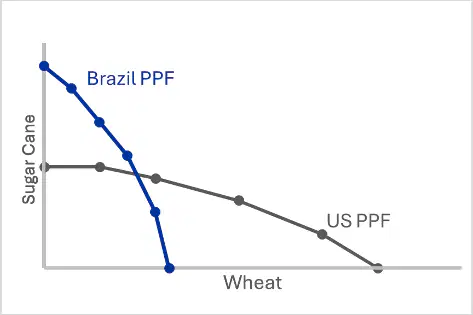
The above chart shows the PPF for both the US and Brazil for two goods, Sugar Cane and Wheat. According to these curves, _______ has a comparative advantage in wheat and _______ has a comparative advantage in sugar cane.
Brazil; Brazil
Brazil; US
US; US
US; Brazil
Below are the number of bushels of olives and grapes that a single farmer can produce in Greece and Italy.
Country
Olives
Grapes
Greece
20
60
Italy
80
40
What is the opportunity cost for each country to produce more olives?
Greece .333 bushels of grapes; Italy 2 bushels of grapes
Greece 3 bushels of grapes; Italy 0.5 bushels of grapes
Greece 3 bushels of olives; Italy 0.5 bushels of olives
Greece .333 bushels of olives; Italy 2 bushels of olives
Below are the number of bushels of olives and grapes that a single farmer can produce in Greece and Italy.
Country
Olives
Grapes
Greece
20
60
Italy
80
40
What is the opportunity cost for each country to produce more grapes?
Greece .333 bushels of grapes; Italy 2 bushels of grapes
Greece 3 bushels of grapes; Italy 0.5 bushels of grapes
Greece 3 bushels of olives; Italy 0.5 bushels of olives
Greece .333 bushels of olives; Italy 2 bushels of olives
Below are the number of bushels of olives and grapes that a single farmer can produce in Greece and Italy.
Country
Olives
Grapes
Greece
20
60
Italy
80
40
Which country has the absolute advantage in olive production?
Greece
Italy
Neither
Both
Below are the number of bushels of olives and grapes that a single farmer can produce in Greece and Italy.
Country
Olives
Grapes
Greece
20
60
Italy
80
40
Which country has the absolute advantage in grape production?
Greece
Italy
Neither
Both
Below are the number of bushels of olives and grapes that a single farmer can produce in Greece and Italy.
Country
Olives
Grapes
Greece
20
60
Italy
80
40
Which country has the comparative advantage in olive production?
Greece
Italy
Neither
Both
Below are the number of bushels of olives and grapes that a single farmer can produce in Greece and Italy.
Country
Olives
Grapes
Greece
20
60
Italy
80
40
Which country has the comparative advantage in grape production?
Greece
Italy
Neither
Both
Below are the weekly output capacities for Canada and Venezuela in lumber and Oil.
Country
Oil (barrels)
Lumber (tons)
Canada
20
40
Venezuela
60
20
What is the opportunity cost for each country to produce more oil?
Canada 0.5 oil; Venezuela 3 oil
Canada 2 lumber; Venezuela .33 lumber
Canada 0.5 lumber; Venezuela .33 lumber
Canada 2 oil; Venezuela .33 oil
Below are the weekly output capacities for Canada and Venezuela in lumber and oil.
Country
Oil (barrels)
Lumber (tons)
Canada
20
40
Venezuela
60
20
What is the opportunity cost for each country to produce more lumber?
Canada 0.5 oil; Venezuela 3 oil
Canada 2 lumber; Venezuela .33 lumber
Canada 0.5 lumber; Venezuela .33 lumber
Canada 2 oil; Venezuela .33 oil
Below are the weekly output capacities for Canada and Venezuela in lumber and oil.
Country
Oil (barrels)
Lumber (tons)
Canada
20
40
Venezuela
60
20
Which country has the absolute advantage in oil production?
Canada
Venezuela
Both
Neither
Below are the weekly output capacities for Canada and Venezuela in lumber and oil.
Country
Oil (barrels)
Lumber (tons)
Canada
20
40
Venezuela
60
20
Which country has the absolute advantage in lumber production?
Canada
Venezuela
Both
Neither
Below are the weekly output capacities for Canada and Venezuela in lumber and oil.
Country
Oil (barrels)
Lumber (tons)
Canada
20
40
Venezuela
60
20
Which country has the comparative advantage in oil production?
Canada
Venezuela
Both
Neither
Below are the weekly output capacities for Canada and Venezuela in lumber and oil.
Country
Oil (barrels)
Lumber (tons)
Canada
20
40
Venezuela
60
20
Which country has the comparative advantage in lumber production?
Canada
Venezuela
Both
Neither

