
NEW
Font size
 Worksheets
Structured Literacy Quiz
Total questions: 63
Worksheet time: 32mins
What is the primary goal of Structured Literacy?
To teach students advanced vocabulary
To prepare students to decode words in an explicit, systematic, and cumulative manner
To focus on creative writing skills
To improve students' handwriting
What do Structured Literacy activities target?
Students' creative abilities
Students' core weaknesses
Students' memorization skills
Students' artistic talents
Which principle of Structured Literacy involves breaking down activities into small sequential steps and placing them into a manageable sequence?
Cumulative
Explicit
Systematic
Diagnostic
What does the Cumulative principle of Structured Literacy emphasize?
Pre-assessment to determine strengths and weaknesses
Having the skills, prior knowledge, and understanding for new skills to be taught
Breaking down activities into small sequential steps
Overtly teaching all the steps needed to complete a task
Which principle of Structured Literacy involves overtly teaching all the steps needed to complete a task, with the teacher modeling guided practice?
Diagnostic
Explicit
Systematic
Cumulative
What is the focus of the Diagnostic principle in Structured Literacy?
Breaking down activities into small sequential steps
Pre-assessment to determine strengths and weaknesses
Having prior knowledge for new skills to be taught
Overtly teaching all the steps needed to complete a task
What does "Systematic" mean in the context of using structured literacy in mathematics?
Breaking down activities into small sequential steps and placing them into a manageable sequence
Pre-assessment to determine strengths and weaknesses
Overtly teaching all the steps needed to complete a task
Having the skills, prior knowledge, and understanding for new skills to be taught
What is the purpose of "Cumulative" in structured literacy for mathematics?
Breaking down activities into small sequential steps
Having the skills, prior knowledge, and understanding for new skills to be taught
Pre-assessment to determine strengths and weaknesses
Overtly teaching all the steps needed to complete a task
What does "Explicit" refer to in the context of structured literacy in mathematics?
Pre-assessment to determine strengths and weaknesses
Breaking down activities into small sequential steps
Overtly teaching all the steps needed to complete a task and modeling guided practice
Having the skills, prior knowledge, and understanding for new skills to be taught
What is the role of "Diagnostic" in structured literacy for mathematics?
Breaking down activities into small sequential steps
Pre-assessment to determine strengths and weaknesses
Overtly teaching all the steps needed to complete a task
Having the skills, prior knowledge, and understanding for new skills to be taught
What are the four components of multisensory instruction as mentioned in Unit 1: Developing a Foundation for Structured Literacy?
Sight, Speech, Sound, Movement
Sight, Writing, Sound, Movement
Sight, Speech, Sound, Reading
Sight, Writing, Reading, Movement

Which sensory activity corresponds to "show me" in multisensory instruction?
Speech
Sight
Sound
Movement

What does "say it" refer to in multisensory instruction?
Sight
Speech
Sound
Movement

Which sensory activity involves "hear its name" in multisensory instruction?
Sight
Speech
Sound
Movement

What does "touch it" refer to in multisensory instruction?
Sight
Speech
Sound
Movement

What must effective reading instruction include?
Teaching principles and evidence-based elements of structured literacy
Creative writing techniques and storytelling methods
Memorization strategies and speed reading techniques
Visual aids and multimedia presentations
Which of the following is one of the 6 elements of structured literacy?
Phonology
Grammar
Pronunciation
Vocabulary
What is the term used to describe the relationship between sounds and symbols in structured literacy?
Syntax
Sound-symbol
Semantics
Morphology
Which element of structured literacy focuses on the arrangement of words and phrases to create sentences?
Syntax
Semantics
Phonology
Morphology
Which element of structured literacy deals with the study of word structure and formation?
Morphology
Phonology
Semantics
Syntax
What does the term "semantics" refer to in the context of structured literacy?
The meaning of words and sentences
The sound of words
The structure of syllables
The arrangement of sentences
Which of the following is NOT one of the 6 elements of structured literacy?
Syllables
Syntax
Grammar
Semantics
What is phonology?
The study of how sounds work together with patterns and rules within a speech sound system of language
The study of how words are formed in a language
The study of sentence structure in a language
The study of the meaning of words in a language
Which of the following is NOT a component of phonology?
Phonological Memory
Phonological Naming
Phonological Awareness
Phonological Syntax
How many components of phonology are mentioned in the learning material?
2
3
4
5
Which of the following is a component of phonology?
Phonological Syntax
Phonological Awareness
Phonological Semantics
Phonological Grammar
What does phonological awareness primarily involve?
Understanding the meaning of words
Breaking up a sentence word by word
Learning grammar rules
Writing sentences
What is the process of breaking words into syllables called?
Phoneme segmentation
Syllable tapping
Word analysis
Sentence parsing
What does rhyme in phonological awareness focus on?
Matching beginning sounds
Matching ending sounds
Breaking sentences into words
Identifying word meanings
What is alliteration in phonological awareness?
Words that rhyme
Words that begin or end the same
Words with similar meanings
Words broken into syllables
What does breaking syllables into phonemes involve?
Identifying the meaning of a sentence
Analyzing sound speech
Matching ending sounds
Writing sentences
What are the three critical points to design instruction for phonological awareness?
Teach, Plan, Scaffold
Listen, Write, Read
Analyze, Memorize, Practice
Observe, Evaluate, Implement
What is the primary focus of Unit 2 in the learning material?
Multisensory Approach to Mathematics
Multisensory Approach to Phonology
Multisensory Approach to Reading Comprehension
Multisensory Approach to Writing Skills
Which of the following is a component of phonemic awareness?
Onset-rime segmentation
Sentence construction
Paragraph writing
Word translation
What does phonemic awareness involve when working with sounds?
Segmenting words into sentences
Segmenting words into sounds
Translating words into different languages
Writing words in cursive
Which of the following is NOT a part of phonemic awareness?
Blending sounds into words
Segmenting initial and final sounds
Writing essays
Deleting and manipulating phonemes
What does "delete, manipulate phonemes" refer to in phonemic awareness?
Removing or changing sounds in words
Writing words in alphabetical order
Translating words into phonetic symbols
Rearranging letters in a word
What are essential skills connected to all areas of reading?
Phonological and Phonemic Awareness
Vocabulary and Grammar Awareness
Syntax and Morphology Awareness
Reading Speed and Comprehension Awareness

What does orthography refer to?
The study of spoken language conventions
The conventions associated with a language's written form
The rules of grammar in spoken communication
The study of word pronunciation
What influences orthography?
Sentence structure
Word origins
Spoken dialects
Cultural traditions
How many letters, sounds, and vowels are there in the English language according to the rules of orthography?
26 letters, 44 sounds, 19 vowels
26 letters, 40 sounds, 15 vowels
30 letters, 44 sounds, 20 vowels
25 letters, 42 sounds, 18 vowels
What is the smallest unit of sound in the English language?
Grapheme
Phoneme
Syllable
Letter
What is the written form of a phoneme called?
Grapheme
Phoneme
Syllable
Letter
What does graphophonemic involve?
Letters and sounds
Words and meanings
Sentences and grammar
Vowels and consonants
What is phoneme-grapheme mapping?
A method to identify sounds in words and match them to their spelling.
A strategy to memorize vocabulary words.
A technique to improve handwriting skills.
A way to learn sentence structure.
What does phoneme-grapheme mapping strengthen?
Phonemic awareness.
Vocabulary recall.
Sentence formation.
Grammar skills.
How does the multisensory strategy help the brain?
It connects the brain’s phonological and orthographic processors to strengthen learning and recall.
It improves the brain’s ability to solve mathematical problems.
It enhances the brain’s ability to memorize historical dates.
It develops the brain’s ability to write essays.
What is one benefit of the multisensory strategy mentioned in the text?
Supporting the development of fluency in reading and spelling.
Improving the ability to write poetry.
Enhancing the understanding of scientific concepts.
Strengthening the ability to draw diagrams.
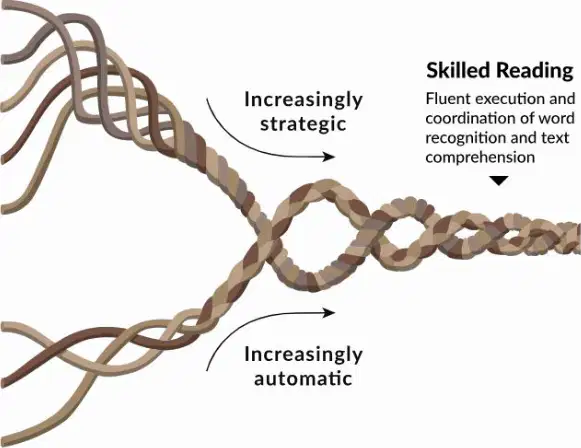
What is the primary goal of skilled reading as depicted in Scarborough's Reading Rope?
Fluent execution and coordination of word recognition and text comprehension
Memorization of vocabulary words
Mastery of phonological awareness only
Understanding syntax without decoding
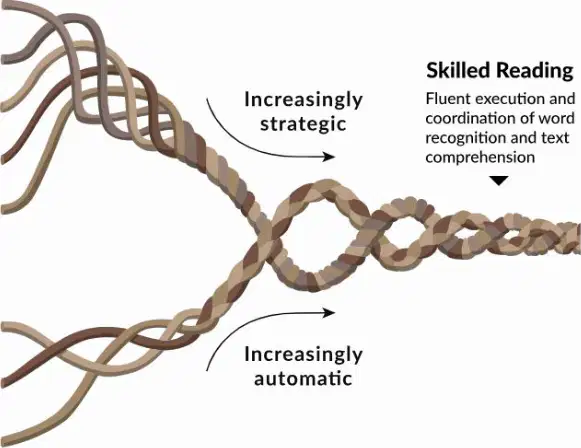
Which of the following is NOT a component of language comprehension in Scarborough's Reading Rope?
Background Knowledge
Phonological Awareness
Verbal Reasoning
Vocabulary
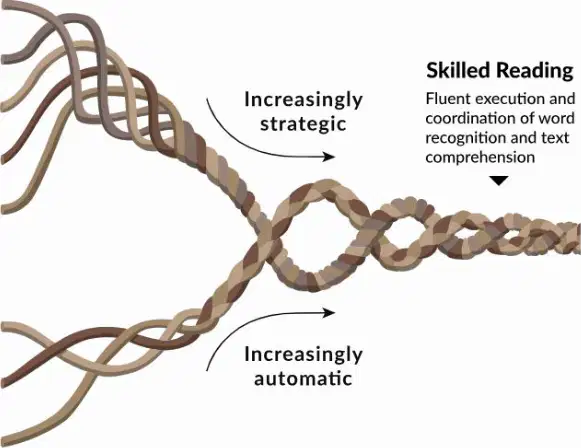
What does "increasingly automatic" refer to in Scarborough's Reading Rope?
The process of decoding and sight recognition becoming effortless
The process of learning new vocabulary words
The process of understanding metaphors and inference
The process of mastering syntax and semantics
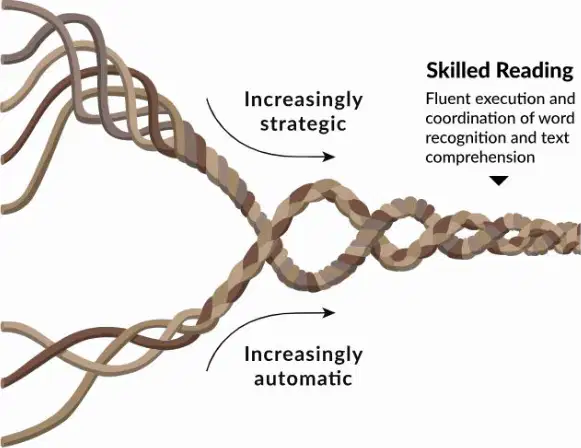
Which component of word recognition involves understanding syllables and phonemes?
Phonological Awareness
Decoding
Sight Recognition
Literacy Knowledge
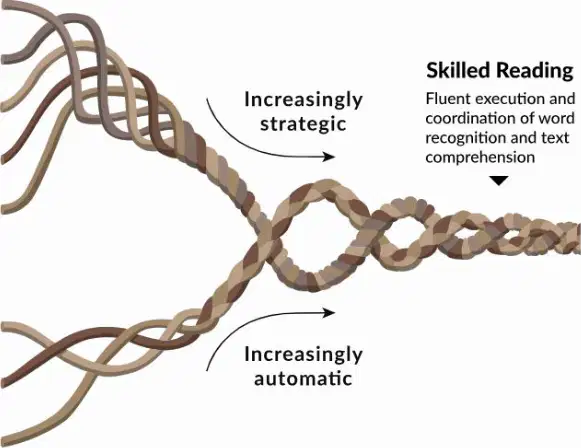
What does "increasingly strategic" refer to in Scarborough's Reading Rope?
The process of language comprehension becoming more deliberate and thoughtful
The process of memorizing spelling rules
The process of decoding words faster
The process of recognizing familiar words
What does syntax dictate in a sentence?
The meaning of individual words
The sequence and function of words
The pronunciation of words
The spelling of words
Which of the following is included in syntax?
Word order
Pronunciation rules
Spelling conventions
Punctuation marks
What is one of the components of syntax mentioned in the material?
Sentence variation
Word pronunciation
Sentence punctuation
Word spelling
Which of the following is NOT included in syntax as per the material?
Grammar
Mechanics of language
Sentence variation
Word pronunciation
What is the study of word forms called?
Syntax
Morphology
Phonology
Semantics
What are the smallest units of meaning in a language?
Phonemes
Morphemes
Sentences
Syllables
Which of the following can be considered a morpheme?
Single letters
Word parts
Entire words
All of the above
What is the study of semantics primarily concerned with?
The structure of sentences
The relationship between words and their meanings
The pronunciation of words
The history of language development
How does direct vocabulary instruction support reading comprehension?
By teaching students to memorize words without context
By encouraging students to focus only on writing
By explicitly teaching words through repeated interactions in various contexts
By limiting interactions to speaking only
Which activities are involved in repeated interactions for vocabulary instruction?
Speaking, listening, reading, and writing
Memorizing, translating, and copying
Drawing, painting, and sculpting
Singing, dancing, and acting

