wayground logo

Free Printable Worksheets

Font size

S
M
L
XL
Worksheets

Unit 4 Review

Total questions: 50

Worksheet time: 1hrs 21mins

Name
Class
Date
1.

When forming an ionic bond, a metal atom​ (a)   electrons to form a(n)​ (b)   .

The nonmetal atom​ (c)   electrons to form a(n)​ (d)   .

Choose from the below words
loses
cation
gains
anion
2.
What elements generally make an ionic bond?
a)
metal and nonmetal
b)
2 or more nonmetals
c)
metal
d)
none of the above
3.
What elements generally make a covalent bond?
a)
metal and nonmetal
b)
2 or more nonmetals
c)
metal
d)
none of the above
4.

In chemical compounds, covalent bonds form when electrons are ​ (a)   between ​ (b)   .

Choose from the below words
shared
2 or more nonmetals
transferred
2 or more metals
1 metal and 1 nonmetal
5.

In chemical compounds, ionic bonds form when electrons are ​​ (a)   between ​ (b)   .

Choose from the below words
2 or more nonmetals
transferred
2 or more metals
1 metal and 1 nonmetal
shared
6.

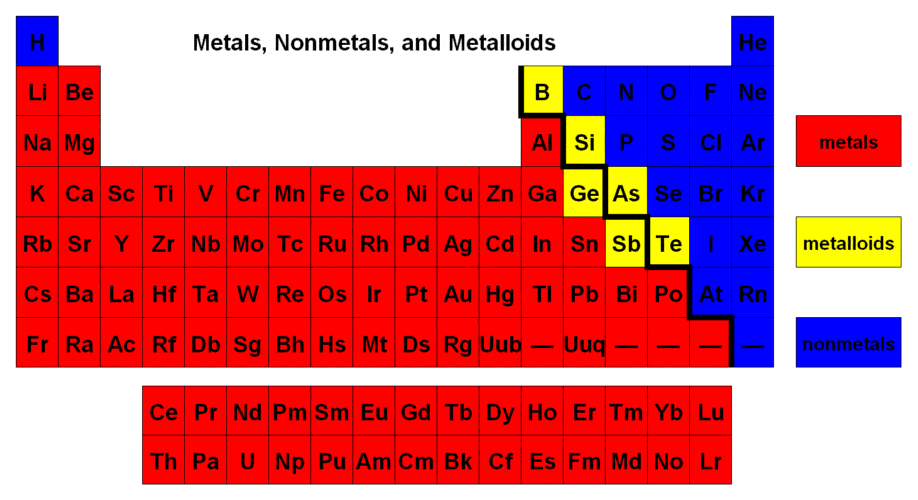
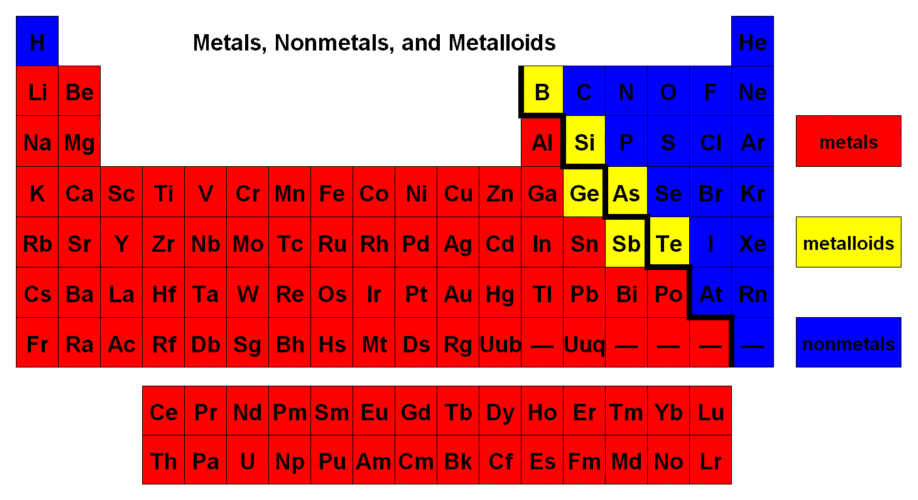
Predict the bond that will form between Cu and F.

a)

Ionic

b)

Covalent

c)

Metallic

7.

Predict the bond that will form between Se and Cl.

a)

Ionic

b)

Covalent

c)

Metallic

8.
What is a valence electron?
a)
an electron that is found in the outermost shell of an atom. 
b)
an electron found in the innermost shell of an atom.
c)
an electron found in the middle shell.
9.
Which substance contains bonds that involve a transfer of electrons from one atom to another?
a)
CO2
b)
NH3
c)
KBr
d)
Cl2
10.

Which substance contains bonds that involve a sharing of electrons from one atom to another?

a)

CuO

b)

NH3

c)

KBr

d)

FeCl2

11.

Ionic compounds have​​ (a)   melting points.

Covalent compounds have ​ (b)   melting points.

Choose from the below words
high
low
12.

Ionic compounds are​ (a)   conductors of electricity when in the liquid state.

Covalent compounds are​ (b)   conductors of electricity when in any state of matter.

Choose from the below words
good
poor
13.

Metals will​ (a)   electrons to form a​ (b)   charge, resulting in a ​ (c)   .

Choose from the below words
lose
positive (+)
cation
gain
negative (-)
anion
14.

Nonmetals will​ (a)   electrons to form a​ (b)   charge, resulting in a ​ (c)   .

Choose from the below words
lose
positive (+)
cation
gain
negative (-)
anion
15.

Sodium will​ ​ (a)   to form a​ (b)   charge.

Choose from the below words
+1
gain 1 electron
-1
lose 1 electron
16.

Nitrogen will​ ​ (a)   to form a​ (b)   charge.

Choose from the below words
-3
gain 3 electrons
+3
lose 3 electrons
17.

Match the elements to their charges.

a)

Calcium

1.

+2

b)

Phosphorus

2.

-3

c)

Chlorine

3.

-1

d)

Cesium

4.

+1

e)

Sulfur

5.

-2

18.

Match the elements to their valence electrons.

a)

Mg

1.

2

b)

K

2.

1

c)

Si

3.

4

d)

O

4.

6

e)

F

5.

7

19.

Match the following cation/anion with how many valence electrons it lost/gained.

a)

Fe3+Fe^{3+}

1.

lost three valence electrons

b)

O2O^{2-}

2.

gained 2 valence electrons

c)

II^-

3.

gained one valence electron

d)

Ca2+Ca^{2+}

4.

lost two valence electrons

e)

Cs+Cs^+

5.

lost one valence electron

20.

If an atom ​ (a)   electrons, it will become negative.

If an atom ​ (b)   electrons, it will become positive.

Choose from the below words
gains
loses
destroys
creates
21.

What would be the chemical formula formed if the cation K+1 combined with the anion O-2?

a)

KO

b)

K2O

c)

KO2

d)

K2O2

22.

What would be the chemical formula of the cation Mg+2 combined with the anion N-3?

a)

Mg3N2

b)

Mg2N3

c)

Mg2N2

d)

Mg3N3

23.

Name the compound: N2O5.

a)

dinitrogen pentaoxide

b)

binitrogen pentaoxide

c)

nitrogen oxide

d)

pentanitrogen dioxide

24.

Name the compound: MgCl2

a)

magnesium chloride

b)

magnesium dichloride

c)

magnesium (II) chloride

d)

manganese chloride

25.

Name the compound: SO3

a)

sulfur trioxide

b)

sulfite ion

c)

sulfur oxide

d)

sodium trioxide

26.

Name the compound: CF4

a)

carbon tetrafluoride

b)

monocarbon tetrafluoride

c)

carbon fluoride

d)

chlorine tetrafluoride

27.

Name the compound: P4O8

a)

tetraphosphorus octoxide

b)

phosphorus oxide

c)

tetrapotassium octoxide

d)

potassium oxide

28.

Name the compound: Zn3P2

a)

zinc phosphide

b)

trizinc diphosphide

c)

zinc phosphate

d)

zinc phosphite

29.

Write the formula: tin (II) phosphide

a)

Sn3P2

b)

Sn3P3

c)

Sn2P3

d)

Sn2P2

30.

Write the formula: lithium nitride

a)

Li3N

b)

LiN

c)

Li3(NO3)2

d)

LiNO3

31.

phosphorus pentafluoride

a)

PFl5

b)

P5F

c)

PF5

d)

PF7

32.

dinitrogen trioxide

a)

N3O2

b)

N2O3

c)

NO3

d)

NO6

33.

The name of FeCl₂ is

a)

iron chloride

b)

iron (II) chloride

c)

iron (I) chloride

d)

iron dichloride

34.
When metals bond with non-metals they form what type of bonds
a)
covalent
b)
ionic
c)
cooperative
d)
lewis
35.

An ionic compound forms between a _______ and _______.

a)

metal and non-metal

b)

two metals

c)

two non-metals

36.

Which of the following combinations would need roman numerals in the name?

a)

potassium + fluorine

b)

beryllium + oxygen

c)

boron + iodine

d)

lead + oxygen

37.

When naming ionic compounds with transition metals you need to include roman numerals to show the _____ of the metal..

a)

atomic number

b)

mass number

c)

charge

d)

ionization energy

38.
Metals tend to 
a)
gain electrons
b)
lose electrons
39.
Nonmetals tend to 
a)
gain electrons
b)
lose electrons
40.
When a nonmetal gains electrons, it becomes this type of ion.
a)
Anion
b)
Cation
41.
When a metal loses electrons, it becomes this type of ion.
a)
anion
b)
cation
42.
When naming ionic compounds you always write the name of the positive element  _______ .
a)
first
b)
second
c)
with "ide"
d)
with a prefix
43.
What is the formula for calcium phosphide?
a)
CaP
b)
Ca2P3
c)
Ca3P2
d)
Ca2P
44.
According to the octet rule most elements need _______ valence electrons.
a)
2
b)
8
c)
6
d)
18
45.
Hydrogen needs _____ electrons in its valence shell to be stable.
a)
4
b)
6
c)
8
d)
2
46.
Which of the following is the correct Lewis dot structure for the molecule fluorine (F2)?
a)
A
b)
B
c)
C
d)
D
47.
How many valence electrons are in Phosphorus?
a)
15
b)
4
c)
5
d)
31
48.
When writing Lewis Structures, only __________ electrons are used.
a)
Inner shell
b)
Core 
c)
Valence
d)
Stable
49.

What is the correct Lewis Dot Structure for ammonia NH3

a)
b)
c)
d)
50.

Which is the correct molecular structure for carbon dioxide?

a)
b)
c)
d)