
 Worksheets
Understanding Newton's Laws of Motion
Total questions: 58
Worksheet time: 3hrs 9mins

A squid moves through the water by ejecting water out of its body into the surrounding water. When the water is pushed out, the ejected water pushes back and thrusts the squid forward.
First Law of Motion (law of inertia)
Second Law of Motion (law of force and acceleration)
Third Law of Motion (law of motion and reaction)
Fourth Law of Motion (law of balanced forces)

Pushing a child on a swing is easier than pushing an adult on the same swing, because the adult has more mass. What which law explains this?
Newton's 1st Law (Law of Inertia)
Newton's 2nd Law (Law of Acceleration)
Newton's 3rd Law (Law of Action-Reaction)
Newton's 4th Law (Law of Science)

it takes less force to push a bicycle than a motorcycle
Newton's 1st Law
Newton's 2nd Law
Newton's 3rd Law
None of the above
A fireman turns on his hose and is knocked backwards
Newton's 1st Law
Newton's 2nd Law
Newton's 3rd Law
None of the above
feet push down on the floor & the floor pushes up at feet while you walk
Newton's 1st Law
Newton's 2nd Law
Newton's 3rd Law
None of the above
takes less force to move a phone than a TV
Newton's 1st Law
Newton's 2nd Law
Newton's 3rd Law
None of the above
seatbelt stops you from hitting the windshield if you hit the brakes quickly
Newton's 1st Law
Newton's 2nd Law
Newton's 3rd Law
None of the above
What is Newton's 2nd Law?
whenever a body exerts a force on a second body, the second body exerts an equal and opposite force on the first.
the acceleration produced by a net force on a body is directly proportional to the magnitude of the net force, in the same direction as the net force, and inversely proportional to the mass of the body.
every body continues in its state of rest, or of motion in a straight line at constant speed, unless it is compelled to change that state by forces exerted on it.
What is Newton's 3rd Law?
Whenever a body exerts a force on a second body, the second body exerts an equal and opposite force on the first.
The acceleration produced by a net force on a body is directly proportional to the magnitude of the net force, in the same direction as the net force, and inversely proportional to the mass of the body.
every body continues in its state of rest, or of motion in a straight line at constant speed, unless it is compelled to change that state by forces exerted upon it
What explains why objects resist changes in their state of motion?
gravity
inertia
force
friction

Looking at the image. Decide if this is balanced or unbalanced.
Unbalanced
Balanced
You push against a wall and the wall is pushing back on you.
Newton's
1st
Law of Motion
Newton's
2nd
Law of Motion
Newton's
3rd
Law of Motion
Law of Conservation of Mass

Examine the table provided. Which of the objects is producing the greatest force?
Soccer ball
Tennis ball
Marble
Ping-Pong Ball
How much force (newtons) is required to accelerate a 2.55 kg remote-controlled toy car at a rate of 6.00 m/s2
0.425 m/s^2
2.35 m/s^2
8.55 m/s^2
15.3 m/s^2
What amount of force needs to be applied to a 20-kg bowling ball to give it an acceleration of 5 m/s2
4 N
25 N
100 N
250 N
If a 10 kilogram object accelerates suddenly at 15 m/s2, how much force was applied to the object?
150 Newtons
15 Newtons
150 kilograms
100 kilograms
What explains a quantity that has BOTH speed and direction?
Inertia
Force
Speed
Velocity
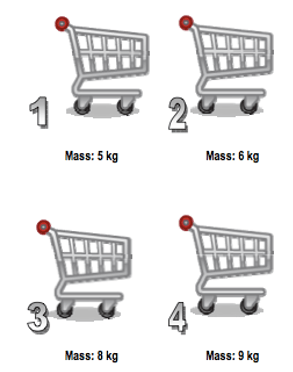
True or False: objects with greater mass require more force to accelerate when compared to objects with less mass.
True
False
The equation to calculate momentum is
p = m x v
p = 1/2 m x v2
p = m x g x h
p = m x g
What is the unit for momentum?
m/sec
kg/sec
kg/m
kg x m/sec
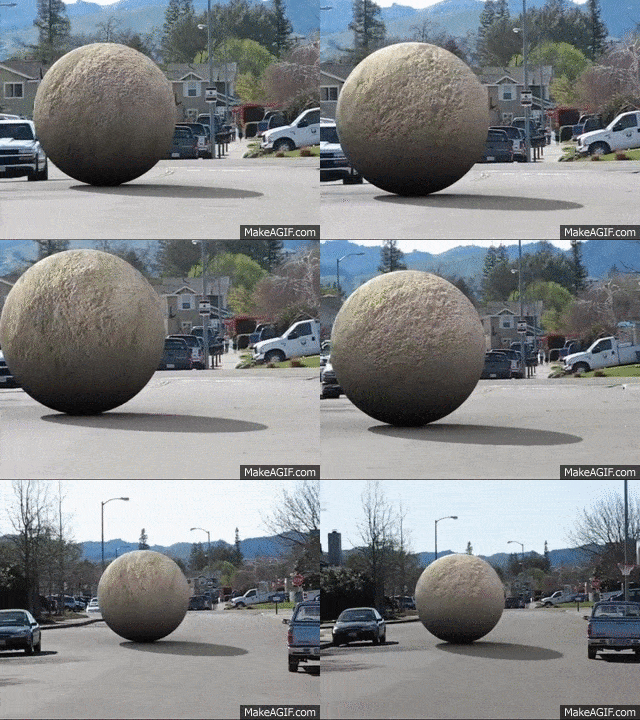
If an object has a momentum of 40 kg x m/s and a mass of 60 kg, what is it's velocity?
2400 m/s
1.5 m/s
240 m/s
.67 m/s
In order for an object to have momentum it must be ________
moving
motionless
alive
asleep


Two skaters begin at rest. Skater 1 has a smaller mass than Skater 2. After they push off each other,...
Skater 1 experiences a greater change in momentum
Skater 2 experiences a greater change in momentum
Skater 1 has a greater speed than Skater 2
Skater 1 experiences a greater force
The Law of Conservation of Momentum states:
The total momentum before a collision is equal to the total momentum after a collision.
The total momentum before a collision is greater than the total momentum after a collision.
The total momentum before a collision is less than the total momentum after a collision.
The total momentum before a collision is not related to the total momentum after a collision.
During a collision. an object experiences an impulse. How can this impulse be calculated?
Multiplying force by time
Multiplying mass by velocity
Dividing velocity by time
Multiplying mass by acceleration
When a cannon fires a cannon ball, it recoils backwards. This occurs because of...
Energy in the system is conserved
Energy in the system is increased
Momentum in the system is conserved
Energy in the system is not conserved
An egg landing on a soft surface will remain intact. The surface increases the _____ and decreases the _____ during the impact
impulse, time
impulse, force
force, time
time, force
Padded dashboards in cars are safer in accidents than non padded ones because the passenger hitting the dash has...
a) Increased time of impact
b) decreased impulse
c) decreased impact force
d) a and b
e) a and c
Before objects A and B collide, A has a momentum of 26 kg*m/s and B has a momentum of -14 kg*m/s. After the collision, A has a momentum of 8 kg*m/s. B has a momentum of..
2 kg*m/s
4 kg*m/s
6 kg*m/s
12 kg*m/s
32 kg*m/s
In an elastic collision...
objects bounce off each other
objects stick together
objects stick together for a while then separate
one object flips over the other
A bug flies into the windshield of a car going the opposite way. Which of the following are true?
the change in velocity of the bug is larger than the truck
Which of the following is Newton's first law of motion?
the acceleration produced by a net force on a second body, the second body exerts an equal and opposite force on the first
the acceleration produced by a net force on a body is directly proportional to the magnitude of the net force, in the same direction as the net force, and inversely proportional to the mass of the body
every body continues in its state of rest, or of motion in a straight line at constant speed, unless it is compelled to change that state by forces exerted upon it.
Mass allows an object to....
stay in its state of motion
speed up
slow down
Which of the following would increase the acceleration of the object?
lessening the force
lessening the mass
increasing the mass
How could you make the acceleration of an object be half of what it was?
double the force
half the mass
double the mass
Mr. Dorris is running down the hall. He sees a crayon and stops. When did he have the most inertia?
running
at rest
same for both running and rest
Why is a gun's recoil small?
gun has less mass
gun has more mass
bullet has more mass
A welder and an HVAC student are running at each other with a velocity of 4 m/s. If after they collide they each have a velocity of 6 m/s, what law of conservation does it violate?
potential energy
kinetic energy
momentum
inertia
If you keep the change in momentum the same, but increase the force, what has to happen to the time?
increase
decrease
nothing
If you keep the change in momentum the same, but decrease the time, what happens to the force?
increases
decreases
stays the same
N*s are the units of which?
momentum
impulse
acceleration
mass
If you want to turn, what type of force do you need?
normal
balanced
unbalanced

