
 Worksheets
Unit 3 - Econiful - FALL 2025
Total questions: 90
Worksheet time: 43mins
What does the circular flow model illustrate?
How money moves from consumers to producers and back again
How businesses sell finished goods to households
How households buy groceries from stores
How GDP is calculated
In the circular flow model, where do businesses buy productive resources from?
Other businesses
Households
The government
Foreign countries
Fill in the blank: In the factor market, businesses ______ productive resources from households.
buy
sell
lend
borrow
Fill in the blank: In the product market, businesses ______ finished goods and services to households.
sell
buy
produce
consume
Nominal GDP is measured in current prices and is NOT adjusted for inflation.
True
False
Real GDP is measured in constant prices and is adjusted for inflation.
True
False
Fill in the blank: Real GDP per capita is calculated by dividing a country’s Real GDP by its total ________.
population
income
exports
area
Stock purchases impact GDP.
True
False
Fill in the blank: Standard of living is a measure of the goods and services available to each person in a country; a measure of economic ________.
well-being
growth
power
inflation
Fill in the blank: Quality of life is the extent to which a person obtains satisfaction from life, including emotional, material, and ________ well-being.
physical
financial
spiritual
social
When Real GDP increases, what typically happens to the economy?
The economy contracts and unemployment rises
The economy expands and jobs are created
Production declines
Consumer spending falls
When Real GDP decreases, what is a likely consequence?
Economic growth
Increased production
Economic contraction and rising unemployment
Higher consumer confidence
What is the total number of people who are employed or actively seeking employment within an economy called?
Labor Force
Employed
Unemployed
Population
A person who has a job, either full-time or part-time, or is temporarily absent from work (e.g., on vacation or sick leave) is considered ________.
employed
unemployed
retired
student
A person who does not have a job but is actively looking for work and available to start is called ________.
unemployed
retired
student
employer
In the business cycle, which phase comes after a recession?
Peak
Depression
Expansion
Trough
What do we call people who are neither working nor actively seeking work?
Underemployed
Not in the Labor Force
Discouraged Workers
Structural Unemployment
Fill in the blank: Retirees, full-time students, stay-at-home parents, and discouraged workers are examples of _____________.
Not in the Labor Force
Employed
Unemployed
Underemployed
Who are discouraged workers?
People who want a job but have stopped looking because they believe no jobs are available for them.
People who are employed below their skill level.
People who are neither working nor actively seeking work.
People who lose their jobs due to economic downturns.
Fill in the blank: A construction worker who was laid off and gave up looking for one after months of unsuccessful job searches is an example of a _____________.
Discouraged Worker
Seasonal Worker
Underemployed Worker
Part-time Worker
When workers are employed below their skill level or want full-time work but can only find part-time jobs, this is called _____________.
Underemployment
Unemployment
Overemployment
Job rotation
If a country has a working-age population of 100 million and 60 million are in the labor force, what is the participation rate?
60%
40%
75%
50%
Short-term unemployment that occurs when people are between jobs or entering the workforce is called:
Cyclical Unemployment
Frictional Unemployment
Structural Unemployment
Underemployment
Long-term unemployment due to changes in the economy that make certain skills obsolete is called _____________.
Structural Unemployment
Frictional Unemployment
Cyclical Unemployment
Seasonal Unemployment
Unemployment caused by economic downturns or recessions is called:
Cyclical Unemployment
Frictional Unemployment
Structural Unemployment
Underemployment
Which of the following groups are included in the labor force? Choose all that apply.
Employed people (full-time, part-time, or temporary leave)
Unemployed people (actively looking for work and available to start)
Children (under 16)
Retirees
Which of the following groups are NOT included in the labor force? Choose all that apply.
Children (under 16)
Retirees
Full-time students (not looking for work)
Stay-at-home parents
Discouraged workers (stopped looking for work)
A hotel lays off workers because fewer people are traveling during an economic crisis. This is an example of _________.
Cyclical Unemployment
Frictional Unemployment
Structural Unemployment
Seasonal Unemployment
Define labor underutilization at the macro level.
Labor underutilization at the macro level refers to the mismatch between available labor resources and their optimal use in the economy.
Labor underutilization at the macro level refers to the total number of people employed in the country.
Labor underutilization at the macro level refers to the increase in wages across all sectors.
Labor underutilization at the macro level refers to the number of hours worked by each individual.
People may be considered as underutilized labor if they are not working. What are two reasons for this status?
Lack of available jobs and mismatch of skills
High salary expectations and overqualification
Preference for part-time work and early retirement
Frequent job changes and poor performance
Fill in the blank: A nominal figure is measured in current prices. It is ______ for inflation.
not adjusted
adjusted
calculated
increased
Fill in the blank: A real figure is measured in constant prices (base year prices). It is ______ for inflation.
adjusted
ignored
increased
reduced
Fill in the blank: Inflation is a general, sustained upward movement of prices for goods and services in an economy. It occurs whenever the inflation rate is above ______%.
0
1
5
10
Fill in the blank: Disinflation is a decrease in the inflation rate or a slowdown in the upward movement of prices for goods and services in the ______.
economy
labor market
government
banking sector
Which indicator is used to measure price stability in a healthy U.S. economy?
GDP Growth Rate
Unemployment Rate
Inflation Rate
Federal Funds Rate
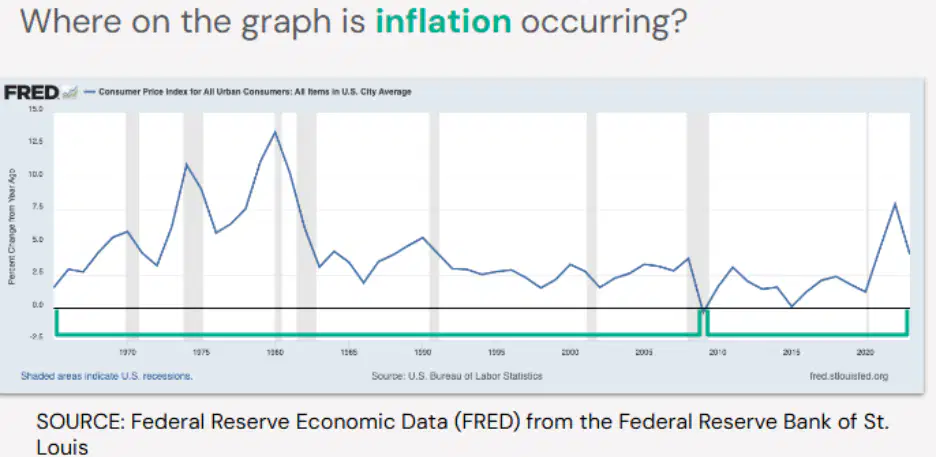
Where on the graph is inflation occurring?
When the percent change in the Consumer Price Index is above 0%
When the percent change in the Consumer Price Index is below 0%
When the percent change in the Consumer Price Index is exactly 0%
When the percent change in the Consumer Price Index is negative
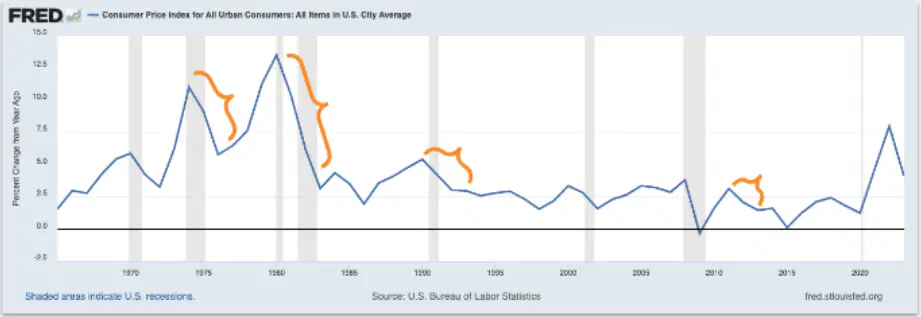
Where on the graph is disinflation occurring?
At the section where the inflation rate is decreasing but remains positive.
At the section where the inflation rate is increasing.
At the section where the inflation rate is constant.
At the section where the inflation rate is negative.
Deflation: a general, sustained ______ movement of the general price level for goods and services in an economy.
downward
upward
sideways
random
Inflation rate: the percentage change in the general price level of goods and services over a period of ______.
time
distance
weight
color
What does the Consumer Price Index (CPI) measure?
The price level paid by households for a representative basket of goods and services
The total amount of money in circulation
The unemployment rate
The interest rate
The base year in CPI calculations is used to measure changes in the cost of living over time.
True
False
Explain how the base year helps economists and policymakers analyze inflation.
The base year provides a reference point for comparing price changes over time.
The base year determines the amount of money in circulation.
The base year sets the interest rates for the economy.
The base year predicts future inflation rates.
Causes of inflation include:
An increase in demand for many goods and services
An increase in production costs for many goods and services
Both A and B
None of the above
If the general price level falls, what are two likely consequences for households and firms?
Households will likely reduce spending; Firms will likely lay workers off.
Households will likely increase spending; Firms will likely hire more workers.
Households will likely save less; Firms will likely expand production.
Households will likely borrow more; Firms will likely raise prices.
Consequences of Deflation include:
Increase in consumer spending
Increase in GDP growth rate
Increase in unemployment
Increase in incomes
What does the Business Cycle refer to?
recurring pattern of growth and decline in economic activity over time
the annual government budget planning process
the process of starting and closing a business
the regular schedule of stock market trading hours
In the business cycle, which stage is characterized by the highest point of economic activity?
Expansion
Peak
Contraction / Recession
Trough
Match each stage of the business cycle with its correct description:
Expansion
Economic activity is growing
Peak
Highest point of economic activity
Contraction / Recession
Economic activity slows down
Trough
Lowest point in the cycle
During which stage of the business cycle does unemployment decrease?
Expansion
Peak
Contraction / Recession
Trough
Fill in the blank: The price of lending and borrowing money is called _________.
interest rate
dividend
commission
premium
Savers earn interest by depositing money in the bank. They supply money.
True
False
Which stage of the business cycle marks the end of a recession?
Expansion
Peak
Contraction / Recession
Trough
During which stage does the inflation rate decrease?
Expansion
Peak
Contraction / Recession
Trough
Who pays interest to the bank for their loan?
Borrowers
Depositors
Shareholders
Employees
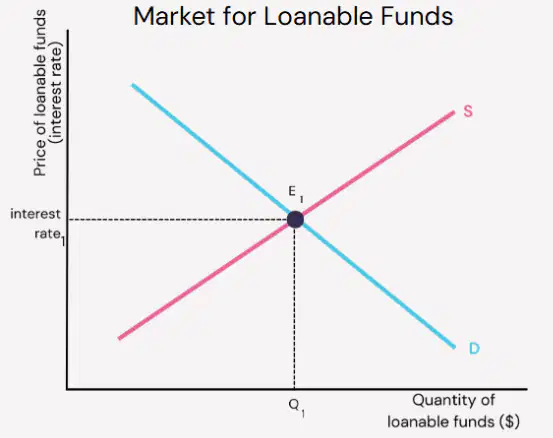
Refer to the diagram 'Market for Loanable Funds'. What does the intersection point E1 represent?
The equilibrium interest rate and quantity of loanable funds.
The maximum possible interest rate in the market.
The point where demand for loanable funds is zero.
The minimum quantity of loanable funds supplied.
Which of the following is an effect of an increase in interest rates?
Incentivizes spending
Incentivizes saving
Can result in a period of economic expansion
Can result in a period of economic contraction
Which of the following is an effect of a decrease in interest rates?
Incentivizes saving
Incentivizes spending
Can result in a period of economic contraction
Can result in a period of economic expansion
What is monetary policy?
The process of adjusting interest rates in an effort to influence economic conditions.
The process of setting tax rates to fund government spending.
The regulation of international trade agreements.
The management of government budgets and expenditures.
The Federal Reserve System conducts the nation's monetary policy.
True
False
What is the goal of promoting stability in the financial system according to the Federal Reserve?
Promote maximum profits for banks
Promote stable prices and maximum employment
Increase government spending
Reduce taxes
What does the Federal Open Market Committee (FOMC) do?
Sets tax rates
sets the target range for the Federal Funds Rate
Provides food assistance
Issues rebates
Fill in the blank: Raising the Federal Funds Rate will ______ the cost of borrowing and increase the benefit of saving, leading to less borrowing for interest-sensitive spending and more saving.
raise
lower
ignore
reduce
Raising the Federal Funds Rate is used to reduce inflation by:
Increasing the money supply
Decreasing the money supply
Increasing government spending
Lowering taxes
Lowering the Federal Funds Rate will lower the cost of borrowing and reduce the benefit of saving, leading to more borrowing for interest-sensitive spending and less saving. This is used to combat:
Inflation
Disinflation and deflation
Unemployment
Tax evasion
Fill in the blank: Fiscal Policy is government spending and ______ to influence a country's economy.
taxation
immigration
education
transportation
Which of the following is an example of Expansionary Fiscal Policy?
Increasing taxes
Decreasing government spending
Increasing spending or cutting taxes to stimulate economic growth
Reducing transfer payments
Fill in the blank: Rebates are a one-time, lump-sum payment or tax reduction provided by the government directly to ______ to immediately increase their income.
households
corporations
banks
foreign investors
Which of the following is a mechanism of contractionary fiscal policy?
Increasing government spending
Raising taxes
Increasing subsidies
Increasing transfer payments
Fill in the blank: Cutting government expenditures on goods and services, such as infrastructure or defense, directly ______ aggregate demand in the economy.
reduces
increases
eliminates
ignores
Which of the following is a pro of contractionary fiscal policy?
Slows economic growth and consumer spending
Can lead to increased unemployment
Reduces inflation by decreasing demand
May disproportionately affect low- and middle-income groups
Fill in the blank: Fiscal policy is enacted by the ______ branch of government.
legislative
executive
judicial
administrative
Fill in the blank: Monetary policy is enacted by a government's ______.
central bank (The FED)
parliament
supreme court
treasury department
Both fiscal and monetary policies are used to prevent the economy from overheating and to avoid recessions and depressions.
True
False
What is the definition of a budget deficit?
When a government's spending exceeds its revenue within a specific period
When a government's revenue exceeds its spending
When a government borrows money
When a government issues securities
Fill in the blank: The formula for deficit is ________ - Government Revenue (where spending > revenue).
Government Spending
Government Debt
Government Assets
Government Surplus
Governments often intentionally run a deficit to stimulate the economy during recessions by increasing spending or cutting taxes.
True
False
What is the effect of a budget deficit?
It must be financed by borrowing, which adds to the national debt
It reduces the national debt
It increases government revenue
It leads to budget surplus
Fill in the blank: A budget surplus occurs when ________ > spending.
revenue
debt
taxes
loans
What is the definition of national debt?
The total, cumulative amount of money the government owes to its creditors
The annual government spending
The government revenue from taxes
The amount borrowed in a single year
Fill in the blank: The national debt is the aggregate result of all past budget deficits minus any budget ________ that have occurred throughout a nation's history.
surpluses
expenses
revenues
loans
Which of the following is a financing tool for the government to cover its deficits?
Issuing securities like Treasury bonds, bills, and notes
Increasing taxes
Reducing spending
Printing more money
Which of the following is a macroeconomic impact of high national debt?
Higher interest payments
Crowding out private investment
Concerns about long-term fiscal sustainability
All of the above
The first step to take in measuring inflation is to
a.
convert the dollar cost of representative goods to an index value
find the percentage change in the monthly price level
select a market basket
find the average price of representative goods
What is Inflation?
Money being able to buy more products
is rising general level of products and it reduces the “production power” of money.
is rising general level of prices and it reduces the “purchasing power” of money.
is lowering general level of prices and it raises the “purchasing power” of money.
What happens when there is too much money and too few goods/products?
Prices go lower?
Recession
economics
inflation
Which of the following is the best example of frictional unemployment?
A construction worker is laid off in December because freezing weather has brought all outdoor building projects to a temporary halt.
A coal miner loses his job because a power company switched from coal to a more cost-effective natural gas, and he lacks the skills for new energy sector jobs.
A factory worker is laid off as consumer demand plummets during an economic recession.
A recent college graduate is currently interviewing for positions and is optimistic about finding a job that fits her degree and career goals.
Which of the following transactions is excluded from the calculation of a country's Gross Domestic Product (GDP)?
A consumer buying a ticket to see a new movie at a local cinema.
A domestic company purchasing new computer servers for its data center.
The purchase of 100 shares of a publicly traded company on the New York Stock Exchange.
The government paying the salary of a newly hired state park ranger.
Which economic indicator is defined as the percentage change in the price level of a basket of goods and services over a specified period of time?
GDP
Inflation rate
Federal Funds Rate
Unemployment rate

