

wayground logo

Free Printable Worksheets

Font size

S
M
L
XL
Worksheets

2nd 6 week's assessment

Total questions: 86

Worksheet time: 1hrs 28mins
Name
Class
Date
1.
Early observers thought continents may have been joined based on what observations
a)
rocks and fossils
b)
earthquakes.
c)
magnetism.
d)
coastline
2.
A German scientist Alfred Wegener was the first to hypothesize that ...........
a)
Continents were once joined
b)
The sea floor is spreading
c)
Continents are moving
d)
The Earth's magnetic pole flips
3.
Pangaea was an ancient supercontinent made up of...
a)
America, Greenland, and Europe.
b)
Antarctica, India, and America.
c)
all of Earth’s continents.
d)
South Africa, India, Australia, and South America.
4.

In sea-floor spreading, molten material rises from the mantle and erupts

a)

along the edges of all the continents.

b)

along mid-ocean ridges.

c)

in deep-ocean trenches.

d)

at the north and south poles.

5.

Most geologists think that the movement of Earth’s plates is caused by _______

a)

convection.

b)

continental drift.

c)

subduction.

d)

conduction.

6.

The geological theory of _______ states that pieces of Earth’s lithosphere are in constant, slow motion.

a)

subduction

b)

plate tectonics

c)

deep-ocean trenches

d)

sea-floor spreading

7.

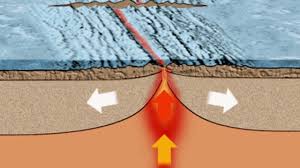
Below is a picture of sea-floor spreading. How are the ocean crusts moving?

a)

Converging

b)

Diverging

c)

Sliding

d)

No movement

8.
What are the two types of crust
a)
continental and oceanic
b)
ocean and upper
c)
lower and upper
d)
pizza and subway
9.
The Himalayas in Asia are an example of what type of plate boundary?
a)
divergent
b)
continent-to-continent convergent
c)
ocean-to-continent convergent
d)
transform
10.
What are Tectonic Plates?
a)
A continent 
b)
The Trees in Vietnam 
c)
ThE PlaTES That MoVE uNdERGRound :)
d)
The Plates that move the Continents
11.
Mountains form from ...
a)
plates sliding past one another
b)
collision of plates
c)
plates moving away from each other
12.
A plate boundary at which two plate move parallel to each other in opposite directions
a)
convergent plate boundary
b)
divergent plate boundary
c)
transform plate boundary
d)
subduction
13.

What is the name of plate 3

a)

Pacific plate

b)

Eurasian plate

c)

Antarctic plate

d)

South American plate

14.

What is the name of plate 6

a)

Eurasian plate

b)

Indo-Australian plate

c)

North American plate

d)

Antarctic plate

15.

What is the name of plate 4

a)

African plate

b)

Indo-Australian plate

c)

Pacific plate

d)

Antarctic plate

16.

What is the name of plate 1

a)

African plate

b)

North American plate

c)

Pacific plate

d)

Pacific plate

17.

What is the name of plate 2

a)

African plate

b)

North American plate

c)

Eurasian plate

d)

Pacific plate

18.

What is the name of plate 5

a)

African plate

b)

South American plate

c)

Eurasian plate

d)

Indo-Australian plate

19.

What is the name of the plate to the south of the Eurasian plate?

a)

Pacific plate

b)

South American plate

c)

Antarctic plate

d)

Indo-Australian plate

20.
Plate 1
a)
Indo-Australian
b)
Pacific Plate
c)
South American
d)
Eurasian
21.
Plate 2
a)
Indo-Australian Plate
b)
Pacific Plate
c)
South American Plate
d)
Eurasian Plate
22.
Plate 3
a)
North American Plate
b)
South American Plate
c)
African Plate
d)
Eurasian Plate
23.
Plate 4
a)
North American Plate
b)
African Plate
c)
Antarctic Plate
d)
Nazca Plate
24.
Plate 5
a)
Indo-Austrailian
b)
South American
c)
African
d)
North American
25.
Plate 6
a)
South American
b)
Antarctic
c)
African
d)
Nazca
26.
Plate 7
a)
Pacific Plate
b)
Eurasian Plate
c)
African Plate
d)
Nazca Plate
27.
Plate 8
a)
North American
b)
South American
c)
Antarctic Plate
d)
African
28.

What is the correct order (starting from the surface) of Earth’s layers?

a)

crust, outer core, inner core, mantle

b)

mantle, outer core, inner core, crust

c)

crust, mantle, outer core, inner core

d)

outer core, inner core, crust, mantle

29.
What is Pangaea?
a)
A German Scientist
b)
the name of the supercontinent that existed millions of years ago
c)
continental drift
d)
an ancient fossil
30.

Which of the following a considered a social infrastructure?

a)

Transport

b)

Education

c)

Communication

d)

Energy

31.

The basic support systems needed to keep an economy going, including power, communications, transportation, sanitation, and education form a country’s

a)

urbanization.

b)

infrastructure.

c)

industrialization.

d)

urban geography.

32.

Industrialization began where there was

a)

a sufficient supply of food.

b)

water for public use.

c)

raw materials for industry.

d)

all of these

33.

Urban areas function as centers of

a)

employment

b)

education

c)

healthcare

d)

all of these

34.
Which of these is not a reason why infrastructure is important?
a)
It makes a society more religious 
b)
It encourages economic activity 
c)
It makes transportation easier 
d)
It improves the health of society
35.
Which of these is an example of transportation infrastructure?
a)
Sewage Systems
b)
Roads
c)
Telecommunication Towers
d)
Satellites 
36.
Which of these is an example of transportation infrastructure?
a)
Water Treatment Plants
b)
Solar Panels
c)
Airports
d)
Radio Antenna 
37.
Which of these is an example of transportation infrastructure?
a)
Railroads
b)
Telecommunication Towers
c)
Natural Gas Lines
d)
Electric Lines 
38.
Which of these is an example of utility infrastructure?
a)
Roads
b)
Phone Lines
c)
Bridges 
d)
Fiber Optic Lines
39.
Which of these is an example of utility infrastructure?
a)
Tunnels
b)
Railroads
c)
Wind Turbines 
d)
Satellites 
40.
Which of these is an example of utility infrastructure?
a)
Airports
b)
Harbors
c)
Tunnels
d)
Water Treatment Plants
41.
Which of these is an example of utility infrastructure?
a)
Sewage Systems
b)
Cell Phone Towers 
c)
Highways
d)
Sidewalks
42.
Which of these is an example of communication infrastructure?
a)
Roads
b)
Cell Phone Towers
c)
Sewage Systems
d)
Bridges
43.
A large man made lake that provides the water for our homes
a)
reservoir
b)
hydroelectric
c)
dam
d)
sanitation
44.
A large wall built to stop water moving in a certain direction
a)
safeguard
b)
dam
c)
ecosystem
d)
criticism
45.
The roads and transport facilities available in a place
a)
communities
b)
activists
c)
infrastructure
d)
ecosystem
46.

Establish rules and laws to protect the people of the civilization.

a)

Government

b)

Trade

c)

Infrastructure

d)

Arts

47.

The resources of a civilization and how they produce and use them to develop wealth

a)

centralized government

b)

religion

c)

economy

d)

system of tribute

48.

There are _____ characteristics of a civilization.

a)

9

b)

1

c)

5

d)

3

49.

UCLA water main break occurred on which date?

a)

July 2014

b)

June 2004

c)

October 2015

d)

May 1994

50.

The LA water main was ______ inches in diameter.

a)

3

b)

30

c)

300

d)

3000

51.

How many cars were damaged in parking structures from LA water main break?

a)

7

b)

70

c)

700

d)

7000

52.

The California State Water project provides water for more than __________ people.

a)

20,000

b)

20,000,000

c)

2,000

d)

2,000,000

53.

The California Water Project has constructed ____ dams since 1960.

a)

21

b)

210

c)

2100

d)

21,000

54.

The Tehachapi Mountains are more than ______ feet above sea level.

a)

200

b)

2000

c)

20,000

55.

Which of the following metals are present in Earth's Core? (Select all that apply)

a)

Nickel

b)

Steel

c)

Aluminum

d)

Iron

e)

Titanium

56.

This image here shows what type of boundary?

a)

Divergent

b)

Convergent: Subduction

c)

Convergent: Collision

d)

Transform

57.

What do geologists notice about the rocks along the sea floor?

a)

They get older as they get farther away from mid ocean ridges

b)

They get thicker closer to continents

c)

Density is impossible to measure

d)

Youngest parts of the crust are along the continents

58.

Which of the following is a feature common with transform boundaries?

a)

Volcanoes

b)

Mountain chains

c)

Ocean Trenches

d)

Earthquakes

59.

Erosion slowly renews the Earth's crust

a)

true

b)

false

60.

Earth's water moves constantly

a)

true

b)

false

61.

Plate movement can cause which of the following

a)

Volcanoes

b)

Earthquakes

c)

Mountains

d)

All of these

62.
What are the three kinds of mountains?
a)
Fault-Block, Volcanic, and Dormant
b)
Fault-Block, Folded, and Towering
c)
Folded, Mechanic, and  Volcanic
d)
Folded, Volcanic, and Fault-Block
63.
This famous transform fault is located in the western United States creates significant earthquake activity for California
a)
New Madrid
b)
Denali Fault
c)
Ramapo Seismic Zone
d)
San Andreas
64.
How can Earth's plates move?  
a)
They only move toward each other.
b)
They only converge or diverge.
c)
They collide, pull apart, or slide past each other.
d)
They collide or slide along each other. 
65.
The formation of the Hawaiian Islands is one example of
a)
volcanoes forming over a hot spot
b)
volcanoes forming along plate boundaries
c)
the Ring of Fire
d)
continental drift
66.
Lava begins as
a)
water
b)
crust
c)
magma
d)
pumice
67.

What is the active volcano area around the Pacific Rim called?

a)

Hot Spots

b)

Pacific Ocean

c)

Ring of Fire

d)

Hawaii

68.

The average of 5 quantities is 6. The average of 3 of those 5 quantities is 8. What is the average of the remaining two quantities?

a)

6.5

b)

4

c)

3

d)

3.5

69.

What is another word for AVERAGE?

a)

Mode

b)

Median

c)

Mean

d)

Not nice

70.

Calculate the mean.

6, 9, 12, 5

a)

8

b)

13

c)

7

d)

3

71.

Calculate the mean.

23, 18, 9, 10, 5

a)

55

b)

13

c)

14

d)

17

72.

Calculate the mean.

2, 9, 10, 6, 8

a)

8

b)

4

c)

7

d)

22

73.

Calculate the mean.

16, 5, 7, 12

a)

9

b)

6

c)

12

d)

10

74.

Calculate the mean.

10, 4, 5, 9

a)

7

b)

5

c)

8

d)

4

75.
Find the mean:
28, 18, 19, 18, 17
a)
20
b)
18
c)
11
d)
19
76.
What is the mean of these numbers?
4,5,5,2,3,3,2,8
a)
40
b)
24
c)
4
d)
256
77.
Calculate the speed:
A bus traveled 98 Km in 2 Hours
a)
94 Km/hr
b)
49 Km/hr
c)
196 Km/hr
d)
0.02 Km/hr
78.
Calculate the speed:
A truck traveled 208 Km in 4 Hours
a)
52 Km/hr
b)
25 Km/hr
c)
0.019 Km/hr
d)
832 Km/hr
79.
Calculate the speed:
A Car traveled 240 Km in 5 Hours
a)
48 Km/Hr
b)
1200 Km/Hr
c)
4.8 Km/Hr
d)
0.02 Km/Hr
80.
All of the following are units of speed except:
a)
Seconds
b)
m/s
c)
Km/s
d)
m/min
81.
All of the following are units of speed except:
a)
Km/hr
b)
Km
c)
Kilometer per hour
d)
Kilometer/Hour
82.
All of the following are examples of speed except:
a)
A car traveling at 55 km/hr
b)
A snail hightailing it 45 mm/sec
c)
Jube timing himself at 23 seconds
d)
Lonnie running down the hall at 45 mph
83.
What is the formula to calculate speed?
a)
Speed = Distance x Time
b)
Speed = Distance/Time
c)
Speed = Time/Distance
d)
Speed = Time x Distance
84.
Which seismic wave does a seismograph detect first?  
a)
P Wave
b)
S Wave
c)
Surface Wave
85.
Which seismic wave moves at right angles?  
a)
P Waves
b)
S Waves
c)
Surface Waves
86.
Which travels fastest, always being the first detected by seismic stations?
a)
P waves
b)
S waves
