wayground logo

Free Printable Worksheets

NEW

Font size

S
M
L
XL
Worksheets

Unit 3 TEST REVIEW

Total questions: 55

Worksheet time: 47mins

Name
Class
Date
1.

Calculate the voltage across a 300-ohm resistor when a current of 0.004 amps flows through it.

a)
0.6 volts
b)
1.5 volts
c)
2.0 volts
d)
1.2 volts
2.

Calculate the current which will flow

when a total resistance of 500 Ohms is

placed in a circuit which has a 15 V

supply.

a)
0.01 A
b)
0.05 A
c)
0.10 A
d)
0.03 A
3.

What current would flow through a

resistor of 20 Ohms connected to a 12

V supply?
a)
0.4A
b)
0.6A
c)
1.2A
d)
0.8A
4.

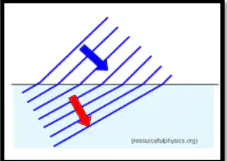
The diagram shows waves passing through a narrow opening. What wave phenomenon is being demonstrated?
a)
Diffraction
b)
Refraction
c)
Reflection
d)
Interference
5.

The diagram shows waves passing through a narrow opening. What wave phenomenon is being demonstrated?

a)
Diffraction
b)
Refraction
c)
Reflection
d)
Interference
6.

Which of the following is an example of an insulator?

a)
Copper
b)
Aluminum
c)
Iron
d)
Rubber
7.

Which of the following is an example of a conductor?
a)
Rubber
b)
Copper
c)
Wood
d)
Plastic
8.

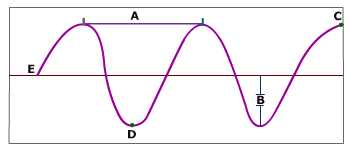
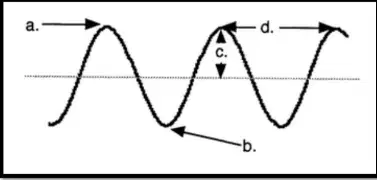
What does the letter "C" represent?

a)

Amplitude

b)
Waveform
c)
Peak
d)
Crest
9.

The _______ of a wave is how many waves pass a given point every second.

a)

Frequency

b)

Wavelength

c)

Amplitude

10.
Which letter represents wavelength?
a)
A
b)
B
c)
C
d)
D
11.
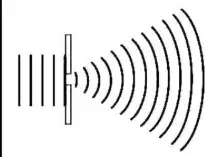
What kind of waves can travel through space?
a)
electromagnetic waves
b)
compressional waves
c)
longitudinal waves
d)
sound waves
12.
What are the spaced out sections of this wave called?
a)
Reflections
b)
Rarefactions
c)
Compressions
d)
Wavelengths
13.

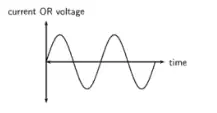
This graph best describes which current?

a)
Direct Current (DC)
b)
Pulsating Current
c)
Static Current
d)
Alternating Current (AC)
14.
What kind of wave is pictured?
a)
Transverse
b)
Longitudinal
c)
surface
d)
none of the above
15.

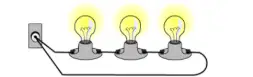
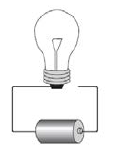
Which is true for this type of circuit?
a)
Each bulb operates independently.
b)
If one bulb goes out, others stay lit.
c)
If one bulb goes out, all bulbs go out.
d)
All bulbs can be replaced individually.
16.
Which of these best completes the circuit?
a)
rubber band
b)
metal nail
c)
leather shoelace
d)
wooden toothpick
17.
In the picture, if you replace the paper clip with a plastic spoon, what happens? 
a)
The bulb doesn't light
b)
The bulb is dimmer
c)
The wires get hot
d)
There is no charge
18.

Color seen when all visible light colors are reflected

a)
black
b)
white
c)
red
d)
blue
19.

The phenomena that explains why objects increase in pitch as they move toward an observer

a)
Doppler effect
b)
Sound wave interference
c)
Frequency modulation
d)
Acoustic resonance
20.

We see a banana as yellow because the color yellow is ____.

a)
reflected light
b)
transmitted light
c)
scattered light
d)
absorbed light
21.

Which of the following has the highest energy?

a)

microwave

b)

ultraviolet rays

c)

x-rays

d)

infrared waves

22.

What unit is used to measure the number of complete wave cycles in a second?

a)

Hertz

b)

Sievert

c)

rem

d)

frequency

23.

This EM region is used in remote controls, night vision cameras, and thermometers.

a)

infrared waves

b)

x-rays

c)

microwaves

d)

ultraviolet rays

24.

Which of the following is arranged in decreasing frequency?

a)

radio waves, microwaves, x-rays, gamma rays

b)

gamma rays, x-rays, infrared, visible light

c)

microwaves, infrared, ultraviolet waves, gamma rays

d)

x-ray, ultraviolet waves, microwaves, radiowaves

25.

What is specific heat capacity?

a)

The power needed to raise the temperature of 1 kg of a substance by 1oC.

b)

The energy needed to raise the temperature of 1 kg of a substance by 1oC.

c)

The temperature increase of 1 kg of a substance when it is heated for 1 minute.

d)

The mass of a substance whose temperature will increase by 1oC when heated for 1 minute.

26.

How do we say Δ in science and maths?

a)

Alpha

b)

Beta

c)

Gamma

d)

Delta

27.

The specific heat capacity of a substance is 1000 J/kgoC. How much energy is required to raise 1 kg of it by 1oC?

a)

10 J

b)

100 J

c)

1000 J

d)

10,000 J

28.
At which point is kinetic energy greatest?
a)
W
b)
X
c)
Y
d)
Z
29.
At which point is potential energy greatest?
a)
W
b)
X
c)
Y
d)
Z
30.

What is the value of g (the acceleration due to gravity)?

a)

9.8 m/s2

b)

12.2 m/s2

c)

10 m/s2

d)

98 m/s2

31.
A battery converts what type of energy to another?
a)
sound to kinetic
b)
light to heat
c)
mechanical to electrical
d)
chemical to electrical
32.
Energy transformations occur when...
a)
energy is created through conduction
b)
energy changes from one form to another
c)
two forces slide together that are touching
d)
a chemical reaction takes place
33.
The purpose of solar panels is to change ___________ energy into ____________.
a)
light, electrical
b)
light, chemical
c)
thermal, electrical
d)
thermal, chemical
34.
The diagram below shows a hot air balloon rising. Propane gas tanks are seen at the bottom of the balloon.  What energy transformations occur when propane gas is used to lift the balloon? 
a)
Mechanical to light to chemical
b)
Chemical to mechanical to thermal 
c)
Thermal to chemical to light
d)
Chemical to thermal to mechanical 
35.
Which of these materials transfers heat energy quickest?
a)
metal
b)
glass
c)
plastic
d)
wood
36.
Energy that travels across distances in the form of electromagnetic waves. 
a)
Convection
b)
Radiation
c)
Conduction
d)
Induction
37.
What happens to particles as they heat up?
a)
They slow down
b)
Nothing
c)
They don't move
d)
They speed up
38.
What kind of energy is represented in this picture?
a)
Thermal
b)
Potential
c)
Nuclear
d)
Mechanical
39.
A measure of the average kinetic energy of the individual particles in an object is called:
a)
thermal energy
b)
conduction
c)
convection
d)
temperature
40.
Energy is measured in units called.....
a)
pounds
b)
meters
c)
horsepower
d)
joules
41.
The Law of Conservation of Energy states:
a)
Energy can created or destroyed but not transformed 
b)
Energy cannot be created or destroyed, it can only transformed
c)
Energy can't be created, destroyed or transformed
42.

travels through solids fastest because the molecules are closer together

a)

Sound

b)

Light

c)

Waves

d)

Energy

43.
What do the lines around this magnet represent?
a)
North Pole
b)
South Pole
c)
Magnetic Declination
d)
Magnetic Field
44.
If you place the North pole of a magnet next to the South pole of another magnet, they will:
a)
Attract
b)
Repel
c)
Do nothing
d)
Shatter
45.
What kind of magnet can be turned on and off?
a)
refridgerator magnet
b)
electromagnet
c)
magnetite
d)
iron
46.
The strongest part of a magnet is...
a)
the bars.
b)
the force field.
c)
the poles. 
d)
the middle.
47.
A simple electromagnet can be made with which of the following?
a)
an electric current
b)
a turbine and nail
c)
a nail, a wire, and a battery
d)
a compass and a battery
48.

Which of the following would increase the strength of an electromagnet?

a)

Using fewer coils of wire around the core

b)

Decreasing the electric current flowing through the wire

c)

Replacing the iron core with a plastic core

d)

Increasing the number of wire coils around the core

49.

Device that works by using the Earth's natural magnetic field
a)
Gyroscope
b)
Magnetometer
c)
Barometer
d)
Compass
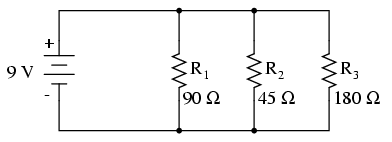
50.
This is an example of a ______ circuit
a)
Series
b)
Parallel
c)
Open
d)
Dihexihedral
51.
Does this diagram represent a series or parallel circuit?
a)
series circuit
b)
parallel circuit
52.
In a parallel circuit which of the following is the same value throughout the circuit?
a)
Voltage
b)
Current
c)
Resistance
d)
Charge
53.
The picture shows an electrical circuit. This circuit is a series circuit because: 
a)
It has 3 light bulbs.
b)
The same current flows through all three light bulbs.
c)
It uses a single battery.
d)
The electrical current is divided between the three light bulbs.
54.
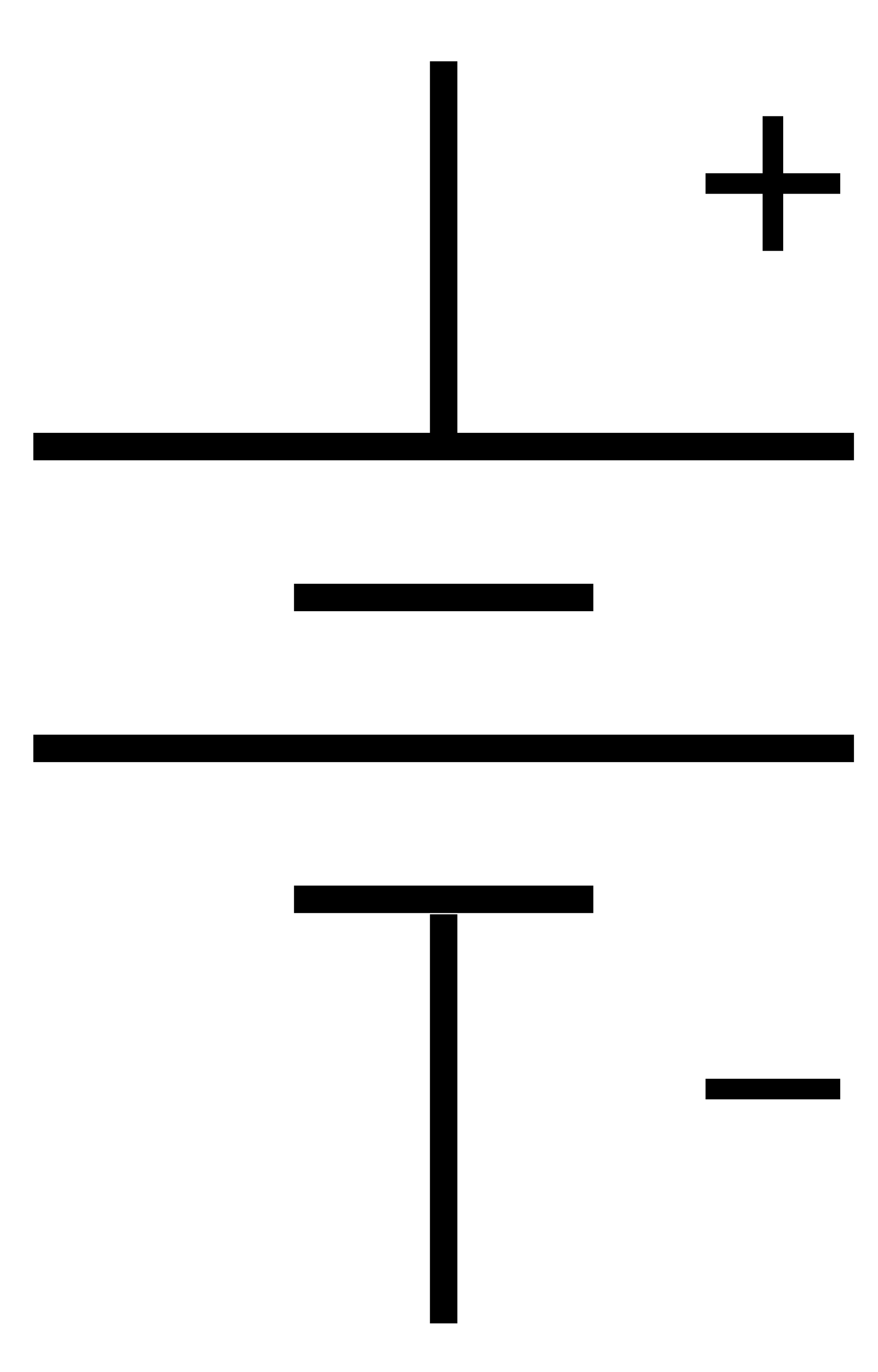
what is this symbol for?
a)
light bulb
b)
switch
c)
battery
d)
resistor
55.
What 'flows' in a wire?
a)
Protons
b)
Neutrons
c)
Atoms
d)
Electrons