
 Worksheets
Page 1
Total questions: 150
Worksheet time: 1hrs 15mins
Based on the cover image titled "Chapter 5: Reptiles" showing a green lizard perched on a branch, which organism is most likely highlighted in this chapter’s opening visual?
A lizard
A frog
A songbird
A butterfly
The opening visual for the chapter shows a reptile with distinct scales and a sturdy body on a branch. Which characteristic in the image most directly supports that it is a reptile?
Presence of scales on the skin
Feathered wings
Moist, smooth skin
Six jointed legs
The chapter title reads "Chapter 5: Reptiles." Which taxonomic group is the stated focus of this chapter?
Reptiles
Amphibians
Mammals
Insects
Considering the branch-habiting reptile shown in the chapter opener, which habitat feature is implied by the background and perch?
Terrestrial or arboreal environment
Open ocean pelagic zone
Frozen tundra with snow cover
Deep subterranean cave
Which visual detail most clearly indicates the animal is adapted for gripping onto branches?
Limb structure with clawed toes
Large flippers
Webbed hind feet only
Hoofed forelimbs
Select all features visible in the opening image that are commonly associated with reptiles.
Keratinized scales
Ectothermic body plan suggested by basking
Feathered plumage
Exoskeleton of chitin
Match each visible structure of the reptile in the image to its likely function.
Scales
Protection and moisture retention
Clawed toes
Gripping and climbing on branches
Tail
Balance and maneuvering
The chapter opener features a single animal prominently. In instructional design, such an opener typically serves which purpose for learners?
Priming the topic with a salient example
Providing exhaustive taxonomic data tables
Delivering assessment instructions
Replacing all textual content with imagery
Given the chapter title, which of the following would most appropriately be included in subsequent sections of the chapter?
Characteristics of reptilian skin
Mechanisms of thermoregulation in reptiles
Life cycles of flowering plants
Architecture of insect exoskeletons
The numeral shown at the bottom-right of the page indicates the chapter’s first page. What is the most likely purpose of this page?
Title page introducing Chapter 5
Appendix with references
Problem set solutions
Glossary of terms
According to the material, approximately how many reptile species exist worldwide?
Fewer than 500 species
About 2,000 species
More than 7,000 species
Around 70,000 species
Which statement best describes reptiles in the context provided?
They form a narrow group with limited diversity
They constitute a diverse group
They are primarily aquatic mammals
They are exclusively chelonians
In practices and research, which reptile groups are most likely to be encountered?
Snakes
Lizards
Chelonians
Crocodilians
Match each reptile group with the example context from the material.
Snakes
Common in practices and research
Lizards
Common in practices and research
Chelonians
Common in practices and research
Which option lists only reptile groups mentioned as commonly seen in practices and research?
Snakes, lizards, chelonians
Lizards, mammals, amphibians
Chelonians, birds, insects
Snakes, crocodilians, fish
What is emphasized about the taxonomic breadth of reptiles in the source?
They include more than 7,000 species, indicating high diversity
They consist of a single family with uniform traits
Their species count is unknown and not estimated
They are defined by mammalian characteristics
Select all statements that align with the presented information about reptiles.
Reptiles are a diverse clade
More than 7,000 reptile species are recognized
Snakes and lizards are rarely encountered in research
Chelonians are among the groups likely seen in practice
Which of the following is NOT identified as commonly seen in practices and research?
Snakes
Lizards
Chelonians
Birds
Based on the visual with icons (tree and snake), what dual emphasis is conveyed about reptiles?
Conservation status and feeding habits
Diversity of the group and commonly encountered subgroups
Reproductive cycles and migration patterns
Aquatic adaptations and mammalian features
Which list correctly pairs the reptile category with the statement from the material?
Diverse group
Reptiles overall
Most likely to be seen in practices and research
Snakes, lizards, chelonians
More than 7,000 species
Reptile species count emphasis
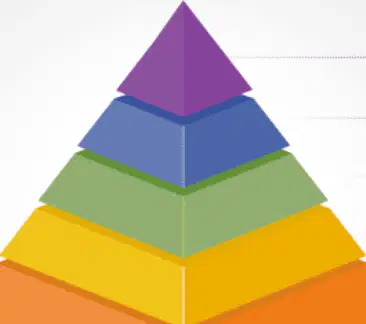
Using the taxonomic hierarchy shown in the pyramid diagram, which rank is immediately more specific than Genus?
Family
Species
Order
Class

In the illustrated hierarchy, which rank sits directly above Class (i.e., less specific than Class)?
Order
Phylum
Family
Genus

Select all ranks that are more general (broader) than Order according to the hierarchy depicted.
Class
Family
Phylum
Kingdom
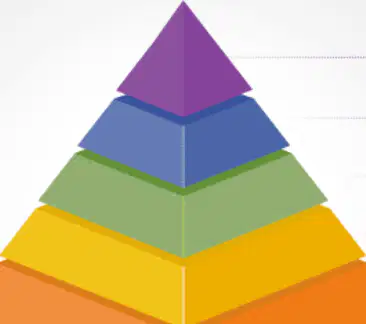
Match each taxonomic rank with its relative position in the pyramid (1 = most specific apex, 7 = broadest base).
Species
1
Genus
2
Family
3
Order
4
Class
5
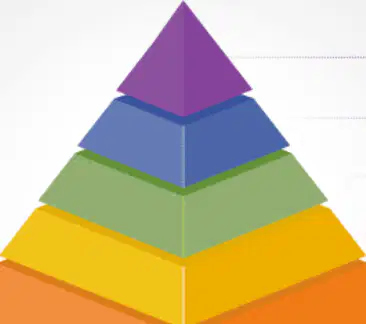
According to the diagram, which sequence correctly orders ranks from most general to most specific?
Kingdom → Phylum → Class → Order → Family → Genus → Species
Species → Genus → Family → Order → Class → Phylum → Kingdom
Kingdom → Class → Phylum → Order → Family → Genus → Species
Phylum → Kingdom → Class → Order → Family → Species → Genus

Which rank would include multiple families under it in the hierarchy shown?
Genus
Order
Species
Phylum

Choose all ranks that are more specific than Family in the depicted hierarchy.
Genus
Order
Species
Class

Which statement best describes the relationship between Phylum and Kingdom in the diagrammed taxonomy?
Phylum is broader than Kingdom.
Phylum is nested within Kingdom and is more specific than Kingdom.
Phylum and Kingdom are equivalent levels.
Phylum is more specific than Species but broader than Genus.
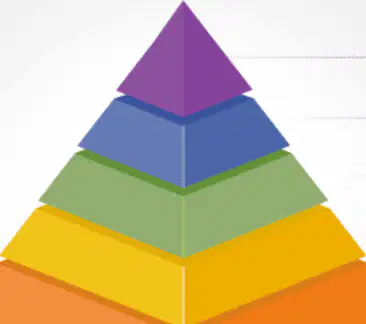
Match each pair to indicate which broader rank directly contains the narrower one in the illustrated hierarchy.
Genus
Family
Order
Class
Class
Phylum
Phylum
Kingdom
Family
Order

In the context of reptiles, which rank would be used to identify a single, interbreeding population according to the hierarchy shown?
Genus
Species
Family
Order
According to the visual, which taxonomic rank is Chelonia associated with for chelonians?
Class
Order
Superorder
Family
Which taxonomic order includes box turtles, red-eared sliders, and tortoises as shown in the visual?
Squamata
Crocodylia
Testudines
Chelonia
Select all groups explicitly listed as examples under Order Testudines in the visual.
Box turtles
Red-eared sliders
Tortoises
Iguanas
Which pairing correctly matches the taxonomic level from the visual to the named group?
Chelonia
Superorder
Testudines
Order
Box turtles
Example group
Red-eared sliders
Example group
Which statement best describes the relationship between Chelonia and Testudines as presented?
Chelonia is a synonym for Testudines with identical rank.
Chelonia is the superorder, and Testudines is the order within it.
Testudines is the superorder above Chelonia.
Chelonia is a family that includes Testudines.
Which organism shown or referenced in the visual is classified under Order Testudines?
Box turtle
Green anole
Komodo dragon
Gharial
Identify the item that is NOT listed among the examples under Order Testudines in the visual.
Box turtles
Red-eared sliders
Tortoises
Alligators
Which of the following correctly categorizes chelonians based on the visual information?
Reptiles grouped in Superorder Chelonia with Order Testudines examples
Amphibians grouped in Order Chelonia with Class Testudines examples
Fish grouped in Superfamily Chelonia with Order Squamata examples
Birds grouped in Order Chelonia with Family Testudines examples

Select all taxa levels explicitly named in the visual.
Superorder
Order
Class
Family
Which example listed under Order Testudines is commonly kept as an aquatic pet, as indicated by the name in the visual?
Box turtles
Red-eared sliders
Tortoises
Komodo dragons
According to the excerpt, which taxonomic order includes both snakes and lizards?
Testudines
Crocodylia
Squamata
Serpentes
Which group is listed as part of snakes within the order described: Boas, Pythons, King snakes, Corn snakes, and Gopher snakes? Select all that apply.
Boas
Pythons
King snakes
Corn snakes
Gopher snakes
Which of the following is explicitly identified as not a separate order but included under the order stated in the excerpt?
Lizards
Turtles
Crocodiles
Amphibians
Match each item to its correct category as presented in the excerpt.
Boas
Snakes within Squamata
Pythons
Snakes within Squamata
King snakes
Snakes within Squamata
Corn snakes
Snakes within Squamata
Based on the excerpt, which statement best characterizes Squamata?
An order comprising turtles and tortoises
An order that includes snakes and lizards
A family restricted to king snakes
A class that contains crocodiles and alligators
Select the items that are examples specifically listed under snakes in the excerpt.
Gopher snakes
Monitor lizards
Corn snakes
Boas
Which option is a taxonomic label at the same level as 'Order' in biological classification as used in the excerpt?
Squamata
Boas
Lizards
King snakes
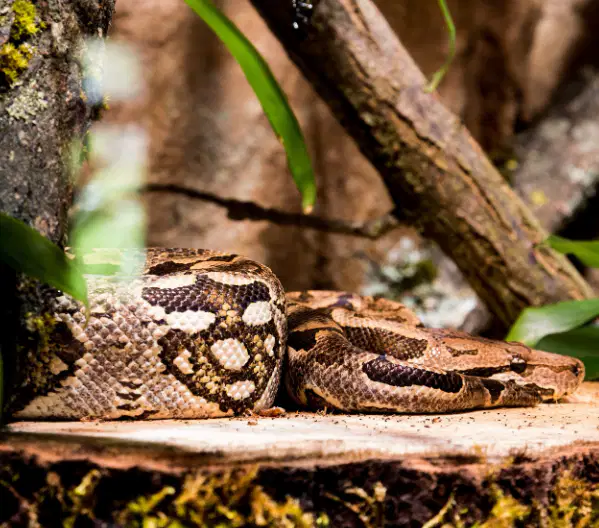
In the provided photos, identify what type of animals are depicted according to the excerpt.
Turtles belonging to Testudines
Snakes within the order Squamata
Crocodiles from Crocodylia
Frogs within Amphibia
Which of the following is not listed as an example of snakes in the excerpt?
King snakes
Corn snakes
Gopher snakes
Vipers
Choose all taxa that the excerpt places under Squamata.
Snakes
Lizards
Turtles
Crocodiles
According to the material, which research area leverages similarities between human and snake skin to study movement of substances across the skin?
Ecologic research
Transdermal research
Embryology
Natural history research
Which statement best describes one stated role of snake venom in biomedical investigation?
Primary source of genetic templates for limb development
Source of protein for biologic activity at the cell surface
Universal antiseptic for ecological fieldwork
Model for human vocal cord physiology
Select all research domains explicitly linked to snakes and their venom in the material.
Ecologic research
Embryology
Transdermal research
Nutritional epidemiology
Which pairing correctly matches the listed topic with its description or focus in the material?
Venom proteins
Biologic activity at the cell surface
Human–snake skin similarities
Basis for transdermal inquiries
Ecologic research
Population and environment interactions
Natural history research
Species traits and historical patterns
Which area is framed as using snakes to investigate developmental processes?
Embryology
Transdermal research
Ecologic research
Natural history research
In the context provided, natural history research with snakes most plausibly concentrates on which theme?
Immediate clinical trials of antivenom
Long-term documentation of species life histories and traits
Economic modeling of antivenom markets
Microscopic analysis of plant cells
Which set lists only topics named under "Snakes and their venom"?
Source of protein for biologic activity at the cell surface
Similarities between human and snake skin
Transdermal research
Cognitive behavioral therapy
Choose the best reason the material gives for using snakes as an animal model in cell-surface studies.
Their scales mimic plant cuticles
Their venom provides proteins active at cell membranes
Their eyes contain photoreceptors identical to humans
Their diet closely matches human nutrition
Which topic explicitly concerns interactions between organisms and their environments as applied to snakes?
Embryology
Ecologic research
Transdermal research
Genomic editing
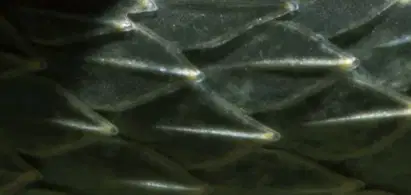
Refer to the image of the coiled snake with textured scales. Which listed topic most directly uses comparative skin features highlighted by such an image?
Natural history research
Transdermal research
Ecologic research
Embryology
Which statement best describes ectothermic organisms as presented: they derive the majority of their heat from outside sources, or they generate most of their heat internally?
They derive the majority of their heat from outside sources
They generate most of their heat internally
They maintain constant body temperature regardless of environment
According to the material, what does the term coelom indicate in these animals?
A segmented body cavity separated by a diaphragm
One visceral cavity with no diaphragm
Two thoracic cavities divided by a muscular wall
A fluid-filled cavity restricted to the cranial region
Which process is defined as the regular shedding of the outermost layer of skin?
Metamorphosis
Ecdysis
Keratinization
Molting of feathers
Based on the description, how do different reptile groups typically shed during ecdysis?
Snakes shed in pieces; lizards and chelonians shed in one piece
Snakes shed in one piece; lizards and chelonians shed in pieces
Lizards shed as a liquid; snakes shed as scales
Chelonians do not shed at all
Which statement about chromatophores (some species) is accurate from the text?
They are muscle fibers that aid in locomotion
They are specialized pigment-containing skin cells allowing color change
They are oxygen-carrying cells in the blood
They are sensory neurons detecting heat
Match each feature to its defining characteristic.
Ectothermic
Derive majority of heat from outside sources
Coelom
One visceral cavity with no diaphragm
Ecdysis
Regular shedding of outer skin
Chromatophores
Pigment-containing skin cells enabling color change
Which combination correctly pairs a feature with an example or consequence stated in the material?
Ecdysis—snakes shed in one piece
Ecdysis—lizards and chelonians shed in one piece
Chromatophores—enable changing colors
Coelom—presence of a diaphragm dividing the cavity
Which feature would most directly explain why an animal’s body temperature fluctuates with ambient conditions?
Chromatophores
Ectothermy
Coelom
Ecdysis
Select all statements that align with the provided description of coelom in these animals.
It is a single visceral cavity
It lacks a diaphragm
It consists of separate thoracic and abdominal compartments
It is divided by a muscular wall
Which feature is directly related to skin pigmentation rather than body temperature or cavity structure?
Ectothermy
Coelom
Chromatophores
Ecdysis
According to the excerpt, which skull type is characteristic of chelonians?
Anapsid skulls with no temporal openings
Diapsid skulls with two temporal openings
Synapsid skulls with a single temporal opening
Kinetic skulls with multiple movable plates
Which statement best describes skulls in other reptiles (non-chelonian) as presented in the excerpt?
They lack temporal openings entirely
They have temporal openings consistent with diapsid morphology
Their jaws are fused at the mandibular symphysis
They show a single occipital opening without spinal flexibility
In snakes, what is true about the mandibular symphysis according to the material?
It is fully fused, preventing jaw movement
It is connected with ligaments rather than being fused
It is cartilaginous and permanently separated
It is absent, with a single lower jaw bone
Which feature enables independent jaw movement in snakes as described?
Rigid cranial sutures
Ligamentous mandibular symphysis
Expanded occipital condyle
Lack of temporal openings
Identify the correct pairing of reptile group and skull type based on the excerpt.
Chelonians
Anapsid skulls
Other reptiles (non-chelonian)
Diapsid skulls
Snakes
Ligamentous mandibular symphysis allowing independent jaws
Which statement about temporal openings aligns with the excerpted content?
Chelonians are anapsids and have no temporal openings
Diapsid reptiles possess temporal openings
Snakes have enlarged temporal openings that fuse the jaws
All reptiles lack temporal openings entirely
What vertebral characteristic is noted in the material?
Inflexible spines with multiple occipital openings
Flexible spines with a single occipital opening
Rigid spines with fused occipital plates
Segmented spines with paired occipital openings
Which feature distinguishes chelonian skulls from diapsid reptile skulls in the excerpt?
Presence of kinetic joints in the palate
Absence of temporal openings
Fusion of the mandibular symphysis
Multiple occipital openings
Based on the excerpt, which combination correctly links skull openings to taxonomic grouping?
Anapsid—temporal openings present; Diapsid—no temporal openings
Anapsid—no temporal openings; Diapsid—temporal openings
Anapsid—single occipital opening; Diapsid—ligamentous jaws
Anapsid—fused jaws; Diapsid—flexible spines

Refer to the image of the snake head. Which anatomical adaptation in snakes facilitates prey ingestion as described in the excerpt?
Fused mandibular symphysis preventing lateral movement
Ligamentous connection at the mandibular symphysis enabling independent jaw motion
Solid maxillary arch that restricts gape
Absence of an occipital opening increasing cranial rigidity
In chelonians, which structure forms the dorsal shell?
Carapace
Plastron
Scute matrix
Nuchal pad
Which statement best describes the plastron in chelonians?
It is the dorsal shell composed of bony plates.
It is the ventral shell that can be hinged in some species.
It is the lateral shell connecting limbs to the torso.
It is a cartilaginous ridge along the spine.
Some chelonians possess hinged plastrons. What is the primary adaptive benefit of this feature?
Improved swimming efficiency by reducing drag
Enhanced protection from predators and desiccation when withdrawn
Facilitates egg-laying by expanding the shell opening
Allows greater flexibility for terrestrial locomotion
Identify the accurate musculoskeletal trait for most reptiles.
Four digits on front feet and five on rear feet
Five digits on front and rear feet
Hindlimbs shorter than forelimbs
Forelimbs longer than hindlimbs
Which pairing correctly matches the term with its description for chelonian shell anatomy?
Carapace
Dorsal shell
Plastron
Ventral shell
Hinged plastron
Allows complete withdrawal for protection
Multi-select: Which features are specifically noted for chelonians? Select all that apply.
Dorsal carapace
Ventral plastron
Hinged plastron in some species
Hindlimbs longer than forelimbs
Multi-select: Which statements describe musculoskeletal traits of most reptiles? Select all that apply.
Five digits on front feet
Five digits on rear feet
Hindlimbs longer than forelimbs
Plastron forms the dorsal shell
A tortoise withdraws fully into its shell using a hinged plastron. What dual protection does this provide according to the material?
From predation and UV radiation
From predators and desiccation
From thermal stress and parasites
From drowning and salt imbalance
Which statement contrasts chelonians with most reptiles based on limb and shell features?
Chelonians have five digits on forelimbs, while most reptiles lack digits.
Chelonians possess dorsal carapace and ventral plastron; most reptiles show hindlimbs longer than forelimbs.
Chelonians have hinged forelimbs; most reptiles have hinged hindlimbs.
Chelonians’ hindlimbs are shorter; most reptiles’ forelimbs are longer.
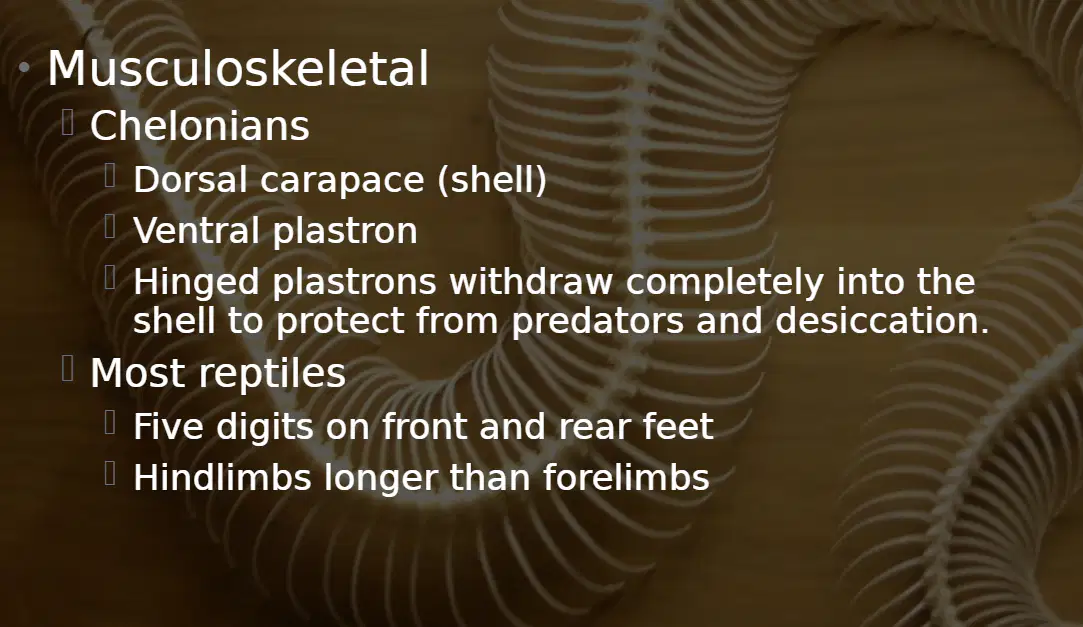
Refer to the visual of a coiled reptile skeleton on wood. Which listed musculoskeletal trait is generally true for most reptiles depicted?
Forelimbs longer than hindlimbs
Hindlimbs longer than forelimbs
Three digits per foot
Absence of a ventral plastron
According to the provided notes on reptile respiratory anatomy, which statement best describes how reptiles compare to mammals?
Reptile respiratory systems are very similar to those of mammals
Reptile respiratory systems are very different from those of mammals
Reptiles have identical glottis placement across species like mammals
Reptiles rely on vocal cords for sound production like mammals
Which capability is highlighted for reptiles regarding breathing during prolonged periods?
They cannot survive more than a few seconds without breathing
They are capable of surviving long periods without breathing
They require continuous ventilation due to high metabolic rates
They only survive long periods without breathing when hibernating
The location of the glottis in reptiles varies by species. What functional consequence is noted for glottis positioning?
It prevents breathing while ingesting
It enables breathing while ingesting
It blocks airflow to enhance vocalization
It fixes the trachea so swallowing is impossible
Reptiles are described as lacking vocal cords. What sounds are they noted to produce?
Complex songs
High-pitched whistles
Hiss or grunt
Clicks with tonal modulation
Which statement about tracheal rings among reptiles is accurate based on the material?
Tracheal rings are complete in all reptiles
Tracheal rings are incomplete in chelonians and complete in snakes
Tracheal rings are complete in chelonians and incomplete in other reptiles
Tracheal rings are absent in reptiles but present in mammals
Regarding reptile lungs, which configuration is mentioned?
Always bilobed lungs only
Always a single lung only
Single or bilobed lungs
Multiple lobes similar to mammalian lungs
Multi-select: Which of the following statements align with the respiratory notes for reptiles? Select all that apply.
Glottis location can vary depending on species
Reptiles possess vocal cords that enable hissing
Reptiles can breathe while ingesting due to glottis positioning
Tracheal rings are complete in chelonians
Reptiles cannot survive long periods without breathing
Match each feature to its correct description regarding reptile respiration.
Glottis location
Varies by species and allows breathing while ingesting
Vocal cords
Absent; typical sounds are hiss or grunt
Tracheal rings in chelonians
Complete (contrast with incomplete in other reptiles)
Lung configuration
Can be single or bilobed
In reptiles, which anatomical feature specifically enables breathing while ingesting?
Presence of vocal cords
Fixed trachea
Glottis location
Bilobed lungs
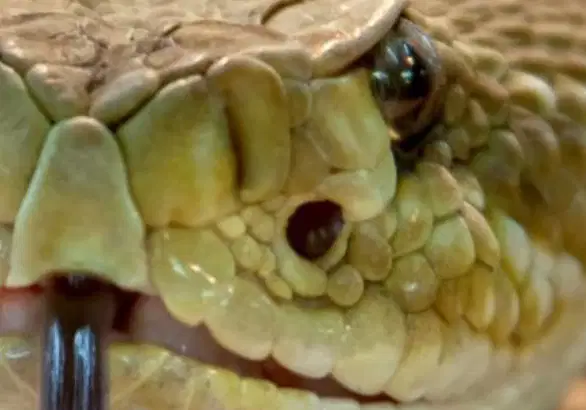
Refer to the image of the snake head and tongue. Based on the accompanying respiratory notes, which statement is most consistent with the depicted animal’s respiratory anatomy?
The snake has complete tracheal rings like other reptiles
The snake’s glottis positioning allows it to breathe while ingesting prey
The snake relies on vocal cords to produce a hiss
The snake has multiple lobed lungs similar to mammals
Which statement best characterizes dietary diversity among reptiles as presented in the material?
Reptiles are exclusively carnivorous across all taxa.
Reptiles include carnivorous, omnivorous, and herbivorous species.
Reptiles are strictly herbivorous except snakes.
Reptiles are omnivorous only when aquatic.
According to the material, what is true about snake diet?
Snakes are strict carnivores.
Snakes are opportunistic herbivores.
Snakes are primarily omnivores with occasional carnivory.
Snake diet varies widely with many herbivorous species.
The forked tongue in certain reptiles is primarily associated with which function described?
Thermoregulation via evaporative cooling.
Scent detection linked to Jacobson’s organ.
Mechanical manipulation of prey.
Production of vocalizations for communication.
Chelonians are noted in the material for which oral feature?
Presence of numerous conical teeth.
Absence of teeth, possessing tomia or a beak.
A specialized molar battery for grinding cellulose.
Retractable fangs used only during mating.
In reptile carnivores discussed, which anatomical adaptation facilitates swallowing prey?
A rigid, narrow esophagus and reduced stomach.
A thin, distensible esophagus and stomach.
A multi-chambered stomach for fermentation.
An external gular pouch that pre-digests food.
Which pairing correctly matches the reptile feature to its function, based on the material?
Forked tongue
Scent detection via Jacobson’s organ
Tomia
Beak-like cutting edges in place of teeth
Distensible esophagus
Allows passage of prey during swallowing
Chelonians
Group noted for lacking teeth
Which statements about reptile dietary categories are accurate according to the content? Select all that apply.
Reptiles can include herbivorous species.
All reptiles are omnivorous.
Snakes are strict carnivores.
Chelonians possess true teeth used for cutting meat.
What term in the material refers to the beak or cutting edges that replace teeth in certain reptiles?
Rugae
Tomia
Carina
Labium
Which description best explains how carnivorous reptiles accommodate large prey during ingestion?
By chewing extensively with molars before swallowing.
By expanding a thin, distensible esophagus and stomach to allow passage of prey.
By storing prey in a crop prior to digestion.
By regurgitating repeatedly to break down prey.
Identify the feature and associated organ that together aid in chemical sensing as described.
Single tongue and pineal gland.
Forked tongue and Jacobson’s organ.
Nictitating membrane and pit organ.
Beak and tympanic membrane.
According to the described urinary anatomy, where is excrement stored in these reptiles?
In the bladder only
In cloaca/rectum
In a separate urine sac
In the small intestine
Which components are explicitly listed as making up the excrement stored in the cloaca/rectum? Select all that apply.
Urine
Urates
Feces
Bile
What is the renal portal system primarily characterized as in these animals?
An endocrine feedback loop controlling urine concentration
A network of vessels associated with kidneys
A specialized lymphatic drainage of the cloaca
A muscular sphincter complex regulating excretion
Why is the renal portal system considered clinically significant?
It enhances systemic distribution of medications injected cranial to the kidneys
It prevents any medication from reaching the kidneys
Medications injected caudal to the kidneys can be carried directly back to the kidneys
It increases fecal excretion of injected drugs
Which injection site poses a risk of delivering medication directly to the kidneys via the renal portal system?
Cranial to the kidneys
Caudal to the kidneys
Intracardiac
Intratracheal
What potential consequence is noted when medications are carried back to the kidneys through the renal portal system?
Enhanced kidney regeneration
Damages kidney
Complete prevention of systemic absorption
Immediate excretion without filtration
Match each term to its description based on the urinary features described.
Cloaca/rectum
Storage location for excrement
Urates
Nitrogenous waste component of excrement
Renal portal system
Network of vessels associated with kidneys
Caudal injection site
Can route medications directly back to kidneys
Which statement best explains the clinical handling of injectable medications in reptiles with a renal portal system?
Always inject caudal to the kidneys to speed systemic distribution
Avoid caudal injections because drugs may be shunted to kidneys first
Prefer intramuscular injections near the heart to protect the kidneys
Use bile salts to block renal portal transport
Select all contents that would NOT be expected in the excrement stored in the cloaca/rectum, based on the description.
Bile
Urine
Urates
Feces

Identify the visual referenced: a snake illustrates the context of the renal portal system. Use the image to recall which anatomical region relative to the kidneys creates concern for injections.
Cranial region is concerning due to systemic shunting
Caudal region is concerning due to direct renal return
Mid-body region is safest due to equal distribution
Head region is preferred to avoid renal exposure
According to the excerpt, which statement correctly defines oviparous reproduction in reptiles? "All turtles and some reptiles lay eggs."
Oviparous reptiles give birth to live young
Oviparous reptiles lay eggs
Oviparous reptiles incubate eggs inside the mother until hatching
Oviparous reptiles provide extended parental care to offspring
Which term refers to reptiles that give birth to live young? The excerpt states: "Some lizards and snakes give birth to live young."
Oviparous
Viviparous
Hemipenes
Metamorphosis
What reproductive structure is noted for male snakes and lizards in the excerpt?
Cloacal spurs
Hemipenes
Spermatophores
Gonopodium
Based on the excerpt, which statement about parental care in most reptile species is accurate?
Most species do not care for the eggs or offspring
Most species guard nests for several months
Most species feed hatchlings until independence
Most species build communal nests and share care
Select all statements that are supported by the excerpt.
All turtles lay eggs
Some lizards and snakes are viviparous
Male snakes and lizards possess hemipenes
Most reptile species provide extensive parental care
Match each reproductive term to its correct description.
Oviparous
Lay eggs
Viviparous
Give birth to live young
Hemipenes
Male reproductive organs of snakes and lizards
Which group is explicitly described in the excerpt as laying eggs?
All turtles and some reptiles
Only snakes
Only lizards
No reptiles
Which claim about reptile reproduction is contradicted by the excerpt?
Some lizards and snakes give birth to live young
Male snakes and lizards have hemipenes
Most species provide parental care to eggs or offspring
All turtles lay eggs
According to the excerpt, which statement best contrasts oviparous and viviparous strategies?
Oviparous involves live birth; viviparous involves egg-laying
Oviparous involves egg-laying; viviparous involves live birth
Both involve extended parental care after hatching
Both apply only to turtles
Refer to the image of a lizard with eggs in sandy soil. Which reproductive strategy is most consistent with that visual and the excerpt’s definitions?
Viviparous, because live young are shown
Oviparous, because eggs are present
Hemipenes, because male organs are depicted
Parental care, because adults feed hatchlings

According to the described circulatory anatomy, what is the chamber configuration of the heart shown in the diagram?
Two atria and two ventricles
One atrium and one ventricle
Two atria and one ventricle
Three atria and one ventricle
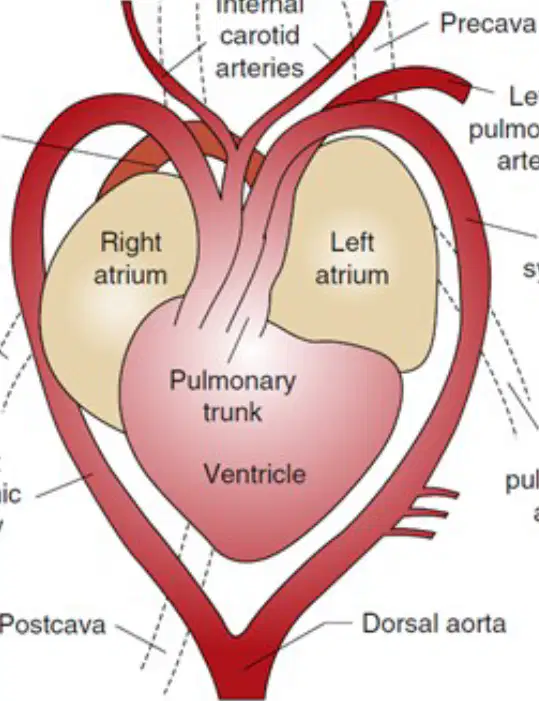
Which labeled vessel in the diagram carries blood away from the ventricle toward the lungs?
Pulmonary trunk
Postcava
Right pulmonary vein
Dorsal aorta
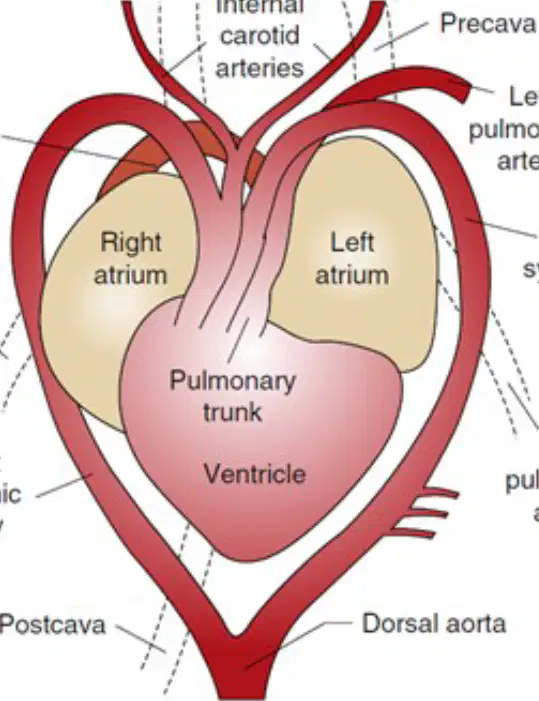
Select all structures that are part of the pulmonary circulation in the diagram.
Left pulmonary artery
Right systemic artery
Right pulmonary vein
Internal carotid arteries
Pulmonary trunk
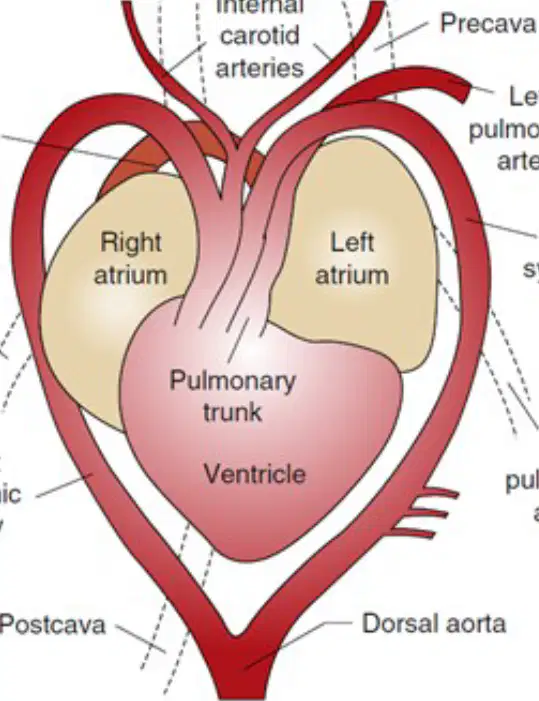
Which statement best characterizes blood flow from the atria to the ventricle in a three‑chambered heart?
Blood from both atria empties into a single ventricle
Each atrium empties into its own separate ventricle
Only the right atrium empties into the ventricle
Atria pump directly into systemic arteries without using a ventricle
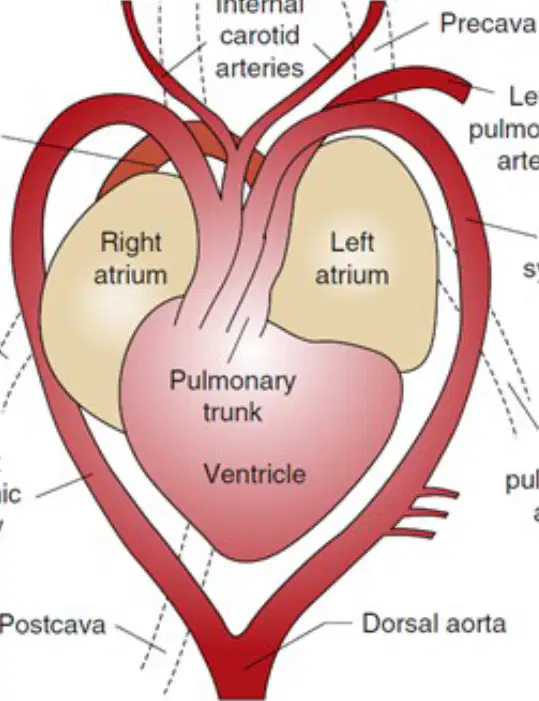
Match each vessel to the circulation it primarily serves, based on the diagram.
Left pulmonary artery
Pulmonary circulation
Right systemic artery
Systemic circulation (arterial)
Postcava
Systemic circulation (venous return)
Dorsal aorta
Systemic circulation (major arterial trunk)

Which labeled structure most directly returns oxygenated blood from the lungs to the heart in the diagram?
Right pulmonary vein
Left systemic aorta
Right pulmonary artery
Internal carotid arteries
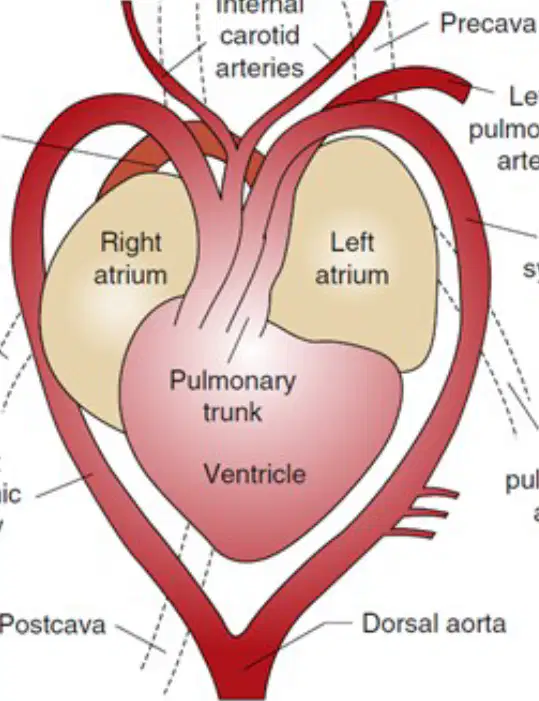
In the heart shown, which combination correctly identifies the receiving chambers for blood returning from the body and lungs?
Right atrium receives pulmonary venous blood; left atrium receives systemic venous blood
Left atrium receives pulmonary venous blood; right atrium receives systemic venous blood
Both atria receive only systemic venous blood
Both atria receive only pulmonary venous blood
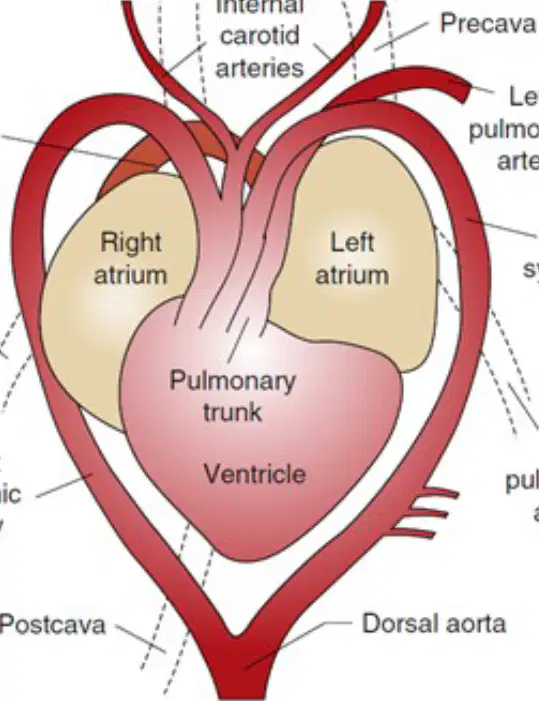
Select the features that distinguish this heart from a typical four‑chambered mammalian heart.
Presence of a single ventricle
Presence of two atria
Presence of a dorsal aorta
Presence of four separate chambers
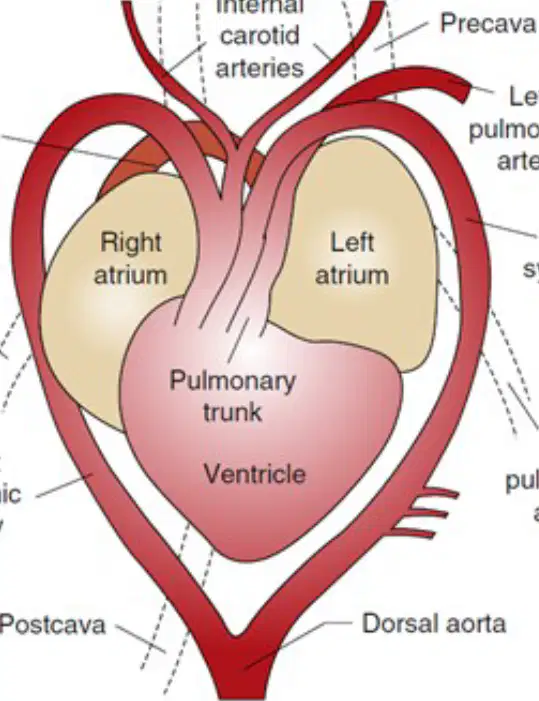
Which pathway best represents blood flow toward systemic tissues from the ventricle in the diagram?
Ventricle → Pulmonary trunk → Pulmonary arteries → Systemic tissues
Ventricle → Dorsal aorta → Systemic arteries → Systemic tissues
Ventricle → Postcava → Systemic veins → Systemic tissues
Ventricle → Internal carotid arteries → Lungs
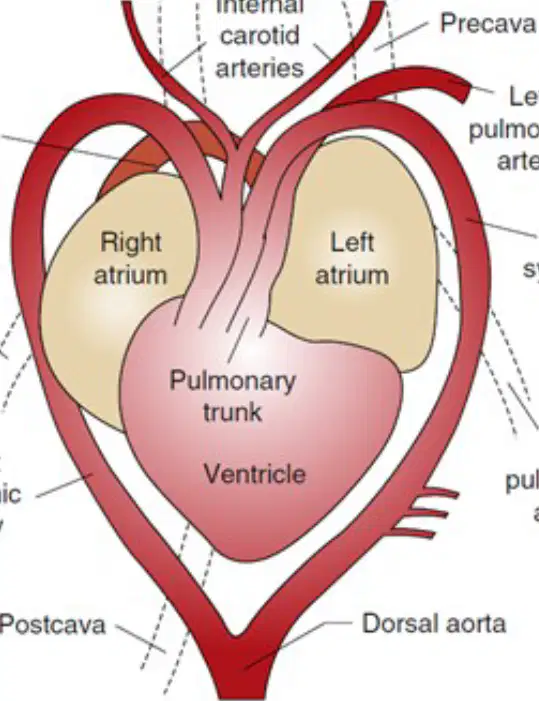
Match each heart chamber to its primary role in the three‑chambered configuration.
Right atrium
Receives systemic venous return
Left atrium
Receives pulmonary venous return
Ventricle
Pumps blood into pulmonary and systemic outflows
According to the excerpt, which statement about reptile eye control is accurate? Choose the best answer.
Reptiles cannot control their iris openings voluntarily
Reptiles have voluntary control over the opening of the iris
Reptiles only adjust iris opening during sleep
Reptiles rely on eyelids to control iris opening
Which feature of reptile eyes is noted as well developed in some species?
Tapetum lucidum
Third eyelid
Binocular vision
True eyelashes
Based on the passage, which group lacks true eyelids?
Turtles and crocodiles
Snakes and lizards
Amphibians
Birds
Identify the correct anatomical placement for reptile ears as described.
Top of the head
Side of the head
Under the jaw
Back of the neck
What is stated about the bones of the reptile middle ear?
Multiple small bones forming a chain
A single bone in the middle ear
No bony structures present
Cartilaginous plates replacing bones
Which statement correctly describes external ears in snakes?
Snakes have large external pinnae
Snakes have small external ears hidden by scales
Snakes do not have external ears
Snakes have external ears only during juvenile stages
What sensory capability is emphasized for snakes in relation to their ears?
Sensitivity to airborne odors
Sensitivity to vibrations
Sensitivity to infrared radiation
Sensitivity to ultraviolet light
Match each structure or trait to the correct reptile sensory system category (Eyes or Ears).
Voluntary control of iris opening
Eyes
Third eyelid present in some species
Eyes
Single bone in middle ear
Ears
External ears absent in snakes
Ears
Select all statements that are supported by the excerpt.
Reptiles have voluntary control over iris opening
Snakes and lizards possess true eyelids
Snakes lack external ears
Reptile ears are located on the side of the head

Which description aligns with how snakes perceive sound based on the excerpt?
Primarily through external ear pinnae capturing air vibrations
Through a multi-bone middle ear amplifying sound waves
By detecting vibrations without external ears
By using eyelid movements to sense acoustic changes

