
Font size
 Worksheets
UNIT 4 REVIEW
Total questions: 19
Worksheet time: 10mins
This is an excerpt about the Western Hemisphere: The Western Hemisphere consists of the Americas. Several terms such as North America, South America, Latin America, Central America, and Middle America are geographical and cultural terms used for this area of the world. Determine which statement is most associated with each area. Choose the area that matches this statement: The cultural region for an area of people that share the historical experience of conquest and colonization by the Spaniards and Portuguese includes countries in South America, Central America, and the Caribbean.
Latin America
North America
the Caribbean
Both Brazil and Haiti are culturally unique in Latin America because —
slavery was not practiced in either place.
Carnival is an important tradition in both places.
Spanish is not the primary language in either place.
both experience devastating hurricanes in the summer.
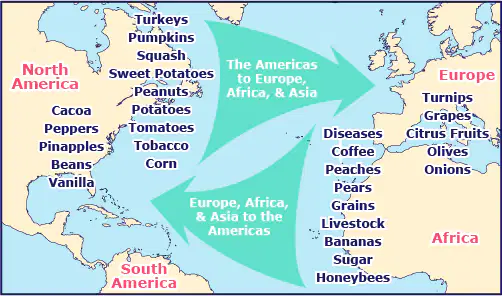
Part A. Which of the following is the correct definition of the Columbian Exchange?
The process of Columbus exchanging and selling food crops to natives.
The process by which people, commodities, and diseases crossed the Atlantic.
The process of diseases arriving from across the ocean and wiping out the natives.
The process of transferring native plants from one place on earth to another.
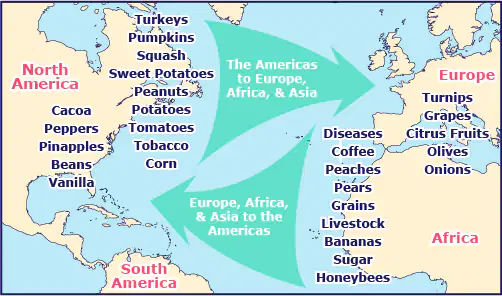
Part B. What is one negative outcome of the Columbian Exchange?
Tobacco was introduced to Europeans.
Honeybees were introduced to the Americas.
American diseases wiped out Europeans.
European diseases wiped out Native American tribes.
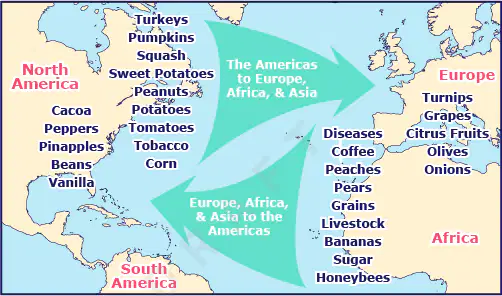
This map illustrates the Columbian Exchange, a pattern of spatial diffusion between the Americas, Europe, Africa, and Asia following European exploration. Which statement BEST explains a long-term impact of the Columbian Exchange on the Americas and Europe?
Native populations in the Americas were protected from new diseases.
The exchange of crops and livestock led to similar diets across both regions.
Europeans stopped exploring new regions after reaching the Americas.
Indigenous technology replaced European farming tools in most areas.
Choose the correct answer from each drop-down menu to complete the statement. Select the combination that correctly completes the sentence: The human landscape found in South America has a strong connection to the _____ and is greatly influenced by its _____
environment; native people
climate; European settlers
physical geography; immigrant populations
environment; imported traditions
The predominance of Roman Catholicism in Latin America is demonstrated by —
the ethnic diversity of the region.
the cultural celebrations of the region.
the variety of music and dance in the region.
the widespread use of Spanish in the region.
The Atacama Desert in Peru is considered to be the driest place on the earth. Which geographic factor is most responsible for producing this phenomenon?
Latitude
Longitude
Mountain barriers
Position on continent
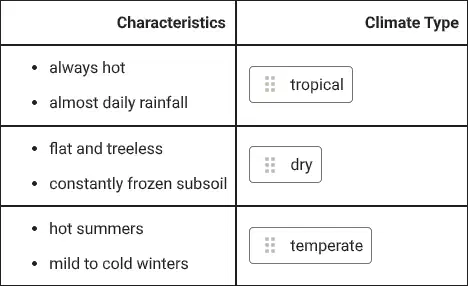
Complete the chart by matching each climate zone to its characteristics.
tropical
always hot; almost daily rainfall
polar
flat and treeless; constantly frozen subsoil
temperate
hot summers; mild to cold winters
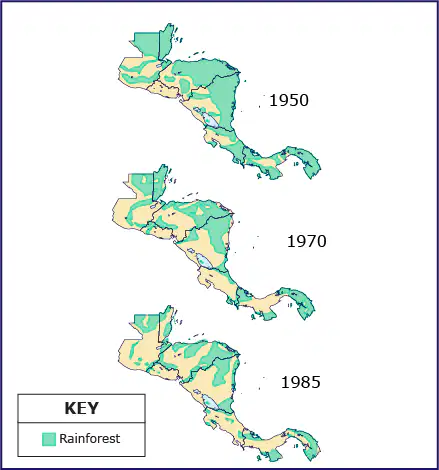
Select the two statements that are supported by the map of Central America’s rainforest from 1950 to 1985.
Central America’s rainforest was larger in 1950 than in 1985.
Central America’s rainforest decreased between 1970 and 1985.
Replanting initiatives have increased the size of the rainforest between 1970 and 1985.
Many animals have become extinct as a result of the growing rainforest.
The impact of deforestation on the environment of Central America has been minimal.
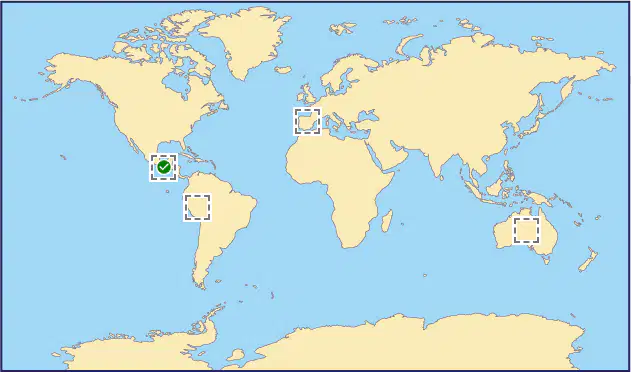
Below is a map of the world. Which part of the world is characterized by ALL of the following: Aztecs built a major city at Tenochtitlan; won independence from Spain in 1821; signed North American Free Trade Agreement (NAFTA). Select the correct area on the map.
Mexico
United States
Spain
Brazil
Natural Phenomena That Influence Earth’s Environment and Climate: 1. The Earth’s rotation on its axis 2. The Moon’s orbit around the Earth 3. The radiation from the Sun 4. The movement of air on Earth. The list above contains different characteristics that influence the environment or climate on Earth. Which two characteristics have the most effect?
1, 3
2, 4
3, 4
1, 2
Determine whether the statement applies to weather, climate, or both. Select the correct answer in each row.
It is always hot and humid year around.
Climate
Today it is rainy outside.
Weather
It usually snows most of the month of December.
Climate
Contains atmospheric conditions such as temperature and precipitation.
Both
Can change within a few minutes or hours.
Weather
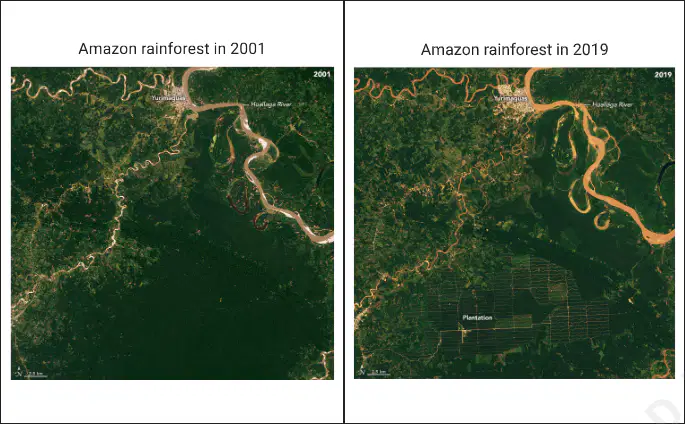
This is a satellite photograph showing the same region of the Amazon rainforest in 2001 and 2019. What do these two images MOST clearly show about how human activity has changed the Amazon region over time?
Natural wildfires have reshaped the rainforest in patterns following elevation.
Agricultural development and logging have contributed to deforestation.
Urban growth has led to the development of large cities throughout the rainforest.
The forested area has expanded as governments have increased conservation efforts.
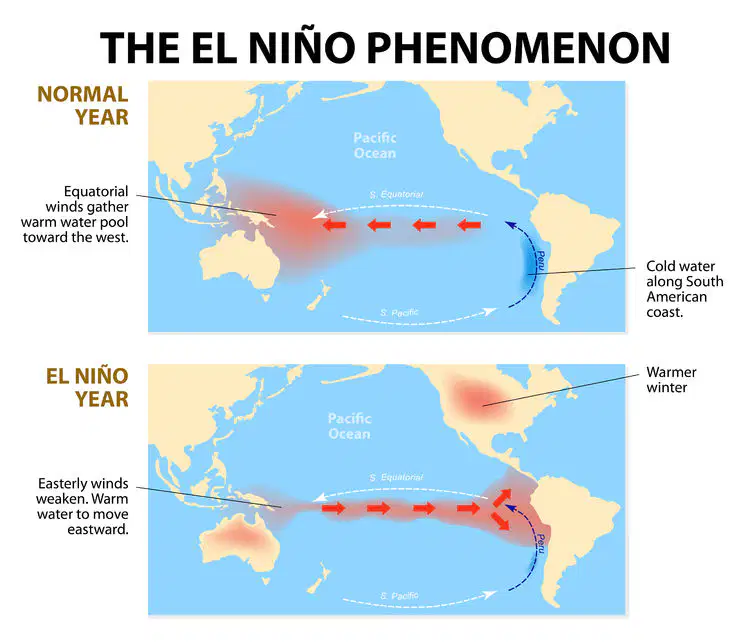
In which location on the map do El Niño and La Niña affect the climate patterns in the weather? Select the correct answer.
Equatorial eastern Pacific Ocean off the west coast of South America
North Atlantic Ocean near Greenland
Interior North America around the Great Plains
Eastern Mediterranean Sea near the Middle East
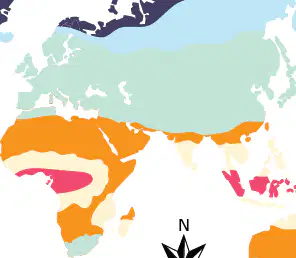
This map shows the climate zones of the world. Based on the map above and your knowledge of geography, what is the most likely cause of the characteristics present in the tropical zone?
wind
mountains
elevation
latitude
The Amazon Rainforest is located in a tropical climate region, which indicates that it is located in latitudes that are —
near the equator
considered mid-latitudes
farthest from the equator
closest to the Atlantic Ocean
The climate of an area is determined by the combination of precipitation and temperature. Which of the following most affects these two factors?
Latitude and longitude
Weathering and erosion
Convection and subduction
Proximity to water and latitude
Which statement best explains why different crops are grown at different elevations in the Andes Mountains of Latin America?
Higher elevations receive more direct sunlight, allowing tropical crops to grow at the top of the mountains.
Changes in elevation create distinct climate zones with different temperatures, which affect what plants can grow.
Mountain elevations have identical climates, so farmers grow different crops only for cultural reasons.
Lower elevations have thinner soil, making it necessary to grow most crops at higher altitudes.

