
Font size
 Worksheets
Chapter 9 Human Body System Review
Total questions: 50
Worksheet time: 1hrs 3mins
The ______________ is the largest organ in the human body.
Small intestine
Large intestine
Lungs
Skin
The _______________ pumps blood throughout the body.
Arteries
Heart
Viens
Kidneys
Homeostasis
is impossible in vertebrates
Is the maintenance of a relatively stable INTERNAL environment
Is the maintenance of a relatively stable EXTERNAL environment
Allows for a wildly fluctuating internal environment
Your skin is part of which body system?
The nervous system
The circulatory system
The respiratory system
The integumentary system
Which is NOT a function of your skin?
Protecting your body from outside invaders
Regulating temperature
Taking in oxygen
Sensing touch and temperature
What is the main function of the circulatory system?
to control and coordinate all the functions of the body
to circulate nutrients, gases and waste around the body
to circulate nutrients in the digestive system
to move gases into and out of the lungs

What are the 4 parts of the Integumentary System?
Skin
Hair
Heart
Nails
Sweat Glands

What are the 3 layers of the skin?
Epidermis, dermis, hair
Dermis, hypo dermis, nails
Epidermis, dermis, fatty layer
Which of these substances are found in bones?
Hydrogen
Calcium
Sodium
Fiber
Muscles and bones must work together in order for movement to occur.
True
False

What are joints?
A place where two bones meet
A type of muscle tissue
A fluid-filled sac in the body
A type of connective tissue
What is the main function of the skeletal system?
support the body
produce hormones
store energy
transport nutrients
Janelle, Alia, and Jazlyn are studying for their biology exam. They are discussing the human body and David asks, 'How many bones are there in the adult human skeleton?'
206
500
100
300
Heart
Arms
Legs
Shoulders
What is an example of an voluntary muscle?
heart
arms
bladder
intestines
The brain communicates with the rest of the body through the spinal cord and nerves
False
True
What are the main parts of the nervous system?
Brain
Spinal cord
Nerves
Legs
The basic unit of structure and function in the nervous system is a nerve cell. Nerve cells are also called-
Osteocytes
Dendrites
Neurons
Spinal Cords
What is the cerebral cortex?
The core of the brain
the body’s ultimate control and
information-processing center.
"old brain"
What is the role of the brainstem in the human brain?
The brainstem is responsible for long-term memory storage
The brainstem regulates body temperature
The brainstem controls muscle movement and coordination
The brainstem controls basic life functions such as breathing, heart rate, and blood pressure.
Blood vessels in the body include arteries, veins, and capillaries.
true
false
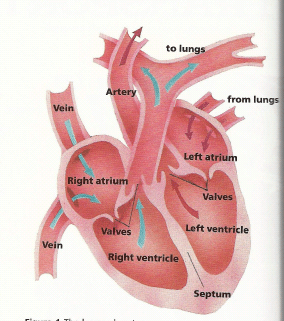
There are _____________chambers in the heart.
3
4
5

What is systole?
Relaxation in a chamber in the heart
Contraction in a chamber of the heart
a complete heartbeat
Dilation in the heart
what is diastole?
Contraction in a chamber of the heart that pushes blood
Blood leaving the heart and going to the body
Relaxation in a chamber of the heart that fills with blood
encloses the lungs
pleura
pericardium
peritoneum
The lungs are part of the ______________system.
circulatory
nervous
skeletal
respiratory
What is the primary function of the excretory system?
To transport oxygen to cells
To digest food
To remove waste products from the body
To regulate body temperature
Which change occurs to the urinary system with aging?
a) In men, the prostate gland shrinks.
b) The ability to concentrate urine increases.
c) Bladder capacity decreases.
d) Secretion of renin and aldosterone increases.
Encouraging patients to empty their bladders soon after feeling the urge rather than delaying emptying prevents:
a) shrinking of the bladder wall.
b) cancer of the bladder and incontinence.
c) blood in the urine.
d) diabetes insipidus.

The _____ is the first part of the digestive system.
large intestine
stomach
mouth
What gland controls all of the other glands?
Pituitary gland
Adreanal gland
Pineal gland
pancreas
Endocrine glands secrete _
Hormones
Neurotransmitters
A wide range of chemical substances
What is the main function of the endocrine system?
It creates chemicals, or hormones, that are sent around the body to maintain homeostasis.
It creates electrical messages that are sent around the body to maintain homeostasis.
It maintains the correct level of oxygen in the body to maintain homeostasis.
It releases waste from the body to maintain homeostasis.
Which of the following hormones is secreted by the ovaries?
estrogen
melatonin
progesterone
estrogen and progesterone
A major function of the lymphatic system is to drain body fluids and return them to the bloodstream.
true
false

The heart pumps blood through this system.
respiratory
endocrine
immune
circulatory
"The ________ system allows us to move around, but the _________ system controls our movement."
Bones
Provides shape & support
Helps you move
Protects organs
Produces blood cells
Controls most functions in the body.
Skeleton
Immune System
Brain
Skin
Large dome-shaped muscle used in breathing
Diaphragm
Heart
Kidney
Smooth Muscles

