
 Worksheets
Case Studies: Italian & German Unification
Total questions: 50
Worksheet time: 49mins
Nationalism grew in Europe as a response to Napoleon because:
Napoleon's conquests united people against foreign rule and inspired national identity.
Napoleon promoted local cultures and traditions.
European countries wanted to adopt French customs.
Napoleon encouraged the dissolution of national boundaries.
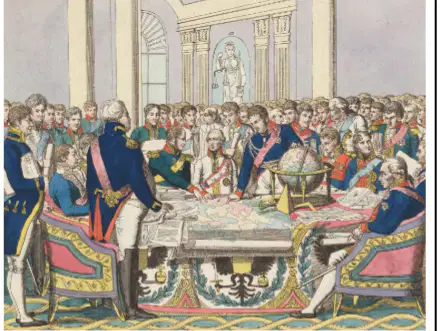
What was the long term effect of the Congress of Vienna?
It established a balance of power in Europe that prevented major wars for decades.
It led to the immediate unification of Germany and Italy.
It resulted in the spread of democracy across Europe.
It caused the collapse of the British Empire.
Nationalism played a role in the unification of Italy by:
Encouraging a shared identity among Italians, leading to efforts to unite the country
Promoting regional divisions and preventing unity
Supporting foreign rule over Italian states
Discouraging any attempts at political change
The person responsible for unifying Italy was:
Giuseppe Garibaldi
Napoleon Bonaparte
Otto von Bismarck
Louis XIV
Who was known as 'The Brain' of Italian Unification?
Giuseppe Garibaldi
Giuseppe Mazzini
Count Camillo Di Cavour
Victor Emmanuel II
Which leader was responsible for founding 'Young Italy', a secret organization that worked toward the goal of a unified Italy?
Count Camillo Di Cavour
Giuseppe Garibaldi
Giuseppe Mazzini
Victor Emmanuel II
Fill in the blank: Garibaldi led an army of Italians across Southern Italy in the 1860's called the _________?
Red Shirts
Blue Coats
Green Berets
White Helmets
The person who negotiated with France and added the Papal States to Sardinia during the process of Italian unification was:
Camillo di Cavour
Giuseppe Garibaldi
Victor Emmanuel II
Giuseppe Mazzini
Giuseppe Garibaldi was given permission to unite Southern Italy with the Kingdom of Piedmont-Sardinia.
True
False
The leader described as 'The Sword' of Italian Unification was:
Giuseppe Garibaldi
Camillo di Cavour
Victor Emmanuel II
Giuseppe Mazzini
Fill in the blank: Mazzini wrote of his dreams for a united Republican Italy where all Italians were ______ and ______.
united, equal
rich, powerful
educated, free
happy, prosperous
The person who arranged for Garibaldi to meet King Victor Emmanuel II was:
Count Cavour
Giuseppe Mazzini
Pope Pius IX
Napoleon III
Cavour played which role in Italian Unification?
He was a leading statesman who helped unify Italy through diplomacy and alliances.
He led the Italian army in battle against Austria.
He was the king who declared Italian unification.
He was a revolutionary who started uprisings across Italy.
Cavour's goal was:
to unify Italy
to expand the French Empire
to maintain Austrian control over Italy
to promote Spanish rule in Europe
Cavour was known as 'the Brain' because:
he was a master strategist and planner.
he was a famous artist.
he was a powerful military leader.
he was a popular king.
Garibaldi's dream was:
To unify Italy into a single nation
To conquer France
To become the King of Spain
To establish a republic in Germany
Garibaldi attempted to accomplish his goal by:
leading military campaigns and uniting Italian territories
negotiating peace treaties with foreign powers
establishing trade agreements with neighboring countries
forming alliances with religious leaders
Garibaldi's contribution to Italian unification was:
He led military campaigns that helped unify Italy.
He negotiated peace treaties with France.
He was the king of unified Italy.
He opposed the idea of Italian unification.
Garibaldi was known as 'the Sword' because of his _______.
military leadership and use of force in the unification of Italy
diplomatic skills in negotiating peace treaties
artistic contributions to Italian culture
economic reforms in Italy
Mazzini promoted the cause of Italian unity by:
founding Young Italy and inspiring nationalist movements
signing the Treaty of Vienna
leading the Congress of Vienna
supporting foreign rule in Italy
Mazzini was known as 'the heart' because:
he was the emotional center of the group.
he was the tallest member.
he was the fastest runner.
he was the oldest member.
The person responsible for unifying Italy was:
Giuseppe Garibaldi
Otto von Bismarck
Napoleon Bonaparte
Winston Churchill
According to Cavour, people can achieve a degree of intelligence and morality by:
education and free institutions
military conquest
economic prosperity alone
religious rituals
According to Cavour, a positive result of Italian unification would be:
increased political stability and economic growth
division among Italian states
loss of national identity
decline in international influence
Cavour’s thoughts on nationalism can be described as:
He believed in pragmatic nationalism focused on unification and modernization.
He advocated for radical revolution and complete independence from all foreign influence.
He rejected nationalism and supported regional autonomy over national unity.
He was a strong supporter of religious nationalism as the basis for Italian unity.
Which country did Cavour recommend allying with in 1859?
He advised forming an alliance with France.
He suggested remaining neutral.
He recommended supporting Austria.
He proposed declaring war on Britain.
Garibaldi was called the “Sword” of Italian Unification because:
he led military campaigns that helped unify Italy.
he wrote the constitution of Italy.
he was the king of Italy.
he negotiated peace treaties with Austria.
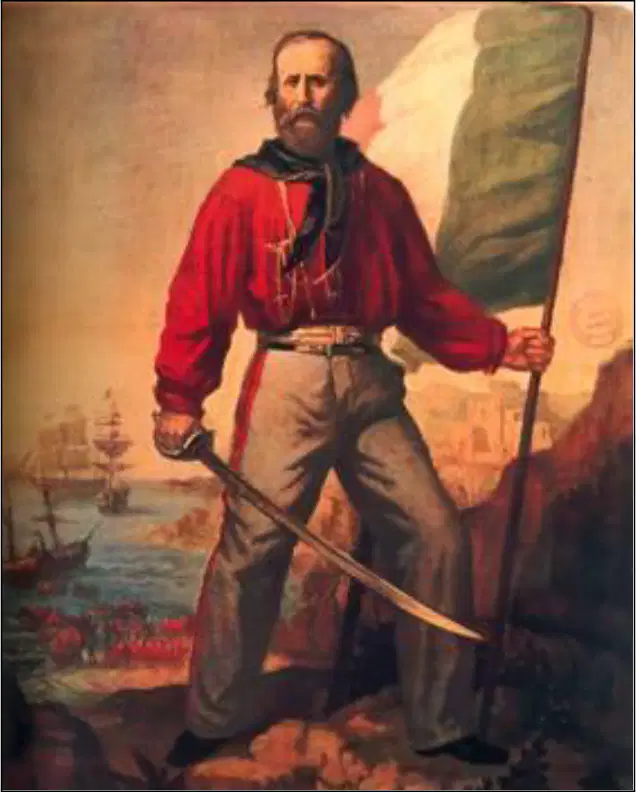
Identify the symbols of Italian nationalism that appear in the painting.
The Italian flag and laurel wreath
The Eiffel Tower and baguette
The Statue of Liberty and bald eagle
The Union Jack and Big Ben
Garibaldi indicates a sense of nationalism in which of the following ways?
By leading efforts to unify Italy and inspire patriotic sentiment
By promoting foreign rule over Italy
By discouraging unity among Italians
By supporting regional divisions instead of national unity
Nationalism contributed to Italian Unification by:
Uniting people with a common identity and purpose
Encouraging foreign rule over Italian states
Promoting regional divisions and isolation
Discouraging the idea of a unified Italy
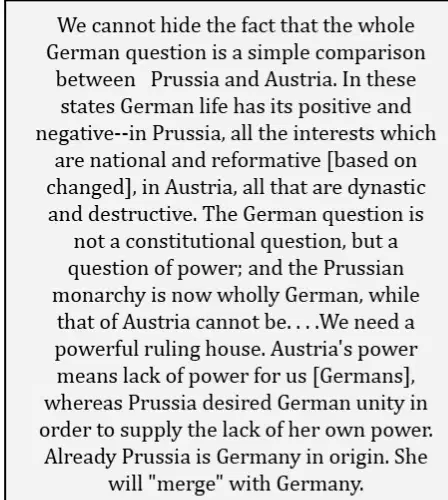
According to Droysen, the goals of Prussia are:
to unify Germany under Prussian leadership
to expand French influence in Europe
to maintain the status quo of small German states
to support Austrian dominance in Germany
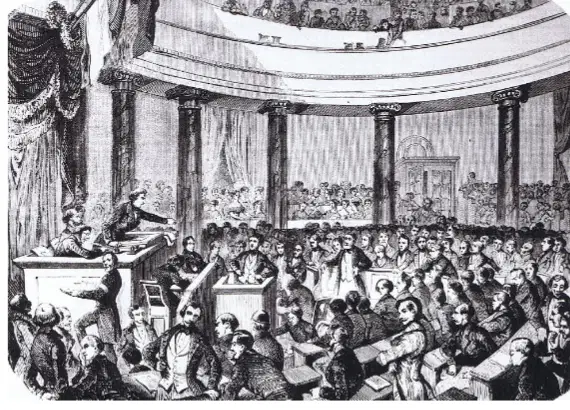
A united Germany needs ________, and it would be provided by ________.
stability; European powers
military support; France
economic aid; the United States
leadership; Prussia
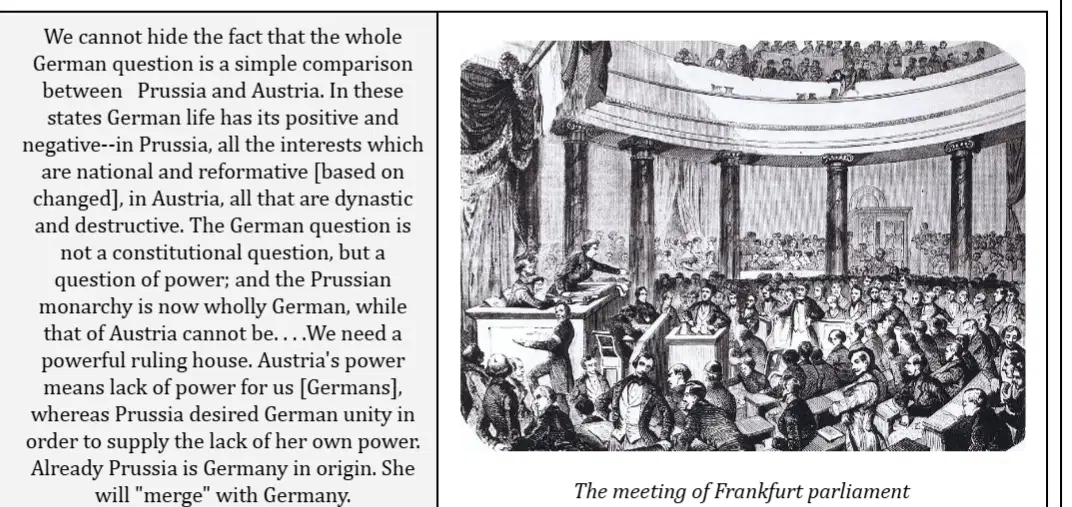
Identify the elements of nationalism found within this speech.
Pride in national identity
Support for international cooperation
Emphasis on individualism
Promotion of regional autonomy
The King of Prussia will not accept the title of King of the German states for which two reasons?
He did not want to offend Austria and he did not want to accept a crown from the people.
He wanted to remain neutral and he was not interested in expansion.
He feared losing his own throne and he lacked military support.
He was already the Emperor of Austria and he wanted to avoid war.
The King of Prussia’s decision affects German unification by:
uniting the German states under Prussian leadership
dividing the German states further
ending all efforts for unification
making Austria the leader of German unification

The King is displaying nationalism by:
Waving the national flag in a public ceremony.
Wearing traditional clothing from another country.
Ignoring national symbols during events.
Promoting foreign cultures over his own.
The main goals of the Congress of Vienna were:
to restore balance of power and maintain peace in Europe
to promote industrialization across Europe
to establish democratic governments in all countries
to expand colonial territories for European powers
According to Bismarck, Austria poses what threat to Germany?
Austria threatens to divide and weaken Germany.
Austria seeks to unite with Germany peacefully.
Austria wants to support German unification.
Austria poses no threat to Germany.
Bismarck indicates a sense of nationalism in the following way:
By promoting German unity and pride.
By supporting regional independence over national unity.
By discouraging patriotic sentiments among citizens.
By prioritizing foreign alliances over national interests.
The war between Prussia and Austria was not fought for which of the following reasons?
Territorial expansion in Africa
Control over German states
Dynastic disputes
Economic dominance in Europe
The leader of the German states was:
Otto von Bismarck
Napoleon Bonaparte
Kaiser Wilhelm II
Frederick the Great
Proclamation of 1871, The Imperial Proclamation (Wilhelm I, King), January 18, 1871: The King of Prussia declares:
The establishment of the German Empire
The abolition of the monarchy
The beginning of the French Revolution
The unification of Italy
The responsibilities of taking the imperial [royal] title include:
Governing the empire and upholding its laws
Leading only military campaigns
Managing only religious ceremonies
Focusing solely on personal wealth
The main goal of the united Germany is:
to establish a strong and unified nation
to divide into smaller states
to remain under foreign control
to abolish all forms of government

The movement for Italian unification and resurgance was known as...
Risorgimento.
Rigamortis.
Realpolitik.
Reconquista.

Established Prussia as a power in Europe by developing a strong modern army. Prussia eventually lead to the unification of the German states and the foundation of Germany as a country.
Frederick the Great
Otto von Bismarck
Frederick William
Kaiser Wilhelm

pride in one's country
Militarism
Alliance
Imperialism
Nationalism
The control and exploitation of a country by a more powerful country is known as what?
Imperialism
Socialism
Communism
Liberalism
Which individual is associated with the phrase blood and iron as related to the unification of Germany?
Otto von Bismarck
Giuseppe Garibaldi
Kaiser Wilhelm II
Count Camillo di Cavour

