wayground logo

Free Printable Worksheets

Font size

S
M
L
XL
Worksheets

Seafloor Spreading Unit 2.2 Vocabulary Assessment

Total questions: 33

Worksheet time: 47mins

Name
Class
Date
1.

Lower part of the mantle; softer part of mantle below the lithosphere which is hotter and under increased pressure:

a)
Asthenosphere
b)
Crust
c)
Lithosphere
2.

Upper part of the mantle; uppermost part of mantle & the crust for a rigid layer about 100 kilometer thick:

a)
Asthenosphere
b)
Crust
c)
Lithosphere
3.
Layer of solid rock that forms the Earth’s outer 'skin:'
a)
Asthenosphere
b)
Crust
c)
Lithosphere
4.
Oceanic crust is mainly composed of which type of rock:
a)
Basalt
b)
Granite
5.
Continental crust is mainly composed of which type of rock:
a)
Basalt
b)
Granite
6.
This forms in a fluid when material get hot, it expands and becomes less dense and rises. When it cools it becomes denser and moves to the bottom.
a)
Convection Current
b)
Lava
c)
Magma
d)
Sea-Floor Spreading
7.
The process by which new oceanic crust continuously forms along mid-ocean ridges and is destroyed at ocean trenches.
a)
Convection Current
b)
Lava
c)
Magma
d)
Sea-Floor Spreading
8.
Molten rock beneath the Earth’s surface is called:
a)
Convection Current
b)
Lava
c)
Magma
d)
Sea-Floor Spreading
9.
Molten rock that erupts on to the Earth’s surface is called:
a)
Convection Current
b)
Lava
c)
Magma
d)
Sea-Floor Spreading
10.
Vast mountain ranges deep below the ocean’s surface are called:
a)
Convection Currents
b)
Mid-Ocean Ridges
c)
Trenches
11.
Deep underwater troughs, or canyons, on the seafloor are called:
a)
Convection Currents
b)
Mid-Ocean Ridges
c)
Trenches
12.
Hess's Evidence of Seafloor Spreading. Match the type of evidence below with this description: the farther from a ridge the rocks were taken, the older they were.
a)
Evidence #1-Molten Material
b)
Evidence #2-Magnetic Stripes
c)
Evidence #3-Drilling Samples
13.
Hess's Evidence of Seafloor Spreading. Match the type of evidence below with this description: rocks that lie in a pattern showing a record of reversals of Earth’s magnetic field.
a)
Evidence #1-Molten Material
b)
Evidence #2-Magnetic Stripes
c)
Evidence #3-Drilling Samples
14.
Hess's Evidence of Seafloor Spreading. Match the type of evidence below with this description: pillow-shaped rocks that formed when molten material erupts and hardens quickly.
a)
Evidence #1-Molten Material
b)
Evidence #2-Magnetic Stripes
c)
Evidence #3-Drilling Samples
15.
Which of the following statements best describes seafloor spreading:
a)
Continents only move suddenly, like when there are earthquakes or volcanoes.
b)
Most tectonic plates move quickly, over 10-20 years.
c)
Ocean floors move like a conveyor belt, carrying the continents with them, over millions of years..
d)
A squirrel that was chasing an acorn started the core to spin, which caused the plates to break apart a long time ago.
16.

Any trace of an ancient organism that has been preserved in rock is a(n)

a)

stone

b)

organism

c)

rock

d)

fossil

17.
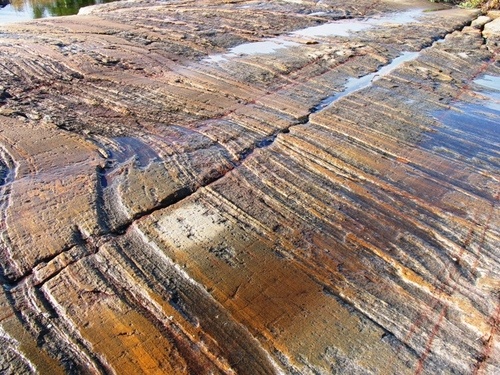
This is a picture of glacier scars found in Africa.  What are these evidence for?
a)
Africa has always been near the equator
b)
Africa was once in an area of the Earth that had a very cold climate
c)
The continents have not moved
d)
sea floor spreading
18.

Undersea mountain chain where new ocean floor is produced at a divergent plate boundary is a ____________

a)

seafloor spreading

b)

deep ocean trench

c)

Mid-ocean ridge

d)

continental drift

19.

Who came up with the idea of sea-floor spreading?

a)

Darwin

b)

Hess

c)

Wegener

d)

Einstein

20.

What is the evidence for sea-floor spreading?

**SELECT ALL THAT APPLY**

a)

Pangaea

b)

Eruptions of molten material

c)

magnetic stripes in rock

d)

ages of rocks themselves (drilling samples)

21.

The Atlantic ocean is ____________ because of few trenches and no where for the spreading ocean floor to go.

a)

shrinking

b)

expanding

22.

The pacific ocean is ____________ because subduction at trenches is happening quicker than new crust can be added

a)

shrinking

b)

expanding

23.

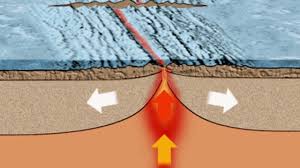
There is seafloor spreading occurring at which spot?

24.

Label the diagram of Sea Floor Spreading

25.

In sea-floor spreading, molten material rises from the mantle and erupts

a)

along the edges of all the continents.

b)

along mid-ocean ridges.

c)

in deep-ocean trenches.

d)

at the north and south poles.

26.

Seafloor spread occurs because....

a)

Plates are smashing together and oozing apart

b)

Magma below the Earth's crust is forced up toward the surface after plates move apart

c)

Maui is trying to break out of his prison

d)

The Earth's magnetic poles are reversing

27.
The youngest rocks would be located _____
a)
Closest to the mid-ocean ridge
b)
farthest away from the mid-ocean ridge
c)
in the middle of the mid-ocean ridge
d)
none of these
28.
One piece of evidence for Plate Tectonic Theory is seafloor spreading.
The diagram provided shows the pattern of rock on either side of the Mid-Atlantic Ridge.
The evidence that indicates that plates are moving apart at this location is that, as one looks at the rocks on either side, one sees that -
a)
rocks are older the farther they are from the center
b)
there is a thickening of the crust where the sides meet
c)
rock types on one side are very different from the other
d)
one rock layer melts as it moves under the other side
29.

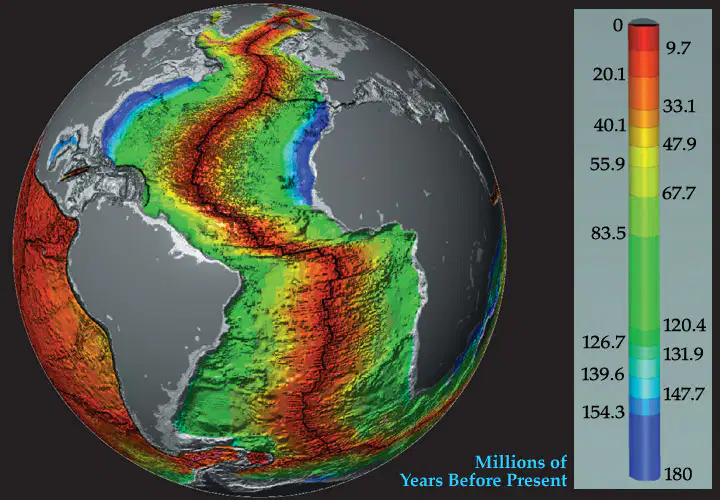
Label the ages of the rock on the map

30.

What color represents the youngest/newest seafloor?

a)

blue

b)

green

c)

red

d)

purple

31.

Which color represents the older seafloor?

a)

purple/blue

b)

red

c)

orange

d)

yellow

32.

Where is the Atlantic Ocean seafloor the youngest/newest?

a)

Down the middle/along mid-ocean ridge

b)

Along the edges/near continents

33.

Where is the Atlantic Ocean seafloor the oldest?

a)

Down the middle/along mid-ocean ridge

b)

Along the edges/near continents