wayground logo

Free Printable Worksheets

Font size

S
M
L
XL
Worksheets

GBH Chemistry Unit 5 Test Review

Total questions: 48

Worksheet time: 1hrs 14mins

Name
Class
Date
1.

Magnesium and oxygen react with each other and form

a)

Magnesium di oxide.

b)

Magnesium triphosphate

c)

Magnesium oxide.

d)

Magnesium Hydroxide

2.

A chemical reaction in which two or more substances combine with each other to form a single substance is called?

a)

Double displacement reaction

b)

Displacement reaction

c)

Synthesis reaction

d)

Decomposition rection

3.

The substances which combine in a chemical reaction is called?

a)

Products

b)

Reactants

c)

Combining elements

d)

Refractions

4.

Number placed in front of an element symbol or chemical formula in an equation.

a)

coefficient

b)

product

c)

reactant

d)

synthesis

5.

New substance produced by a chemical reaction.

a)

product

b)

reactant

c)

coefficient

6.

Chemical reaction in which a substance combines with oxygen and releases energy.

a)

combustion

b)

decomposition

c)

synthesis

d)

product

7.

Chemical reaction in which one compound breaks down and forms two or more substances.

a)

decomposition

b)

double replacement

c)

single replacement

d)

synthesis

8.

Describes a reaction in which the negative ions in two compounds switch places, forming two new compounds.

a)

combustion

b)

decomposition

c)

double replacement

d)

single replacement

9.

Describes a reaction in which the negative ions in two compounds switch places, forming two new compounds.

a)

combustion

b)

decomposition

c)

double replacement

d)

single replacement

10.

The chemical formula for water is H₂O. The 2 in the formula represents a

a)

A. coefficient

b)

B. element

c)

C. superscript

d)

D. subscript

11.

The chemical formula for photosynthesis is 6O2 + 6H₂O → C6H12O6 + 60₂. How many atoms of oxygen are found in the product?

a)

A. 2

b)

B. 6

c)

C. 8

d)

D. 18

12.

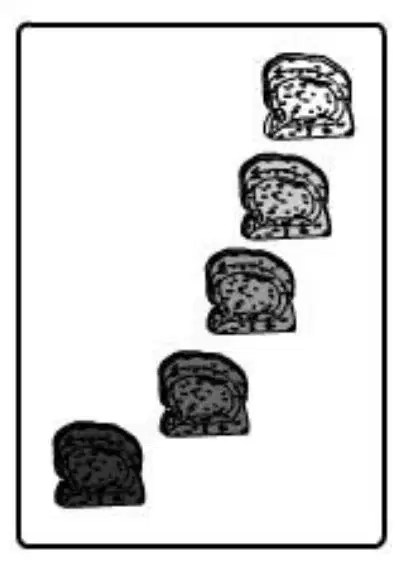
The picture shows the different stages of a slice of bread being burnt. Which of the following CANNOT be used as an evidence of a chemical change?

a)

Heat energy was absorbed during the change.

b)

The burned part of the toast did not taste good.

c)

The burned part changed color and turned black.

d)

The surface of the bread changed to carbon.

13.
During a lab experiment, a scientist numbers three beakers. Next, she pours 150 mL of  liquid into each beaker. Each liquid is different.Then, the scientist adds 5 g of white solid baking soda (NaHCO3) to each beaker and stirs. She observes the results.
In which of the beakers does the scientist observe clear evidence of a chemical reaction?
a)
beaker 1 only
b)
beaker 2 only
c)
beaker 3 only
d)
beakers 1,2, and 3
14.
Which of the following is a chemical reaction?
a)
Water freezes.
b)
Sugar dissolves in water.
c)
Salt and pepper are mixed in a dish.
d)
Iron rusts.
15.
Before a chemical reaction, the total mass of two reactants is measured to be 40 grams.  After the reaction, what should be the total mass of the products?
a)
0 grams
b)
20 grams
c)
40 grams
d)
80 grams
16.
When two substances were combined, bubbles were produced and the temperature dropped.  This most likely means that:
a)
a chemical reaction took place
b)
the two substances had low boiling points
c)
one substance dissolved in the other
d)
the two substances are non-reactive
17.
Which of these is not a chemical reaction?
a)
Burning of wood
b)
Milk going bad
c)
Mixing vinegar and baking soda
d)
Melting of ice
18.
Matter can not be created nor destroyed: it can only be
a)
Destroyed a little bit
b)
Invisible
c)
Transformed, changed
d)
None of the above
19.

How many oxygen atoms are in the products for the chemical reaction below?
4Fe + 3O2  2Fe2O34Fe\ +\ 3O_{2\ }\rightarrow\ 2Fe_2O_3  

a)

2

b)

3

c)

5

d)

6

20.
Is this equation balanced or unbalanced? 
H2 + O2 --> H2O
a)
balanced
b)
unbalanced
21.
Copper chloride and aluminum react to produce aluminum chloride and copper.  Which of the following is the correctly balanced chemical equation for this reaction?
a)
CuCl2 + Al -> AlCl3 + Cu
b)
3CuCl2 + Al -> AlCl3 + 2Cu
c)
3CuCl2 + 2Al -> 2AlCl3 + 3Cu
d)
CuCl2 + 3Al -> AlCl3 + 2Cu
22.
The first part of a balanced chemical equation is shown:  H2SO4 + 2NaOH → ________.  In order for this equation to be balanced, how many hydrogen (H) atoms must be present in the products?
a)
2
b)
3
c)
4
d)
5
23.
Copper chloride and aluminum react to produce aluminum chloride and copper.  Which of the following is the correctly balanced chemical equation for this reaction?
a)
CuCl2 + Al -> AlCl3 + Cu
b)
3CuCl2 + Al -> AlCl3 + 2Cu
c)
3CuCl2 + 2Al -> 2AlCl3 + 3Cu
d)
CuCl2 + 3Al -> AlCl3 + 2Cu
24.

These are all models of the same molecule. What would this molecule look like in a chemical/molecular formula?

a)

CH

b)

C4H

c)

CH4

d)

4CH

25.

What coefficient should go in the last blank space in order for the equation to be balanced?

a)

1

b)

2

c)

3

d)

4

26.

Which among the following is(are) double displacement

reaction(s)?

(1) Pb + CuCl2 --> PbCl2 + Cu

(2) Na2SO4 + BaCl2 --> BaSO4 + 2NaCl

(3) C + O2 --> CO2

(4) CH4 + 2O2 --> CO2 + 2H2O

a)

(a) (1) and (4)

b)

(b) (2) only

c)

(c) (1) and (2)

d)

(d) (3) and (4)

27.

Is the following equation balanced?

Al + O2 ---> 2Al2O3

a)

YES

b)

NO

28.

What reaction has the following general formula:

A + CD --> C + AD

a)

Combination

b)

Decomposition

c)

Single Replacement

d)

Double Replacement

e)

Combustion

29.

What reaction has the following general formula:

AB --> A + B

a)

Combination

b)

Decomposition

c)

Single Replacement

d)

Double Replacement

e)

Combustion

30.

What type of reaction is the following:
BaCl2+2KI > 2KCl + BaI2BaCl_2+2KI\ ->\ 2KCl\ +\ BaI_2  

a)

Combination

b)

Decomposition

c)

Single Replacement

d)

Double Replacement

e)

Combustion

31.

Which of the elements below is NOT a diatomic molecule?

a)

hydrogen

b)

helium

c)

chlorine

d)

nitrogen

32.
Which is NOT an indicator of a chemical change?
a)
temperature change
b)
formation of a precipitate
c)
shape change
d)
production of light
33.

What are the products of this reaction?
Copper II and Silver Nitrate --> 

a)
Cu(NO3)2+Ag
b)
CuNO3 + Ag
c)
CuAg+NO3
d)
Cu+ AgNO3
34.
Write a Balanced Equation for this reaction:
C2H4 + 2 O2 -->
a)
C2O2 + H4
b)
CO2 + HOH
c)
CO + H
d)
2 CO2 + 2H2O
35.
Which of the following equations represents the balanced synthesis reaction of iron (III) and oxygen?
a)
Fe + 3 O2 → Fe2O3
b)
3 Fe + 3 O2 → 2 Fe2O3
c)
2 Fe + O2 → Fe2O3
d)
4 Fe + 3 O2 → 2 Fe2O3
36.
What are the correct formulas and coefficients for the products of the following single-replacement reaction?
Mg + Al(OH)3 →
a)
No Reaction
b)
Al + Mg(OH)3
c)
2 Al + 3 Mg(OH)2
d)
3 Al + MgOH3
37.
 Predict the product(s):  H2O -->
a)
H and O
b)
H2 and O2
c)
H and OH
38.
Classify
Zn + H
2S → ZnS + H2
a)
synthesis
b)
combustion
c)
single replacement
d)
double replacement
39.

___ Na2CO3 + ___ Ag3P → ___ Na3P + ___ Ag2CO3

a)

3, 2, 1, 3

b)

2, 2, 2, 3

c)

3, 2, 2, 3,

d)

3, 2, 3, 2

40.

Predict the products when sodium chlorate reacts with barium hydroxide.

a)

NaOH and BaClO3

b)

NaOH and Ba(ClO4)2

c)

Na2OH and Ba(ClO3)2

d)

NaOH and Ba(ClO3)2

41.

Double: KNO3 + BaSO4 Double:\ KNO_3\ +\ BaSO_4\ \rightarrow  

a)

2KNO3 + BaSO4  Ba(NO3)2 + K2SO42KNO_3\ +\ BaSO_4\ \rightarrow\ Ba\left(NO_3\right)_2\ +\ K_2SO_4  

b)

KNO3 + BaSO4  Ba(NO3)2 + K2SO4KNO_3\ +\ BaSO_4\ \rightarrow\ Ba\left(NO_3\right)_2\ +\ K_2SO_4  

c)

2KNO3 + 2BaSO4  B2aNO3 + K2SO42KNO_3\ +\ 2BaSO_4\ \rightarrow\ B2aNO_3\ +\ K_2SO_4  

42.

Double: BaO + Fe2S3Double:\ BaO\ +\ Fe_2S_3\rightarrow  

a)

3BaO + Fe2S3 Fe2O3 + 3BaS3BaO\ +\ Fe_2S_3\rightarrow\ Fe_2O_3\ +\ 3BaS  

b)

BaO + Fe2S3 Fe2O3 + BaSBaO\ +\ Fe_2S_3\rightarrow\ Fe_2O_3\ +\ BaS  

c)

BaO + Fe2S3 Fe2O3 + 3BaSBaO\ +\ Fe_2S_3\rightarrow\ Fe_2O_3\ +\ 3BaS  

43.

Predict the products:

Mg(NO3)2 + CaCl2

a)

Mg(NO3)2 + CaCl2

b)

MgCa + Cl2(NO3)2

c)

Ca(NO3)2 + MgCl2

d)

CaNO3 + MgCl

44.
Based on the activity series, will this reaction occur?
Au (s) + HCl (l) →
a)
Yes
b)
No
45.
Based on the activity series, will this reaction occur?
Br2 (l) + KI (aq) →
a)
Yes
b)
No
46.
Based on the activity series, will this reaction occur?
Ni (s) + H2O (l) →
a)
Yes
b)
No
47.

Label the parts of the reaction.

48.

Please drag the coefficients to the proper location for this equation will be balanced.