
 Worksheets
Lesson 6 Assessment - D of I
Total questions: 52
Worksheet time: 25mins
Select the letter next to the best answer. When was the Declaration of Independence finally approved by the colonies? (This day is considered America's birthday)
Fourth of July, 1776
All Hallo's Eve, 1775
January 1, 1775
July 4th, 1492
Select the letter next to the best answer. Who wrote most of the Declaration of Independence?
John Adams
Thomas Jefferson
Ben Franklin
James Madison
Select the letter next to the best answer. What was the Declaration of Independence?
a document to say that colonists are free
a document to say that the colonies are now an independent nation
a letter to the King showing how colonists are ready for peace
a letter that explains the rules of the new American government
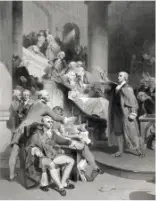
Select the letter next to the best answer. Patrick Henry gave a famous speech that ended with the words "give me liberty, or give me death!" With which group did he identify himself?
Patriots
Loyalists
British citizens
members of Parliament
Select the letter next to the best answer. The Continental army was composed of
troops from all the colonies.
troops from throughout Great Britain.
only troops from the New England colonies.
only troops from Virginia and Massachusetts.
Which of these describes the mood of most colonies immediately following the events at Lexington and Concord?
They were reluctant to start a war.
They were eager to declare war against the British.
They sided with the Loyalists against the Patriots.
They wanted to move to Great Britain.
Which of these best describes the outcome of the Battle of Bunker Hill?
The British won decisively.
The militia won by a narrow margin.
The militia surrendered to the British.
The British won but suffered many losses.
Why was George Washington chosen to be a military leader?
He had experience.
He wanted the role.
He was very wealthy.
He was highly educated.
What effect did Common Sense have in the colonies?
It instilled fear of war in the colonists.
It convinced the colonists to remain loyal to Great Britain.
It persuaded many colonists that America should be independent.
It petitioned the king to end the quarrel between the colonies and Great Britain.
What was the purpose of the Olive Branch Petition?
to persuade British troops to leave Boston
to encourage colonists to join the army
to convince Parliament to repeal the Stamp Act
to ask King George to make peace with the colonies
Why was the Declaration of Independence written?
to start the American Revolution
to offer a peace settlement to Great Britain
to instruct how a country wins its freedom
to explain why the colonies were separating from Great Britain
How do natural rights, as described in the Declaration of Independence, differ from other rights?
People are born with natural rights.
People can vote to choose natural rights.
Natural rights are given only to citizens.
Natural rights come from the government.
According to Thomas Jefferson, the power to rule comes from
God.
the king.
Parliament.
the governed.
Why did Thomas Jefferson say that King George III was an unfit ruler?
He was not born in Great Britain.
He denied the colonists their rights.
He was not elected by Parliament.
He lived far away from the colonies.
Look at the timeline. Which of these belongs in place of the question mark on the timeline?
Common Sense published
Olive Branch Petition sent
American Revolution ends
Declaration of Independence signed
What decision was made at the Second Continental Congress?
to form an army
to make a gesture of peace
to declare war on Great Britain
to demand a repeal of the Tea Act
To Great Britain, the signing of the Declaration of Independence was
an act of loyalty.
an act of treason.
an act of bravery.
an act of insanity.
Was the Olive Branch successful? YES OR NO
Yes
No
The Declaration was written based on the principle of .....
natural rights
no more taxes
freedom of religion
equality for all men and women
TRUE OR FALSE: The battles of Lexington, Concord, and Bunker Hill happened BEFORE the Declaration of Independence.
True
False
to formally discuss an issue
debated
Declaration of Independence
Common Sense
petition
impose
rights common to everyone, as opposed to those given by law
debated
Declaration of Independence
Common Sense
petition
natural rights
a pamphlet published in 1776 by Thomas Paine that persuaded many American colonists to support independence
debated
Declaration of Independence
Common Sense
petition
natural rights
the document written to declare the American colonies as an independent nation, free from British rule
debated
Declaration of Independence
Common Sense
petition
natural rights
to put in place by authority, such a law, tax, or punishment
debated
Declaration of Independence
Common Sense
impose
natural rights
a formal, written request made to an official person or organization
debated
Declaration of Independence
Common Sense
petition
impose

Which of the following are not "Inalienable Rights"?
Life
Liberty
Power
Pursuit of Happiness
Which of the following are not "Inalienable Rights"?
Life
Liberty
Power
Pursuit of Happiness

2. What are the four parts of the Declaration of Independence?
Preamble, Conclusion, natural rights, arguments
Preamble, Bill of Rights, Amendments, Ideals
Conclusion, Preamble, Arguments, Ideals
Conclusion, Arguments, Complaints, Ideals

The line from the Declaration that best describes having rights that everyone can see is...
We the people in order to form a more perfect union
All men are created equal
We hold these truths to be self evident
Life, liberty, and the pursuit of happiness

Which section of the Declaration explains how the King violated the colonists rights?
Ideals
Arguments
Complaints
Conclusion

Which section of the Declaration explains why the colonists were justified to leave England and start their own government?
Ideals
Arguments
Complaints
Conclusion

If a government violates peoples natural rights, they can
Elect a new King
Start a new government
Suffer in silence
Pay more taxes to the king

Which of the following is NOT a complaint against the king of England?
Requiring the quartering of British troops
Life, Liberty, and the pursuit of happiness
Imposing taxes without the consent of the people being taxed
For cutting off trade with other countries

Which phrase best summarizes the Declaration of Independence?
It's not you, its me
You're not mature enough for this relationship
Dear King, Goodbye!
Do you think we can be friends again?

The Founding Fathers beliefs in government and explanation of how governments are created are explain in this section of the Declaration:
Ideals
Arguments
Complaints
Conclusion

Jefferson argued the protection of Natural Rights is why governments are formed
True
False
Who inspired the ideas of natural rights?
John Locke
John Adams
Benjamin Franklin
Thomas Jefferson
Who was the primary author of the Declaration?
John Locke
John Adams
Thomas Jefferson
Benjamin Franklin
Life, Liberty, and the Pursuit of Happiness are considered natural, or unalienable, rights given by
The King
A Government
the Creator
States
The Declaration consists of 4 parts: Ideals, Arguments, Complaints, and the Conclusion
True
False

Which signer has the most famous signature on the Declaration?
Benjamin Franklin
Thomas Jefferson
John Adams
John Hancock
What is the best synonym for declaration?
announcement
secret
freedom
independence
What is the best synonym for independence?
enforce
secret
control
freedom
What is the best synonym for liberty?
enforce
secret
control
freedom
What is a grievance?
announcement
complaint
secret
freedom
What is a preamble?
conclusion
main idea
introduction
essay
What is a right?
to make a formal announcement
something you are allowed to do or have
the opposite of left
to control others
What is the best definition for abolish?
to end something
to start something
to finish something
What is the best definition for government?
when there is no group in control of a country or state
the group of people who control a country or state
a piece of paper that outlines the laws people have to follow
Who were the Founding Fathers?
The group of women who helped create the government of the US
The group of men who helped create the government of the US
The group of people who make the laws and decisions for a country.
What is the best definition of inalienable?
an important announcement
the group of people who rule a country or state
freedom from control of another country
a right that can't be taken from you

