
 Worksheets
Postest Anatomy 2.3 Special Sense system bag 1 batch 2024
Total questions: 10
Worksheet time: 10mins
The nerve that innervates the lateral rectus muscle is...
Optic nerve (II)
Oculomotor nerve (III)
Trochlear nerve (IV)
Trigeminal nerve (V)
Abducens nerve (VI)
The part of the eye that regulates the amount of light entering the eye is...
Sclera
Iris
Lens
Cornea
Retina
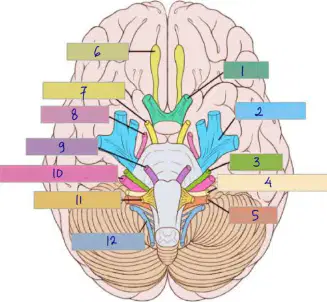
Based on the numbered cranial nerves in the diagram, which label corresponds to the nerve that innervates the lateral rectus muscle?
Number 1
Number 2
Number 7
Number 8
Number 9
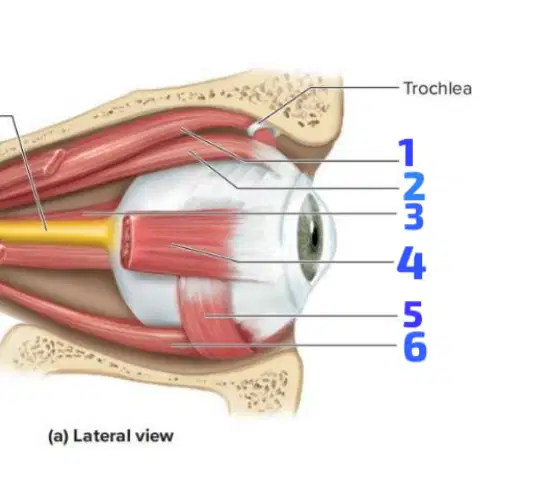
Referring to the lateral view diagram of the extraocular muscles with labels 1–6, which labeled muscle moves the eyeball medially (toward the nose)?
Number 1
Number 2
Number 3
Number 4
Number 6
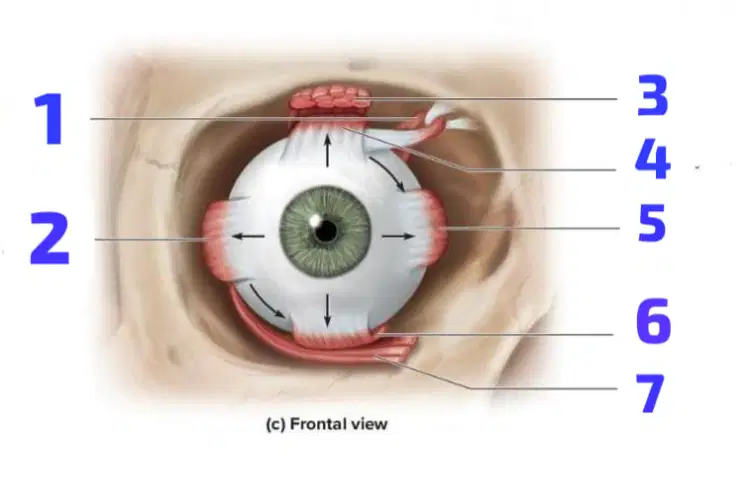
This muscle is innervated by the abducens nerve and lies on the lateral side. Which labeled structure is it in the frontal eye diagram?
Number 1
Number 2
Number 3
Number 4
Number 5
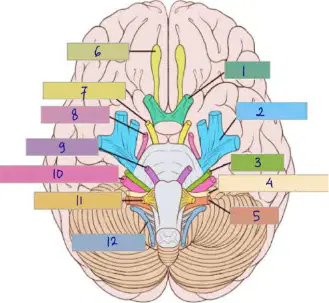
The levator palpebrae muscle is described as closing the eyelid and is innervated by which numbered cranial nerve in the diagram?
Number 1
Number 2
Number 7
Number 8
Number 9
A pathological increase in intraocular pressure due to impaired aqueous humor drainage is the basic pathophysiology of...
Cataract
Glaucoma
Conjunctivitis
Ptosis
Strabismus
A patient presents with a complaint that the right eyelid cannot close completely and the eye is dry. Which ocular adnexal structure’s secretory function is most likely impaired?
Lacrimal gland
Meibomian glands
Conjunctiva
Orbicularis oculi muscle
Eyelashes
The pupillary light reflex involves afferent and efferent pathways. The afferent pathway is carried by which nerve?
CN II (Optic)
CN III (Oculomotor)
CN IV (Trochlear)
CN V (Trigeminal)
CN VI (Abducens)
A corneal ulcer can cause corneal clouding. Which primary function is most affected?
Regulation of the amount of light entering the eye
Refraction (bending) of light
Production of aqueous humor
Attachment of extraocular muscles
Sensation of eye pain

