
 Worksheets
Seizure part 1
Total questions: 15
Worksheet time: 15mins
15 y/o girl presents with history of two episodes (six and four months ago) of generalized body stiffening and shaking upon waking up in the morning, each lasting for about one minutes during which she was unresponsive and confused for half hour afterwards.
Her older sister has had a few episodes of shaking and loss of consciousness as well.
There is no history of drug/alcohol use, no history of head trauma.
Birth and development history are normal.
Neurological exam is normal. Brain MRI is normal. EEG show 4-6 Hz generalized epileptic discharge
What is the most likely cause of her symptoms?
Temporal lobe focal epilepsy
Idiopathic or genetic epilepsy
Occipital lobe epilepsy
West syndrome
Lennox–Gastaut syndrome
26 y/o woman presents with hx of stereotyped events characterized by repetitive right arm movement and lip smacking for 2-3 minutes. She seems slow and distracted and does not respond to questions during the event and does not recall the episode afterwards. No tonic-clonic movement, she does not fall or lose consciousness during the event. She remains confused for 7-8 minutes afterwards and then returns to her baseline.
The description is most consistent with which of the following seizure types?
Myoclonic
Simple partial
Generalized tonic–clonic
Complex partial
Absence
67-year-old man with past medical history significant for hypertension and chronic smoking (50 pack yr hx) presented with a two-month history of episodic repetitive left arm shaking lasting for 2-3 minutes. He is fully conscious and aware during these episodes. He sometimes feels that his left arm is weak for a few minutes after it stops shaking.
The episodes are most suggestive of this seizure type:
Absence
Generalized tonic clonic
Complex partial
Myoclonic
Simple partial
67-year-old man with past medical history significant for hypertension and chronic smoking (50 pack yr hx) presented with a two-month history of episodic repetitive left arm shaking lasting for 2-3 minutes. He is fully conscious and aware during these episodes. He sometimes feels that his left arm is weak for a few minutes after it stops shaking.
Brain tumor
Vascular malformation
Idiopathic epilepsy
Drug use
Congenital malformation
A 54-year-old man presents with paroxysmal episodes described as suddenly stopping whatever he is doing, staring off into space, at times exhibiting chewing movements of his mouth and repetitive picking at his clothes with the left hand lasting ~ 1-2 minutes.
During these episodes he does not respond to verbal commands.
He has no recollection of the events only recognizing an abnormal smell and then losing track of time briefly.
Episodes have been occurring once or twice a month for the last year.
The episodes are most suggestive of this seizure type:
Simple partial
Complex partial
Absence
Myoclonic
Generalized tonic clonic
All of the following are helpful in differentiating between absence and complex partial seizure EXCEPT?
Preceding aura
Duration
Post-ictal confusion
EEG findings
Age of onset
15 y/o girl presents with history of two episodes (six and four months ago) of generalized body stiffening and shaking upon waking up in the morning, each lasting for about one minutes during which she was unresponsive and confused for half hour afterwards.
The description best fit into which of the seizure types :
Absence
Atonic
Complex partial
Generalized tonic clonic
Simple partial motor
15 y/o girl presents with history of two episodes (six and four months ago) of generalized body stiffening and shaking upon waking up in the morning, each lasting for about one minutes during which she was unresponsive and confused for half hour afterwards.
All of the following could be possible cause/etiology of seizure in this case EXCEPT:
Ateriovenous malformation (AVM)
Cerebrovascular disease
Drug abuse
Idiopathic (genetic epilepsy
An 18 year old girl presents with history of episodic headaches since age 12. She has no past medical history except severe motion sickness in childhood. The headaches are unilateral, throbbing in character, associated with nausea and photophobia, worse before her periods. There is history of similar headaches in her mother and younger sister.
What is the most likely cause of her headaches?
Brain tumor
CSF hypotension syndrome
Migraine
Temporal arteritis
Pseudotumor cerebri
She reports that she has been having more frequent headaches for past few months requiring her to take almost daily ibuprofen. She does not take any medication except for birth control pill that she started taking six month ago. She has been under stress lately and has not been sleeping well.
All of the following will be helpful in managing her headaches EXCEPT:
Switching to an alternative oral contraceptive
Sleep hygiene
Nortriptyline (tricyclic antidepressant)
Sumatriptan
Minimizing analgesic use
The patient is counseled on avoiding analgesic overuse and switched to progestin only oral contraceptive. Her headaches improve within 3 months.
She returns after ten years later with new headache that she has had for past three months. The headache is generalized and has been more or less constant, but worse in the morning. She has also had blurry vision, dizziness, and nausea (with occasional vomiting) for past few weeks. Of note, she has gained 20 pounds since last year due to poor dietary habits and lack of regular physical activity.
Which of the following is the LEAST LIKELY cause of her headache?
Cerebral venous sinus thrombosis
Pseudotumor cerebri
Brain tumor
Migraine
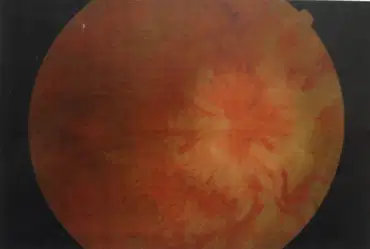
The brain MRI and MR venogram obtained later are found to be normal. She is referred to an ophthalmologist for blurry vision and undergoes a dilated fundus exam. The fundus photograph is shown below.
What should be the next diagnostic test to help confirm the diagnosis?
Brain biopsy
Spinal tap
CT angiogram
EEG
Which one of the following is MOST LIKELY to be associated with papilledema and left hemiparesis?
Brain tumor
CSF hypotension syndrome
Migraine
Pseudotumor cerebri
Tension headache
A 42 year old woman presents with a two week history of generalized moderate to severe occipital headache, dizziness, and neck pain. The headache is constant, pulling in character, worse upon standing or walking and is relieved on lying down. The headache also gets worse with coughing or sneezing. There is no history of fever or head trauma. There is no prior or family history of headache.
The general exam in normal; she is afebrile. The neurological exam is normal. There is mild neck stiffness.
All of the following diagnoses will be reasonable to consider in this case EXCEPT:
Arnold–Chiari malformation
Aseptic meningitis
Migraine
CSF leak
Sentinel subarachnoid bleed
Which one of the following medications is used for abortive treatment of migraine?
Metoclopramide
Propranolol
Tricyclic antidepressants
Topiramate
Valproic acid

