
 Worksheets
Topic 4: Ecosystems Quiz
Total questions: 38
Worksheet time: 19mins

Which of the following shows the correct order of organisms in the food chain described in the diagram?
Plankton → Large fish → Small fish → Fishermen
Plankton → Small fish → Large fish → Fishermen
Fishermen → Large fish → Small fish → Plankton
Small fish → Plankton → Large fish → Fishermen
What is bioaccumulation?
The process of energy transfer in a food chain
The gradual build-up of chemicals in organisms over time
The breakdown of pollutants by bacteria
The movement of nutrients through soil

Which organism first takes in mercury compounds from seawater?
Large fish
Small fish
Plankton
Fishermen
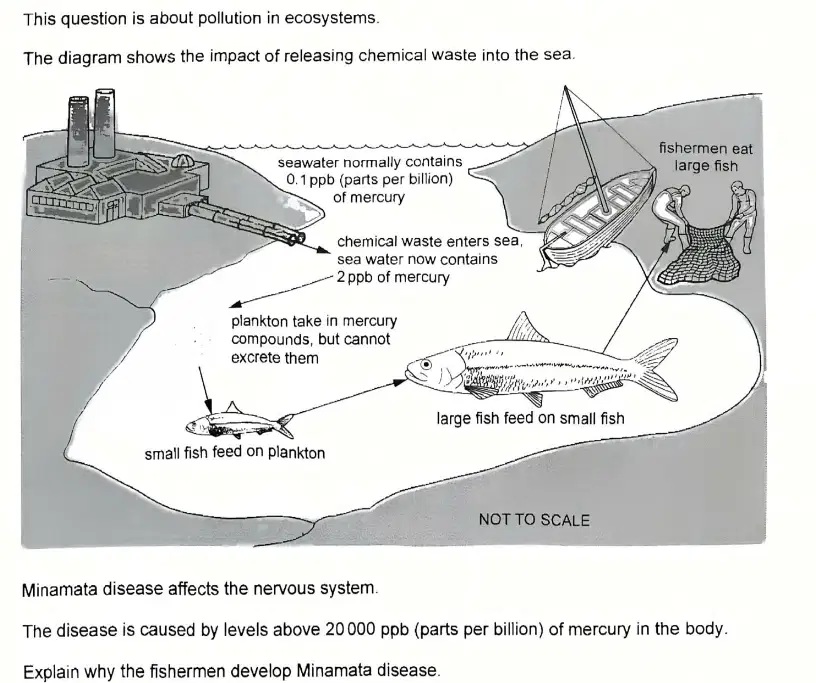
Minamata disease is caused by:
Lack of oxygen in blood
Excess mercury in the body
Eating fish with low protein
Drinking seawater
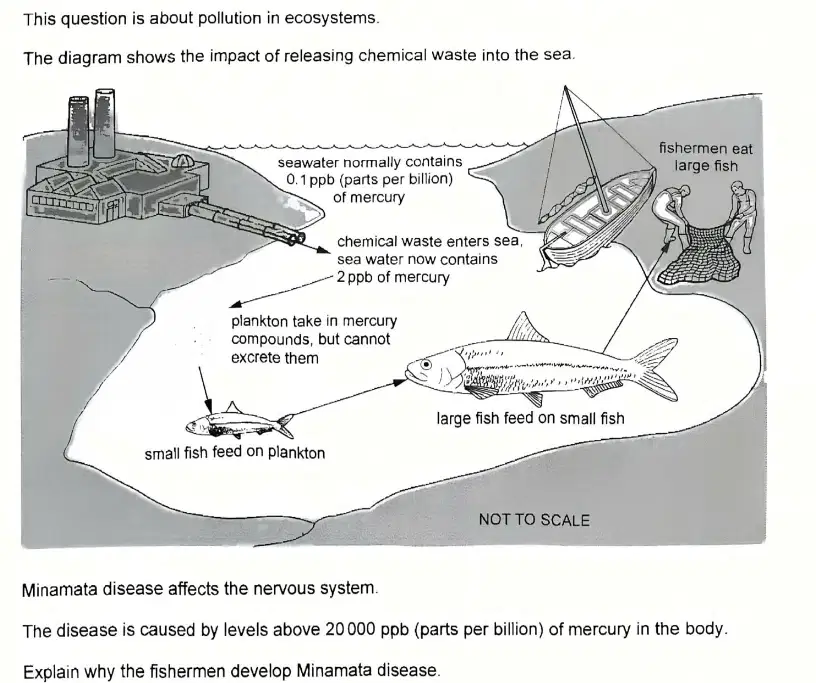
Which statement about mercury in seawater is correct?
Normal seawater contains 2 ppb mercury
After pollution, seawater contains 0.1 ppb mercury
Normal seawater contains 0.1 ppb mercury
Mercury levels in seawater do not change
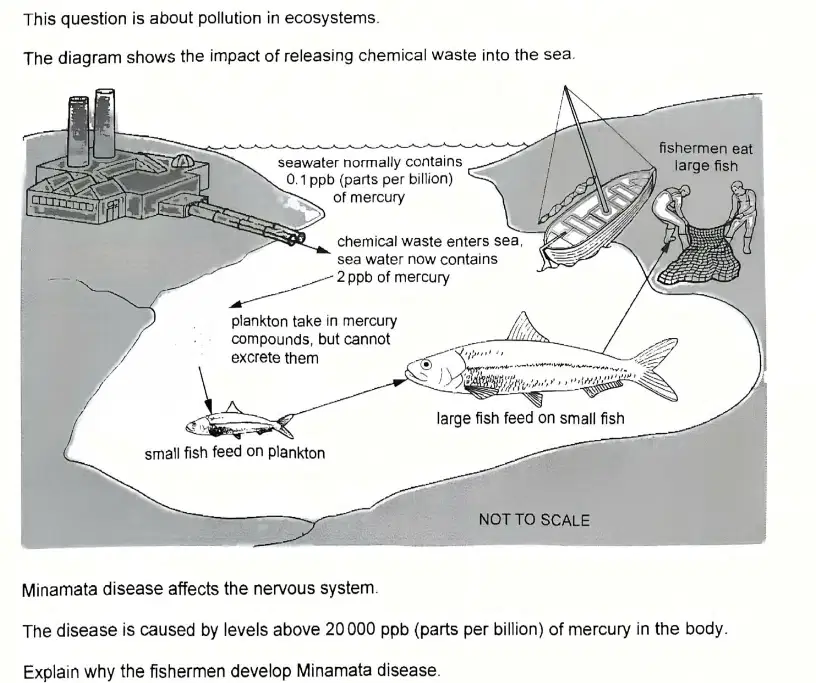
What is the main reason mercury cannot be removed from plankton?
Plankton do not respire
Mercury compounds cannot be excreted
Plankton store mercury in their bones
Mercury evaporates from plankton
Which term describes the increase in concentration of toxins along a food chain?
Bioaccumulation
Biomagnification
Photosynthesis
Decomposition
Which organism is a producer in the food chain plankton → small fish → large fish → fishermen?
Plankton
Small fish
Large fish
Fishermen
What is the role of decomposers in an ecosystem?
They produce food
They break down dead organisms and recycle nutrients
They accumulate toxins
They form the base of the food chain
Which of these is a non-living component of an ecosystem?
Fish
Plankton
Water
Grasshopper
Why do large fish have higher mercury levels than small fish?
They produce mercury during respiration
They eat many small fish that contain mercury
They absorb mercury from seawater directly
They excrete mercury slowly
Why do fishermen develop Minamata disease?
They swim in polluted water
They eat large fish that contain very high levels of mercury
They breathe in mercury vapour from seawater
They drink water from rivers
Which statement best explains biomagnification?
Mercury concentration decreases along the food chain
Mercury concentration increases at higher trophic levels
Mercury evaporates from seawater
Mercury is broken down by bacteria
Which factor makes deserts difficult places for organisms to live?
High rainfall
Low rainfall and extreme temperatures
Abundant water
Dense vegetation
What do arrows in a food web represent?
The direction of water flow
The direction of energy transfer
The movement of decomposers
The recycling of nutrients
Which of these is an example of an invasive species? (Native species: Kangaroo rats, Polar bears, Termites)
Stoats introduced to New Zealand
Kangaroo rats in deserts
Polar bears in the Arctic
Termites in soil
Why are invasive species harmful to ecosystems?
They always die quickly
They compete with native species and disrupt food webs
They increase biodiversity
They reduce pollution
Which process allows oxygen to enter blood from air sacs in lungs?
Osmosis
Diffusion
Respiration
Photosynthesis
Which term describes the network of interactions between living organisms and non-living things?
Habitat
Ecosystem
Community
Population
Which organism acts as a primary consumer in the food chain plankton → small fish → large fish → fishermen?
Plankton
Small fish
Large fish
Fishermen
If mercury levels in seawater increase from 2 ppb to 5 ppb, which group is most at risk of Minamata disease?
Plankton
Small fish
Large fish
Humans who eat large fish
Which strategy would most effectively reduce mercury bioaccumulation in humans?
Increase fishing of large fish
Reduce chemical waste entering the sea
Add more plankton to the ocean
Ban all seafood consumption
A pesticide is sprayed on crops. Which organism in a food chain will have the highest concentration of pesticide?
Producer
Primary consumer
Secondary consumer
Tertiary consumer
Which of these best describes why DDT persists in ecosystems?
It evaporates quickly
It is biodegradable
It is persistent and not broken down by decomposers
It dissolves in water easily
Which of these organisms would be most affected by biomagnification of DDT?
Grass
Grasshopper
Frog
Hawk
Which factor would most likely decrease biodiversity in a forest ecosystem?
Planting more native trees
Introducing an invasive species
Reducing pollution
Protecting habitats
Which of these is an abiotic factor in an ecosystem?
Soil
Earthworm
Grass
Beetle
Which statement explains why energy decreases at each trophic level?
Energy is created at higher levels
Energy is lost as heat during respiration
Energy is recycled completely
Energy is stored in decomposers
Which of these organisms is a decomposer?
Mushroom
Grasshopper
Snake
Fish
Which of these is the best example of a food web?
A diagram showing only producers
A diagram showing interconnected food chains
A diagram showing only consumers
A diagram showing only decomposers
Which strategy would most effectively prevent bioaccumulation of mercury?
Ban fishing
Stop mercury pollution at its source
Increase fish farming
Add chemicals to seawater
Why is biomagnification more dangerous for top predators than for organisms at lower trophic levels?
They eat less food
They eat many organisms, accumulating toxins
They excrete toxins quickly
They produce toxins themselves
Which of these best explains why ecosystems are complex?
They contain only producers
They involve many interactions between organisms and environment
They have simple food chains
They do not include abiotic factors
Which statement about invasive species is correct?
They always increase biodiversity
They can cause extinction of native species
They never affect food webs
They reduce competition
Which of these best explains why DDT was banned in many countries?
It was too expensive
It caused bioaccumulation and harmed wildlife
It was not effective against insects
It evaporated too quickly
Which factor would most likely increase stability in an ecosystem?
High biodiversity
Introduction of invasive species
Pollution
Habitat destruction
Which of these is the best reason for conserving ecosystems?
To reduce biodiversity
To maintain ecological balance and resources
To increase pollution
To eliminate all predators
Which of these best explains why mercury poisoning is still a global issue?
Mercury is biodegradable
Mercury persists and spreads through food chains worldwide
Mercury evaporates quickly
Mercury is harmless

