
 Worksheets
Maurya, SE Asia, East Africa Review
Total questions: 40
Worksheet time: 13mins
Who founded the Mauryan Empire?
Asoka
Chandragupta Maurya
Siddhartha
Chandra Gupta I
How were Asoka and Chandragupta related?
Asoka was Chandragupta's father
Asoka was Chandragupta's son
Asoka was Chandragupta's grandson
Asoka was Chandragupta's grandfather
To which religion did Asoka convert?
Hinduism
Buddhism
Christianity
Jainism
How did Asoka practice religious tolerance?
He made Hindus leave the empire.
He made Buddhists convert to Hinduism.
He allowed people to follow their own religion.
He jailed anyone who did not share his beliefs.
How did Asoka inform his people about his laws and beliefs?
He told them
He had them carved on giant stone pillars
He wrote songs and had them sung throughout the empire
He posted them on Instagram
What were the main features of the Mauryan Empire's economic structure?
Free market economy, excessive administration of resources, and limited trade routes
Decentralized economy, inefficient administration of resources, and lack of trade routes
Centralized economy, efficient administration of resources, and trade routes
Barter system, no administration of resources, and isolated economy
Explain the role of the Mauryan Empire's bureaucracy in maintaining administrative control.
Selling goods in the market
Performing religious rituals
Efficiently collecting taxes, managing the army, overseeing public works, and ensuring law and order
Building monuments and temples
Discuss the administrative system of the Mauryan Empire under Chandragupta Maurya's rule.
Loosely organized with no provincial divisions.
Highly organized and efficient, with provinces and a complex bureaucracy.
Ruled by a single dictator with no bureaucracy.
Chaotic and disorganized with no clear administrative structure.
Who founded the Mauryan dynasty?
Chandragupta Maurya
Ashoka
Chandra Gupta I
Chandra Gupta II
Ashoka's laws carved into pillars were called...
rules
edicts
codes
regulations
What did Chandragupta Maurya give up his throne to become?
a farmer
an artist
a monk
a soldier
Chandragupta Maurya was unpopular because he forced which group to pay heavy taxes to fund his wars?
monks
scribes
peasants
farmers
How did Asoka treat other religions in the Mauryan Empire?
He punished people who practiced Hinduism.
Asoka only allowed people to practice Buddhism and Hinduism.
Asoka forced all of the people to practice Hinduism.
He wanted all religions to be honored and respected.
This river is considered India's holiest river.
Nile River
Mississippi River
Ganges River
Euphrates River


Which of these sea-based kingdoms prospered by charging fees for ships traveling between India and China?
Sinhala Dynasties
Majapahit Kingdom
Srivijaya Empire
Ehmer Empire
The Khmer Empire was located primarily in which modern-day country?
India
Vietnam
Cambodia
Myanmar
Which crop helped sustain the large population of the Khmer Empire?
Corn
Rice
Beans
Potatoes
Which empire attacked the Srivijaya Empire because it was excluded from fees for shipping from China to the Middle East?
Delhi Sultanate
Chola Empire
Pandyas
Majapahit
The transport of goods overseas between two countries or regions is known as what?
empire relations
foreign exchange
maritime trade
international trade
Angkor Wat
Largest and most powerful Andean empire. Controlled the Pacific coast of South America from Ecuador to Chile from its capital, Cuzco.
A branch of Islam whose members acknowledge the first four caliphs as the rightful successors of Muhammad.
City, now in ruins (in the modern African country of Zimbabwe), whose many stone structures were built between about 1250 and 1450, when it was a trading center and the capital of a large state.
A temple complex built in the Khmer Empire and dedicated to the Hindu god Vishnu.
Which two cultures have had the greatest impact on Southeast Asia?
India and Japan
Japan and China
China and India
China and Tibet
In which Southeast Asian country do 40 percent of the region’s people live?
Vietnam
Singapore
Thailand
Indonesia
Which Southeast Asian country has a large ethnic Tagalog minority?
Malaysia
Laos
the Philippines
Myanmar

Which island kingdom was famous for building the great Buddhist temple at Borobudur?
The Srivijaya Empire
The Sailendra Dynasty
The Khmer Empire
The Dai Viet Dynasty
Vietnamese Kingdoms: ___________ was harshly ruled by China, and in 938, China acknowledged the independence of ______________.
Nam Viet, Dai Viet
Dai Viet, Nam Viet
Silla, Choson
Nam Viet, Gupta
The Trung sisters
helped invade Korea and unite the peninsula
helped spread Hinduism throughout Asia
led the Nam Viet people in a rebellion against Chinese rule
built Angkor Wat
During the Vietnamese Ly Dynasty, which of the following occurred?
Effective roads were built, a professional army was established, and Buddhism was reinforced.
Hinduism flourished, and great achievements in math and science were made.
A Korean written language was developed, celadons were created, and ondols were used to heat houses.
Rice cultivation expanded the economy, 20,000 Buddhist shrines were built, and wars weakened political leadership.

Which letter represents the city-state Kilwa?
D
E
F
G

Why was East Africa a good location for trade?
What did East African mariners planning to cross the Indian Ocean base their journey on?
the demand for goods
the summer months
the agricultural cycle
the monsoon winds
Identify the location of the Swahili city states.

to strengthen India’s control of East Africa
to control trade across the Indian Ocean
to provide adequate food for the growing population
to provide room for the growing number of Bantu
It was a vital center of culture and learning
What made Kilwa a powerful city-state?
Its location near gold mines
Its large farming lands
Its control of the Red Sea
Its alliances with Europe
Which port did Kilwa take over to control the gold trade?
Mombasa
Sofala
Zanzibar
Malindi
Stretching 1000 miles along the Indian Ocean, coral reefs and barrier islands protect it from the weather.
Savanna
Grasslands
Ethiopian Highlands
Swahili Coast
Which port city was essential to Aksum's trading power?
Adulis
Cairo
Alexandria
Kush
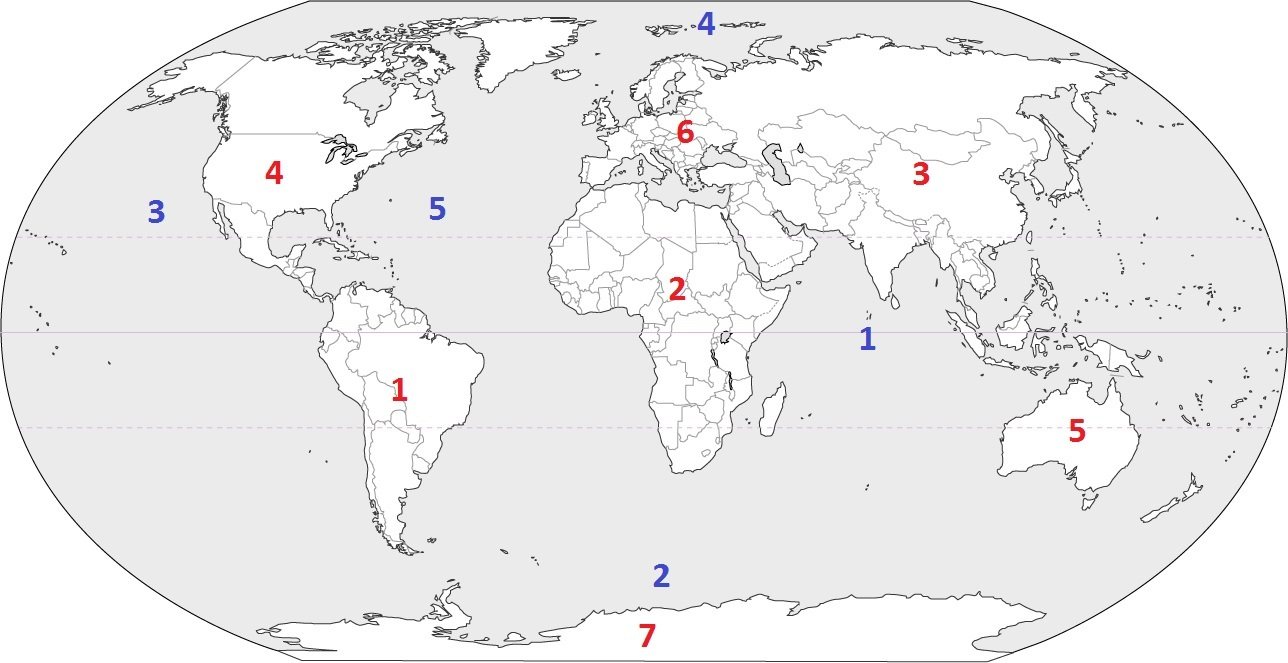
Identify the ocean at location #1.
Southern Ocean
Arctic Ocean
Atlantic Ocean
Indian Ocean

