
 Worksheets
unit 112 level 1 sources and distribution: Introduction
Total questions: 25
Worksheet time: 13mins
Which task is a core responsibility of a plumber working on cold water systems?
Design, install, test and maintain systems
Only replace worn pipes when they leak
Focus mainly on hot water circulation
Operate treatment plants for municipalities
Why is advising customers on good water usage part of a plumber’s role?
Water is increasingly valuable and limited
Customers prefer longer showers generally
It reduces the need for permits always
It eliminates maintenance work entirely
A new plumber completes a cold water installation but does not test or maintain it. What responsibility has been overlooked?
Ensuring proper testing and ongoing maintenance
Selling conservation devices to all clients
Managing citywide water distribution networks
Designing hot water boilers for heating
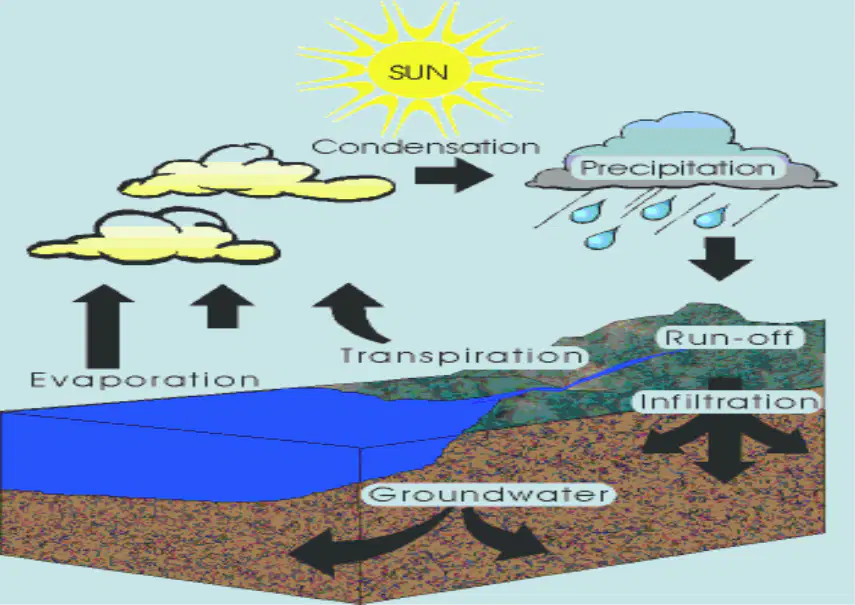
In the rainwater cycle diagram, which process changes liquid water from seas and rivers into water vapor that rises?
Evaporation from water bodies
Infiltration through soil layers
Run-off along ground surfaces
Condensation forming cloud droplets

Which statement best describes precipitation in the water cycle?
Water vapor cools and falls as rain
Water warms and turns to vapor
Water moves downward through soil
Water flows downhill to rivers
Which option is the correct order for the four-stage cycle shown: starting at water in seas and oceans?
Evaporation → Clouds → Rain on land → Rivers return
Rain on land → Clouds → Evaporation → Rivers return
Clouds → Evaporation → Rivers return → Rain on land
Rivers return → Rain on land → Clouds → Evaporation
What term refers to the level below ground where soil and rock are saturated with water?
Water table beneath the surface
Cloud layer in the atmosphere
Run-off channel on a slope
Condensation zone in clouds
What is the key difference between lakes and reservoirs in water supply context?
Lakes are natural, reservoirs are man-made
Lakes are deeper, reservoirs are shallow
Lakes are smaller, reservoirs are huge
Lakes are salty, reservoirs are fresh
Which pair both store large amounts of water for supply?
Lakes and reservoirs
Wells and boreholes
Pipes and hydrants
Clouds and fog
What is the purpose of adding fluoride before distribution?
Assist pH testing accuracy
Improve dental health benefits
Increase sedimentation rate
Remove remaining suspended solids
Which statement about sand filtration is correct?
Water passes while particles stay in sand
Particles pass while sand traps water
Both water and particles pass through
Sand filters only work with pressure
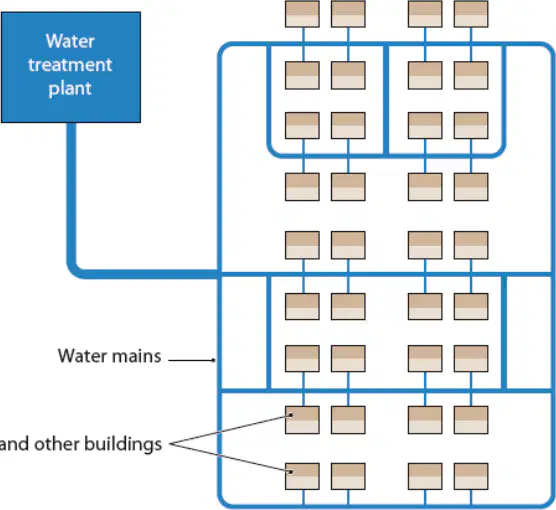
In the diagram, what connects the water treatment plant to neighborhoods in a typical mains distribution system?
A network of water mains pipes
A single large storage tank
Individual household pumps
A series of open channels
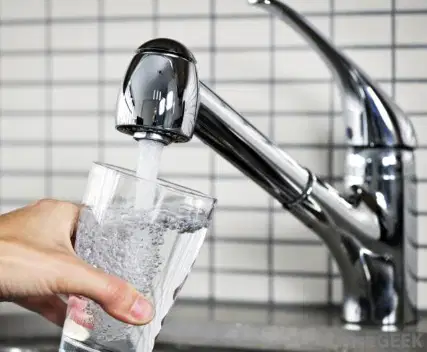
Until water is released from a tap, how is it classified for drinking purposes?
Wholesome water suitable for drinking
Non-potable process grade water
Untreated raw surface water
Greywater for flushing only

Which pipe material has largely replaced cast iron for water mains?
MDPE (medium density polyethylene)
PVC-U (unplasticised PVC)
Copper with soldered joints
Galvanized mild steel tubing
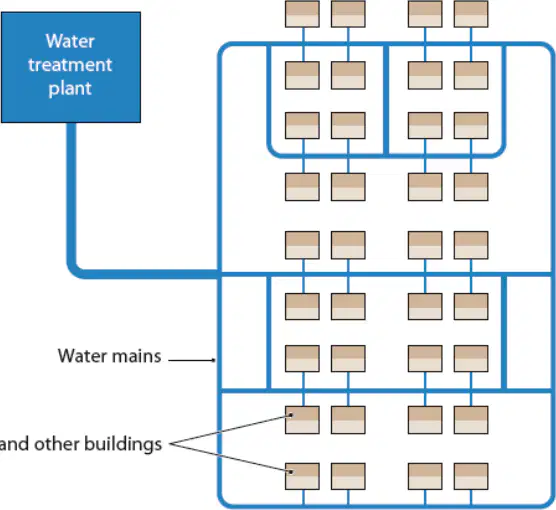
Which component is the starting point for the mains distribution diagram?
Water treatment plant
Local service valve
Domestic water meter
Fire hydrant assembly
What does the term 'wholesome water' most closely mean in this context?
Water meeting standards for safe drinking
Water suitable only for irrigation use
Water reserved for industrial processes
Water intended for toilet flushing only

Which change in pipe materials reflects modern practice in water mains installation?
Replacing cast iron with MDPE pipes
Replacing MDPE with cast iron pipes
Replacing copper with lead service pipes
Replacing PVC with clay tile conduits

Which source is most likely obtained by drilling a narrow, deep hole into rock?
Borehole water source
Surface stream intake
Roof rainwater system
Open reservoir supply

In the diagrams, which layer does water move through to form aquifers?
Impervious strata blocking flow
Pervious strata allowing flow
Bedrock with no pores
Clay cap over the surface
A builder needs a small, low-impact water source that is easy to maintain. Which is most suitable?
Deep well with wide lining
Traditional hand-dug shaft
Modern drilled borehole
Artesian spring capture
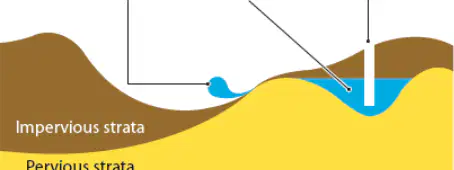
Which feature in the top diagram indicates an unconfined aquifer?
Layer trapped between impervious strata
Open water table under surface ground
Pressurised water below the plane
Clay barrier above confined layer
Select all statements that are true about springs.
They are naturally occurring water sources
They require pumped extraction to flow
They can start the beginning of a stream
They are always man-made outlets
Which factor most explains why shallow wells often have poorer water quality?
They penetrate below all aquifers
They collect surface contaminants easily
They are always drilled through rock
They use strong pumps stirring silt
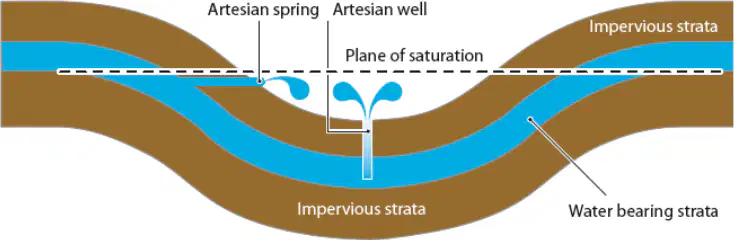
In the lower diagram, what is the role of the impervious strata around the artesian aquifer?
Allows water to seep upward freely
Traps water to maintain pressure
Creates evaporation at the surface
Filters contaminants from rivers
Compared with a traditional well, a borehole is typically described as what?
Larger and more intrusive
Smaller and less intrusive
Wider and hand excavated
Deeper and always artesian

