
 Worksheets
Lesson Objectives
Total questions: 36
Worksheet time: 18mins
A brief overview of the historical contexts that help in the development of drawing and painting includes:
The influence of different cultures, technological advancements, and changing artistic movements.
Only the invention of photography in the 19th century.
The exclusive use of digital tools in modern times.
A focus solely on prehistoric cave paintings.
The characteristics of drawing and painting throughout history include:
Changes in style, technique, and subject matter over time
A constant use of only one technique
No influence from cultural or historical events
Uniformity in artistic expression across all periods

Qual foi o tipo de trabalho artístico mais marcante que você realizou no ensino fundamental?
Desenho feito em aula de artes
Redação sobre um tema livre
Experimento de ciências
Apresentação de teatro
Did you know? Drawing and painting were fundamental for the development of human communication, as a form of non-verbal language.
True
False
What is non-verbal language?
A) A language that uses words to communicate
B) A language that uses images or gestures to communicate
C) A language that uses only sounds
D) A language that uses only written text
Fill in the blank: Non-verbal language is different from verbal language because verbal language uses _______.
words
gestures
facial expressions
body language
With the passage of time, drawing and painting began to incorporate artistic contexts. Which civilizations stood out in sculpture and helped develop drawing and painting concepts?
Egyptians and Persians
Greeks and Romans
Chinese and Japanese
Mayans and Aztecs
The Greeks worshipped the beauty of the ______ of the human body.
proportion
color
weight
height

What is the name of the sculpture shown in the image, attributed to Alexandre of Antioch?
Venus de Milo
Winged Victory of Samothrace
Discobolus
Laocoön and His Sons
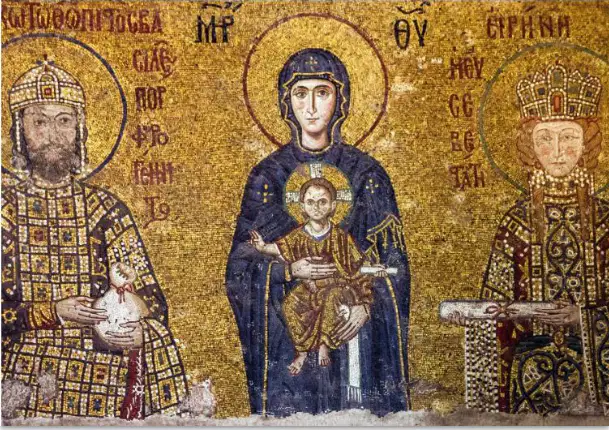
According to the passage, how were paintings in Medieval Art characterized?
They were realistic and focused on anatomy
They were colorful and not concerned with proportion or anatomical details
They were abstract and monochromatic
They were focused on landscapes

According to the passage, why were illustrations and paintings used for teaching in the Middle Ages?
Because most European citizens could not read or write
Because they were cheaper than books
Because they were more beautiful
Because they were easier to transport
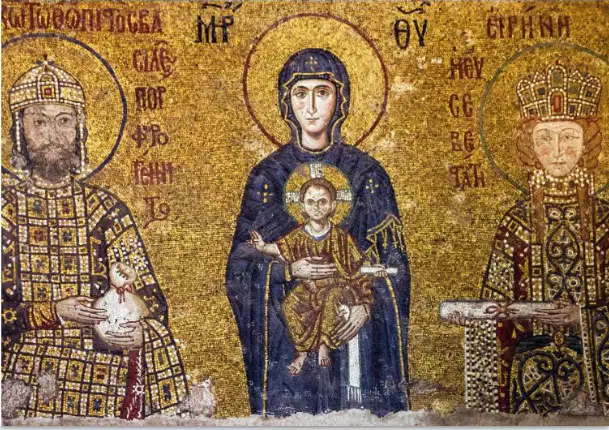
Fill in the blank: In Medieval Art, paintings were _______ and did not focus on proportion or anatomical details. They were didactic and taught through images.
colorful
realistic
monochrome
abstract
Identify the figures shown in the image.
Triangle and square
Circle and rectangle
Hexagon and pentagon
Oval and star
The place being depicted in the image is:
A library
A hospital
A supermarket
A school
The image depicts which scenes?
A group of people playing football and a family having a picnic
A classroom with students and a teacher
A busy city street with cars and buses
A mountain landscape with hikers
The colors in the image are:
bright and vibrant
dull and faded
black and white
monochromatic
The image conveys the message:
Save water for a better future.
Use more water for daily activities.
Water is an unlimited resource.
Wasting water has no consequences.

What does the illumination in the image commemorate?
Christmas
Pentecost
Easter
Epiphany
During the Renaissance, there was a return to which classical antiquity?
Egyptian
Greco-Roman
Medieval
Asian
What is perspective in art, as described in the Renaissance?
A technique for drawing cartoons
A method for representing three-dimensional space that creates the illusion of thickness and depth in figures
A way to paint only flat images
A style of coloring
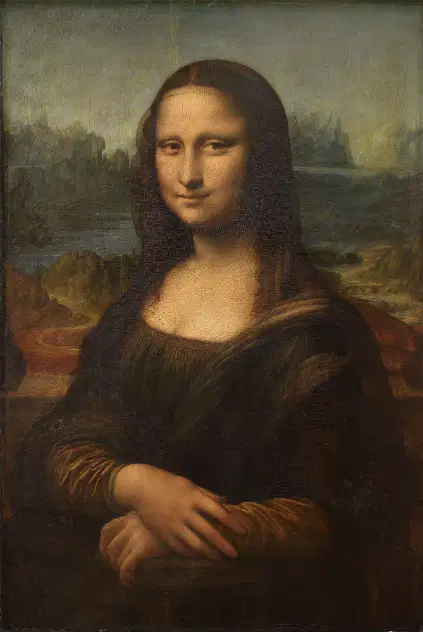
Fill in the blank: The painting 'Mona Lisa' was created by ________ in 1503.
Leonardo da Vinci
Vincent van Gogh
Pablo Picasso
Claude Monet

Which of the following best describes the main characteristics of Greek, Medieval, and Renaissance Arts?
Greek art emphasizes harmony and proportion; Medieval art is religious and symbolic; Renaissance art focuses on realism and humanism.
Greek art is abstract; Medieval art is focused on landscapes; Renaissance art ignores perspective.
Greek art is known for its use of bright colors; Medieval art is centered on mythology; Renaissance art avoids classical influences.
Greek art is minimalist; Medieval art is secular; Renaissance art is purely decorative.
After three centuries of art focused on proportion and mathematical reasoning of elements, the Baroque brought a change in thinking: Expression of feelings and thoughts in painting and drawing. Can you observe this in the image on the side?
Yes, the image shows clear expression of feelings and thoughts typical of Baroque art.
No, the image only focuses on mathematical reasoning and proportion.
No, the image represents abstract art without emotional expression.
No, the image is a modern artwork unrelated to Baroque style.
According to the passage, what is Impressionism? (Fill in the blank: Impressionism is an art movement that breaks with traditional concepts, depicting landscapes with _______ outlines and quick, fragmented, and juxtaposed brushstrokes, trying to capture the effects of light at the moment.)
imprecise
precise
geometric
blurred
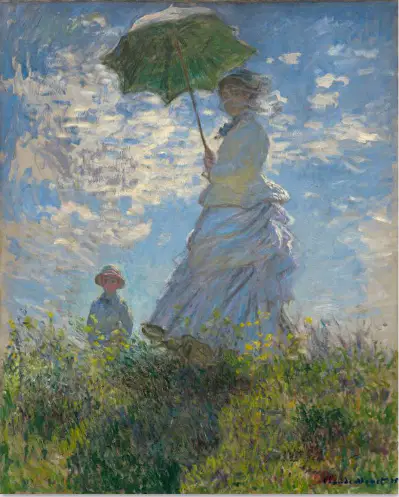
Observe the painting 'Woman with a Parasol' (1875) by Claude Monet. The effects of light in the image, as mentioned in the passage about Impressionism, are:
Soft, natural light with visible brushstrokes capturing fleeting moments
Harsh, artificial lighting with sharp shadows
Muted, uniform lighting with little contrast
Strong, direct sunlight with no variation
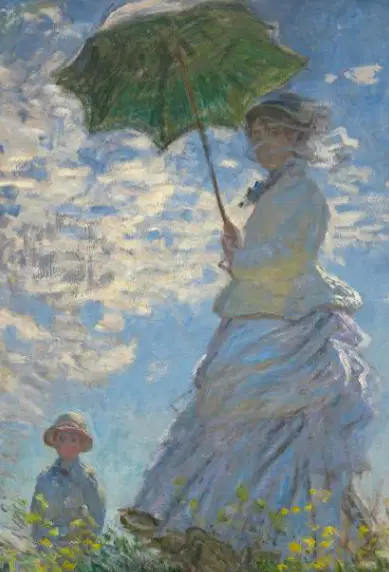
Who is the artist of the painting 'Mulher com sombrinha (1875)'?
Vincent van Gogh
Claude Monet
Pablo Picasso
Leonardo da Vinci
In 1907, a major rupture in art occurred with the work 'Les Demoiselles D'Avignon' by Pablo Picasso. What is the name of the artist who created 'Les Demoiselles D'Avignon'?
Pablo Picasso
Vincent van Gogh
Claude Monet
Salvador Dalí
In which year did this rupture in art occur?
1907
1912
1895
1920
This painting marks the beginning of cubism, as well as highlighting the impact of African art on the artist's work. Which art movement did 'Les Demoiselles D'Avignon' help to start?
Cubism
Surrealism
Impressionism
Expressionism
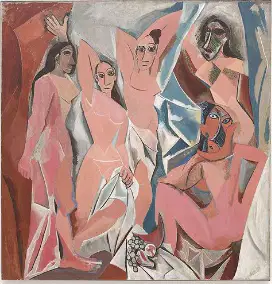
Can you perceive the geometrization of the shapes of the figures in the painting 'Les Demoiselles D'Avignon'?
Yes, the geometrization of the shapes is evident in the painting.
No, the shapes in the painting are not geometrized.
The painting uses only realistic shapes without geometrization.
The painting does not depict any figures.
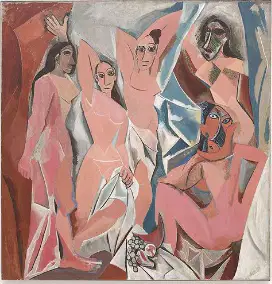
What cultural influence is evident in Picasso's 'Les Demoiselles D'Avignon'?
African art
Japanese art
Greek art
Indian art
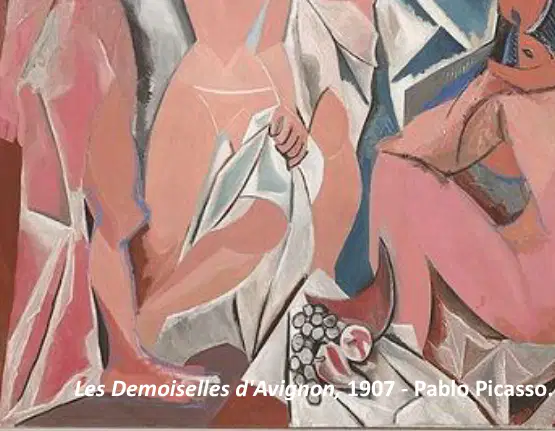
What is the name of the painting shown in the image?
The Starry Night
Les Demoiselles d'Avignon
Guernica
The Persistence of Memory
Who is the artist of the painting 'Les Demoiselles d'Avignon'?
Pablo Picasso
Vincent van Gogh
Salvador Dalí
Claude Monet
Fill in the blank: The painting 'Les Demoiselles d'Avignon' was created in the year _____
1907
1912
1899
1923
Which of the following best describes how to illustrate an excerpt from 'The Little Prince' by Antoine de Saint-Exupéry using medieval aesthetic principles?
Create an illustration based on the passage, following medieval aesthetic principles.
Draw a modern abstract version of the excerpt.
Use only bright neon colors and futuristic shapes.
Illustrate the excerpt using only cartoonish and exaggerated features.
What historical contexts did we learn about today that helped in the development of drawing and painting?
We learned about some historical contexts that aided the development of drawing and painting.
We learned about the future of digital art and animation.
We learned about the chemistry behind paint production.
We learned about the mathematical principles of perspective.

