
 Worksheets
Exercise and the heat!!
Total questions: 68
Worksheet time: 34mins
What is cardiovascular drift?
Downward drift in HR associated with a rise in body temperature
Upward drift in HR associated with a rise in body temperature
Upward drift in HR associated with a decrease in body temperature
Downward drift in HR associated with a decrease in body temperature
A 1 degree increase of body temperature increases bpm by _____?
10
2
5
20
What does the body do to cool itself via radiation during cardiovascular drift?
The body increases blood flow to the surface for cooling via radiation.
The body decreases blood flow to the surface to retain heat.
The body increases sweating to cool via evaporation only.
The body reduces metabolic rate to lower heat production.
Reduced venous return during cardiovascular drift is caused by:
Increased plasma volume
Water loss
Decreased body temperature
Increased blood flow to muscles
During cardiovascular drift, HR increases to maintain _____
cardiac output
blood pressure
respiratory rate
oxygen saturation
Rising core temperature affects protein molecules such as enzymes and receptors and affects the rate of chemical reactions.
True
False
Identify the methods shown in the video that support performers in adapting to exercising in the heat.
Hydration and wearing light clothing
Skipping warm-up routines
Exercising indoors only
Ignoring signs of heat stress
What physiological adaptations were identified in the video last week?
Increased heart rate and sweating
Decreased oxygen intake
Reduced muscle activity
Lower body temperature
Pre-comp Acclimatisation: How many days are recommended for acclimatisation?
7 and 14 days
3 and 5 days
1 and 2 days
10 and 20 days
5 and 8 days
Pre-comp Acclimatisation: What does acclimatisation increase?
A) Plasma volume
B) Loss of electrolytes
C) Core body temperature
D) Heart rate
What is decreased within sweat loss during acclimatisation?
Loss of electrolytes (used for electrical impulses)
Loss of water-soluble vitamins
Loss of proteins
Loss of carbohydrates
What cooling aid is recommended to reduce core body temperature and delay dehydration?
Ice vests
Hot packs
Wool blankets
Electric heaters
During competition, what is the purpose of pacing strategies?
To alter goals and reduce feelings of exertion at low intensity.
To increase the risk of injury during performance.
To ignore fatigue and push beyond physical limits.
To ensure random changes in speed and effort.
During competition, why is it important to wear suitable clothing such as lightweight compression wear?
To minimise heat loss and remove sweat from skin rapidly.
To increase muscle fatigue during exercise.
To restrict movement and reduce flexibility.
To absorb more heat from the environment.
During competition, which type of solution should be used to rehydrate as often as possible to replace fluids, minerals, glucose, and electrolytes?
Hypotonic or isotonic solution
Hypertonic solution
Only water
Carbonated drinks
Which of the following is recommended for cooling down post competition?
Use cold towels and cold fans
Take an ice bath
Avoid fluids
None of the above
Ice baths are recommended post competition.
True
False
Fill in the blank: After competition, it is important to rehydrate using isotonic solutions to replace ________, glucose and electrolytes.
fluids
proteins
vitamins
fats
Low humidity leads to an increase in _________
sweating
rainfall
humidity
cloud cover
High humidity decreases sweating and affects the cooling process.
True
False
Athletes can lose various litres of fluid during exercise. What is the average amount lost per hour?
1-2 litres
2-3 litres
3-4 litres
4-5 litres
Sweating has a cooling effect but can lead to fluid loss. What can this lead to?
Hydration
Dehydration
Increased thermoregulation
Lower core temperature
Which of the following is a symptom of dehydration?
Dry mouth
Runny nose
Excessive sweating
Frequent urination
What is dehydration? Fill in the blank: Dehydration is the loss of ________ in body tissues, largely caused by sweating.
water
oxygen
salt
protein
Dehydration can lead to kidney problems.
True
False
What is thermoregulation?
Regulation of body temperature around a physiological set point.
Regulation of blood pressure in the body.
Regulation of heart rate during exercise.
Regulation of oxygen levels in the blood.
Which of the following is NOT a main cause of rise in core body temperature?
High and prolonged exercise intensities
High air temperatures
Low relative humidity
High relative humidity
Fill in the blank: Internal body temperature is regulated by ________, constantly despite environmental temperature changes.
Thermoreceptors
Photoreceptors
Chemoreceptors
Baroreceptors
Heat moves from body core to body shell via blood.
True
False
Which equation represents a dangerous situation for the body?
High humidity + low temperature + physical work
High humidity + high temperature + physical work
Low humidity + high temperature + physical work
High humidity + high temperature + rest
When heat reaches the skin, it can be dissipated by which of the following processes?
Conduction
Convection
Radiation
Evaporation
All of the above
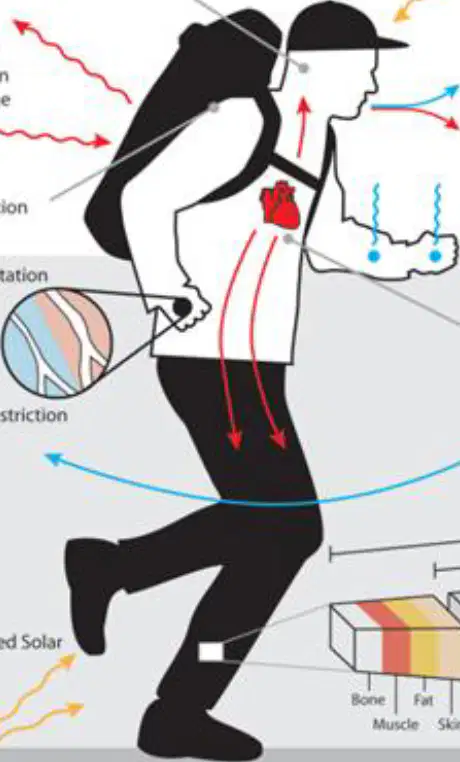
Fill in the blank: The process by which the body loses heat through the conversion of liquid sweat to vapor is called ________.
Evaporation
Conduction
Radiation
Convection
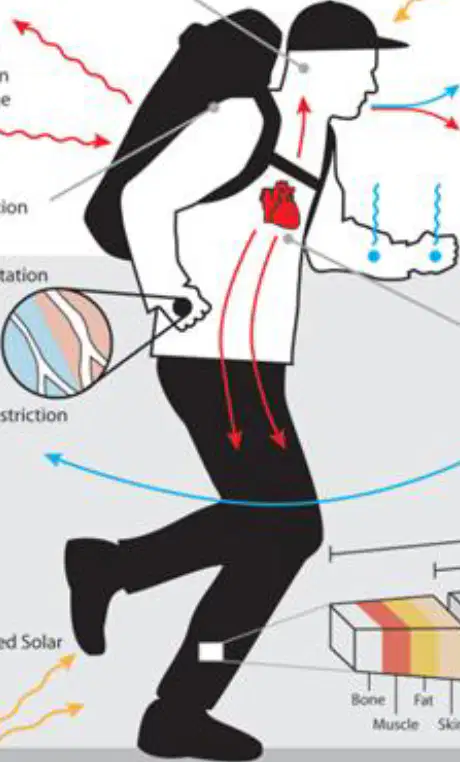
Vasodilation helps the body lose heat.
True
False
What is hyperthermia?
Significantly lowered core body temperature
Significantly raised core body temperature
Normal core body temperature
Fluctuating core body temperature
Fill in the blank: When the body cannot regulate its temperature, it is getting too _____
hot
cold
wet
dry
At what core body temperature does the brain shut exercise down?
35 degrees
37 degrees
40 degrees
45 degrees
Combined with CV Drift, a condition called ______ can be developed.
Cardiac Arrest
Thermal Strain
Heat Stroke
Hypothermia
Which of the following is a warning sign of heat illness?
Nausea
Headache
Chills, goose bumps
All of the above
Cessation of sweating is a warning sign of heatstroke.
True
False
Effects of heat, humidity and body’s thermoregulatory response on the CV system: Decreased blood volume, venous return, stroke volume, cardiac output and blood pressure leads to which of the following?
Increased heart rate to compensate
Decreased heart rate
No change in heart rate
Increased blood pressure
Increased _______ on the CV system is a result of decreased blood volume, venous return, stroke volume, cardiac output and blood pressure.
strain
relaxation
oxygenation
hydration
Reduced oxygen transport to the working muscles is one of the effects of heat and humidity on the CV system.
True
False
Dehydration and drying of airway in temperatures above 32 degrees can lead to increased ________ production.
mucus
saliva
blood
sweat
Dehydration and drying of airway in temperatures above 32 degrees can lead to constriction of ________.
airways
alveoli
bronchioles
capillaries
Increased breathing frequency to maintain oxygen consumption leads to increased ________ cost of exercise.
oxygen
carbon
energy
water
Increased irritation of airways can result in which of the following symptoms?
Coughing
Wheezing
Asthma symptoms
All of the above
Fill in the blank: Strength endurance and _______ capacity are reduced.
aerobic
muscular
anaerobic
flexibility
Fill in the blank: Oxygen 'cost' of activity is _______ and aerobic energy production is decreased.
increased
decreased
unchanged
eliminated
Fill in the blank: Athletes with EIA must take _______.
precautions
medals
breaks
drinks
Fill in the blank: Performance in mid-to long distance events is _______.
decreased
improved
unchanged
maximized
Fill in the blank: Energy production from the anaerobic system is _______.
increased
decreased
constant
negligible
Fill in the blank: Duration of exercise _______ due to LA build up.
decreases
increases
remains constant
fluctuates
Hyperthermia does not affect maximal strength production and therefore explosive events are not affected.
True
False
Fill in the blank: The longer the endurance event, the greater the effect on performance due to the gradual rise in _______ and metabolic rate associated with increased core temperature.
heat
oxygen
glucose
pressure
Which of the following is a reason for decreased exercise duration?
Increased oxygen uptake
Decreased lactic acid accumulation
Increased muscle strength
Lactic acid accumulation occurs more readily, leading to early fatigue
Strength endurance and aerobic capacity are _______ during exercise, decreasing performance in cycling and mid to long distance events.
reduced
increased
unchanged
maximized
What precaution must exercise induced asthma sufferers take?
Exercise induced asthma sufferers must take precautions such as using bronchodilators.
They should avoid all forms of exercise completely.
They must only exercise outdoors in cold weather.
They should not use any medication before exercising.
Perceived exertion _______ as exercise feels harder.
increases
decreases
remains the same
disappears
Thermoregulation is defined as:
The process by which organisms maintain their body temperature within certain boundaries
The process of converting food into energy
The ability to sense external stimuli
The mechanism for producing hormones
Thermoreceptors are defined as:
Receptors that detect changes in temperature.
Receptors that detect changes in pressure.
Receptors that detect changes in light.
Receptors that detect changes in sound.
Dehydration is defined as:
A condition caused by excessive loss of water from the body.
A condition caused by excessive intake of water.
A condition caused by lack of sleep.
A condition caused by overeating.
Hyperthermia is defined as:
An abnormally high body temperature
An abnormally low body temperature
A normal body temperature
A temporary increase in blood pressure
Cardiovascular drift is defined as:
A gradual increase in heart rate during prolonged exercise, despite constant workload.
A sudden drop in blood pressure during exercise.
An immediate increase in cardiac output at the start of exercise.
A decrease in body temperature during physical activity.
Fill in the blank: The process of maintaining internal core temperature is called _________.
Thermoregulation
Photosynthesis
Respiration
Osmosis
Fill in the blank: _________ are receptors which sense a change in temperature.
Thermoreceptors
Photoreceptors
Chemoreceptors
Mechanoreceptors
Fill in the blank: Loss of water in body tissues is known as _________.
Dehydration
Osmosis
Hydration
Saturation
Fill in the blank: Significantly raised core body temperature is called _________
Hyperthermia
Hypothermia
Anemia
Bradycardia
Fill in the blank: Upward drift in HR during sustained steady state exercise activity associated with an increase in body temperature is called _________
Cardiovascular drift
Respiratory drift
Thermal drift
Metabolic drift

