
 Worksheets
Chemical Reactions and Enzymes Worksheet (Grade 9)
Total questions: 150
Worksheet time: 1hrs 15mins
Which statement is true of chemical reactions?
Reactants are on the right
Products are on the right
Products have fewer atoms than reactants
Reactants have fewer atoms than products
Which of the following equations is balanced?
2Fe + 3Cl2 → 2FeCl3
Fe + Cl2 → FeCl3
3Fe + 2Cl2 → 3FeCl3
Fe + 2Cl2 → 3FeCl2
In the following equation, what are the products of the reaction? C6H12O6 + 6O2 → 6CO2 + 6H2O
C6H12O6 and 6H2O
C6H12O6 and 6O2
6O2 and 6CO2
6CO2 and 6H2O
Complete the following chemical equation so it is balanced. C6H12O6 + 6O2 → 6CO2 + ...........
6H2O
12H2O
3H2O
H2O
What principle can be applied to all chemical reactions?
conservation of mass
reactants formed from products
energy loss theory
coefficient principle
Which equation satisfies the law of conservation of matter?
3O2 + 2Al → 2AlO3
3O2 + 2Al → 3AlO3
4O2 + Al → AlO3
4O2 + 3Al → 3AlO3
Why must the number and type of atoms in the reactants equal the number and type atoms in the products formed?
Atoms are converted to other elements by chemical reactions.
The law of conservation of mass says matter cannot be created or destroyed.
Chemical processes convert between matter and energy.
Energy released by an exothermic reaction must balance energy absorbed by an endothermic one
Which statement is true of chemical equations?
Reactants come after the arrow, products come before.
Reactants and products come before the arrow.
Reactants come before the arrow, products come after.
Reactants and products both come after the arrow.
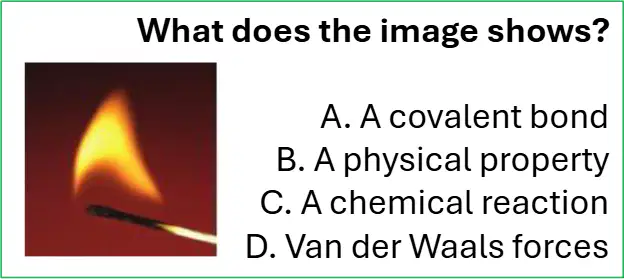
What does the image shows?
A covalent bond
A physical property
A chemical reaction
Van der Waals forces
What is the function of the enzyme-substrate complex?
destroy the enzyme
prevent bondage at the active site
stop chemical reactions
break and forming chemical bonds
Which of the following is a substance that lowers the activation energy?
A substrate
A catalyst
A reactant
An anion
The minimum amount of energy needed for a chemical reaction is called ____.
product threshold
absorbent energy
principle mass
activation energy

How can enzymes benefit chemical reactions, as shown in this energy diagram?
lowering activation energy
raising activation energy
slowing reactions
increasing the amount of product
Which is true about enzymes?
They act on nonspecific, randomly chosen substrates.
After a reaction, they cannot be reused.
They can speed up metabolic processes in the body.
They cannot change shape
What is an active site?
the reactant to which an enzyme binds
the specific place where a substrate binds on an enzyme
a molecule that acts as a biological catalyst
a mixture that maintains the pH of a solution within a specific range
Why is the active site of an enzyme important to enzyme activity?
It raises the activation energy of a reaction.
It allows the enzyme to interact with a large variety of substrates.
It allows the enzyme to catalyze very specific reactions.
It allows an endothermic reaction to run as an exothermic reaction.
The specific location where a substrate binds on an enzyme is called the ____.
active site
enzyme-substrate complex
binding point
catalyst
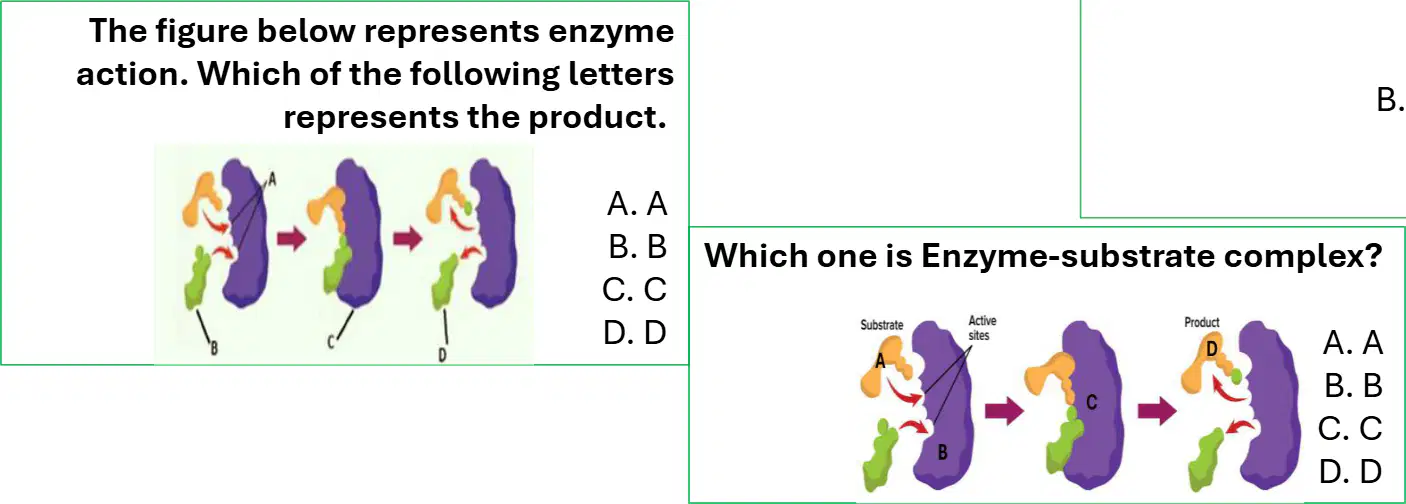
The figure below represents enzyme action. Which of the following letters represents the product.
A
B
C
D
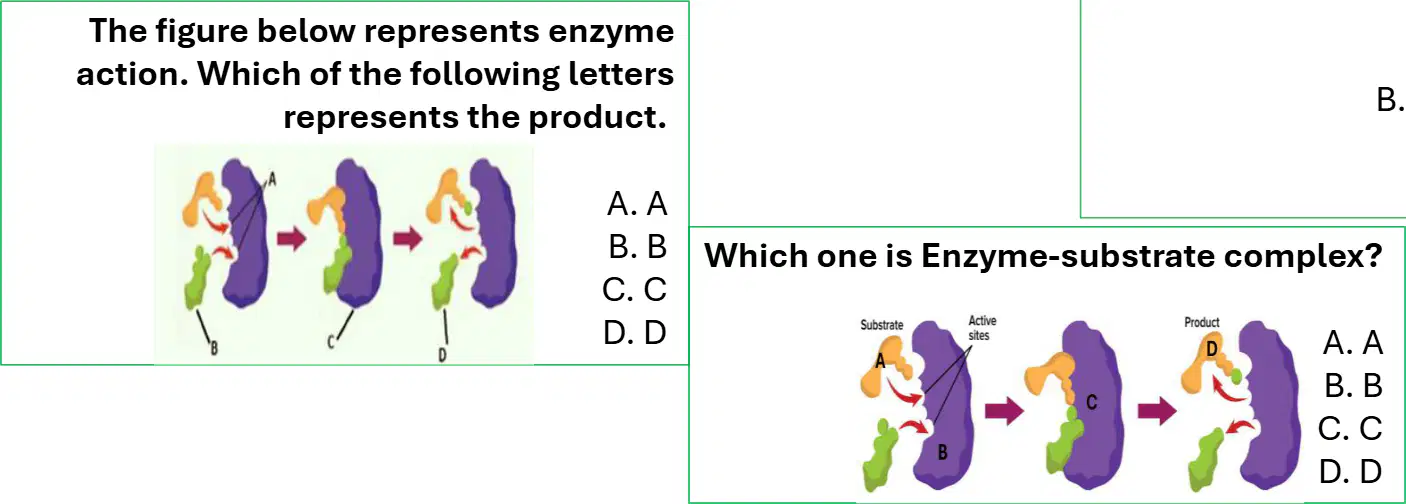
Which one is Enzyme-substrate complex?
A
B
C
D
Which of the following is not a property of water?
It is adhesive.
It is cohesive.
It combusts.
It is a good solvent
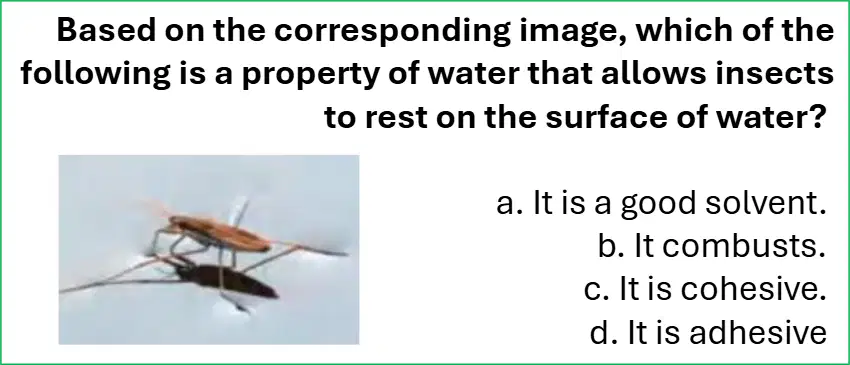
Based on the corresponding image, which of the following is a property of water that allows insects to rest on the surface of water?
It is a good solvent.
It combusts.
It is cohesive.
It is adhesive
Which property of water allows it to dissolve many different substances?
Cohesion
Adhesion
Solubility
Polarity
Leaves can rest on the surface of water due to the property of ____________.
Cohesion
Solubility
Adhesion
Collision
Which statement is not true about pure water?
It has a pH of 7.0
It is composed of polar molecules
It is composed of ionic bonds
It is a good solvent
Molecules that have an unequal distribution of charges are called ____.
enzymes
polar molecules
substrate molecules
solvents
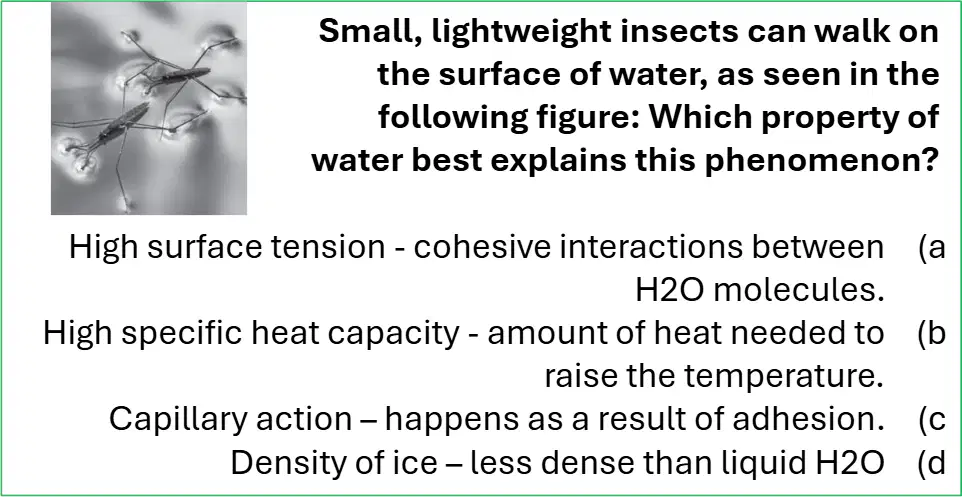
Small, lightweight insects can walk on the surface of water, as seen in the following figure: Which property of water best explains this phenomenon?
High surface tension - cohesive interactions between H2O molecules.
High specific heat capacity - amount of heat needed to raise the temperature.
Capillary action – happens as a result of adhesion.
Density of ice – less dense than liquid H2O.
What are van der Waals forces?
attractive forces between molecules
minimum amount of energy needed for a chemical reaction
forces that bond ions together
molecules that store genetic information
What is a polar molecule?
a molecule with oppositely charged regions
a molecule that produces hydroxide ions (OH-) in solution
a large molecule formed by joining smaller molecules together
a molecule that has lost or gained electrons
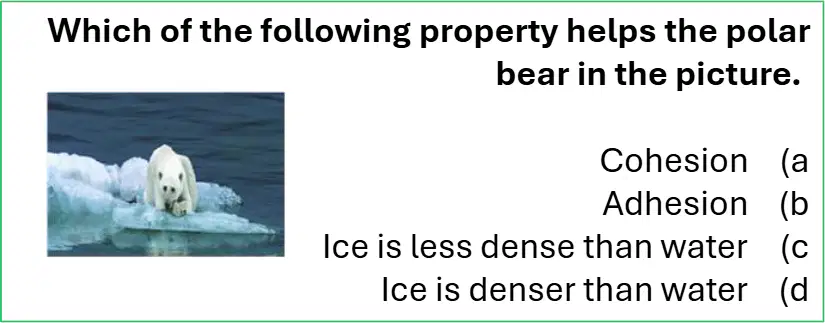
Which of the following property helps the polar bear in the picture.
Cohesion
Adhesion
Ice is less dense than water
Ice is denser than water
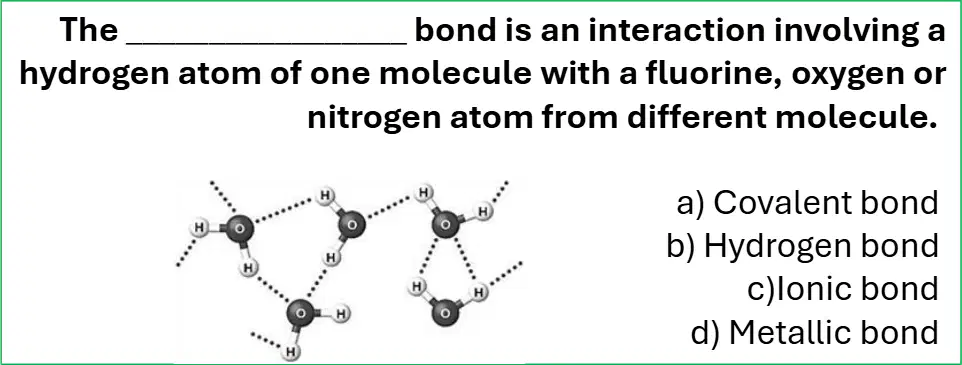
The __________ bond is an interaction involving a hydrogen atom of one molecule with a fluorine, oxygen or nitrogen atom from different molecule.
Covalent bond
Hydrogen bond
Ionic bond
Metallic bond
Which of the following can be classified as a van der Waals force?
a strong electrostatic interaction between two atoms in an ionic bond
a non-polar covalent bond
a weak electrostatic interaction between two polar molecules
a polar covalent bond
Why are intermolecular forces, such as van der Waals forces, important to biological Function?
Intermolecular forces do not play a major role in biological functions.
They are stronger than ionic or covalent bonds.
They are easy to form and break apart, making them ideal for short-term interactions.
They are easy to form and break apart, making them ideal for long-term interactions
How are water molecules in a rain drop held together?
attraction between positive charges
attraction between negative charges
van der Waals forces
ionic bonds
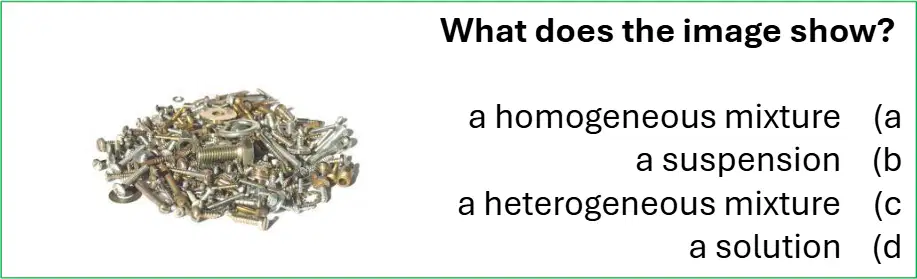
What does the image show?
a homogeneous mixture
a suspension
a heterogeneous mixture
a solution
Which of these is not a characteristic of a solution?
substances retain properties
homogenous mixture forms
there is uniform composition
substances change properties
How do solutes and solvents interact?
solvents change the properties of solutes
solvents dissolve in solutes
solutes change the properties of solvents
solutes dissolve in solvents
................. is a homogeneous mixture that is formed by dissolving a substance in solvent.
solution
suspension
colloid
solute
A beaker contains three solids- flour, sugar & baking soda. Which describes the content of the beaker?
a homogeneous mixture
a suspension
a heterogeneous mixture
a solution
A(n) ................. is combination of two or more different substances in which each retains its individual characteristics.
mixture
compound
solution
element
A(n) ______ is a substance that produces hydroxide ions (OH−) in water, while a(n) ______ produces hydrogen ions (H+) in water. Choose the pair that correctly fills the blanks in order.
base; acid
acid; base
buffer; salt
salt; buffer
Which is a substance that produces OH− ions when it is dissolved in water?
A base
An acid
A buffer
A salt
The human stomach needs to maintain a pH value between 1 and 2 in order to digest food properly. Which of the following describes the environment of the human stomach?
It is acidic
It is basic
It is neutral
It can change to be basic and acidic
Biological buffers work to keep pH in your body in a range of __.
7.5–8.5
4.5–5.5
5.5–6.5
6.5–7.5
Acid solutions are produced by the release of ____ ions.
potassium
hydrogen
oxygen
sodium
What is a base?
a substance that releases hydroxide ions (OH−) into solution
a substance that quenches chemical reactions
a substance that decreases pH
a substance that releases hydrogen ions (H+) into solution
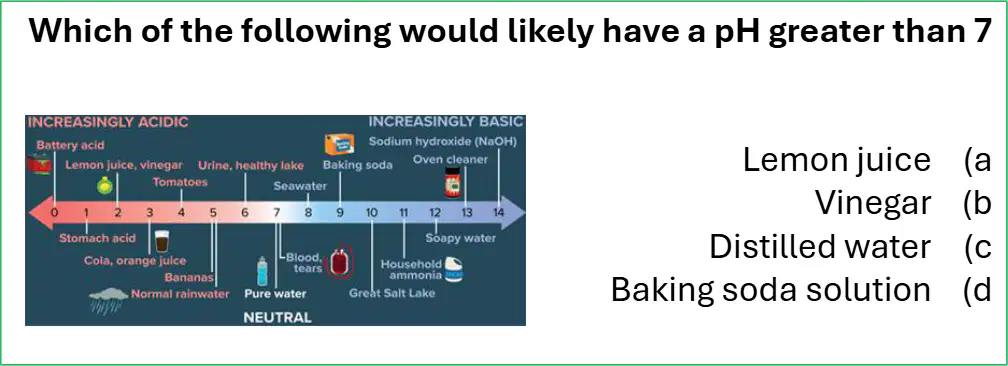
Which of the following would likely have a pH greater than 7? Refer to the pH scale showing common substances from increasing acidity (battery acid, lemon juice) to increasing basicity (soapy water, household ammonia).
Lemon juice
Vinegar
Distilled water
Baking soda solution
pH is a measure of the concentration of which ions in a solution?
Oxygen ions
Carbon ions
Nitrogen ions
Hydrogen ions
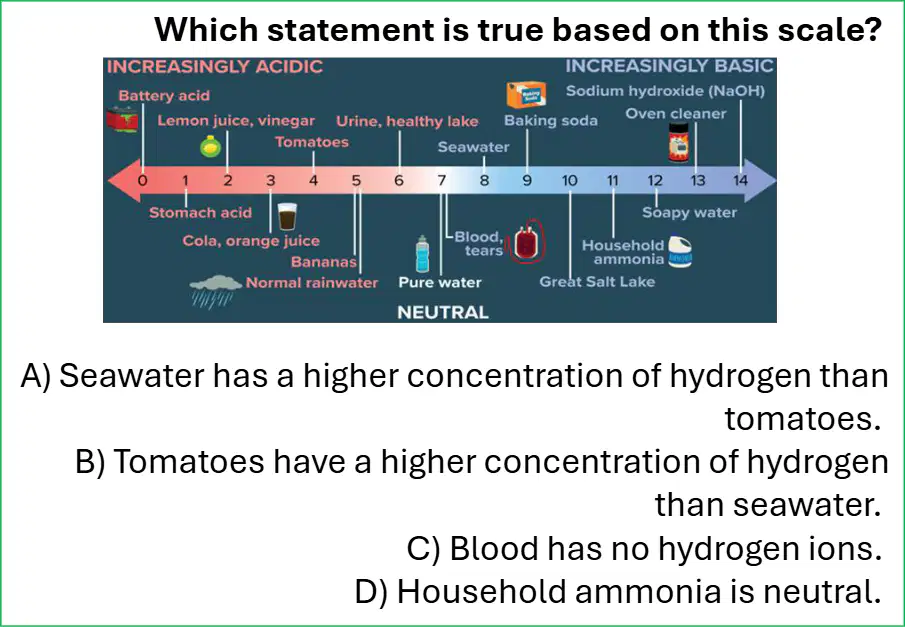
Which statement is true based on the pH scale shown, which lists substances from increasingly acidic (battery acid, lemon juice) to increasingly basic (soapy water, household ammonia)?
Seawater has a higher concentration of hydrogen than tomatoes.
Tomatoes have a higher concentration of hydrogen than seawater.
Blood has no hydrogen ions.
Household ammonia is neutral.
Which of the following is NOT a correct explanation of importance of buffers to living organisms.
Buffers allow large fluctuations in the concentrations of hydrogen ions in a cell.
Buffers help maintain the pH level in the cell between 6.5 and 7.5.
Buffers play a role in maintaining homeostasis.
Buffers maintain the proper environment for enzymatic reactions and biological processes to occur.
Which of the following is NOT a biological function of lipids?
cushioning and insulation
precursors to the synthesis of signaling molecules
store energy
speeding up reactions
Which of the following is attributed to lipids;
Speed reaction
Control cell growth
Energy storage
Genetic information storage
Which class of macromolecules store and communicate genetic information?
carbohydrates
lipids
proteins
nucleic acids
Which substance is not part of a nucleotide?
phosphate
base
water
sugar
Which of the following functions can be attributed to nucleic acids and nucleotides?
long-term energy storage
chemical signaling between cells
genetic information storage and transmission
barrier in biological membranes
Which of the following macromolecules matches its correct role in the cell?
Nucleic acid – Transport substances
Lipids – Store genetic information
Proteins – Speed reactions
Carbohydrates – Make hormones
You are analyzing a compound in a laboratory. You find that it is made up of carbon, hydrogen, and oxygen in a ratio of two hydrogen atoms for each carbon atom. How will you classify the compound?
carbohydrate
lipid
protein
nucleic acid
Which of the following functions can be attributed to carbohydrates;
Chemical signaling.
Speed reactions
Energy storage
Genetic information storage
Which of the following functions is/are attributed to carbohydrates;
Structural support
Signaling between cells
Energy storage
All of the above
Which of the following functions is not attributed to carbohydrates;
Signaling between cells.
Structural support
Energy storage
Genetic information storage
What is the ratio of carbohydrates in a monosaccharide?
1 carbon: 3 hydrogen: 1 oxygen
1 carbon: 2 hydrogen: 1 oxygen
2 carbon: 1 hydrogen: 2 oxygen
1 carbon: 2 hydrogen: 2 oxygen
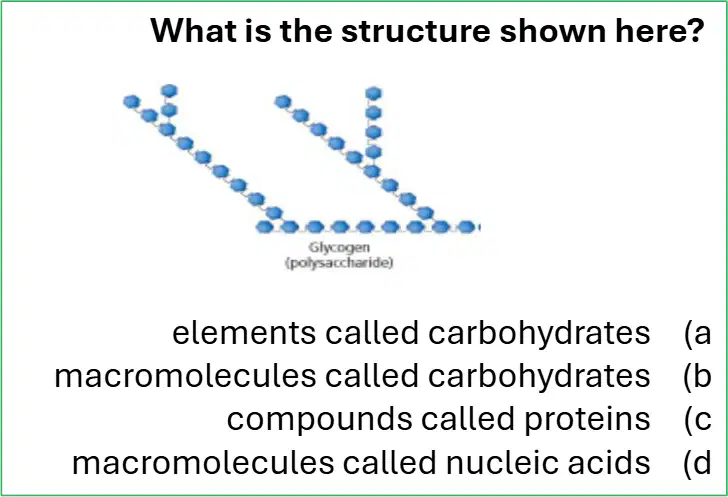
What is the structure shown here?
elements called carbohydrates
macromolecules called carbohydrates
compounds called proteins
macromolecules called nucleic acids
What is a polymer?
a molecule that speeds up biological reactions by lowering activation energy
a combination of two or more different substances in which each substance keeps its individual characteristics
a pure substance with unique properties, formed when two or more different elements combine
a large molecule formed from smaller identical (or nearly identical) repeating units
What are saturated fats?
Lipids with double bonds between carbon atoms
Proteins with double bonds between carbon atoms
Lipids with single bonds between carbon atoms
Proteins with single bonds between carbon atoms

The figure shows examples of biological macromolecules. Which of the following macromolecules are responsible for energy storage.
(C) & (B)
(D) & (A)
(C) & (D)
(C) & (A)
Albumin is a protein found in egg whites. Which of the following describes the chemical structure of albumin?
A set of three fatty acids attached to a molecule of glycerol
A folded chain of amino acids
A series of monosaccharides linked together
A sequence of nucleic acids twisted into a form of a helix
Which of the following joins amino acids together?
metallic bonds
peptide bonds
van der Waals forces
ionic bonds
Why is the sequence of amino acids important to protein function?
The sequence of amino acids doesn't have an effect.
Amino acids can only be combined in a specific order, otherwise the bonds will fall apart.
The order of the amino acids can be read like a code to assemble DNA.
The order of amino acids determines the shape a protein will take.
Which two elements are always found in amino acids?
Nitrogen and sulfur
Carbon and oxygen
Hydrogen and phosphorus
Sulfur and oxygen
Which of the following compounds can be classified as a proteins?
polysaccharides
fatty acids
enzymes
nucleic acids
During their mission to planet Mars, astronauts have found material that might be a cell. Which of the following must the material have to be considered a cell?
The material must have a nucleus
The material must have mitochondria
The material must have a cell membrane
The material must have chloroplasts

Which kind of cell is shown in the figure below?
Animal cell
Plant cell
Eukaryotic cell
Prokaryotic cell
What are the differences between prokaryotes and eukaryotes? Select all that apply.
nucleus
plasma membrane
DNA
organelles
ribosomes
Why do many scientists think that prokaryotes are similar to the first organisms on Earth?
Prokaryote cells have a nucleus.
The first organisms were all plantlike.
Prokaryote cells have no nucleus.
They have membrane-bound organelles.
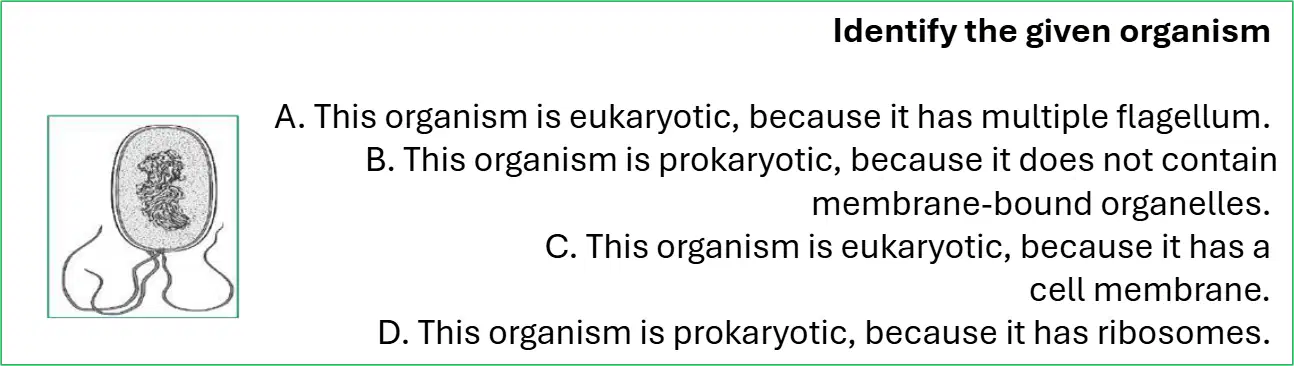
Identify the given organism
This organism is eukaryotic, because it has multiple flagellum.
This organism is prokaryotic, because it does not contain membrane-bound organelles.
This organism is eukaryotic, because it has a cell membrane.
This organism is prokaryotic, because it has ribosomes.
In which structure would you find a nucleus?
bacterial cell
plant cell
prokaryote
virus
How is the plasma membrane of a cell organized?
one layer of phospholipids, through which proteins freely move
one layer of phospholipids, which are laid out end-to-end, with a hydrophobic tail touching a hydrophilic head
two layers of phospholipids, each of which has its hydrophilic side turned inward
two layers of phospholipids, with their polar hydrophilic heads facing away from each other
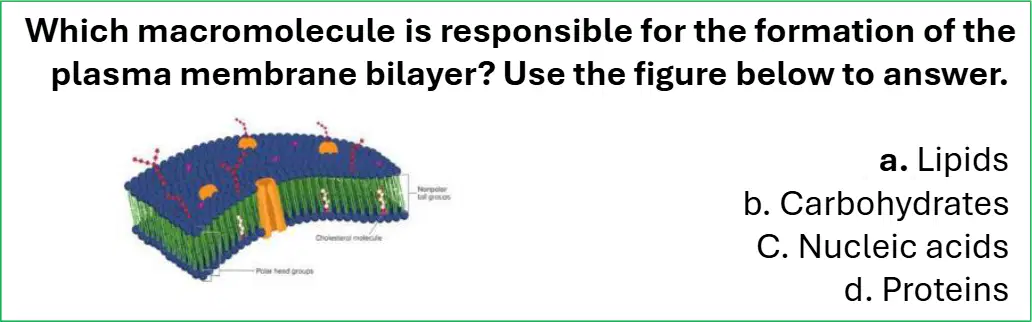
Which macromolecule is responsible for the formation of the plasma membrane bilayer? Use the figure below to answer.
Lipids
Carbohydrates
Nucleic acids
Proteins
A ____ contains polar and nonpolar ends, forming the plasma membrane.
Microtubule
transport protein
cytoskeleton
phospholipid bilayer
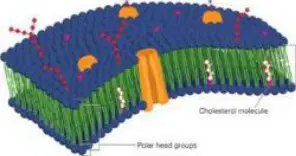
The picture shows a phospholipid bilayer. What crucial functions do the nonpolar tails of the phospholipids have.
speed chemical reactions with enzymes
keep water-soluble substances from passing easily into the cell
allow water-soluble substances to pass easily into the cell
help encode genetic material
Use the illustration showing the phospholipid bilayer of the cellular membrane to answer: Which is the effect of having the polar and nonpolar ends of phospholipid molecules?
It allows transport proteins to move easily through the membrane
It helps the cell to maintain its characteristic shape
It makes more room inside the phospholipid bilayer
It controls the movement of substances across the membrane
Which one is the best representation of the phospholipid bilayer of the plasma membrane? Choose the diagram that correctly shows polar heads facing the water on both sides and nonpolar tails oriented inward.
first image
second image
third image
fourth image
Which cellular structure helps control what enters and leaves the cell?
cytoplasm
cytoskeleton
plasma membrane
nucleus
Which number in the illustration represents the location where you would expect to find water-insoluble substances?
1
2
3
4
The image shows the structure of the phospholipid bilayer. Each component of the bilayer has an important role in supporting cellular activities. What is the importance of cholesterol in this case?
It contributes to the fluidity of the plasma membrane by preventing the fatty acid tails of the phospholipid bilayer from sticking together.
It gives the cell its shape by anchoring to the cell’s inner support structure.
It defines the cell’s characteristics and helps cells identify chemical signals.
It moves needed substances or waste materials through the plasma membrane.
Which of the following represents the structures (1) and (2) shown in the figure?
Vitamin chain and membrane protein
Nonpolar tails and membrane protein
Cilia and transport protein
Carbohydrate chain and membrane protein
Which of the following represents the transport protein in the plasma membrane.
A
B
C
D
Which of the following represents the phospholipid bilayer in the plasma membrane (use the above image).
A
B
C
D
_____ is a property of the plasma membrane that allows it to control what enters and leaves the cell.
selective permeability
diffusion
homeostasis
fluid mosaic model
The plasma membrane has certain functions that help maintain the homeostasis of a cell. i. It provides protection to the cell by prohibiting the entry of toxic or unwanted substances. ii. The partially permeable nature of the membrane only allows specific ions and molecules to enter the cell. iii. It prevents the exit of important or useful substances. Which of these functions supports this claim?
i and ii only
i and iii only
ii and iii only
i, ii, iii
In the figure, the fish net selectively captures fish while allowing water and other debris to pass through. Which of the following works similarly?
The plasma membrane
The cytoplasm
The cytoskeleton
The nucleolus
What characteristic of the plasma membrane is illustrated in this drawing showing specific substances moving into and out of the cell?
selective permeability
phospholipid bilayer
fluid mosaic construction
impermeability to water
What is the definition of selective permeability?
It is the property of the plasma membrane that allows it to control movement of substances into or out of the cell.
It moves needed substances or waste materials through the plasma membrane.
It is the process of maintaining balance in an organism’s internal environment.
It is layers composed of phospholipid molecules arranged with polar heads facing outside and nonpolar tails facing the inside.
Why is the phospholipid bilayer critical to cell function?
It forms a shell around the cell nucleus.
Phospholipids allow water-soluble substances to pass easily into the cell.
Transport proteins are blocked from entering plasma membrane.
Arrangement of phospholipids enables selective permeability.
What is the function of a selectively permeable membrane?
provides alternative to phospholipid bilayer
prevents transport proteins from harming cell
controls what enters and leaves cell
blocks all water from entering cell
What critical function does cholesterol serve in the body?
destroys the plasma membrane
binds fatty acid tails to water
disrupts homeostasis
increases fluidity of plasma membrane
Materials can cross the plasma membrane through tunnels created by _____.
organelles
transport proteins
water molecules
glucose molecules
The net movement of particles from an area of higher concentration to an area of lower concentration is called
Diffusion
Osmosis
Active transport
Exocytosis
Which of the following is not a main factor that affects the rate of diffusion?
conductivity
temperature
pressure
concentration
A molecule needs to enter into the cell but cannot go through the plasma membrane because of its polarity. However, the molecule can bind to a protein and the protein changes shape to allow the particle to move through the membrane.
carrier
receptor
channel
motor
A molecule that is important for cell functioning cannot diffuse through the plasma membrane, but needs a protein that can open and close to allow the molecule to diffuse. What is this protein called?
motor protein
channel protein
receptor protein
carrier protein
What moves needed substances or waste materials through the plasma membrane?
transport proteins
polar heads
DNA
water molecules
What describes transport proteins moving molecules across the plasma membrane?
Diffusion
dynamic equilibrium
facilitated diffusion
osmosis
Which of the following indicates the process shown in the figure below.
Diffusion
Exocytosis
Facilitated diffusion
Active transport
The condition of continuous, random movement of particles but no overall change in concentration of materials is called
dynamic equilibrium
facilitated diffusion
osmosis
selective permeability
The spread of a drop of food dye throughout a glass of milk is called
diffusion
osmosis
endocytosis
exocytosis
Which of these describes continuous particle movement with no overall change in concentration?
selective permeability
facilitated diffusion
osmosis
dynamic equilibrium
Diffusion occurs when there is a net movement of particles from an area of
higher to lower concentration
lower to higher concentration
equal to equal concentration
variable to constant concentration
Predict how oxygen crosses the plasma membrane if the concentration of oxygen is lower inside the cell than it is outside the cell.
Oxygen enters the cell through channel proteins.
Oxygen leaves the cell through channel proteins.
Oxygen enters the cell through the plasma membrane.
Oxygen leaves the cell through the plasma membrane.
What is the term that describes the net movement of particles from an area of higher concentration to an area of lower concentration?
Osmosis
Diffusion
Active transport
Exocytosis
The picture shows the movement of ink molecules in water. Which of the following processes has occurred?
endocytosis
osmosis
diffusion
exocytosis
Which type of solution could cause an animal cell to burst like the picture below?
Hypotonic
Isotonic
Hypertonic
No one of these
The figure below shows an animal cell after being placed in a specific solution. Based on the figure, which of the following describes this solution?
Hypotonic
Isotonic
Osmotic pressure
Hypertonic
The diagram above represents a cell in water. Explain why more water is moving out of the cell than into the cell.
The concentration of solute in the cell is higher than it is outside the cell.
The concentration of water outside the cell is too great.
The concentration of solute outside the cell is higher than it is inside the cell.
The concentration of solute outside and inside are the same.
Which of the following solution would allow cells to retain their normal shapes?
Hypotonic
Isotonic
Hypertonic
When the concentration inside the cell is lower
The animal cells below were placed in a hypotonic solution. What happened to the damaged cell?
Osmosis was prevented in the cell.
Osmosis caused the cell to shrivel.
Osmotic pressure caused the cell to rupture.
The cell was damaged by bacteria.
The figure below shows a blood cell placed in a solution. Which of the following is the solution used?
Hypotonic
Isotonic
Hypertonic
Osmosis
What type of solution is this cell in? What would be the net movement of water?
Hypotonic, out of the cell
Hypertonic, out of the cell
Hypotonic, into the cell
Hypertonic, into the cell
The figure below shows a group of cells placed in solutions of different concentrations. Which of the following refers to cells in a highly concentrated solution.
(C), (D)
(C), (B)
(D), (A)
(A), (C)
The figure below shows a group of cells placed in solutions of different concentrations. Which of the following refers to cells in a low concentrated solution?
(C), (D)
(B), (D)
(D), (A)
(C), (A)
A pump located in a cell's plasma membrane transports sodium and ..........
potassium
calcium
chloride
hydrogen
Which type of transport requires energy input in the cell.
Osmosis
Simple diffusion
Facilitated diffusion
Active transport
How do carrier proteins facilitate active transport?
block the plasma membrane
move substances against a concentration gradient
prevent homeostasis
create an isotonic solution
Why can sugar enter the cell through the coupled channel?
Because sugar is smaller than Na+
Because Na+ moves down its gradient, carrying sugar with it
Because ATP directly binds to sugar
Because sugar naturally diffuses faster
Some cells use elaborate pumping systems, such as the Na+/K+ ATPase pump shown below. Which of the following shows how this pump works to maintain the level of sodium ions (Na+) and potassium ions (K+) inside and outside the cell?
Transports 2 Na+ out of the cell and moves 3 K+ into the cell
Transports 3 Na+ into the cell and moves 2 K+ out of the cell
Transports 3 Na+ out of the cell and moves 2 K+ into the cell
Transports 2 Na+ into the cell and moves 3 K+ out of the cell
The graph below describes the relationship between the amount of glucose entering a cell and the rate at which the glucose enters the cell with the help of carrier proteins. The graph line shows that as the amount of glucose increases, the diffusion rate increases until a maximum rate is reached. Which of the following is the correct reason for the stability of diffusion rate when high amounts of glucose are reached?
Because there is no more carrier proteins to transport the glucose
Because the cell is unable to produce more energy required for diffusion
Because the cell cannot handle more glucose
Because the carrier proteins change their shapes
Which best explains the phrase “piggy-back their way into a cell,” as shown in the figure caption?
Sugar uses ATP directly
Sugar attaches to Na+ and enters through a protein channel
Sugar dissolves in the membrane
Sugar moves only when K+ leaves the cell
Different transport processes are used by organisms to carry materials into and out of their cells. Which transport mechanism is shown in the diagram above?
Exocytosis: bulk transport in which materials are transported out of the cell
Facilitated diffusion: molecules moving along their concentration gradient with the help of transport proteins
Endocytosis: bulk transport in which materials move into the cell
Passive transport: molecules simply move along their concentration gradient
Which method of cellular transport can you see in the picture below?
Facilitative diffusion
Osmosis
Exocytosis
Endocytosis
Which method of cellular transport can you see in the picture below?
Facilitative diffusion
Osmosis
Exocytosis
Endocytosis
What is a significant difference of endocytosis and exocytosis?
Exocytosis does not require energy input
Endocytosis does not involve waste secretion
Endocytosis does not require energy input
Exocytosis does not maintain homeostasis
Which of the following is not true of exocytosis?
results in hormone secretion
does not require energy input
allows waste matter to be expelled
occurs at the plasma membrane
The ___ is a network of fibers that form a framework and anchor organelles
endoplasmic reticulum
cytoplasm
cytoskeleton
golgi apparatus
What is the main function of the cytoskeleton in a cell?
To store genetic information
To act as a supporting network of protein fibers
To produce ATP
To transport oxygen
Which component of the cytoskeleton helps give the cell its shape?
Ribosomes
Microtubules
Microfilaments
Lysosomes
Microfilaments help the cell by:
Moving substances inside the nucleus
Helping in movement of the entire cell or its parts
Producing proteins
Storing minerals
A scientist observes a cell that cannot divide properly. Which cytoskeleton structure is MOST likely malfunctioning?
Microfilaments, because they store energy
Microtubules, because they form spindle fibers
Cell membrane, because it regulates materials
Lysosomes, because they digest waste
Which cytoskeleton component is responsible for moving substances within the cell?
Microtubules
Microfilaments
Centrioles only
Golgi bodies
Which is not a component of the cytoskeleton?
Microtubule
Microfilament
Centriole
Cell wall
The semifluid environment inside the plasma membrane is called..
endoplasmic reticulum
microtubules
Cytoplasm
mitochondria
Which of the following is the main component of the cell wall in prokaryotes (bacteria)?
Cellulose
Chitin
Peptidoglycan
Lignin
The primary function of the cell wall in both prokaryotes and eukaryotic plants is:
Controlling cell division
Providing support and protection
Producing energy
Transporting proteins
A researcher wants to identify whether an unknown cell is bacterial, fungal, or plant. Which test would be MOST useful?
Check for the presence of mitochondria
Check what the cell wall is made of
Check the size of ribosomes
Check for photosynthesis
Which group of organisms has a cell wall made of cellulose?
Animals
Plants
Fungi
Archaea
Ribosomes are produced in the ........ and produce proteins in the...
nucleolus; cytoplasm
nucleus; Golgi apparatus
mitochondria; cytoplasm
nucleolus; nucleus
Which of the following is a function of the RER?
Detoxifying harmful chemicals
Producing proteins for secretion
Breaking down waste
Storing water
Which is the site of protein synthesis?
Nuclear pore
Nucleolus
Chromatin
Endoplasmic reticulum
The main function of the Smooth ER is:
Protein synthesis
Detoxification and lipid synthesis
ATP production
DNA replication
Which organelle produces protein for a cell?
ribosome
nucleus
endoplasmic reticulum
Golgi apparatus
What is the function of the smooth ER?
A variety of complex carbohydrates and lipids are synthesized.
Proteins are synthesized and produced.
It surrounds the nucleus with a double membrane.
Carbohydrates, lipids, and other substances are consumed.
What structure synthesizes proteins that will be used by the cell?
Ribosome
Nucleolus
Chromatin
Endoplasmic reticulum

