
 Worksheets
Rational Functions and Their Properties
Total questions: 125
Worksheet time: 4hrs 19mins
The graph of a rational function can best be descirbed as
A line
A parabola
A gradual curve
A hyperbola
A circle
The two symmetrical parts that make up a rational function's graph are referred to as
Roots
Indexes
Branches
Curves
Axis of symmetry
The domain and range of the parent function of rational functions is:
x≥ 0 and y≥0
x≤ 0 and y≤0
(−∞,∞) and
(−∞,∞)
All nonzero real numbers
All real numbers
The asymptote(s) of the parent function of rational functions is/are:
x=0
y=0
x=1
y=1
x=0 and y=0

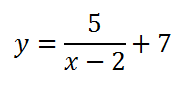
A rational function in the form shown has
x= h as its horizontal asymptote and y=k as its vertical asymptote
x=h as its vertical asymptote and y=k as its horizontal asymptote
x = -h as its horizontal asymptote and y=k as its vertical asymptote
x = -h as its vertical asymptote and y=k as its horizontal asymptote
Not sure what an asymptote is but I feel none of the answers listed are correct
y= x5 is what kind of transformation from the parent function of rational equations?
Vertical stretch by factor of 5
Vertical compress by a factor of 5
Translation 5 units to the right
Translation 5 units to the left
Translation 5 units up

Which of the following represent(s) the domain of the function shown?
x = -3
x = 3
(- ∞ ,3) ∪ (3, ∞ )
(- ∞ ,-3) ∪ (-3, ∞ )
(- ∞ ,3] ∪ [3, ∞ )

What are the vertical and horizontal asymptotes of the following function?
horizontal asymptote is -2 and vertical asymptote is 2
horizontal asymptote is 2 and vertical asymptote is -2
horizontal asymptote is -6 and vertical asymptote is 2
horizontal asymptote is 1/2 and vertical asymptote is -6
horizontal asymptote is 2 and vertical asymptote is -1/2

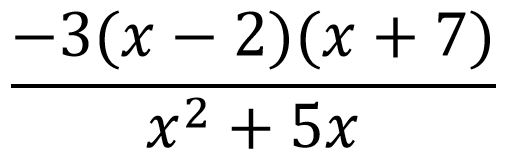
What are the vertical and horizontal asymptotes of the following function?
vertical asymptote is 3 and horizontal asymptote is 1
vertical asymptote is 1 and horizontal asymptote is 3
vertical asymptote is 1 and horizontal asymptote is -3
vertical asymptote is -1/3 and horizontal asymptote is 1
vertical asymptote is 3 and horizontal asymptote is -1/3

What is the domain and range for the following rational function?
Domain: All real numbers except -1
Range: All real numbers except 2/3
Domain: All real numbers except -1
Range: All real numbers except -3/2
Domain: All real numbers except 2/3
Range: All real numbers except -1
Domain: All real numbers except -2/3
Range: All real numbers except -1
Domain: All real numbers except 4/3
Range: All real numbers except 1

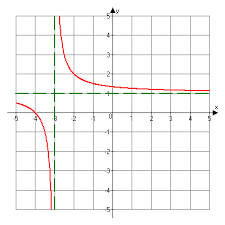
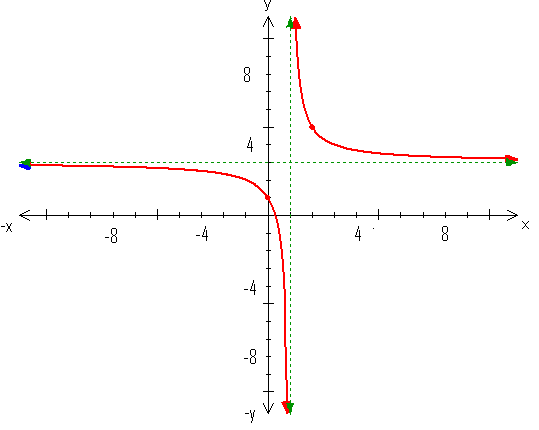
What is an asymptote?
an imaginary line that your function never touches
a part of your function
a point on your graph
a type of fruit

Select all the information that applies to the given rational function.
V.A. at x = -3 and x = 1
Hole at (1, 0)
H.A. at y = 2
x-intercepts at (3,0) and (1, 0)


What (if any) holes exist?
x=2
x=2 and x=3
x=-3
x=3

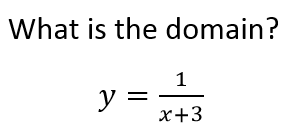
What is the domain?
All real numbers
All real numbers except 4
All real numbers except 2
All real numbers except 2 and -2

Is there a hole or a vertical asymptote?
A hole when x = 2
A vertical asymptote at x = 2
there is no hole or vertical asymptote
4x-16
_______
x2-16


Identify the parent function of the graph.
Rational
Cubic
Exponential
Sine
Give the name of the parent function of
y=x+61Exponential
Rational
Square Root
Constant
Which of the following could be a graph of y=x1 ?


What is the vertical asymptote equation?
x = -2
x = 3
x = 2
x = -3
What is the horizontal asymptote equation?
y = -2
y = 3
y = 2
y = -3
What is the domain?
All Real Numbers
All Real Numbers except x = 2
All Real Numbers except x = 3
All Real Numbers except x = -2
What is the range?
All Real Numbers
All Real Numbers except x = 2
All Real Numbers except x = 3
All Real Numbers except x = -2
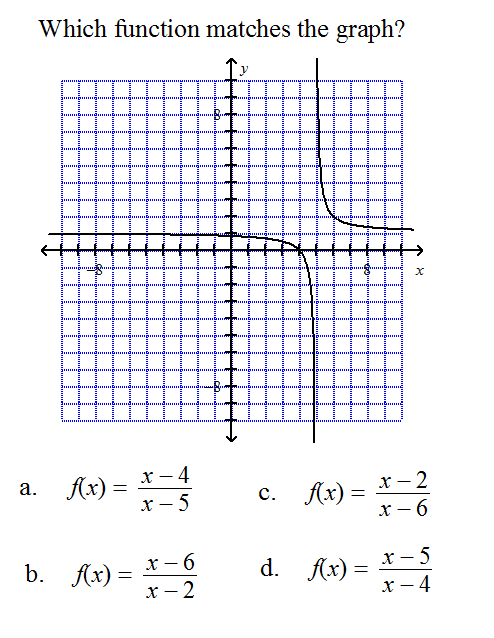




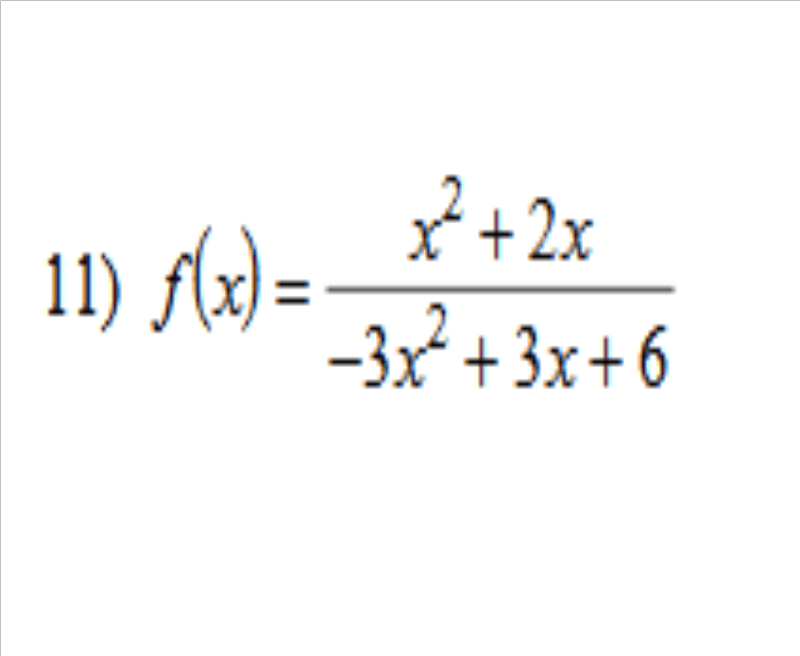
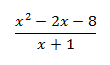
Determine whether the graph of the function has a vertical asymptote or a removeable discontinuity at x = -1.
Vertical Asymptote
Discontinuity
Hump Day
Infinite

How many discontinuities does f(x) have?
None
1
2
3


What creates a hole in the graph of a rational function?
Crossing the x-axis
An absence of dirt.
Crossing a vertical asymptote.
A factor that cancels out.

R: All real number y≠ 1
R: All real number y≠ -3
R: All real number y≠ 1
R: All real number y≠ 3



Holes: x = 2
H.A.: None
Holes: x = 1
H.A.: None
Holes: x = 2
H.A.: y = 1/4
Holes: x = None
H.A.: None

List the x value for the resulting hole in the graph?
2
2 and 3
-3
3
How do you determine the Horizontal Asymptote?
replace all x-values with 0
replace the y-value with 0 or make the numerator equal 0
set denominator equal to 0
compare the degrees of the numerator and denominator
How do you know if a factor in the denominator is a hole instead of a V.A. ?
It cancels out
it equals 0
you set the numerator equal to 0
you compare the degrees
When finding the H.A., if the numerator degree is greater than the denominator degree, the answer is...
y = 0
none
y =a / b
What's an H.A.?
When finding the H.A., if the numerator degree is equal to the denominator degree, the answer is...
y = 0
none
y =a / b
What's an H.A.?
The first thing you should do to find all the attributes for a rational function is...
Factor it all out
Find the V.A.
Find the H.A.
Find the x / y intercepts

What is the equation(s) of the vertical asymptote of the given rational function, f(x)?
x = -4
x = -1
x = 3
x = -1, x = 3

True or False. There is a hole in f(x).
True
False

What is the domain of the given function, f(x)?
(-∞,2) U (2,∞)
(-∞,9) U (9,∞)
(-∞,∞)

What is the equation of the horizontal asymptote?
y = 0
None
y = 1

Find the vertical asymptote(s) of f(x).
x = -5 and x = 7
x = 3 and x = 4
x = 3 and x = -5
There are no vertical asymptotes

Find the equation of the vertical asymptote(s) of f(x).
x = -5
x = -5 and x = -3
y = 0
x = -3

Determine the domain of f(x).
(-∞,1) U (1,∞)
(-∞,-4) U (-4,∞)
(-∞,-4) U (-4,4) U (4,∞)
(-∞,4) U (4,∞)

Use a graphing calculator, Desmos, or app to graph the function. Click the answer choices to confirm that you practiced the graph.

No vertical asymptotes.
Horizontal asymptote at y = 2.

Use a graphing calculator, Desmos, or app to graph the function. Click the answer choices to confirm that you practiced the graph.

Vertical asymptote at x = -9/2
Horizontal asymptote at y = 5/2

Use a graphing calculator, Desmos, or app to graph the function. Click the answer choices to confirm that you practiced the graph.

Vertical asymptote at x = 3/4
Horizontal asymptote at y = -1/4

Use a graphing calculator, Desmos, or app to graph the function. Click the answer choices to confirm that you practiced the graph.

Vertical asymptotes at x = 4 and x = 2
Horizontal asymptote at y = 0

Use a graphing calculator, Desmos, or app to graph the function. Click the answer choices to confirm that you practiced the graph.

Vertical asymptotes around x = -2 and x = 1/3
Horizontal asymptote at y = 0

Use a graphing calculator, Desmos, or app to graph the function. Click the answer choice to confirm that you practiced the graph.

Vertical asymptotes around x = -2 and x = 5
Horizontal asymptote at y = 0

Use a graphing calculator, Desmos, or app to graph the function. Click the answer choices to confirm that you practiced the graph.

Vertical asymptotes around x = 6 and x = -1
Horizontal asymptote at y = 1

Use a graphing calculator, Desmos, or app to graph the function. Click the answer choices to confirm that you practiced the graph.

Vertical asymptotes at x = 5 and x = -2
Horizontal asymptote at y = -1

Use a graphing calculator, Desmos, or app to graph the function. Click the answer choices to confirm that you practiced the graph.

Vertical asymptotes: none!
Horizontal asymptote at y = 1

Use a graphing calculator, Desmos, or app to graph the function. Click the answer choices to confirm that you practiced the graph.

Vertical asymptotes: none!
Horizontal asymptote at y = -4
Select all the functions that have a slanted asymptote?


Select all the following statements that are true.
Vertical asymptote at x=1
Vertical asymptote at x=0
No vertical asymptote
Hole at (-1, 0)
Hole at (1, -1)
y=2x2−2xx2−4x+3
Select ALL the following statements that are true.
Vertical asymptote at x = 1
Vertical asymptote at x=0
Horizontal asymptote at y = 1/2
Hole at (-1, 2)
Hole at (1, -1)

Select the graph that show the corresponding vertical & horizontal asymptotes to this function


Choose the best equation for the graph.


Write the equation for the graph.
y=x
y=x2
y=x1
y=∣x∣
Based on your previous answers, which could be the graph of
x+5x2−6x−16


What are the asymptotes of this graph?
y=1, x=−2
y=−2, x=1
y=2, x=1
y=−1, x=2
What are the zeros of
x = 8 and x = -2
x = 8, x = -2 and x = -5
x = -8 and x = 2
x = -5

What is the point of discontinuity?
x = -3
(-3,2)
x = -5
(3,8)
What creates a hole in the graph of a rational function?
Crossing the x-axis
An absence of dirt.
Crossing a vertical asymptote.
A factor that cancels out.

What is the VERTICAL asymptote of this function? (click on the graph to enlarge)
x=1
x=-3
y=1
y= -3
What is the HORIZONTAL asymptote of this function? (click on the graph to enlarge)
x=1
x=-3
y=1
y= -3
Determine whether the graph of the function has a vertical asymptote or a removeable discontinuity at x = -1.
Vertical Asymptote
Discontinuity
Hump Day
Infinite
How many discontinuities does f(x) have?
None
1
2
3
How does the graph of g(x)=x1−3 compare to the graph of f(x)=x1 ?
It is located 3 units higher.
It is located 3 units lower.
It is located 3 units to the left.
It is reflected over the x-axis.
How does the graph of g(x)=x+41 compare to the graph of f(x)=x1 ?
It is located 4 units higher.
It is located 4 units to the right.
It is located 4 units to the left.
It is 4 times taller.


