
NEW
Font size
 Worksheets
OSCE teaching- Clinical exams and skills- Y1- LancsIM
Total questions: 15
Worksheet time: 5mins
What is the purpose of Percussion during the respiratory examination?
To assess the rate and depth of breathing.
To feel for tactile fremitus or tracheal deviation.
To assess the density of the underlying lung tissue.
To listen for wheezing or crackles.
Why does guidance suggest keeping your fingers on the radial pulse while actually counting the respiratory rate?
To save time by measuring both simultaneously
Preventing the patient from consciously altering their breathing
To ensure the patient is still alive
To feel for the respiratory sinus arrhythmia
Where would you auscultate the tricuspid valve?
2nd intercostal space, right sternal border
4th–5th intercostal space, right sternal border
Apex, 5th intercostal space mid-clavicular line
4th–5th intercostal space, left sternal border
How high do you inflate over estimated systolic?
20-30mmHg
30-40mmHg
15-20mmHg
As high as you can
Osler's nodes are seen in which condition?
Anaemia
Infective endocarditis
Marfan's Syndrome
Mitral Stenosis

What does this picture show?
Cataract
Kayser-Fleischer Rings
Corneal Arcus
Anterior Dislocation of the Lens
During auscultation, you hear dullness on patient's chest. What specific confirmatory technique should you perform?
Check for Sacral Oedema
Palpate for Lymphadenopathy
Measure Peak Expiratory Flow Rate
Perform Vocal Resonance
What is correct deflation rate for Manual Blood Pressure Measurement?
5mm per second
2mm per second
As fast as possible
10mm per second
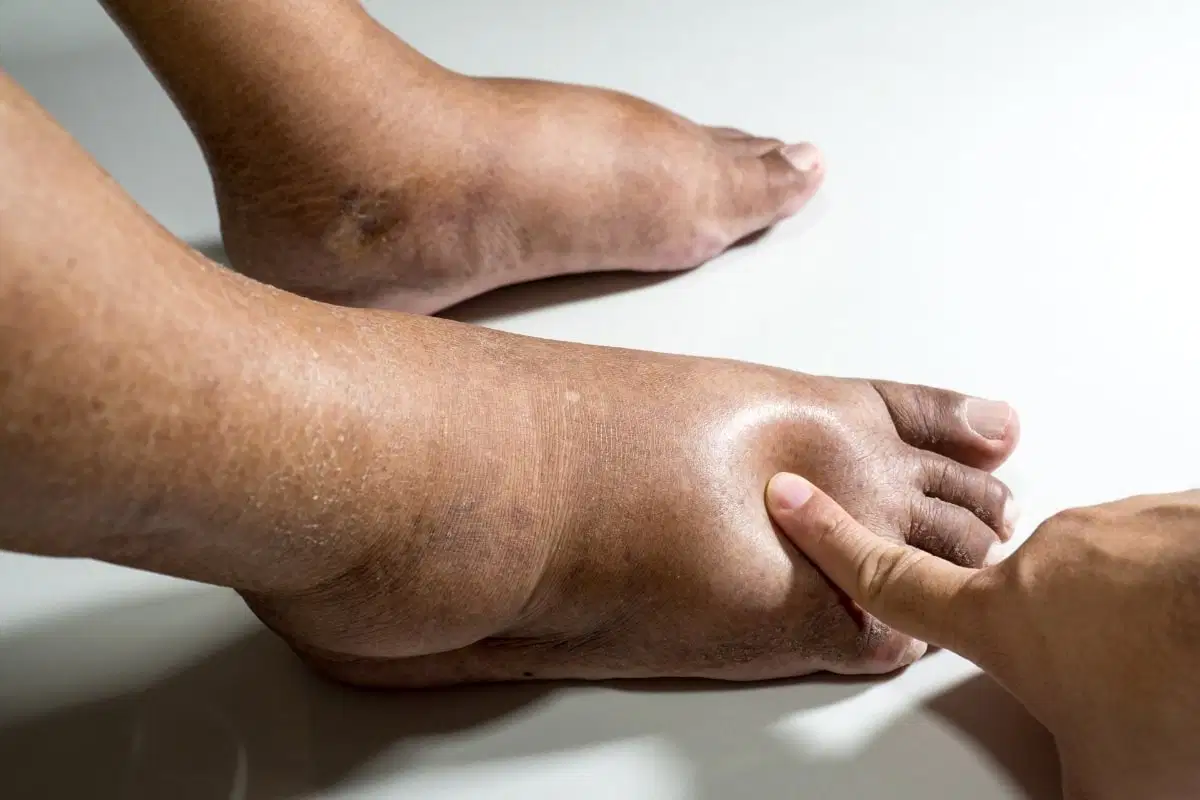
What clinical sign is primarily demonstrated in this image, and what is the finger checking for?
Deep Vein Thrombosis (DVT); checking for Homan's Sign
Gout; checking for a tender, hot joint
Oedema; checking if the indentation is 'pitting'
Cellulitis; checking for warmth and pain
What does a collapsing pulse represent?
Aortic Stenosis
Hypertrophic Cardiomyopathy
Cardiac Tamponade
Aortic Regurgitation
What is the main purpose of NEWS2?
To discharge patient
To guide antibiotic treatment
To identify deteriorating patients
To identify patients with an active infection
Auscultation of the lungs reveals a high-pitched, whistling noise, most often heard during expiration. This is known as:
Stridor
Wheeze
Coarse crackles
Pleural rub
Where is Central Cyanosis best observed?
Fingernail Beds
Conjunctiva
Palms of the hands
Under the tongue/lips
Where would you auscultate for mitral stenosis?
Apex with patient rolled to the left
Left lower strenal edge with patient sitting forward
2nd left intercostal space
Carotid arteries held oin expiration
Which parameter is NOT in NEWS2?
Blood glucose
Blood Pressure
Heart Rate
Consciousness

