
 Worksheets
6th Grade MIDTERM Review
Total questions: 125
Worksheet time: 4hrs 57mins
What is the smallest unit of an element that has all of the properties of that element?
Molecule
Atom
Compound
Mixture
What is the temperature at which a substance changes from liquid to gas?
Melting Point
Freezing Point
Boiling Point
Sublimation Point
What is a shorthand notation that uses chemical symbols and numbers as subscripts to represent the type of atoms and number of atoms that are present in the smallest unit of the substance?
Chemical Formula
Chemical Equation
Chemical Symbol
Chemical Reaction
What is matter that is composed of two or more elements that are chemically combined?
Element
Mixture
Compound
Solution
What is the amount of mass in a given amount of space, measured in a unit of mass per unit of volume?
Mass
Volume
Density
Weight
What is a pure substance that cannot be separated into simpler substances by physical or chemical means?
Mixture
Compound
Element
Solution
What type of mixture has parts that are easy to see and separate?
Homogeneous Mixture
Heterogeneous Mixture
Solution
Colloid
What is a substance so evenly mixed that it is difficult to see the parts and is uniform in composition?
Heterogeneous Mixture
Homogeneous Mixture
Suspension
Colloid
What is the temperature at which a substance changes from solid to liquid?
Boiling Point
Freezing Point
Melting Point
Sublimation Point
What is made of two or more substances that are combined but whose atoms are not chemically bonded?
Compound
Element
Mixture
Solution
What is an arrangement of the elements according to their atomic numbers and periodic trends of physical and chemical properties?
Chemical Formula
Periodic Table
Element Chart
Atomic Structure
What is a characteristic of a substance that can be observed or measured without changing the identity of the substance?
Chemical Property
Physical Property
Density
Mass
What consists of just one type of particle and has the same physical properties throughout?
Mixture
Compound
Element
Pure Substance
What is the amount of matter in a given space or volume; a relationship between mass and volume (Formula: D = M/V)?
Mass
Volume
Density
Weight
What is the amount of matter a body contains?
Volume
Density
Mass
Weight
Select all of the following images that show a physical change:

broken pencil

broken egg shell

cut paper

rusty nail

color change
Gravitational Force is
A contact force that resists the motion of two objects that are touching
A force that acts between objects that are electrically charged
The force of attraction or repulsion between unlike or like poles
A force of attraction between any two objects in the universe

This image represents the field lines of electrical charges that will
Attract
Repel
As distance between two objects DECREASES, the gravitational force between them
Decreases
Stays the same
Ceases to exist
Increases
Frictional Force
Contact Force
Non-Contact Force
What is the definition of balanced forces?
Forces that are unequal in size and opposite in direction
Forces that are equal in size and opposite in direction, resulting in no change in an object's motion.
Forces that are equal in size and same in direction
Forces that are unbalanced in size and direction
Give an example of unbalanced forces in action.
A person pushing a shopping cart with a constant force.
A car accelerating forward while the brakes are being applied.
A book resting on a table.
A car moving at a constant speed on a straight road.
How do balanced forces impact the overall movement of an object?
Balanced forces make the object move in a circular path.
Balanced forces do not change the object's state of motion.
Balanced forces cause the object to accelerate indefinitely.
Balanced forces result in the object changing direction constantly.
Which of the following indicate unbalanced forces acting on an object?
When the net force is zero.
When the object is moving at a constant speed.
When the object is at rest.
When the net force acting on the object is not zero.
What happens to an object when the forces acting on it are balanced?
The object accelerates
The object disappears
The object changes color
The object remains at rest or continues moving at a constant velocity.
Can unbalanced forces ever result in an object remaining at rest?
Yes
No
You and your dad are pushing the couch. Your dad pushes with 35 N right and you push with 25 N right. What is the net force on the couch?
60 N Right
50 N Right
10 N Right
60 N Left
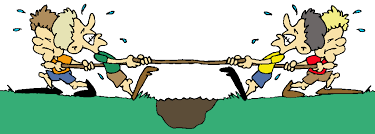


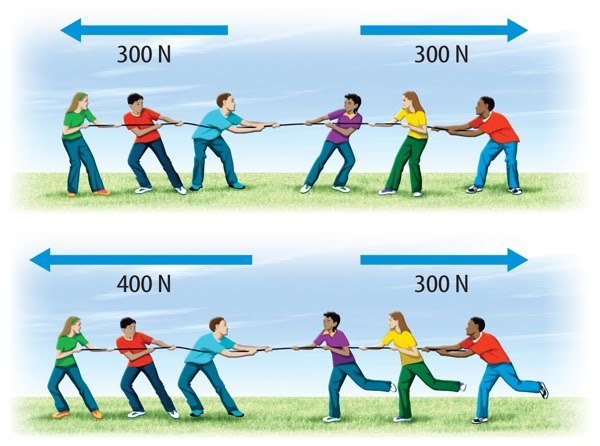
In a tug of war the one side pulls with a force of 200N Left. The other team pulls with a force of 150N Right. What is the net force?
Two forces that act in opposite directions on an object and cause no change in motion are called?
Force
Balanced Force
Unbalanced Force
Inertia
A book sitting on a shelf.
Balanced Force
Unbalanced Force
Cars in a NASCAR race speeding around the track.
Balanced Force
Unbalanced Force
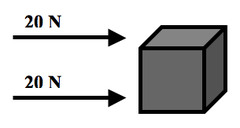

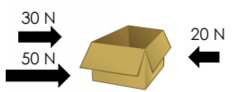
60 N Right


The sum and overall direction of all forces acting on an object

What is the definition of unbalanced forces?
Forces that are equal in size and opposite in direction
Forces that are not equal in size and same in direction
Forces that are not equal in size and opposite in direction
Forces that are not equal in size and random in direction
How do balanced forces affect an object?
They cause the object to slow down
They cause the object to change direction
They cause the object to speed up
They do not cause any change in the object's motion.
A soccer ball kicked down the field is:
a balanced force
an unbalanced force
0 Newtons
traveling at a constant speed
___________ forces always cause an object's motion to change.
balanced
unbalanced
contact
non-contact
What is the force that pulls objects toward the center of the Earth?
Friction
Gravity
Magnetism
Normal force
Which of the following is an example of friction in everyday life?
A magnet sticking to a refrigerator
A book sliding across a table and stopping
A ball falling to the ground
A car accelerating on a highway
Which force is responsible for keeping a book at rest on a table?
Gravity
Friction
Normal force
Magnetism
Which of the following surfaces would likely have the least friction?
Sandpaper
Ice
Carpet
Grass
If an object is in free fall, what forces are acting on it?
Only gravity
Gravity and friction
Gravity and normal force
Gravity and magnetism
What is another term for a normal force?
abnormal force
reaction force
applied force
gravity


How do you find the net force of this image.
Add up all the arrows
Add a green arrow and the orange arrow.
Subtract all the arrows.
Add the green arrows and subtract the orange arrow.
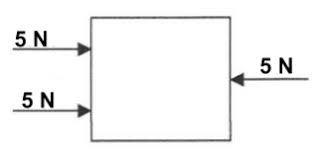
Is the Net Force balanced or Unbalanced?
Balanced
Unbalanced
If a person is picking up a book with the force of 50 N and the gravity is pushing down with 15 N, what is the net force?
50 N
35 N
65 N
15 N

What force is acting from the surface of the desk onto the laptop resting on the surface?
magnetic
electric
normal
An object moves when unbalanced forces act on the object.
True
False
When an action force occurs, there is always a reaction force. Which of the following TWO terms describe the reaction force?
stronger
downward
opposite
weaker
equal
When a baseball player catches a ball, the ball pushes towards the glove; this is the action force. What is the reaction force?
The reaction force is the glove pushing back on the ball with a stronger force.
The reaction force is the glove pulling back on the ball with an equal force.
The reaction force is the glove pushing back on the ball with an equal force.
The reaction force is the ball pushing away from the glove with an equal force.
When a baseball bat hits a baseball, how does the force of the baseball hitting the bat compare to the force of the bat hitting the baseball?
The bat hitting the ball is a greater force than the ball hitting the bat
The bat hitting the ball is a weaker force than the ball hitting the bat
The bat hitting the ball is equal to the force of the ball hitting the bat
The bat hitting the ball is the only force in this situation

This image illustrates Newton's third law. Why are the two arrows the same length?
Because the forces are EQUAL
Because the forces are weak
Because the forces are strong
Because it looks nicer that way
This image illustrates Newton's third law. Why are the two arrows going in different directions?
Because the forces are pushing
Because the forces are opposite
Because the forces are pulling
Because it looks nicer that way

Arrows are often used to show the strength and direction of forces. Which of the following pairs of arrows shows equal and opposite forces?
A
B
C
D

The ability of a system to do work is...
friction
energy
gravity
creativity

Energy that is stored in a system or object is called...
Kinetic Energy
Thermal Energy
Electrical Energy
Potential Energy

Energy of motion is called...
Kinetic Energy
Electrical Energy
Potential Energy
Thermal Energy

A change of energy from one form to another is called...
Kinetic Energy
Energy Transformation
Potential Energy
Energy Change

A group of interacting or interdependent elements forming a complex whole, as in all the factors or variables in an environment, or all the variables that might affect a science experiment.
Community
Energy
System
Force

All of the potential and kinetic energy within a specific system.
Total Energy
Net Force
Work
Speed

A unit used to measure energy.
Farenheit
Celsius
Amp
Joule

When would a skateboarder have the most potential energy?
While rolling down the ramp
While moving up the ramp
At the bottom of the ramp
At the top of the ramp
Investigating which of the following questions would involve kinetic energy?
What is the effect of a boat’s shape on its speed?
Do boats float higher in salt or fresh water?
How does the color of a boat affect heat absorption?
What material makes the strongest boat?

The image here shows four soccer balls at four different locations on an uneven soccer field very near sea level.
Which soccer ball has the greatest amount of potential energy?
Ball A
Ball B
Ball C
Ball D

A diagram of a pendulum is shown above. The pendulum is released from Position 1. At which two positions will the pendulum’s potential equal its kinetic energy?
1 and 2
2 and 4
3 and 4
4 and 5

Students conducted an experiment by stretching the same rubber band to various lengths, releasing it, and measuring how far it traveled.
Based on the chart, what conclusion can be drawn?
The more mass that a rubber band has, the more difficult it is to move.
The shorter the length of a rubber band, the less energy can be stored in it.
The more potential energy put into a rubber band, the more kinetic energy released.
The farther a rubber band travels, the less it can be stretched later on.

Students conduct a laboratory investigation by rolling a toy car across a 2-meter table top. The students conduct three trials and record data in the table. What is the average speed of the toy car?
4.5 m/s
18 m/s
0.18 m/s
16.5 m/s

A student constructs a table of distances and times. Using the data, which section of the table represents the highest average speed?
Section A
Section B
Section C
Section F
A car uses 57 liters of gasoline for every 644 kilometers traveled. It takes 8 hours to use all the gasoline in the tank. What is the average speed of the car during the trip?
11.3 km/h
80.5 km/h
7.125 km/h
456 km/h
A train travels 800 kilometers in 6 hours. What is the average speed of the train?
150 km/h
133 km/h
806 km/h
4,800 km/h
A train travels at a speed of 70 kilometers per hour for 3 hours, and a car travels 80 kilometers per hour for 2 hours. Which of the two vehicles travels farther?
The car travels farther because it travels 210 kilometers
The train travels farther because it travels 160 kilometers
The car travels farther because it travels at a faster speed
The train travels farther because it travels 210 kilometers
A man travels 25 kilometers in 15 minutes. A police officer stops him and writes a ticket for speeding. The posted speed limit is 80 kilometers per hour. Did the man exceed the posted speed limit?
No, he was traveling at a speed of 25 km/h
No, he was traveling at a speed less than 80 km/h
Yes, he was traveling at a speed of 100 km/h
Yes, traveling at a speed of 80 km/h is too fast for travel safety

Four students take turns kicking a soccer ball. They record the distance the ball rolls and the amount of time it takes the ball to completely stop. Which student kicks the ball with the greatest average speed?
Student 1
Student 2
Student 3
Student 4
A boy on a bicycle travels at a speed of 30 kilometers per hour. How many kilometers will he have traveled when he is 0.20 hours away from his starting point?
6 km
12 km
30 km
60 km
A ball traveled 8 meters in 10 seconds. What is the average speed of the ball?
0.8
1.25
80
18

A family drove several hours to visit a theme park. Their travel progress is charted. What was the average speed in kilometers per hour?
50
0.02
1,250
0.2

what season is the southern hemisphere experiencing at position K.
winter
fall
summer
spring

Alaska is in the northern part of North America. According to the diagram, which season is Alaska experiencing?
Winter
Spring
Summer
Fall

We experience summer when the part of Earth we are living on ______________ the Sun.
tilts away
tilts toward
rotates away
rotates toward

Which season is taking place in the Northern Hemisphere in Position 1?
Winter
Spring
Summer
Fall

The earth is a tilted planet. What is the degree of tilt?
Approximately 25 degrees
Exactly 25 degrees
23.5 degrees
90 degrees with respect to the sun
How does Earth's axial tilt affect the seasons?
It causes the Earth to rotate faster.
It changes the distance between the Earth and the Sun.
It causes different parts of Earth to receive varying amounts of sunlight throughout the year.
It affects the gravitational pull of the Moon.
What happens to the length of days and nights when the Northern Hemisphere is tilted away from the Sun?
Days are longer than nights.
Days and nights are of equal length.
Nights are longer than days.
There is no change in the length of days and nights.
What is the primary reason for the occurrence of different seasons on Earth?
The Earth's distance from the Sun changes significantly.
The Earth's axial tilt.
The Earth's rotation speed.
The Earth's orbit is a perfect circle.
If the Earth's axial tilt were to increase, what would likely happen to the seasons?
Seasons would become less distinct.
Seasons would become more extreme.
There would be no change in the seasons.
Seasons would disappear completely.
What would happen if the Earth had no tilt? (1-2 sentences)
If it is Summer in the Northern Hemisphere, then it is __________ in the Southern Hemisphere.
Summer
Winter
Fall
Spring
If it is Winter in the Northern Hemisphere, then it is ___________ in the Southern Hemisphere.
Summer
Winter
Fall
Spring
If it is Fall in the Northern Hemisphere, then it is ___________ in the Southern Hemisphere.
Summer
Winter
Fall
Spring
If it is Spring in the Northern Hemisphere, then it is __________ in the Southern Hemisphere.
Summer
Winter
Fall
Spring


Wha type of tide would this arrangement of earth-moon-sun create?
full moon tide
new moon tide
neap tide
spring tide

What is the tide that occurs during a first quarter and a third quarter moon?
neap tide
low tide
spring tide
high tide
Neap tides are the ________ tides.
strongest
weakest
What is the tide that occurs during a full moon and a new moon.
spring tide
low tide
high tide
neap tide
What is the rise and fall of the level of the water in the ocean?
tides
waves
tsunamis
hurricanes

The figure below illustrates ocean water levels in a location on the Florida coast.
What is the tidal range in this location?
–1 m
0 m
+1 m
2 m
During which if these moon phases are we going to see the strongest tide?
full moon
3rd quarter
waxing crescent
waning gibbous
The moon is mainly responsible for the tides on Earth because it is _________ _________.
much closer
far away
behind the sun

The tidal bulge follows the movement of the _____.
moon
sun
Earth
ocean

The _____ _____ is the difference between the levels of ocean water at high tides and low tides. That range depends on the sun-Earth-moon;s position.
ocean waves
mountain level
sea level
tidal range
Which of the following images shows revolution or orbiting?


Which direction does the moon revolve around Earth?
Clockwise
Counterclockwise

