
 Worksheets
Unit 1: Electricity and Magnetism Study Guide
Total questions: 121
Worksheet time: 1hrs 15mins
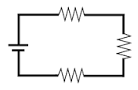


Which of these will repel each other?
Negatively charged balloon and positively charged sphere.
Negatively charged balloon and neutral sphere.
Negatively charged balloon and negatively charged sphere.
Negatively charged balloon and neutral wall.

If the light bulb in the middle burned out, what would happen to the other two?
The light bulb to the left would stay lit, but the one to the right would turn off.
They would both stay lit.
The light bulb to the right would stay lit, but the one to the left would turn off.
They would both turn off.
Which is an example of static electricity?
Neutrons are located in the center of an atom
A light bulb turns on when the circuit is closed
An electromagnet picks up metal objects
a boy shocks his sister after sliding his feet across the carpet
What is the build up of electrical charges in one place called?
neutrons
static electricity
insulator
conductor
What type of electric circuit only has ONE path for the electricity to flow?
series
parallel
open
none of the above
Items that have opposite charges do what?
attract
repel
nothing changes
Items that have the same charge will do what?
attract
repel
If the light bulb turns ON in a circuit, that means the circuit is
open
closed
Imagine you are creating a circuit. It works and the light bulb turns on. Then you add a piece of plastic to the circuit, and the light bulb does not turn on. We can infer that the plastic is
an insulator
a conductor
an electron
static electricity
A parallel circuit has more than one path for electricity to flow
true
false
What is the purpose of a fuse?
to break the circuit and turn the power off if there is too much power being run
to add more power to the circuit
to be a conductor
to be an insulator
What kind of electricity is natural (example: lightning)?
current electricity
static electricity
power source
insulator

This picture shows a circuit that is
closed
open
an insulator
static electricity
Which of the following is a conductor?
wood
rubber
metal
plastic
Which of the following is an insulator?
an eraser
a wire
a penny
a metal spoon
What is electricity?
an object that electrons do not flow through
energy created by moving charged particles
when two objects repel each other
a circuit that has only one path for electricity to flow

A form of energy caused by the movements of electrons
electricity
electron
electric current
series circuit

Flow of electrons or charge through a circuit.
parallel circuit
closed circuit
open circuit
electric current

a path in which electrons from a voltage or current source flow. Consists of a battery, a wire, a load & a switch to open and close a circuit.
electric circuit
series circuit
electricity
electric current

an incomplete circuit through which electricity will not flow
open circuit
electron
closed circuit
electric circuit

An electric circuit through which current can flow in an uninterrupted path.
closed circuit
volts
conductor
insulator

A material that allows heat and electricity to pass through it.
electron
parallel circuit
conductor
insulator

A material that does not allow heat or electrons to move through it easily.
methods of generating power
closed circuits
conductor
insulator

An electric circuit with only one path through which charge can flows. All components are connected in a series.
voltage circuit
series circuit
parallel circuit
electric current

A circuit that contains more than one path for current flow.
voltage circuit
series circuit
parallel circuit
electric current

A measure of how strong the available electricity is.
amps
volts
ohms
m/s

coal fired, hydroelectricity, gas fired, solar, wind
parallel circuit
series circuit
methods of generating power
volts

The parts of an atom which move from one atom to the next to create a flow of electricity
current
electron
proton
neutron

A device that moves a magnet to produce an electric current is known as-
electrical generator
electric motor
electromagnet
transformer

The type of magnet in which the magnetic field is produced by an electric current is called an-
horseshoe magnet
bar magnet
refrigerator magnet
electromagnet

An electric current can be created in a coil of wire by having a-
moving magnetic field
stationary magnetic field

To create a powerful electromagnet, select wire at a _______ diameter and a create ________ loops on a metal rod.
small; less
small ; more
large ; less
large ; more

Connecting a battery to a metal rod looped with metal wire creates a(n) ______________________ force.
magnetic
mechanical
gravitational
friction

If the one bulb burned out, what would happen to the other bulb?
stay lit
not light up
brighter
dimmer

Is the image shown a series or a parallel circuit?
series
parallel
Is the image shown the switch is closed, are the lights on or off?
all lights are off
all lights are on

In the image, what type of circuit is shown?
series
parallel

What type of circuit is shown in the image?
series
parallel

What type of circuit is shown in the image?
series
parallel

What will happen to the 2 magnets if they are released?
attract
repel

Are the lights on in this circuit?
yes, the lights are on
no, the lights are off

What type of circuit is shown in the image?
series
parallel
Which of the following would have a light bulb turned on?
an open switch
a closed switch
a break in the wire
a wire and a load only

In the bottom of the picture, what explains why the balloons are repelling each other?
opposites attract
like charges in the balloon are repelling each other
the helium has negative charges
What is a complete closed path that electrical currents travel?
circuit
switch
resistance
battery

Which of the following best describes what is being created in the picture?
static electricity
potential energy
magnetic field

Why does the top magnet appear to float above the bottom magnet?
The magnets are made of different materials.
The like poles repel each other.
The opposite poles repel each other.
the magnets have different gravitational pull

Which electromagnet can lift more paperclips?
example W
example x
Copper wire, an iron nail, and a battery can be used to make an
(a)
Is a metal fork a conductor or insulator?
conductor
insulator
Is rubber a conductor or insulator?
conductor
insulator
Which of the following best describes what happens if you increase the number of turns of wire in an electromagnet?
the wire burns up
the magnetic field gets bigger
the magnet weakens
the poles reverse


Magnetism is a force of ____________________________ that occurs between two _____________ objects.
attraction or repulsion, magnetic
external or internal, magnetic
external or repulsion, electronic
attraction or internal, electronic
A magnetic field is a field of force that is produced by moving ________ charges.
northern
positive
gravitational
electric

The magnetic ____________ around a bar magnet is shown above.
legs
flowers
field
direction
The Earth produces its own ________ field.
spectrum
electric
magnetic
progressive
A compass points toward the south pole of Earth's magnetic field, located near the Earth's geographical ________.
north
south
east
west
In magnetic materials, all of the ________ are pointing in the same direction.
doors
electrons
domains
orbits
A permanent magnet is a material that produces a ___________________ field without any ___________________ magnetic field being present.
electronic, internal
magnetic, internal
magnetic, external
electronic, external
Permanent magnets can be demagnetized by ___________________ them past the Curie point (approximately 1,060 °F).
heating
freezing
shaking
solidifying
Every magnet has both a _________ pole and a __________ pole.
North, South
East, West
Positive, Negative
Positive, South
Certain materials respond to magnetic fields by becoming ______________ themselves. ____________ is one of these materials.
magnetic, Plastic
electronic, Iron
magnetic, Iron
electronic, Plastic
Some objects that normally aren't magnetic can become magnetized when connected to a circuit. Items that are magnetized in this way are called ________.
electromagnets
electrons
electrochromic devices
permanent magnets
Probably the most useful thing about electromagnets is that they can be turned ________ and ________.
on, off
positive, negative
north, south
on, negative
If two magnets are close together, the magnetic force will be ________.
smelly
weak
strong
positive
If two magnets are placed so that a north pole and a south pole are facing each other, they will _____________ each other.
date
spin
repel
attract
If two magnets are placed so that two ____________ poles or two ____________ poles are facing each other, they will repel each other.
North, South
external, internal
positive, negative
North, West

Although magnetic fields are _____________, one common way that people investigate them is to use ________ filings.
invisible, iron
touchable, iron
invisible, plastic
touchable, plastic

By sprinkling iron filings in a magnetic field on a flat surface, it is possible to see the __________ of a magnetic field.
shape
distance
mass
temperature

The image above shows how iron filings respond to magnetic fields generated by two magnets with ____________ poles facing each other.
opposite
like
positive
negative

The image above shows how iron filings respond to magnetic fields generated by two magnets with ____________ poles facing each other.
like
opposite
positive
negative

A horseshoe magnet will generate a magnetic field similar in shape to that of two ________ poles brought near each other.
like
opposite
positive
negative

Which answer describes the pictures correctly?
Both drawings show attraction of magnetic forces.
The left drawing shows repulsion and the right drawing shows attraction of magnetic forces.
Both drawings show repulsion of magnetic forces.
The left drawing shows attraction and the right drawing shows repulsion of magnetic forces.
Which metal is NOT magnetic?
copper
iron
cobalt
nickel

compass
magnetic field



