Wayground logo

Free Printable Worksheets

Font size

S
M
L
XL
Worksheets

1st Semester Review

Total questions: 70

Worksheet time: 2hrs 10mins

Name
Class
Date
1.
How many carbon atoms (C) are in a CO2 molecule?
a)
1
b)
2
c)
3
d)
0
2.

How many Hydrogen atoms (H) are in a molecule of H2O?

a)

1

b)

2

c)

3

d)

0

3.
When a molecule is made up of more than two different elements ( Example CO2)  we call this .......................
a)
a mixture 
b)
atom
c)
a compound 
4.

How many atoms of hydrogen are in a molecule of glucose (C6H12O6)?

a)

12

b)

6

c)

18

d)

4

5.

A student mixes 125 grams of sugar, 250 grams of water and 5 grams of flavoring. The solution masses out to...

a)

250 grams

b)

380 grams

c)

375 grams

d)

400 grams

6.
Which of these is not a chemical reaction?
a)
Burning of wood
b)
Milk going bad
c)
Mixing vinegar and baking soda
d)
Melting of ice
7.
If reaction starts with 20g of reactants it should produce 
a)
a total of 40g of products
b)
a total of 10g of products
c)
a total of 80 g of products
d)
a total of 20g of products
8.
A precipitate is a 
a)
liquid that forms when two solids are reacted
b)
a solid that forms when two liquids are mixed
c)
a gas that forms when vinegar and baking soda react
d)
a change of color in a solution
9.

Does this picture accurately show the Law of Conservation of Mass?

a)

Yes

b)

No

10.

How many grams of CHOCOLATE POWDER are shown in the example of conservation of mass below?

a)

450 g

b)

465 g

c)

0 g

d)

15 g

11.

Is this an example of a physical or chemical change?

a)

physical

b)

chemical

12.

Is this an example of a physical or chemical change?

a)

physical

b)

chemical

13.

Is this an example of a physical or chemical change?

a)

physical

b)

chemical

14.

Melting butter for popcorn is a

a)

chemical change

b)

physical change

15.

A change in which NEW substances are formed.

a)

Chemical change

b)

Physical change

16.

Which of the following is NOT an example of chemical change?

a)

sour milk

b)

burning wood

c)

breaking a pencil

d)

rust

17.

What happens to the kinetic energy of particles in a substance when the temperature increases?

a)

The kinetic energy decreases.

b)

The kinetic energy remains the same.

c)

The kinetic energy increases.

d)

The kinetic energy becomes zero.

18.

Which of the following statements is true about the relationship between temperature and kinetic energy?

a)

Temperature and kinetic energy are unrelated.

b)

As temperature increases, kinetic energy decreases.

c)

As temperature decreases, kinetic energy increases.

d)

As temperature increases, kinetic energy increases.

19.
In convection, WARM air
a)
Rises
b)
Sinks
20.
In convection, COOL air
a)
Rises
b)
Sinks
21.

You place a pot onto a hot stovetop. The heat is transferred from the stove to the pot by

a)

Convection

b)

Conduction

c)

Radiation

d)

Temperature

22.

The total thermal energy of an object is also known as...

a)

Temperature

b)

Insulator

c)

Conductor

d)

Heat

23.

When particles become hotter, they tend to move...

a)

Slower

b)

Faster

c)

At the same rate

d)

Backwards

24.

When heat is transferred through a fluid (liquid or gas), this type of energy transfer is occurring:

a)

Conduction

b)

Convection

c)

Radiation

d)

Evaporation

25.

Heat transferred over a distance, without the use of matter:

a)

Conduction

b)

Convection

c)

Radiation

d)

Evaporation

26.

Which transverse wave has the highest frequency?

¿Qué onda transversal tiene la frecuencia más alta?

a)

1

b)

2

c)

3

d)

4

27.

Carries energy from one place to another

Transporta energía de un lugar a otro

a)

Waves

Olas

b)

Amplitude

Amplitud

c)

Frequency

Frecuencia

d)

Crest

Cresta

28.

The number of waves that passes a certain point in a set period of time

El número de ondas que pasa por un cierto punto en un período de tiempo determinado

a)

Frequency

Frecuencia

b)

Amplitude

Amplitud

c)

Wavelength

Longitud de onda

d)

Amplength

29.

What kind of wave is pictured below?

¿Qué tipo de ola se muestra a continuación?

a)

compressional wave

onda de compresión

b)

transverse wave

onda transversal

c)

sound wave

onda sonora

d)

mechanical wave

onda mecánica

30.

Which vocabulary term is used to identify the distance between points C & E?

¿Qué término de vocabulario se utiliza para identificar la distancia entre los puntos C y E?

a)

Amplitude

Amplitud

b)

Crest

Cresta

c)

Frequency

Frecuencia

d)

Wavelength

Longitud de onda

31.

The formula for Speed is...

a)

Speed = distance/ time

b)

Speed = time/ distance

32.

Based on the UNITS given, which of the following would be a correct answer for finding the SPEED.

a)

S = 4 miles

b)

S = 4 minutes

c)

S = 4 min/miles

d)

S = 4 miles/min

33.

Which of the following could be an answer if solving for the distance?

a)

d = 4 seconds

b)

d = 4 meters/second

c)

d = 4 seconds/meters

d)

d = 4 meters

34.

If Harry drives 4 miles in 2 minutes, what was his speed?

a)

0.5 miles/min

b)

2 miles/min

c)

2 min/m

d)

0.5 min/m

35.

If Emma is running for 8 minutes at 2 miles/min, how far did she run?

a)

4 miles

b)

16 min

c)

16 miles

d)

0.5 min

36.
You ride your bike around the block at a constant speed of 11 km/h.
a)
Acceleration occurred because speed increased.
b)
Acceleration occurred because speed decreased.
c)
Acceleration occurred because you changed directions.
37.
Changing the speed and changing the direction of your bicycle are both examples of acceleration.
a)
TRUE
b)
FALSE
38.

What is this?

"This airplane is traveling at 500 mph, West"

a)

Speed

b)

Velocity

c)

Acceleration

39.

Which is an example of velocity?

a)

A car driving 55 miles per hour south.

b)

A bicyclist traveling 10 meters per hour.

c)

A roller coaster is traveling 10 meters per second.

d)

A rocket blasting off at 2,500 meters per second.
40.
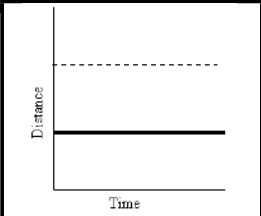
What does this graph represent?
a)
Constant Speed
b)
Acceleration
c)
Not moving
41.
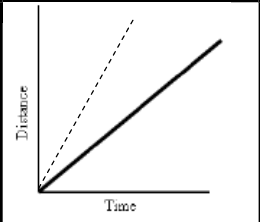
What does this graph represent?
a)
Constant speed
b)
Acceleration
c)
Not moving
42.
What does this graph represent?
a)
Constant speed
b)
Acceleration
c)
Not moving
43.

Why do the values on the graph form a straight line?

a)

The speed is constant

b)

The distance remains unchanged.

c)

The direction of motion stays the same.

d)

The speed gradually increases over time.

44.
8 N to the left , and 4 N to the right. Find the net force. Is this balanced?
a)
12 N Right  No
b)
4 N Left  No
c)
12 N Right  Yes
d)
4 N Left  Yes
45.
Force pair that has a net force of zero.
a)
Balanced force
b)
Unbalanced force
46.
Which one is balanced?
a)
top
b)
bottom
c)
both
d)
neither
47.
What is the net force?
a)
5000 N right
b)
4000 N right
c)
40 N left
d)
4000 N left
48.
What law?
a)
1st
b)
2nd
c)
3rd
49.
A magician pulls a tablecloth out from under dishes and glasses on a table without disturbing them.
a)
Newton's 1st Law
b)
Newton's 2nd Law
c)
Newton's 3rd Law
50.
Which has more Inertia? (so need more force to move) 
a)
Truck
b)
Ant
c)
A cat
d)
A skateboard
51.
In the picture, the vehicle will move because of...
a)
Newton's 1st Law
b)
Newton's 2nd Law
c)
Newton's 3rd Law
d)
Newton's 9th Law
52.
What geologic feature/event would you most likely to find at a divergent boundary between two pieces of oceanic crust?
a)
Rift Valley
b)
Mid-Ocean Ridge
c)
Island Arc
d)
Flat land
53.
What geologic feature/event would you most likely to find at a divergent boundary between two pieces of continental crust?
a)
Mid-Ocean Ridge
b)
Mountain
c)
Rift Valley
d)
Island Arc
54.

Deep ocean trenches are associated with:

a)

mid-ocean ridge systems.

b)

transform fault boundaries.

c)

subduction zones.

d)

rift zones.

55.

The youngest rocks on the ocean floor are typically located near what feature?

a)

a mid-ocean ridge

b)

a subduction zone

c)

on an island arc

d)

a deep-sea trench

56.
What type of boundary is the SAN ANDREAS FAULT on?
a)
Covergent
b)
Transformers
c)
Divergent
d)
Transform
57.
What is the name of the plate boundary that slides past each other?
a)
Divergent
b)
Convergent
c)
Transform
d)
Mr. C the Slide Man
58.

What two crustal features occur near every subduction zone?

a)

Volcanoes and Trenches

b)

Rift Valleys and Mid Ocean Ridges

c)

Volcanoes and Rift Valleys

d)

Mid Ocean Ridges and Trenches

59.

The process that occurs at a divergent oceanic boundary that creates new crust (sea floor) is called?

a)

Subduction

b)

Seafloor Spreading

c)

Continental Drift

d)

Volcanism

60.
In the diagram given, what happens as we move to the left?
a)
Stars Get Larger
b)
Stars get Colder
c)
Stars get Hotter
d)
Stars get Brighter
61.
As a whole, Giants are considered hotter than White Dwarfs.
a)
True
b)
False
62.
What type of galaxy is shown in this image?
a)
Spiral
b)
Elliptical
c)
Irregular
d)
Irrational
63.
What are the the 3 types of galaxies?
a)
Spiral, Regular, and Elliptical 
b)
Spiral, Irregular, and Elliptical 
c)
 Milky Way, Elliptical, and Spiral 
d)
Milky Way, Elliptical, and Irregular 
64.
Our solar system is located inside a galaxy called the _____________.
a)
Local Group
b)
Milky Way
c)
Andromeda
d)
Constellation
65.
Red stars are the _____________.
a)
hottest
b)
coolest
c)
biggest
d)
brightest
66.
What is found on the x axis of an H-R diagram?
a)
Luminosity
(or brightness)
b)
Temperature
c)
Star Size
d)
Distance
67.
Which star has the lowest temperature?
a)
A
b)
B
c)
C
d)
D
68.
This is an image of the formation of a star, also known as a .... 
a)
Main Sequence
b)
Planetary System
c)
Supernova
d)
Stellar Nebula
69.
What type of galaxy is this?
a)
Spiral
b)
Elliptical
c)
Irregular 
d)
Irrational
70.
The universe is
a)
1 light year across
b)
everything that exists
c)
only our galaxy