
 Worksheets
FALL FINAL 25-26 REVIEW 1
Total questions: 54
Worksheet time: 32mins
By the end of the seventeenth century, which of the following was true of women in New England?
They had begun to challenge their subordinate role in society.
They were a majority in many church congregations.
They voted in local elections.
They frequently divorced their husbands.
They could lead town meetings.
The rise in manufacturing beginning in the early 1800s eventually resulted in which of the following by 1848?
The emergence of a larger middle class in the North
A decline in economic inequality in urban areas
An increased demand for agricultural workers in the Midwest
The improvement of working conditions in factories
Anti-immigrant nativism of the 1840s and 1850s had the most in common with which of the following earlier developments?
The passage of the Alien and Sedition Acts (1798), which limited rights for foreign-born residents
The conflict between Patriots and Loyalists during the American Revolution
The persecution of religious dissenters in the Massachusetts Bay Colony
The signing of the Treaty of Greenville (1794) that ended wars between the United States and Native Americans in the Northwest Territory
All of the following groups of non-English colonists migrated into the British North American colonies in large numbers throughout the eighteenth century EXCEPT
Germans
Russians
Scots
Irish
Dutch
Five of the thirteen states voted for ratification of the Constitution only after
slavery was allowed to continue without federal interference
several slave revolts rocked the Carolinas and Virginia
they were assured that the Supreme Court would have the power of judicial review
they were assured that a Bill of Rights would be added shortly after ratification
the other states threatened to organize the government without them
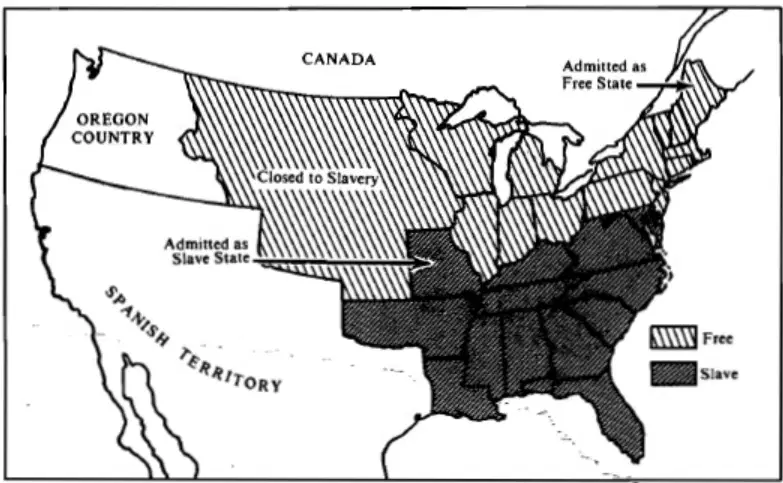
The map above shows the United States immediately following the
passage of the Northwest Ordinance
negotiation of the Adams-Onis Treaty
passage of the Missouri Compromise
settlement of the Mexican War
passage of the Compromise of 1850
A Maryland master placed the following newspaper advertisement in 1772 after Harry, his slave, had run away: “He has been seen about the Negro Quarters in Patuxent, but is supposed to have removed among his Acquaintances on Potomack; he is also well acquainted with a Negro of Mr. Wall’s named Rachael; a few miles from that Quarter is his Aunt, and he may possibly be harboured thereabouts.”
Slaves had no opportunity to develop their own culture and society.
Slaves commonly formed settlements of their own away from the plantations.
Slaves lived entirely independently of their masters.
Slaves frequently associated with free Black people.
Slaves maintained social networks among kindred and friends despite forced separations.
The belief by some Americans that the Civil War was “a rich man’s war but a poor man’s fight” was reflected in
Sherman’s march to Atlanta
the draft riots in New York City
Lincoln’s suspension of habeas corpus in the South
Thoreau’s denunciation of the war
John Brown’s raid on Harpers Ferry
Which of the following statements best characterizes the activists who attended the Seneca Falls Convention?
They advocated better working conditions for children.
They called for expanded women’s rights.
They supported Theodore Roosevelt for president.
They advocated the conservation of natural resources.
They endorsed assimilation of American Indians into White society.
Which of the following factors most directly contradicted Adams’ theory about the Revolution?
The existence of considerable Loyalist opposition to the Patriot cause
The existence of significant social and economic divisions within the colonies
The importance of colonial military victories in bringing about independence
The importance of support from European allies in defeating the British
Which of the following is the most likely reason why Adams dates the beginning of the American Revolution to the 1760s?
Which of the following was a major cause of the opposition to the Stamp Act?
Renewed efforts by Great Britain to consolidate imperial control over the colonies
The forging of American Indian political alliances with European powers
Increased involvement of colonial merchants in the Atlantic economy
The expansion of the colonial population into the interior of the continent
Which of the following aspects of life in the United States in the early nineteenth century most likely influenced Adams’ recollection of Revolutionary events?
The rapid development of the market revolution
The development of a national culture and national identity
The growing popularity of the idea of Manifest Destiny
The rapid growth of a mass democracy
Addams’ ideas expressed in the excerpt have most in common with which of the following historical views about women?
According to the excerpt, Addams believes that women could be the moral voice in society and that by granting them access to the political sphere through suffrage, they could serve as an important balance to the issues on which men tended to focus. Which of the following best describes the belief expressed in the excerpt?
The seventeenth-century Puritan belief that women must be governed by their husbands and fathers
The belief of some mid-nineteenth-century reformers that women could act as the moral voice in society
The argument of some nineteenth-century advice books that women’s sphere was restricted to the home and family
The rejection of traditional gender roles by feminists in the mid-twentieth century
The ideas expressed in the excerpt most clearly reflect the ideals of which of the following?
Progressivism
Conservatism
Expansionism
States’ rights
Which of the following would have been most likely to support the sentiments expressed by Addams in the excerpt?
Know-Nothings
Machine politicians
Southern Democrats
Settlement house workers
The concerns Addams raises in the excerpt were most directly a reaction to which of the following?
Social injustice and rising economic inequality
The expansion of government regulation of corporations
The transformation of rural society by mechanized agriculture
Fears about the growing number of immigrants in the United States
Which of the following statements about African American soldiers during the Civil War is correct?
They were primarily engaged in military campaigns west of the Mississippi.
They were limited to noncombat duty.
They were barred from receiving awards for valor in combat.
For most of the war, they were paid less than White soldiers of equal rank.
For most of the war, they were led by African American officers.
The phrase in the excerpt “Some of them seem willing to fight for you” could most likely be interpreted as having which of the following purposes?
Authorizing the policy of total war by Union generals in fighting in the South
Addressing the difficulties of feeding runaway enslaved people at military encampments
Acknowledging the shuffling of commanding officers in the Union army
Highlighting the enlistment of formerly enslaved people into the Union army
Read the excerpt from President Abraham Lincoln's letter to James Conkling explaining why he issued the Emancipation Proclamation, 1863: “There are those who are dissatisfied with me. To such I would say: You desire peace; and you blame me that we do not have it. But how can we attain it? ... “But to be plain, you are dissatisfied with me about the Negro. ... You dislike the emancipation proclamation; and, perhaps, would have it retracted. You say it is unconstitutional—I think differently. I think the Constitution invests its commander-in-chief, with the law of war, in time of war. The most that can be said, if so much, is, that slaves are property. Is there—has there ever been—any question that by the law of war, property, both of enemies and friends, may be taken when needed? And is it not needed whenever taking it, helps us, or hurts the enemy? ... “You say you will not fight to free Negroes. Some of them seem willing to fight for you. ... I issued the proclamation on purpose to aid you in saving the Union. ... Why should they do anything for us, if we will do nothing for them? If they stake their lives for us, they must be prompted by the strongest motive—even the promise of freedom. And the promise being made, must be kept.”
Allowing slavery to exist was still a political option.
Maintaining the blockade of Southern states was difficult.
Changing the purpose of the war would strengthen the Union cause.
Achieving the Confederacy’s unconditional surrender was the Union’s main objective.
The excerpt could best be used by historians studying which of the following?
What prevented European powers from supporting the South
What motivated African Americans during the war
How Lincoln used executive powers to initiate wartime policy
How Confederate strategy prevented a rapid Union victory
Which of the following claims is supported by the arguments made by both Levine and Langguth?
Local political tactics served to deny African Americans their rights.
White southerners accepted racial and political equality.
Republicans permanently changed the balance of political power in the South.
African Americans gained property rights while becoming self-sufficient.
Levine’s argument about Reconstruction in the excerpt differs from that of Langguth in that Levine argues
African Americans were held in a perpetual state of slavery
White Southerners willingly worked alongside the emancipated population
Northern Republicans gradually withdrew their support for Reconstruction policies
White plantation owners conceded to Republican policies in the South
Which of the following arguments about Reconstruction policies would both authors most likely disagree with?
White Southerners across all economic classes rejected Reconstruction policies.
With Republicans in retreat, Southern Democrats grew more supportive of Reconstruction policies.
Reconstruction policies failed to prevent the spread of violence against formerly enslaved people.
Unfair labor conditions in the South persisted despite Reconstruction policies.
Mr. President, it was solemnly asserted on this floor, some time ago, that all parties in the non-slaveholding States had come to a fixed and solemn determination upon two propositions. One was that there should be no further admission of any States into this Union which permitted, by their constitutions, the existence of slavery; and the other was that slavery shall not hereafter exist in any of the territories of the United States, the effect of which would be to give to the non-slaveholding States the monopoly of the public domain. . . . The subject has been agitated in the other House [of Congress], and they have sent up a bill 'prohibiting the extension of slavery . . . to any territory which may be acquired by the United States hereafter.' At the same time, two resolutions which have been moved to extend the compromise line from the Rocky Mountains to the Pacific, during the present session, have been rejected by a decided majority. Sir, there is no mistaking the signs of the times; and it is high time that the Southern States—the slaveholding States—should inquire what is now their relative strength in this Union, and what it will be if this determination is carried into effect hereafter. John C. Calhoun, senator, speech in the United States Senate, 1847
Increased conflict between urban immigrants and nativists
Compromises between the Supreme Court and national leaders
The expanding influence of the Northern abolitionist movement
Growing sectional tensions caused by the Mexican-American War
The speech given by Calhoun relates to which of the following?
States' rights and nullification
The abolition of slavery
The expansion of the railroad
Women's suffrage
Which of the following best describes the effect of regional attitudes on federal policy making?
The effect of regional attitudes on federal policy making
The ways in which immigration changed American culture
The efforts by national leaders to expand the Pacific trade
The widespread support for the immediate end of slavery
Read the excerpt below: “From infancy I was taught to love humanity and liberty. Inquiry and experience have since confirmed my reverence for the lessons then given me, by convincing me more fully of their truth and excellence. Benevolence towards mankind excites wishes for their welfare, and such wishes endear the means of fulfilling them. Those can be found in liberty alone, and therefore her sacred cause ought to be espoused by every man, on every occasion, to the utmost of his power. . . . These being my sentiments, I am encouraged to offer you, my countrymen, my thoughts on some late transactions, that in my opinion are of the utmost importance to you. . . . “If the BRITISH PARLIAMENT has a legal authority to order, that we shall furnish a single article for the troops here, and to compel obedience to that order; they have the same right to order us to supply those troops with arms, clothes, and . . . to compel obedience to that order also. . . . What is this but taxing us at a certain sum, and leaving to us only the manner of raising it? How is this mode more tolerable than the STAMP ACT?” John Dickinson, Letters from a Farmer in Pennsylvania, to the Inhabitants of the British Colonies, 1768
Native Americans west of the Appalachian Mountains
Enslaved people in the South
Anglican ministers in the middle colonies
Merchants in New England
Based on the excerpt, the most likely purpose of Dickinson’s letters was to
use Enlightenment rhetoric to encourage American autonomy
support efforts to claim the French territory of Louisiana
argue for increased industrial production in the colonies
call for the immediate end of the international slave trade
The American Colonization Society was established in the early nineteenth century with the goal of
encouraging immigration from Ireland and Germany
encouraging Chinese contract laborers to emigrate to the United States
settling White Americans on western lands
settling American Indians on reservations
transporting African Americans to Africa
The goal of the American Colonization society was to
return freed slaves to Africa
recruit immigrant labor for American factories
assimilate recent immigrants into American society
extend United States influence to overseas colonies
promote western expansion by funding internal improvements
Members of the American (Know-Nothing) Party of the 1850s typically supported
universal manhood suffrage
restoration of a national bank
immediate abolition of slavery
homesteads in the western territories
restrictions on Catholics’ holding public office
Which of the following was a major issue during Andrew Jackson's presidency?
taxation of consumer items
reelection of Andrew Jackson
enunciation of the doctrine of nullification
alliance of Southern planters and Western farmers
expansion of the New England textile industry
The most important factor in Andrew Jackson’s successful bid for the presidency in 1828 was his
choice of John C. Calhoun as his running mate
reputation as a hero of the War of 1812
commitment to broad-based social reform
reputation as an intellectual thinker and writer
extensive experience in elective office
The Sons of Liberty initiated the Boston Tea Party in direct response to
the removal of British troops from Massachusetts during the French and Indian War
Parliament’s passage of the Intolerable Acts
British efforts to protect the East India Company from bankruptcy
British attacks on colonial troops at Lexington and Concord
Lord Hillsborough’s decision to dissolve the Massachusetts Assembly
By the 1750’s, the British colonies on the North American mainland were characterized by all of the following EXCEPT
disdain for British constitutional monarchy
many religious denominations
a society without a hereditary aristocracy
a growing number of non-English settlers
acceptance of slavery as a labor system
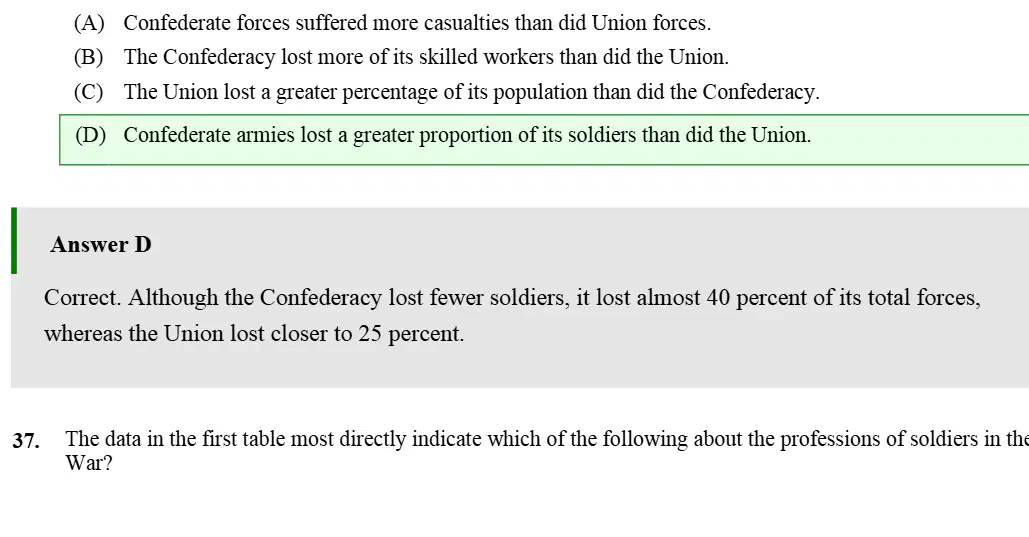
The data in the tables indicate which of the following?
Confederate forces suffered more casualties than did Union forces.
The Confederacy lost more of its skilled workers than did the Union.
The Union lost a greater percentage of its population than did the Confederacy.
Confederate armies lost a greater proportion of its soldiers than did the Union.
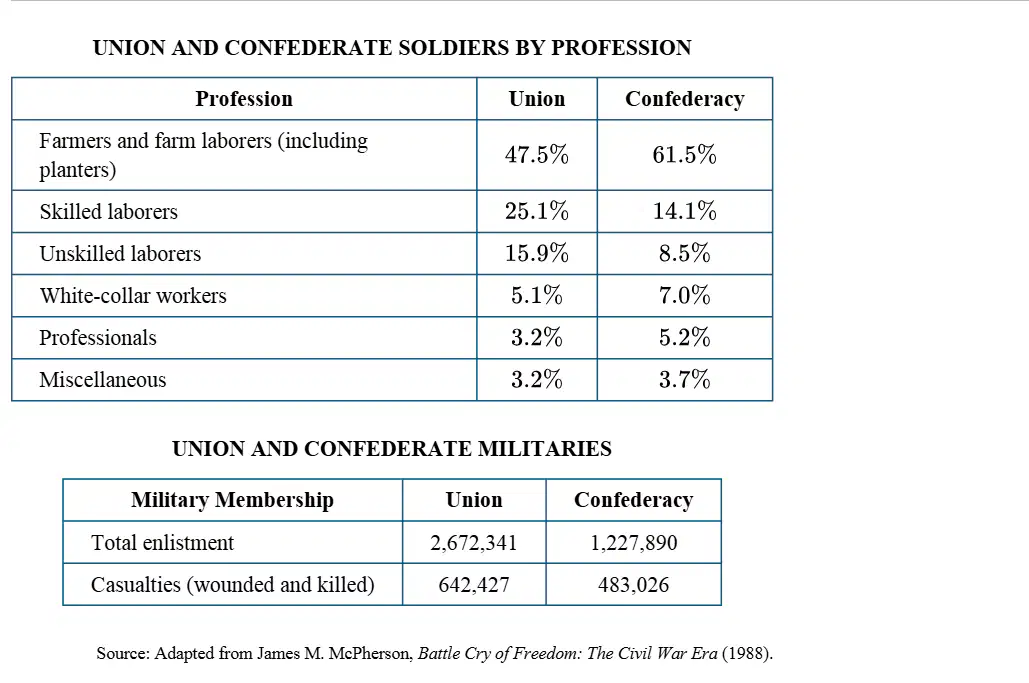
The data in the first table most directly indicate which of the following about the professions of soldiers in the Civil War?
Most soldiers in the Civil War were not professional soldiers before the war.
Most soldiers in the Civil War were career military professionals.
The majority of Civil War soldiers were foreign mercenaries.
Civil War soldiers were primarily from wealthy backgrounds.
The Confederacy relied more heavily on agricultural workers to fill its armies than did the Union.
The Confederacy enlisted more factory workers to fill its armies than did the Union.
The Confederacy relied more heavily on agricultural workers to fill its armies than did the Union.
The majority of soldiers in both Confederate and Union forces were sharecroppers.
The Confederacy enlisted more skilled workers than did the Union.
The data in the tables most likely indicate which of the following?
The Union had more educated leadership in its army than did the Confederacy.
The Confederacy more typically enlisted enslaved African Americans to fill its army.
The Union had a larger and more diverse population of workers to enlist from than did the Confederacy.
The Confederacy had more wealthy people in its armed forces than did the Union.
As originally ratified, the United States Constitution provided for
a presidential Cabinet
a two-term presidential limit
an electoral college
political parties
the direct election of United States senators
40. The Constitutional Convention of 1787 did all of the following EXCEPT:
Drafted the Bill of Rights
Established a federal government
Created a system of checks and balances
Resolved disputes between large and small states
Which of the following was a major purpose of the first ten amendments to the United States Constitution?
create a government that would be satisfactory to both slave and free states
create a government that would be satisfactory to both large and small states
create a strong central government that would not threaten the sovereignty of the states
establish a balance of power between the three branches of the national government
determine provisions to be included in the Bill of Rights
The Supreme Court’s decision in the Dred Scott case in 1857 effectively repealed the
Missouri Compromise
Fugitive Slave Act
Ostend Manifesto
Wilmot Proviso
Eleventh Amendment to the Constitution
Which of the following principles was established by the Dred Scott decision?
Congress could abolish slavery at will.
National legislation could not limit the spread of slavery in the territories.
The rights of all people are protected by the Constitution.
Slaves residing in a free state automatically became free.
Through squatter sovereignty, a territory had the sole right to determine the status of slavery within its territorial limits.
The expansion of suffrage to most adult White men in the early nineteenth century most directly resulted in which of the following?
The growth of new political parties
The abolition of slavery in the northern states
The signing of peace treaties with Native Americans
The employment of women in textile manufacturing
Read the excerpt below and answer the following question: “Mississippi planter and agricultural reformer M. W. Phillips, a regular contributor to the American Cotton Planter, wrote about soil exhaustion and crop rotation, and extolled the virtues of manuring and self-provisioning. In one of his most widely reproduced articles, Phillips condemned planters before whom ‘everything has to bend [and] give way to large crops of cotton.’ . . . Phillips imagined the cotton economy in terms of flows of energy, nutrients, and fertility, all of which he was convinced were being expended at an unsustainable rate. He used images of human, animal, and mineral depletion to represent an onrushing ecological catastrophe. But he did so within the incised [limited] terms allowed him by his culture—the culture of cotton. Phillips was arguing that the slaveholding South needed to slow the rate at which it was converting human beings into cotton plants.” Walter Johnson, historian, River of Dark Dreams: Slavery and Empire in the Cotton Kingdom, 2013 44. Which of the following resulted from the mass production of cotton described in the excerpt?
(A) Southerners eventually sought to diversify the crops they grew.
(B) Some southerners relocated their plantations to the west of the Appalachian Mountains.
(C) A cotton gin was developed that processed raw cotton more quickly.
(D) Southerners supported protective tariffs to stimulate the United States economy.
In the first half of the 1800s, which of the following resulted from the debates about the cotton economy described in the excerpt?
Northerners began to frame antislavery arguments in ecological terms.
A distinct Southern economic and cultural identity emerged.
Large numbers of immigrants moved to Southern cities to pursue economic opportunities.
The federal government built an extensive network of roads, canals, and railroads to support cotton agriculture.
Which of the following most directly contributed to the development described in the excerpt?
The introduction of enslaved Africans in the 1600s into what is now the United States
The election of Andrew Jackson to the presidency and his decision to enforce tariff collections
A series of insurrections and rebellions by enslaved people in the first half of the 1800s
A belief by southern businessmen that the southern economy should focus on the export of select agricultural products
The Constitutional Convention designed the electoral college to
strengthen the legislative branch against the executive branch
strengthen the executive branch against the legislative branch
ensure the independence of the judiciary
protect the sovereignty of the states
insulate the presidency from the popular will
In addition to the cotton gin, Eli Whitney’s major contribution to American Technology was his
introduction of interchangeable parts
development of the first practical locomotive
invention of the mechanical reaper
installation of the first textile mill
development of steam power
Hakluyt’s call for the English to learn about Native American “language, manners, and customs” best represents which of the following developments in the 1500s?
Native Americans and Europeans partnered for trade.
Europeans introduced maize cultivation to the Americas.
Native Americans were sent in large numbers into slavery in Europe.
Europeans refused defensive military alliances with Native Americans.
Read the excerpt below and answer the following question: “The second chief and principal end [of colonization] . . . consists in the [sale] of the mass of our clothes and other commodities of England, and in receiving back of the needful commodities that we now receive from all other places of the world. . . . This one thing is to be done, without which it were in vain to go about this; and that is the matter of planting [colonies] and fortification. . . . We are to plant upon the mouths of the great navigable rivers which are there [in America], by strong order of fortification, and there to plant our colonies. . . . And these fortifications shall keep the [native] people of [America] in obedience and good order. . . . “. . . Without this planting in due time, we shall never be able to have full knowledge of the language, manners, and customs of the people of those regions. . . . And although by other means we might attain to the knowledge thereof, yet being not there fortified and strongly seated, the French that swarm with [a] multitude of people, or other nations, might secretly fortify and settle themselves before us.” Richard Hakluyt, English government official, A Discourse on Western Planting, 1584 50. Which of the following developments in the 1500s is best illustrated by the excerpt?
(A) European settlers faced resistance from Native Americans.
(B) Europeans transported enslaved Africans to the Americas to produce sugar.
(C) Europeans sought new sources of wealth in the Americas.
(D) European missionaries traveled to the Americas seeking religious converts.

