
Font size
 Worksheets
RC6 Civics and Economics
Total questions: 104
Worksheet time: 52mins
How was slavery viewed in the ancient world?
It was widely accepted as a normal part of society
It was illegal in most civilizations
It was permitted only during wartime
It was based solely on race
Centralized government was usually based on __________ authority = THEOCRACY.
military
religious
economic
popular
Agricultural surplus led to an increase in __________, especially along rivers and by sea.
warfare
isolation
trade
taxation
What were the responsibilities of citizenship in the Greek polis? Select all that apply.
participating in government and voting
military service when required
paying taxes and obeying the law
avoiding public debate
Athens was the first to develop what type of government?
oligarchy
democracy
monarchy
theocracy
What were the democratic principles of Athens? Select all that apply.
direct democracy
public debate on issues
duties of the citizen such as jury service
rule by hereditary nobles
Sparta: What type of government did Sparta have?
oligarchy
direct democracy
absolute monarchy
theocracy
What was the written law code of the Roman Republic?
Code of Justinian
Hammurabi’s Code
Twelve Tables
Edict of Milan
Republic = __________ Democracy.
direct
representative
absolute
popular
How long did the Pax Romana last?
about 50 years
about 100 years
about 200 years
about 400 years
Who initiated the Pax Romana?
Julius Caesar
Augustus (Octavian)
Marcus Aurelius
Constantine
What is the “feudal system”?
a centralized empire ruled by a single monarch
a political system of landholding and mutual obligations between lords and vassals
a religious hierarchy led by the pope
a city-state governed by direct democracy
What is “Manorialism” (or the manorial system) based on?
long-distance maritime trade
self-sufficient agricultural estates worked by peasants/serfs
urban manufacturing guilds
imperial taxation
TRADE PATTERNS (WHI.10) Goods: Gold from West __________.
Asia
Europe
Africa
America
TRADE PATTERNS (WHI.10) Goods: Spices from lands around the __________ Ocean.
Atlantic
Indian
Arctic
Pacific
Goods: Textiles from __________, __________, the ____________, and later __________.
India, China, the Middle East, Europe
Greece, Rome, the Andes, Africa
Persia, Egypt, the Sahara, Australia
Russia, Scandinavia, the Arctic, Japan
Porcelain from ________ and ________. Which pair correctly completes the statement about trade goods on the Silk Roads?
China and Persia
India and Rome
West Africa and Europe
Japan and Byzantium
Paper spread from ________ through the ________ world to ________ and Western ________. Which sequence best completes the statement about the diffusion of paper technology?
China; Muslim; Byzantium; Europe
India; Christian; Rome; Asia
Persia; Buddhist; Constantinople; Africa
Japan; Hindu; Venice; Americas
New crops from ________ (e.g., for making sugar). Which location best completes the statement?
India
China
West Africa
Byzantium
Navigation innovations included a compass from ________ and a lateen sail from the ________ Ocean. Which option correctly completes both blanks?
China; Indian
Persia; Atlantic
India; Pacific
Arabia; Arctic
Spread of ________ across the hemisphere. Which belief best completes the statement about ideas along trade routes?
Islam
Judaism
Animism
Zoroastrianism
Buddhism from China moved to ________ and ________. Which pair correctly completes the statement?
Korea and Japan
India and Persia
Arabia and Egypt
Byzantium and Rome
__________ and __________ from India and Southeast Asia. Which pair of religions best completes the statement about ideas exchanged on trade routes?
Hinduism and Buddhism
Christianity and Islam
Shinto and Daoism
Judaism and Zoroastrianism
__________ into West Africa, Central and Southeast Asia. Which religion best completes the statement about diffusion along trade networks?
Islam
Buddhism
Hinduism
Shinto
Printing and paper money came from ________. Which origin best completes the statement?
China
India
Rome
West Africa
How did the Crusades impact the Renaissance? Choose the best explanation.
They increased contact and trade with the Islamic world, bringing classical knowledge and goods that helped spark urban growth and learning in Europe.
They isolated Europe from the Mediterranean, reducing trade and halting the spread of learning.
They converted most of Asia to Christianity, creating a uniform culture that ended innovation.
They destroyed Italian city-states, which delayed economic recovery until the 1700s.
How would “letters of credit” increase trade? Choose the best explanation.
They reduced the need to carry large amounts of coin over long distances, making transactions safer and easier.
They forced merchants to pay taxes in cash at every city gate, increasing government revenue.
They replaced all coins with gold bars, which were easier to transport.
They allowed only nobles to buy goods on credit, restricting commoners from trade.
Where did the Renaissance start, and why? Choose the best explanation.
It began in Italian city-states such as Florence due to wealth from trade and banking that funded arts and learning.
It began in England because of royal support from the Hundred Years’ War.
It began in Russia because of isolation from Western Europe.
It began in the Holy Roman Empire because the plague never reached there.
Which statement best describes Machiavelli’s views on a good ruler?
A ruler should maintain power effectively; if necessary it is better to be feared than loved, and the ends can justify the means.
A ruler must always be loved and never use force under any circumstances.
A ruler should surrender power to church leaders in all political matters.
A ruler’s main duty is to expand democracy and avoid warfare at all costs.
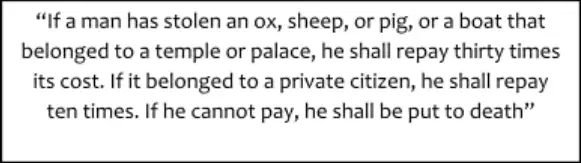
The passage below is an excerpt from which written law code? “If a man has stolen an ox, sheep, or pig, or a boat that belonged to a temple or palace, he shall repay thirty times its cost. If it belonged to a private citizen, he shall repay ten times. If he cannot pay, he shall be put to death.”
Hammurabi’s Code
Islamic Law
Justinian’s Code
New Testament
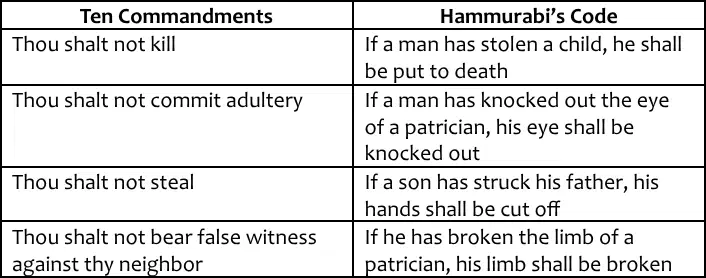
According to the table below comparing two written law codes, which option best explains the difference between them? Table summary: Ten Commandments—moral directives such as “Thou shalt not kill,” “Thou shalt not commit adultery,” “Thou shalt not steal,” and “Thou shalt not bear false witness.” Hammurabi’s Code—specific penalties such as death for child stealing, eye-for-an-eye for injuring a patrician, cutting off a son’s hands for striking his father, and breaking a limb if one has broken a patrician’s limb.
The Code of Hammurabi established harsh punishments.
The Ten Commandments prevented violent crimes.
The Ten Commandments had stricter punishments.
The Code of Hammurabi only applied to patrician men.
In most ancient civilizations, the labor force was most likely made up of –
military
women
slaves
artisans
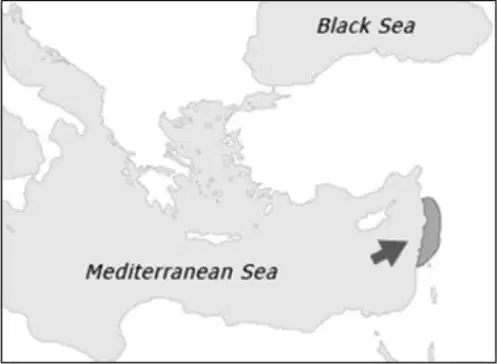
Which statement best describes the ancient civilization shaded on the map of the eastern Mediterranean coast?
It increased trade throughout Europe and North Africa.
It established the first Olympic games.
It created a writing system that consisted of pictograms.
It created the world’s first city-state.
Which of the following would not have contributed to an agricultural surplus?
Better tools
Plows
Drought
Irrigation
Which Hebrew leader is associated with the founding of Hebrew law?
Abraham
Ezekiel
Moses
David
The hereditary rulers of ancient Egypt were known as:
Pharaohs
Kings
Shamans
Emperors
What was the political structure of the first civilization of Sumer?
A dynasty
A collection of city-states
A kingdom
An imperial bureaucracy
Which written law codes are from the ancient river valley civilizations?
Justinian’s Code
Ten Commandments
Twelve Tables
Code of Hammurabi
The first empire-builder, _____ united the city-states of Mesopotamia under his rule.
Nebuchadnezzar
Assurbanipal
Hammurabi
Sargon I
Which characteristic was most common in ancient river valley civilizations?
Limited population growth
Social equality
Hereditary rulers
Limited economic growth
The early river valley civilizations of Mesopotamia and Egypt developed governments that were ruled by –
tribal councils
elected officials
religious authorities
representatives assemblies
The main idea of Hammurabi’s Code was –
An eye for an eye
All citizens are entitled to property
All men are equal before the law
Innocent until proven guilty
Which group occupied the lowest class in Greek society?
Foreigners
Slaves
Women
Children
Compared to women of other Greek city-states, the women of Sparta –
Were better educated
Led very secluded lives
Were more religious
Had more personal freedom
What type of governmental system was originated by the polis of Athens?
Representative democracy
Theocracy
Monarchy
Direct democracy
Which group in classical Athens had political rights?
Women and foreigners
Slaves
Resident aliens
Citizens
Which form of government is based upon rule by a small group of people?
Theocracy
Oligarchy
Democracy
Monarchy
Which of the following Athenians did not make reforms that led to or expanded democracy?
Socrates
Draco
Pericles
Solon
Which form of government did Sparta have?
Aristocracy
Democracy
Tyranny
Oligarchy
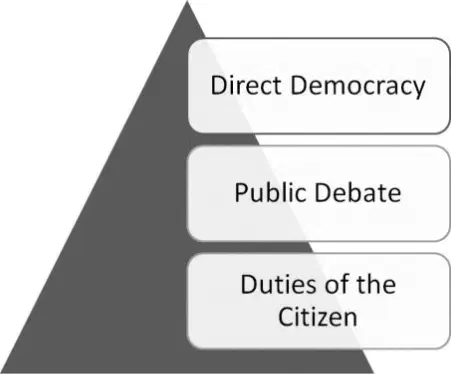
These features describe the government of the city-state of – Direct Democracy; Public Debate; Duties of the Citizen.
Athens
Persepolis
Sparta
Rome
The Spartans’ use of _____ allowed their military lifestyle, but also made it necessary as revolt was a constant fear.
Hoplite warfare
Helots
Religion
Latifundia
All citizens in ancient Athens had the right to attend the Assembly, where they could meet in open discussion and cast votes. This situation is an example of –
Totalitarianism
Direct democracy
Representative democracy
Absolutism

This diagram represents the development of government in – Monarchy → Aristocracy → Tyranny → Direct Democracy.
Classical Sparta
Classical Athens
the Roman Empire
the Roman Republic
Which term best describes the role of Spartan males from early childhood to adulthood?
Farmers
Soldiers
Politicians
Philosophers
Which term was associated with slavery in Sparta?
Plebeian
Untouchables
Peasants
Helots
How did the Roman government differ from Greek government?
Slaves did not have any political rights
The people chose the officials who governed
Women were allowed to participate in the governing process
The people made all political decisions
Which group was excluded from citizenship in the Roman Republic?
Patrician men
Foreigners
Women
Plebeian men
The majority of people in the Roman Republic were members of the –
Slave class
Patrician class
Plebeian class
Serf class
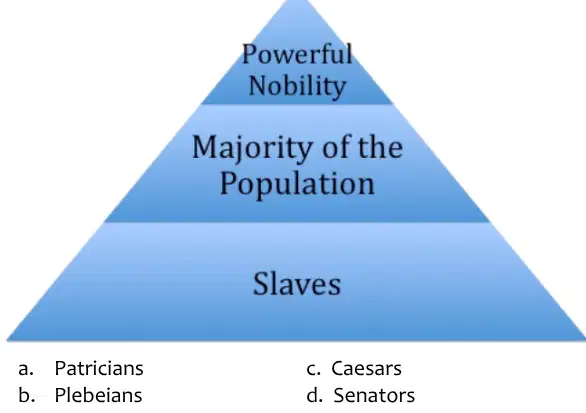
Which is the Roman title for the social class at the top of the pyramid shown?
Patricians
Plebeians
Caesars
Senators
Which phrase best describes the Twelve Tables?
A part of the Roman religion
A marketplace for Romans
The meeting place for the Senate
The codified laws of the Roman Republic
In the Roman government, what officials protected the rights of the plebeians?
Patricians
Senators
Tribunes
Consuls
In the Roman Republic, which group was responsible for making laws and public policy?
Senate
Consuls
Tribunes
Plebeians
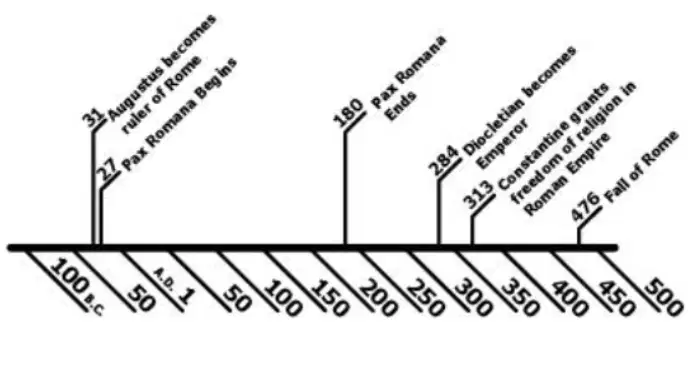
Using the timeline, the Pax Romana began under the rule of which ruler?
Diocletian
Augustus
Theodosius
Constantine
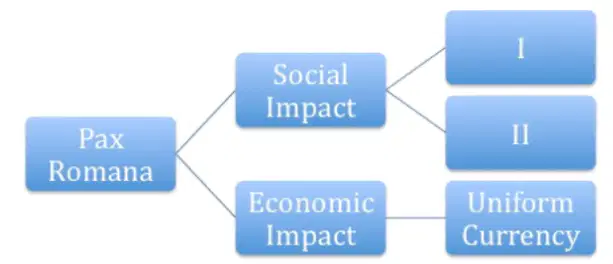
Which two statements best replace “I” and “II” in the Pax Romana impact graphic?
Promoted economic prosperity; fostered economic stability
Created civil service system; developed uniform rule of law
Expanded trade; promoted safe travel on good roads
Stabilized class structure; increased emphasis on family
Which characteristic do classical China and Rome during the Pax Romana have in common?
Christianity as a major religion
A democratic form of government
Widespread belief in Confucian principles
Use of a civil service system in government
When economic improvement allowed trade to expand within the Roman Empire?
Collection of taxes on all goods exported to East Asia
Creation of laws to further separate patricians and plebeians
Establishment of common currency throughout the empire
Creation of a civil service system throughout the empire
Which of the following was NOT a characteristic of Pax Romana?
Uniform rule of law
Building of roads
Prosperity and stability
Division of the empire
The Pax Romana period impacted politics throughout the Roman Empire by –
Creating government jobs for the unemployed
Ending the influence of Greek culture
Restricting trade with foreign armies
Devastating the economy to pay for wars
The political and military system based on the holding of land is called
Communism
Manorialism
Mercantilism
Feudalism
The center of economic and social life during the Middle Ages was the
Manor
School
Church
Village
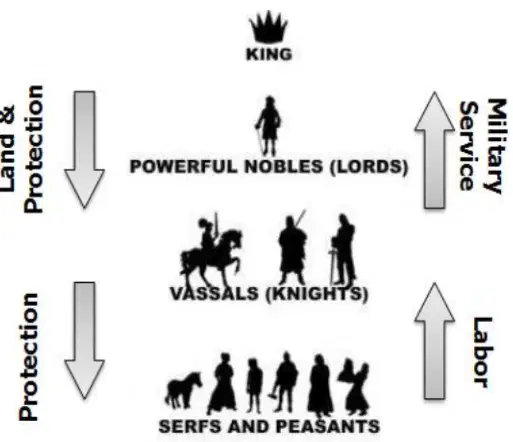
What did vassals most likely contribute to feudal society?
Fought in battles
Provided skilled labor on manors
Rented land to nobles
Gave land to serfs
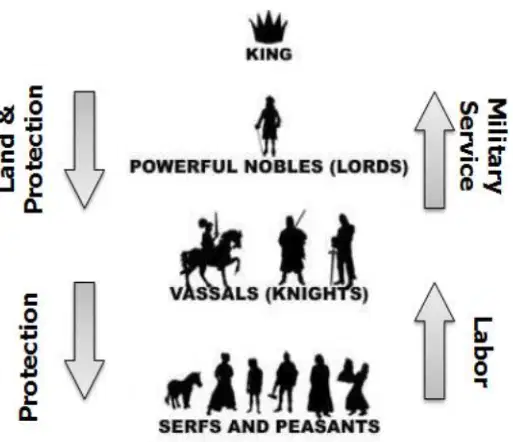
What did serfs and peasants get in return for their labor?
Military service
Labor
Money
Protection
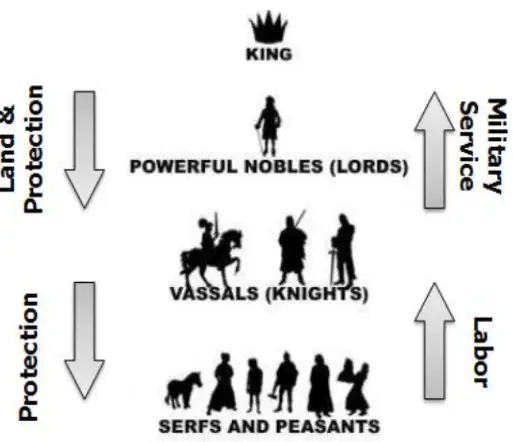
What did the lords offer to their vassals and knights in return for military service?
Land and protection
Labor
Clothing
Money
The major source of labor in the feudal system were the –
Knights
Vassals
Serfs
Nobles and lords
Which of the following best completes the graphic?
Serfs fought to end the rigid class structure
People ended agreements that tied them to feudal obligations
Landholding lords freed serfs from feudal obligations
People entered into agreements with landholding lords
Feudalism was defined by the relationship between a lord and a –
Peasant
Vassal
Serf
Fief
Which cause best explains the sequence of events shown?
Charlemagne was named Roman Emperor
Invasions by Germanic tribes
Franks emerged as a force in Western Europe
Missionaries carried Christianity to the people
Which group made up the largest part of the population and was the main labor force of medieval life?
Knights
Peasants
Lords
Vassals
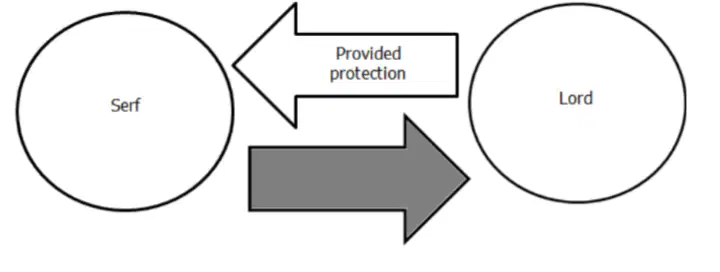
What piece of information best fits the shaded region?
Provided a fief
Provided fortified shelter
Provided labor
Provided military service
Where did the philosophy of Buddhism originate?
Egypt
Japan
China
India
As a result of trans-Saharan trade, the areas of West Africa converted to –
Islam
Buddhism
Judaism
Christianity
A negative effect of the use of trade routes was the spread of –
the Bubonic plague
new technology
knowledge
religion
Which area had an abundance of Amber?
Baltic region
India
West Africa
China
Which religion spread from mainland Asia to Japan?
Islam
Buddhism
Hinduism
Christianity
Where did Hinduism originate?
Mongolia
China
Japan
India
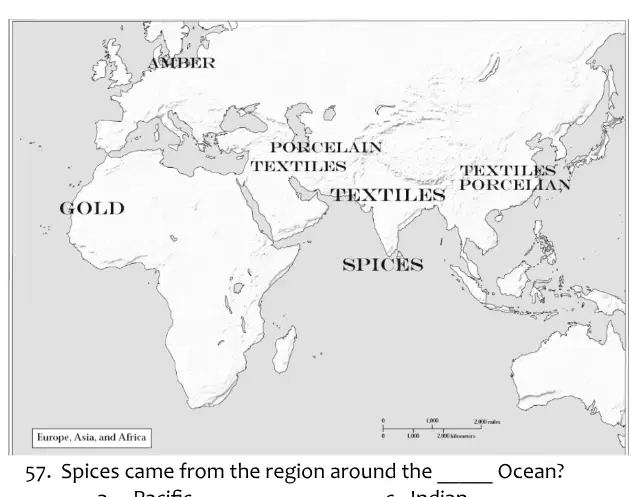
Use the map to answer this question. Spices came from the region around the ____ Ocean? The map labels SPICES over the sea between East Africa, Arabia, India, and Southeast Asia.
Pacific
Atlantic
Indian
Southern
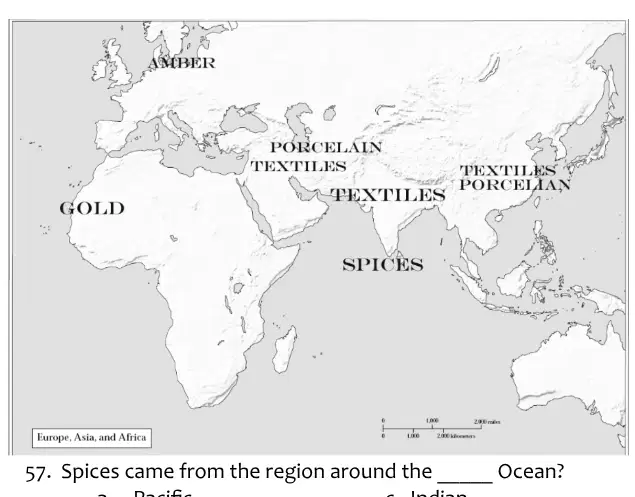
Use the map to answer this question. What area was NOT a source of textiles? The map labels TEXTILES over Persia, India, and East Asia.
Persia
China
The Baltic
India
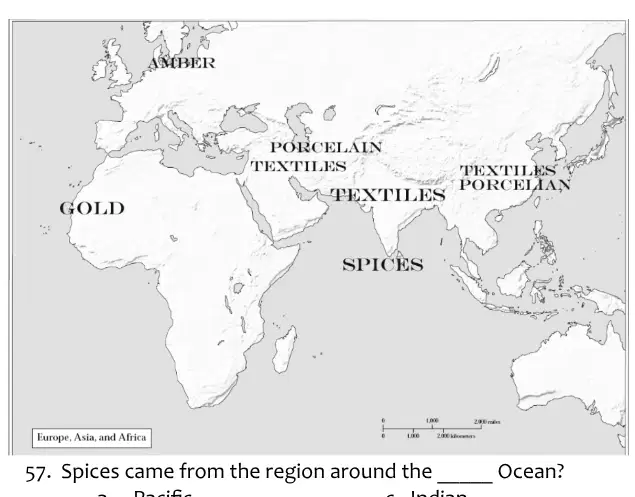
Use the map to answer this question. Amber came from the region of –
West Africa
The Baltic Sea
The Indian Ocean
China
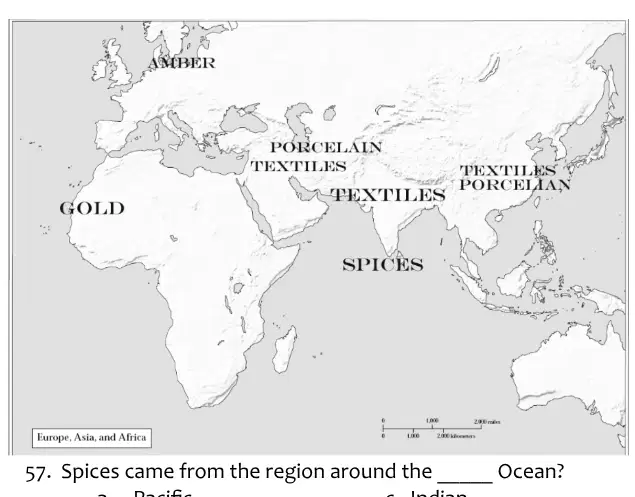
Use the map to answer this question. Which regions produced porcelain?
West Africa & the Baltic
China and Persia
China and Japan
Persia and India
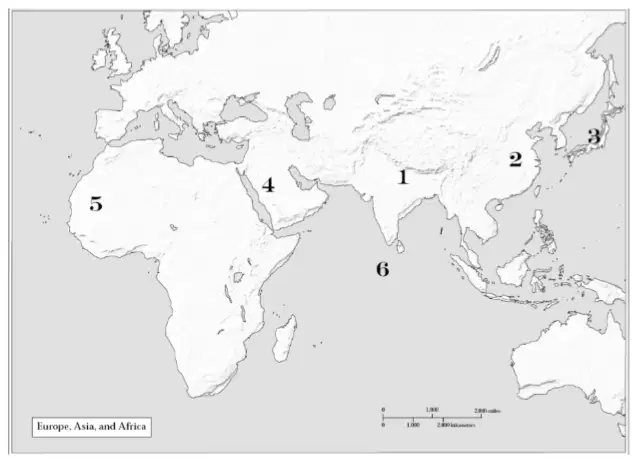
The technology of the lateen sail came from the area with the number: The numbered map shows 1–6 placed on world regions; number 4 marks the Arabian Peninsula/Red Sea area.
4
2
3
6
Which idea or technology did NOT come from China?
Printing
Shipbuilding
Paper money
Compass
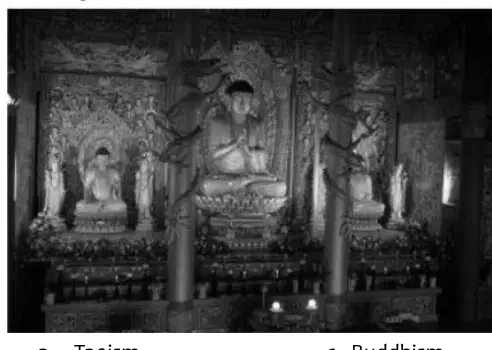
This image is often associated with –
Taoism
Hinduism
Buddhism
Shintoism
One of the economic effects of the Crusades was that it encouraged the use of –
Shipping
Coin manufacturing
Credit and banking
Paper money
The use of which of the following made banking practices easier?
Bartering
Lydian coins
Arabic numerals
Latin alphabet
The Crusades stimulated trade by introducing Europeans to many desirable –
Cultures
Products
Religious practices
Languages
As a result of the expansion of trade after the Crusades, all of the following items were trade EXCEPT –
Textiles
Silk
Spices
Silver
Which of these was NOT an economic impact of the Crusades on Europe?
Stimulated the production of goods in Europe to trade in Middle Eastern markets
The Church’s rule against usury made the influence of the Church stronger
New bookkeeping practices were introduced including the use of Arabic numbers
Letters of Credit expanded the money supply and made trade easier
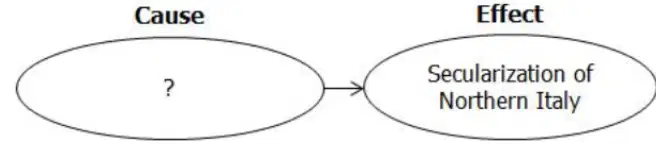
Which of the following best completes the graphic? Economic Foundations of the Italian Renaissance. Cause leads to Effect: Secularization of Northern Italy.
The banks’ practice of charging interest
The use of the barter system increased in Europe
The rise of the feudal system in Europe
The Church increased the use of the usury
How did the Crusades stimulate trade in Europe?
Expanded the Church’s use of the usury
Ended contact between Europeans and Middle Easterners
Introduced Europeans to products from the Middle East
Discouraged the use of credit to pay for goods
Which statement does NOT describe the changing economic system in Europe after the Crusades?
Barter system replaced money
New banking practices were created
Partnerships were developed
Businesses used credit certificates
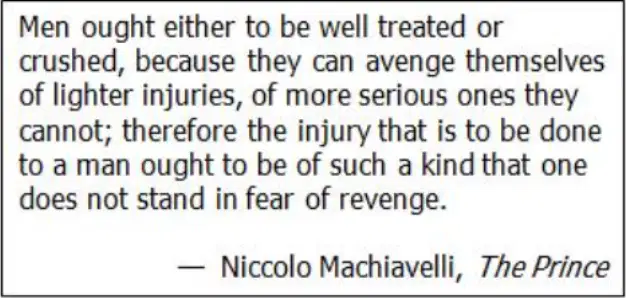
Which theory on governing would be best supported by this quote? “Men ought either to be well treated or crushed, because they can avenge themselves of lighter injuries, of more serious ones they cannot; therefore the injury that is to be done to a man ought to be of such a kind that one does not stand in fear of revenge.” — Niccolo Machiavelli, The Prince
People should have the power to choose their leaders
Rulers should never use force on their subjects
People will try to remove rulers with absolute power
Rulers should have absolute power over their subjects
The Renaissance began –
Italy
England
Spain
France
Which political philosopher maintained “the end justifies the means?”
Thomas More
Miguel Cervantes
Nicolo Machiavelli
Plato
Italian cities like Venice and Genoa became important after the Crusades due to their –
Banking centers
Religious toleration
Access to trade routes
Large population of workers

