
Font size
 Worksheets
Untitled Quiz
Total questions: 124
Worksheet time: 1hrs 2mins
Asocia cada definición con el tipo de conocimiento correcto: Se basa en un sistema de creencias no demostrables. Proporciona apoyo moral, ético o emocional a la conducta humana y propone un vínculo con lo sagrado.
Conocimiento religioso
Conocimiento científico
Conocimiento filosófico
Conocimiento empírico
Relaciona cada definición con el tipo de conocimiento correcto: Es el conjunto de hechos verificables respaldados por evidencia recopilada a través de teorías científicas, así como el estudio de cómo se adquiere y produce nuevo conocimiento mediante el método científico.
Conocimiento religioso
Conocimiento científico
Conocimiento filosófico
Conocimiento empírico
Asocia cada definición con el tipo de conocimiento correcto: Es el cuerpo acumulado de sabiduría existencial, reflexiva y contemplativa formado por la humanidad a lo largo de la historia, desde las civilizaciones antiguas hasta las contemporáneas.
Conocimiento religioso
Conocimiento científico
Conocimiento filosófico
Conocimiento empírico
Asocia cada definición con el tipo de conocimiento correcto: Se basa en la experiencia; en última instancia, es nuestra percepción del mundo la que nos dice qué existe y cuáles son sus características, ofreciendo una especie de verdad.
Conocimiento religioso
Conocimiento científico
Conocimiento filosófico
Conocimiento empírico
¿Qué representan los objetivos de una investigación?
Los objetivos, metas y propósitos de la investigación
Las variables y su operacionalización
El cronograma y el presupuesto del proyecto
Las conclusiones y recomendaciones
Seleccione la lista que presenta correctamente los pasos del método científico en orden.
Observaciones y preguntas → Hipótesis y experimentación → Conclusiones y documentación → Nuevas preguntas y experimentación continua
Hipótesis y experimentación → Observaciones y preguntas → Nuevas preguntas y experimentación continua → Conclusiones y documentación
Conclusiones y documentación → Observaciones y preguntas → Hipótesis y experimentación → Nuevas preguntas y experimentación continua
Nuevas preguntas y experimentación continua → Conclusiones y documentación → Hipótesis y experimentación → Observaciones y preguntas
Según la declaración de la hoja de trabajo, ¿el conocimiento científico tiene como objetivo entender cuál de los siguientes?
Los procesos, leyes y principios que rigen la naturaleza
Los deberes morales que guían el comportamiento humano
Las preguntas contemplativas de la existencia
Las opiniones personales de los investigadores
Asocia la definición con el concepto correcto: Puede ser por conveniencia, voluntario, accidental, basado en cuotas o intencional.
Muestreo no probabilístico
Muestra
Población
Diseño experimental
Asocia la definición con el concepto correcto: El conjunto de todas las entidades que poseen la característica que se investiga.
Muestreo no probabilístico
Muestra
Población
Marco de muestreo
Asocia la definición con el concepto correcto: Un subconjunto de la población que representa todas las entidades del estudio.
Muestreo no probabilístico
Muestra
Población
Unidad de análisis
Clasifica la siguiente cita: “El análisis de los niveles de microplásticos en los sedimentos de los ríos puede mostrar altos niveles de contaminación ambiental (Rodríguez, 2016).”
Cita indirecta con énfasis en el texto
Cita directa con énfasis en el autor
Paráfrasis sin cita
Referencia en nota al pie solamente
Relaciona los tipos de documentos académicos con sus características: Resumen el trabajo existente sobre un tema, incluyen muchas referencias útiles, son a menudo manuscritos extensos y generalmente no informan nuevos resultados.
Artículo de revisión
Artículo editorial
Comunicación corta
Nota técnica
Relaciona los tipos de documentos académicos con sus características: Presentan el punto de vista del autor o comentan sobre una publicación reciente (libro, tesis, artículo).
Artículo de revisión
Artículo editorial
Comunicación corta
Artículo de datos de investigación
Relaciona los tipos de documentos académicos con sus características: Presentan descubrimientos nuevos u originales, explican la metodología utilizada para obtener los resultados y contienen datos experimentales.
Comunicación corta
Artículo editorial
Artículo de revisión
Reseña de libro
En una estrategia para buscar información académica, ¿cuál es la acción correcta para el Paso 1?
Seleccionar las palabras clave
Configurar y filtrar las opciones de búsqueda (idioma, fecha, autores, etc.)
Revisar los resultados
Descargar y organizar los documentos seleccionados
En una estrategia para buscar información académica, ¿cuál es la acción correcta para el Paso 2?
Configurar y filtrar opciones de búsqueda (idioma, fecha, autores, etc.)
Seleccionar las palabras clave
Analizar los documentos descargados comparando objetivos, alcance, metodología y resultados
Seleccionar los resultados más relevantes
En una estrategia para buscar información académica, ¿cuál es la acción correcta para el Paso 3?
Revisar los resultados
Seleccionar las palabras clave
Descargar y organizar los documentos seleccionados
Seleccionar los resultados más relevantes
En una estrategia para buscar información académica, ¿cuál es la acción correcta para el Paso 4?
Seleccionar los resultados más relevantes
Revisar los resultados
Seleccionar las palabras clave
Analizar los documentos descargados comparando objetivos, alcance, metodología y resultados
En una estrategia para buscar información académica, ¿cuál es la acción correcta para el Paso 5?
Descargar y organizar los documentos seleccionados
Configurar y filtrar las opciones de búsqueda (idioma, fecha, autores, etc.)
Analizar los documentos descargados comparando objetivos, alcance, metodología y resultados
Revisar los resultados
En una estrategia para buscar información académica, ¿cuál es la acción correcta para el Paso 6?
Analizar los documentos descargados comparando objetivos, alcance, metodología y resultados
Seleccionar los resultados más relevantes
Revisar los resultados
Descargar y organizar los documentos seleccionados
¿Qué es Redalyc?
Una red de revistas científicas de América Latina y el Caribe, España y Portugal que difunde trabajos académicos en acceso abierto
Una base de datos de pago de patentes y normas de América del Norte
Un repositorio privado para cuadernos de laboratorio no publicados
Un índice de libros de texto solo para cursos de pregrado
¿Qué pasos son parte de una estrategia para buscar documentos académicos y científicos utilizando herramientas como Google Scholar? Selecciona todos los que apliquen.
Identificar las palabras clave del tema y realizar la búsqueda
Analizar la relevancia de los resultados de búsqueda
Descargar los documentos y organizar la información recopilada en carpetas
Ignorar la relevancia y guardar automáticamente cada resultado
Confiar exclusivamente en las recomendaciones de las redes sociales
¿Qué componentes forman el marco de referencia de una investigación? Seleccione todos los que apliquen.
Marco histórico
Marco teórico
Marco conceptual
Marco financiero
La afirmación “Organizar la información a través de un análisis crítico de los enfoques teóricos presentados en artículos o libros” corresponde a qué elemento?
Directrices del marco teórico
Objetivos de investigación
Declaración del problema
Diseño metodológico
Elija la opción que se EXCLUYE de ser una función de una hipótesis (es decir, NO es una función de una hipótesis).
Guiar la investigación
Proponer relaciones entre variables
Mostrar estudios que demuestran relaciones de causa y efecto
Orientar la recolección de datos
Dada la hipótesis “El nivel de productividad del personal de una organización está determinado por la formación académica recibida por cada persona”, ¿de qué tipo es esta hipótesis?
Causal
Descriptiva
Nula
Exploratoria
En un proyecto de investigación, el trabajo generalmente comienza con el problema, y se identifican dos variables principales. Estas se llaman:
Variable independiente y variable dependiente
Variable moderadora y variable de control
Variable latente y variable observada
Variable cualitativa y variable cuantitativa
Elija la alternativa que se EXCLUYE de los métodos teóricos (es decir, NO es un método teórico).
Juicio de expertos (criterio de expertos)
Análisis lógico
Método histórico-lógico
Modelado
Elija la alternativa que contiene las principales medidas estadísticas para el procesamiento de datos.
Medidas de tendencia central y medidas de dispersión
Medidas de forma y curtosis solamente
Pruebas no paramétricas solamente
Esquemas de codificación cualitativa
Según Jany (1998), la definición “la totalidad de elementos o individuos que tienen características similares y sobre los cuales se desea hacer inferencias” corresponde a qué concepto?
Población
Muestra
Marco de muestreo
Unidad de análisis
Elija la alternativa que se EXCLUYE de un presupuesto de gastos de investigación (es decir, que NO pertenece).
Variables
Costos de personal
Equipo y materiales
Viajes y logística
Elija la alternativa que se EXCLUYE de los pasos para seleccionar una muestra en la investigación cuantitativa (es decir, NO es un paso).
Revisar permanentemente las unidades de análisis
Definir la población objetivo
Elegir el método de muestreo
Determinar el tamaño de la muestra
Podemos decir que hemos adquirido conocimiento cuando hemos hecho qué?
Formado una representación mental del objeto
Memorizado una lista de palabras no relacionadas
Acuerdo unánime con un grupo
Recolectado datos sin interpretación
De la lista, ¿cuáles son variables ordinales? Selecciona todas las que apliquen.
Nivel de educación
Estrato socioeconómico
Peso corporal
Temperatura en grados Celsius
Tipo de sangre
Cuando reconocemos los sabores de los alimentos, ¿estamos utilizando qué tipo de conocimiento?
Conocimiento empírico
Conocimiento religioso
Conocimiento filosófico
Conocimiento científico
La investigación cuantitativa es un método de investigación que desarrolla y emplea ¿cuál de los siguientes para cuantificar las características de la comunidad que se investiga?
Modelos matemáticos
Análisis narrativos
Observación etnográfica exclusiva
Críticas retóricas
¿Qué famoso filósofo propuso tres grados de conocimiento: 1) conocimiento (lo que es real), 2) ignorancia (lo que es irreal) y 3) opinión (lo que está entre el ser y el no ser)?
Platón
Aristóteles
Descartes
Kant
Clasifica la siguiente cita: Según Nietzsche (1878) “la cultura griega del período clásico es una cultura de hombres...,” y la cita se da textualmente y se atribuye al autor.
Cita directa con énfasis en el autor
Cita indirecta con énfasis en el texto
Cita secundaria (citando una cita)
Cita en bloque sin atribución
Los artículos científicos, como editoriales, comentarios o perspectivas, se caracterizan por qué rasgo?
Expresar el punto de vista de un autor
Informar sobre nuevos resultados experimentales extensos
Proporcionar solo conjuntos de datos estadísticos sin interpretación
Servir como manuales de laboratorio instructivos
¿Cuál es el propósito de las herramientas de índice en el catálogo SCIELO?
Especificar las características de los resultados de búsqueda
Pagar cargos por procesamiento de artículos
Restringir el acceso a suscriptores de pago
Traducir todos los artículos automáticamente
La cita: “Zapata (2005) afirma que la investigación es una de las diversas formas que permiten acceder al conocimiento de un hecho...” Esta cita es del siguiente tipo:
Cita indirecta con énfasis en el autor
Cita directa con énfasis en el autor
Cita indirecta con énfasis en el texto
Cita directa con énfasis en el texto
La cita: “Varios economistas han afirmado que ‘la crisis ha sido motivada por lo que es más perverso en el mundo capitalista’ (Lynch, 2012, p. 127).” Esta cita es del siguiente tipo:
Cita indirecta con énfasis en el autor
Cita directa con énfasis en el texto
Cita indirecta con énfasis en el texto
Cita directa con énfasis en el autor
La siguiente afirmación corresponde a qué sección de un informe de investigación: “Debes indicar la raíz del problema que se está estudiando. Se debe proporcionar un contexto del problema en relación con la teoría, la investigación y/o la práctica, y su importancia.”
Antecedentes de la investigación
Declaración del problema
Justificación
Objetivos
Cuando se utiliza la herramienta de análisis llamada “diagrama de Ishikawa” o “espina de pescado”, que se desarrolla en base a un problema central, ¿qué pretende determinar?
Las causas del problema
Las soluciones inmediatas al problema
Los efectos producidos por el problema
Los síntomas reportados por los participantes
Elija la afirmación atribuida a Acroff (1967) relacionada con la formulación de problemas que se considera correcta:
Un problema correctamente enunciado está parcialmente resuelto
Un problema correctamente enunciado está completamente resuelto
Un problema correctamente enunciado es imposible de resolver
Un problema correctamente enunciado no requiere evidencia
Entre los siguientes, tres son funciones de variables independientes y una corresponde a variables dependientes. Seleccione la alternativa que corresponde a variables dependientes:
También llamado efecto o acción condicionada
También llamado estímulo o factor de condicionamiento
Utilizado para manipular tratamientos en un experimento
Elegido por el investigador para actuar como causa
El autor de la siguiente definición—“Una hipótesis es una suposición sobre algunos elementos empíricos y otros conceptuales, y sus relaciones mutuas, que surge más allá de los hechos y experiencias conocidas, con el propósito de lograr una mayor comprensión de ellos”—pertenece a:
Arias Galicia (1991)
Karl Popper (1959)
Kerlinger (1973)
Hernández Sampieri (2014)
Elige la alternativa que NO es una forma de pregunta:
Abierta
Cerrada
Dicotómica
Semi-cerrada
Entre las siguientes alternativas, tres corresponden a técnicas de investigación y una corresponde a un instrumento de investigación. Elija la opción que indica el instrumento:
Entrevista
Observación
Grupo focal
Cuestionario
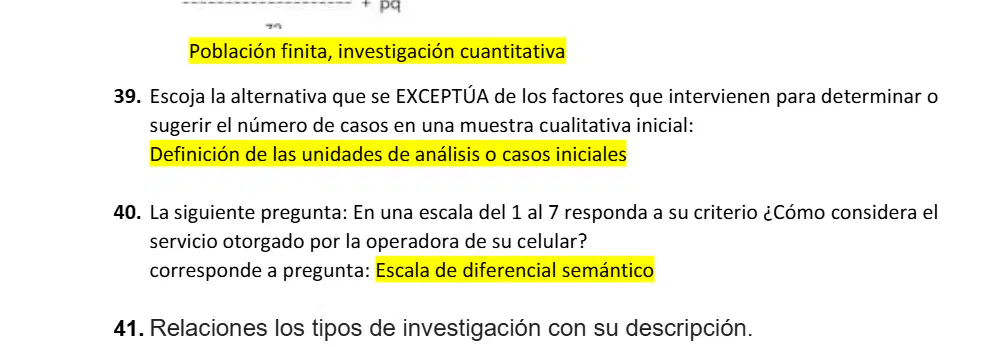
Elija la alternativa que indica el caso en el que se aplica la siguiente fórmula de tamaño de muestra: n=(N−1)E2+pqNpq .
Población finita en investigación cuantitativa
Población infinita en investigación cuantitativa
Muestreo cualitativo con saturación teórica
Censo de toda la población
Choose the alternative that is EXCEPT among the factors that influence or suggest the number of cases in an initial qualitative sample:
Definition of the units of analysis or initial cases
Available time and resources
Heterogeneity of the study context
Theoretical saturation criterion
The following question corresponds to which type of scale? “On a scale from 1 to 7, rate according to your judgment: How do you consider the service provided by your mobile operator?”
Likert scale
Semantic differential scale
Guttman scale
Thurstone scale
Which type of research corresponds to the description: “Construction of theory from people’s own interpretations”?
Grounded theory designs
Ethnographic designs
Biographical or narrative designs
Phenomenological designs
Which type of research corresponds to the description: “Complex studies of a human group focused on material and immaterial culture”?
Ethnographic designs
Grounded theory designs
Experimental designs
Case study designs
Which type of research corresponds to the description: “The subjective testimony of an informant is intended to be shown”?
Biographical or narrative designs
Grounded theory designs
Correlational designs
Survey designs
In scientific research, the orderly and systematic way of proceeding to reach a given result or end is known as:
Method
Technique
Instrument
Theory
In quantitative designs, according to the strategy applied in the study, which types of research can be carried out?
Experimental and non-experimental
Exploratory only
Qualitative and quantitative
Descriptive and correlational
According to Muñoz and Riverola, knowledge is the capacity that the human being has to do what?
Solve a determined set of problems
Accumulate data without interpretation
Memorize isolated facts
Describe phenomena without acting on them
For what purpose is a preliminary bibliographic search carried out during the design of an investigation?
To have a clear idea of the problem, the variables, and the methodology used by other authors
To avoid defining the research problem
To replace fieldwork with secondary sources
To ensure the study has no literature review
Google Scholar is best described as:
An academic search engine that locates documents such as articles, theses, books, and summaries from publishers, repositories, preprints, universities, and other academic organizations
A general-purpose web browser for entertainment sites
A desktop word processor for writing theses
A reference manager for formatting citations only
Mendeley is:
A free application that is at the same time a reference manager, a PDF reader, a system to store and organize documents of scientific information, and an academic social network to share bibliographies and publications
A statistical package for data analysis
A general web browser
A video conferencing platform
In each Google Scholar search result, a star icon appears. What is it used for?
To save the result in the user’s library
To translate the page automatically
To share the result on social networks
To report an indexing error to the publisher
Which type of citation corresponds to the definition: “The cited text is expressed in our own words”?
Indirect citation (paraphrase)
Direct citation (verbatim)
Block quotation
Footnote-only reference
Which type of citation corresponds to the definition: “The cited text is identical to the original”?
Direct citation (verbatim)
Indirect citation (paraphrase)
Summary without reference
Secondary citation
Which group of connectors is primarily used to introduce information?
To begin, In the first place, To start
That is, In other words, That is to say
For example, In particular, In the case of
However, Nevertheless, On the other hand
Which group of connectors is primarily used to explain or clarify information?
That is, In other words, This is
To begin, In the first place, To start
For example, In particular, In the case of
Despite, Although, Even though
Which group of connectors is primarily used to exemplify information?
For example, In particular, In the case of
That is, In other words, This is
To begin, In the first place, To start
Nevertheless, Conversely, On the contrary
The elaboration of the theoretical framework is recommended to be carried out based on structuring an index, summary, or outline that must always be linked to:
Research variables
Bibliography only
Conclusions of the study
Sampling design
The following definition of Theoretical Framework — “The lens through which the researcher will see and approach the phenomenon or situation to be studied” — corresponds to which author?
Merriam (1998)
Creswell (2014)
Yin (2009)
Stake (1995)
The hypothesis “As the cost of money (interest rate) increases, the amount of business investment decreases” is best classified as:
Correlational
Descriptive
Causal
Null
The hypothesis “The main causes of the current unemployment rate in the city are not determined by the government’s economic measures” is best classified as:
Null
Alternative
Causal
Descriptive
One of the following options is EXCEPTED from being considered a criterion for formulating the research problem. Identify it:
It must state clearly the what, how, and what-for of the research.
It must be feasible in scope and resources.
It must be relevant and significant to the field.
It must align with the study objectives and questions.
The following options show classifications of the Observation technique. One alternative is incorrectly stated. Indicate which one:
Human observation and robotic observation
Direct observation and indirect observation
Participant observation and non‑participant observation
Structured observation and unstructured observation
One of the following alternatives is EXCEPTED from being part of the initial contact in an interview. Identify it:
Present the research problem and hypotheses.
Greet and establish rapport with the interviewee.
Explain the purpose of the interview and confidentiality.
Confirm consent and schedule details.
How many steps are there to select a qualitative research sample?
2
3
4
5
The statement “The number of cases that allow us to answer the research questions, which will later be called category saturation,” corresponds to which criterion for sample size in qualitative research?
Understanding of the phenomenon
Availability of participants
Statistical power requirements
Convenience of access
Choose the alternative that is EXCEPTED from being a graphical representation used in data processing:
Chi‑square
Histogram
Bar chart
Pie chart
Order the elements of the research process by selecting the correct sequence: Problem; Theoretical Framework; Methodology; Analysis; Discussion and Conclusion.
Problem → Theoretical Framework → Methodology → Analysis → Discussion and Conclusion
Theoretical Framework → Problem → Methodology → Analysis → Discussion and Conclusion
Problem → Methodology → Theoretical Framework → Analysis → Discussion and Conclusion
Problem → Theoretical Framework → Analysis → Methodology → Discussion and Conclusion
Complete the sentence with the most accurate option: Research is ______ from the ______ and makes it possible to overcome ______ about the processes and ______ that surround our lives.
developed; scientific method; common knowledge; phenomena
designed; experimental method; opinions; facts
conducted; statistical method; beliefs; events
implemented; technical method; anecdotes; situations
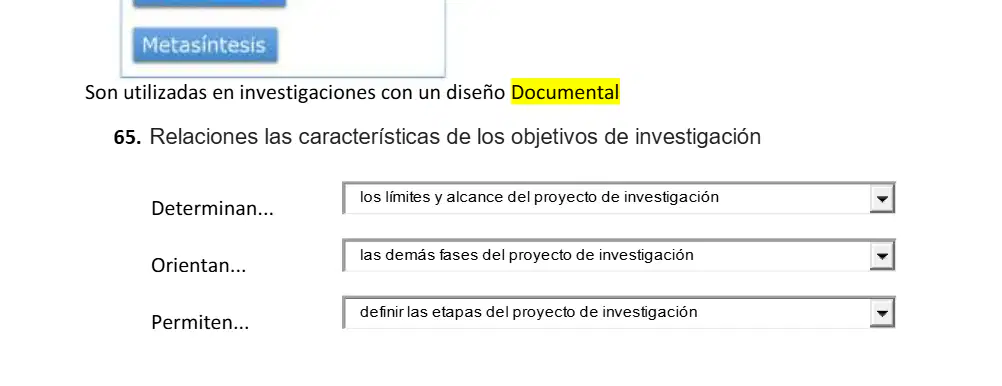
The techniques shown in the figure (Narrative reviews, Evidence review, Meta‑analysis, Meta‑synthesis) are used in research with which design?
Documentary
Experimental
Field
Ethnographic
According to their characteristics, research objectives determine:
the limits and scope of the research project
the schedule of interviews only
the choice of statistical software
the funding source
According to their characteristics, research objectives guide:
the remaining phases of the research project
only the literature review chapter
only the sampling procedure
only the dissemination plan
According to their characteristics, research objectives allow:
defining the stages of the research project
discarding the theoretical framework
avoiding ethical approval
replacing research questions
Match the term to the definition: Notification service about the publication of academic and scientific documents by an author or topic area in Google Scholar is called:
Google Scholar Alerts
Google Scholar Library
Google Scholar Profile
Google Scholar Metrics
Match the term to the definition: The service for registering, storing, and organizing academic and scientific documents in Google Scholar is called:
Google Scholar Library
Google Scholar Alerts
Google Scholar Profile
Google Scholar Metrics
Match the term to the definition: The personal space for researchers in Google Scholar, where their publications and the citations they receive are listed, is called:
Google Scholar Profile
Google Scholar Alerts
Google Scholar Library
Google Scholar Search
Complete the statement: Scientific or academic databases contain ______ that is relevant, up‑to‑date, accurate, verified, and of high quality.
information
summaries
advertising
metadata only
Which group consists of connectors used to add ideas?
besides, moreover, above all, anyway, in any case
however, on the contrary, nevertheless, instead
therefore, thus, as a result, consequently
first, next, finally, subsequently
Which group consists of connectors used to contrast ideas?
however, on the contrary, nevertheless, instead
besides, moreover, above all, anyway, in any case
therefore, thus, as a result, consequently
that is, namely, in other words, specifically
Which group consists of connectors used to present results or consequences?
therefore, thus, as a result, consequently
however, on the contrary, nevertheless, instead
besides, moreover, above all, anyway, in any case
for example, for instance, such as, including
What does following a profile in Google Scholar mean?
It allows you to receive alerts about new publications and the citations those works receive.
It automatically grants co‑authorship on new papers by that author.
It enables editing other researchers’ profiles.
It gives access to paywalled journals for free.
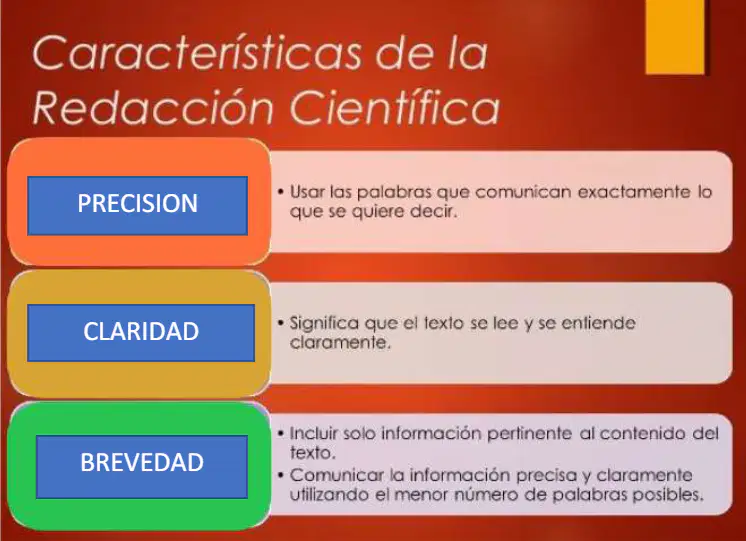
According to the figure “Characteristics of Scientific Writing,” which characteristic corresponds to the description: Use words that communicate exactly what you want to say.
Precision
Clarity
Brevity
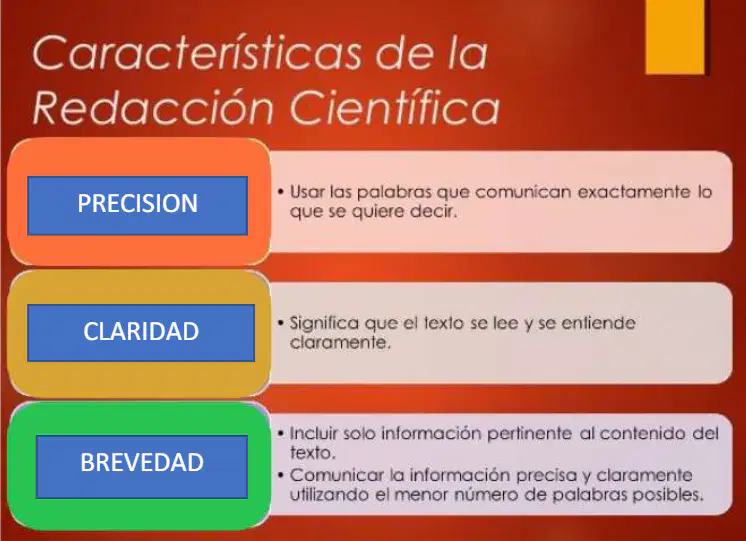
According to the figure “Characteristics of Scientific Writing,” which characteristic corresponds to the description: The text is read and understood clearly.
Precision
Clarity
Brevity
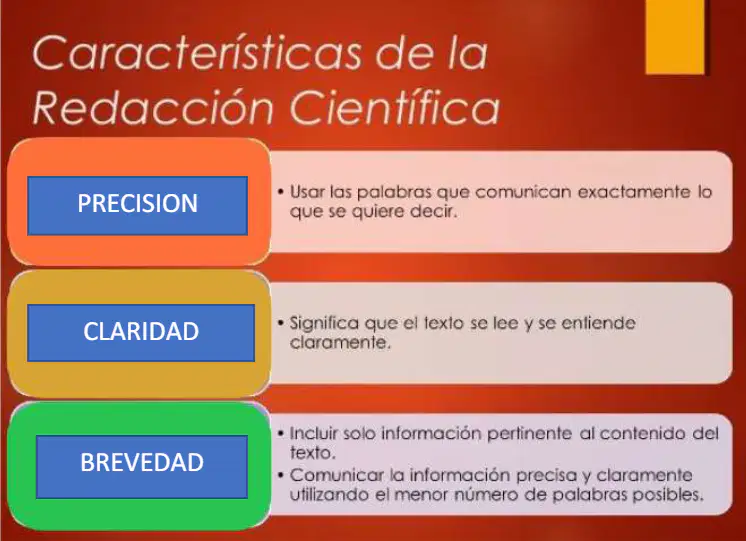
According to the figure “Characteristics of Scientific Writing,” which characteristic corresponds to the description: Include only pertinent information and communicate with the fewest possible words.
Precision
Clarity
Brevity
The following indicator definition states: “It explains how the concept is defined specifically in the proposed study, which may differ from its etymological definition.” This corresponds to which type of definition?
Operational definition
Conceptual definition
Etymological definition
Theoretical definition
Given the hypothesis “An organization’s level of productivity is determined by the degree of academic training that each person has,” identify the dependent variable.
Level of productivity
Degree of academic training
Size of the organization
Age of the person
Choose the option that correctly lists the elements of a problem statement in research.
Definition and delimitation of the problem; research questions; objectives; justification
Literature review; sampling; data analysis; conclusions
Title; abstract; keywords; references
Population; instrument; procedure; annexes
Complete the statement: The variable that comes between the independent variable and the dependent variable is the ______.
Intervening variable
Independent variable
Moderating variable
Control variable
For correct writing of the theoretical framework, it should be prepared according to what is established by which of the following?
Writing norms
Sampling plans
Ethical clearance forms
Financial statements
Variance and standard deviation are statistical measures of what?
Dispersion
Central tendency
Association
Trend over time
Choose the alternative that is NOT an empirical method.
Historical–logical
Observation
Experiment
Survey
The following response scale — Strongly agree; Agree; Neither agree nor disagree; Disagree; Strongly disagree — corresponds to which type of questions?
Likert scale
Semantic differential
Ranking scale
Guttman scale
The statement “Define the variables or the criteria for ordering the data obtained in fieldwork” corresponds to a step for which part of the research process?
Data processing
Problem formulation
Sampling design
Reporting of results
The statement “The procedure is not mechanical; it depends on the investigator’s decision-making process” corresponds to which type of sampling?
Nonprobabilistic samples
Probabilistic samples
Systematic samples
Cluster samples
Which set of skills should a researcher apply in qualitative research projects?
Observing, listening, comparing, and writing
Calculating, coding, randomizing, and graphing
Measuring, calibrating, weighing, and timing
Budgeting, purchasing, contracting, and auditing
According to phenomenological research designs, what is the primary object of study?
Human groups and social institutions
Individual cognitive processes only
Physical and chemical laws
Historical documents exclusively
What does it mean that scientific knowledge must be critical?
The researcher must constantly evaluate the design, process, and results of the investigation
The researcher must reject prior theories outright
The researcher should avoid revising methods once a study begins
The researcher must focus only on positive findings
The type of knowledge that starts from reflection, observation, and dialogue about reality and context—our experiences and natural, cultural, and political phenomena—corresponds to which category?
Philosophical knowledge
Technical knowledge
Mythical knowledge
Empirical knowledge only
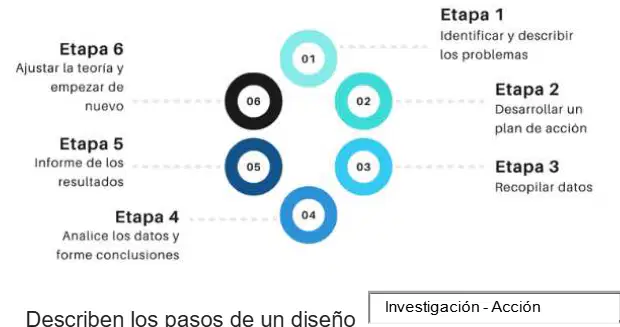
The stages shown (1. Identify and describe problems; 2. Design an action plan; 3. Gather data; 4. Analyze data and form conclusions; 5. Report results; 6. Adjust the theory and begin again) describe the steps of which research design?
Action research
Experimental design
Case study
Cross-sectional survey
A thesaurus is a list of words or terms used to represent concepts. In sum, thesauri are used as a means of restricting keywords by focusing on a controlled vocabulary that allows the knowledge on a given topic to be properly organized. According to this description, a thesaurus is primarily a list of what?
Concept maps
Words or terms
Authors' names
Index numbers
Latindex is a network of institutions that operate in a coordinated manner to gather and disseminate information on scientific journals produced in the region, integrating those that disseminate Ibero-American studies in the world. Their registration and consultation are free. According to this description, how many institutions make up Latindex?
12
18
24
30
The so-called Latindex catalog 2.0 was launched in the year:
2015
2016
2017
2018
Scientific databases are collections of publications of scientific-technical content such as journal articles, books, theses, conferences, etc. What is their main objective according to the statement?
Limit access to specialized information in a field
Gather all possible bibliographic production on an area of knowledge
Prioritize only peer-reviewed journals
Replace traditional libraries with digital repositories
A thesaurus (from Latin thesaurus ‘treasure’) is an ordered, controlled, and structured list of words or terms used for the search of documents, their classification, and thematic analysis. According to this, what is a primary use of a thesaurus?
Generating research hypotheses
Searching for and classifying documents
Calculating statistical averages
Designing experimental protocols
From the following options, one is an exception and is not considered a generator of ideas. Which one is the exception?
Literature review
Personal experience
Brainstorming
The research problem
Choose the option that correctly completes the definition: Operationalization of variables is the process of taking a variable from the Abstract level to a ______ level.
Symbolic
Conjectural
Concrete
Hypothetical
Choose the alternative that correctly completes the following statement: A variable is something that varies, and this variation is subject to being ______.
explained
measured
controlled
ignored
Why should variables be defined?
Because operationalizing a variable makes it measurable
Because definitions replace data collection
Because variables cannot change once defined
Because definitions eliminate the need for analysis
In a research project or study, the independent variable constitutes the ______ of the problem.
effect
control
cause
outcome
The recommended steps for data processing total how many?
3
4
5
6
The following statement corresponds to which concept? “It refers to the list, the map, or the source from which all the sampling units or units of analysis in the population can be extracted and from which the study subjects will be taken.”
Sampling error
Sampling frame
Sample size
Population parameter
The following statement corresponds to which section of a research report? “A synthesis of the state of knowledge on the topic is presented, answering the questions, objectives, or hypotheses.”
Introduction
Methodology
Conclusions
Limitations
With respect to the bibliography, choose the correct statement.
The reference list may include works not cited in the text
All items in the bibliography must be cited in the text and vice versa
Only sources consulted but not cited should be listed
Only primary sources should appear in the bibliography
Choose the alternative that contains three statistical measures of central tendency.
Range, variance, standard deviation
Mean, median, mode
Quartiles, deciles, percentiles
Skewness, kurtosis, covariance

