
Font size
 Worksheets
Chapter 5 Learning Objectives
Total questions: 67
Worksheet time: 34mins
Which scenario best illustrates an ethical issue commonly raised by information systems?
Automating backups to reduce data loss
Compressing files to save storage space
Tracking employee keystrokes without consent
Upgrading servers for better performance
Which principles are most appropriate to guide ethical decision-making in information systems?
Maximizing data collection for analytics
Respect for privacy and informed consent
Unrestricted sharing of proprietary code
Transparency and accountability of processes
Which challenge to individual privacy is amplified by contemporary IS and the Internet?
Local-only storage of paper records
Anonymized aggregate statistics reporting
Wide-scale data profiling across platforms
Manual entry errors in spreadsheets
In the context of information systems, what does accountability and liability primarily concern?
Ensuring high uptime of servers
Assigning responsibility for harm caused
Reducing costs of cloud services
Increasing speed of database queries
Which statement best defines ethics in the context of individual decision-making?
Legal statutes governments enact to regulate behavior
Rules of compliance organizations impose on employees
Cultural norms communities use to enforce traditions
Principles of right and wrong guiding free moral agents
Information systems can trigger intense social change. What is a likely impact of such change?
Reducing opportunities for innovation across industries
Stabilizing existing distributions of power and rights
Threatening existing distributions of power and obligations
Eliminating the need for ethical reasoning in workplaces
Which scenario illustrates an ethical dilemma introduced by information systems?
Comparing prices of cloud storage subscriptions
Selecting an ergonomic keyboard for office comfort
Deciding whether to collect user data beyond consent
Choosing the fastest internet provider for home use
Which options represent new opportunities for crime arising from information systems? Select all that apply.
Identity theft using breached databases
Public posting of open-source tools
Phishing campaigns targeting employees
Routine software patch management
Unauthorized access to cloud resources
What distinguishes new kinds of crimes enabled by information systems from traditional crimes?
They depend on digital technologies and networks
They are prosecuted under civil law exclusively
They always occur in physical locations only
They require no intent or malicious motivation
An IT manager introduces a system that shifts control of customer data from users to the firm. Which ethical principle is most directly challenged?
Promotion of industry-standard encryption suites
Respect for individual autonomy and informed choice
Adherence to legacy data retention schedules
Maximization of organizational efficiency metrics
Which set best captures why information systems raise new ethical questions?
Faster processors and larger storage capacity
Opportunities for social change and new crimes
Higher hardware costs and licensing fees
Improved user interfaces and accessibility features
Which option best describes the moral dimension focused on rules for collecting, using, and sharing personal data?
Quality of life
Accountability and control
Information rights and obligations
Property rights and obligations
Which moral dimension deals primarily with intellectual property, licensing, and ownership of digital assets?
System quality
Information rights and obligations
Property rights and obligations
Accountability and control
A fintech app incorrectly charges fees and no one can trace who is responsible. Which moral dimension is most violated?
Property rights and obligations
Accountability and control
System quality
Quality of life
An online service ships with frequent crashes and security bugs that harm users. Which moral dimension is directly implicated?
Accountability and control
Quality of life
System quality
Information rights and obligations
A social network’s addictive design reduces sleep and increases anxiety for teens. Which moral dimension is highlighted?
Property rights and obligations
Accountability and control
System quality
Quality of life
Which trends intensify privacy risks by enabling cheaper retention of massive datasets? Select all that apply.
Computing power impact
Mobile device growth
Data analysis advances
Data storage cost decline
Networking advances
Which statement best captures the impact of computing power doubling every 18 months on ethical issues?
It slows the spread of mobile devices worldwide
It eliminates the need for accountability controls
It enables more complex surveillance algorithms
It reduces data collection incentives overall
Which combination of trends most expands real-time tracking and profiling at scale?
System quality improvements
Property rights expansion
Computing power increases
Networking advances
Mobile device growth
Which best describes profiling in advanced data analysis?
Aggregating multi-source data into individual dossiers
Encrypting sensitive records to prevent unauthorized access
Automating data entry workflows across enterprise systems
Detecting anomalies in real-time streaming telemetry
What is the primary goal of Nonobvious Relationship Awareness (NORA)?
Classify images using deep neural networks
Summarize public reports for executive dashboards
Reveal obscure hidden connections among entities
Measure system performance under variable loads
Which statements are accurate about combining data from multiple sources in advanced analysis? Select all that apply.
Primarily reduces storage costs across data centers
Ensures datasets are anonymized by default
Finds hidden links that aid identifying criminals
Creates detailed dossiers on individuals
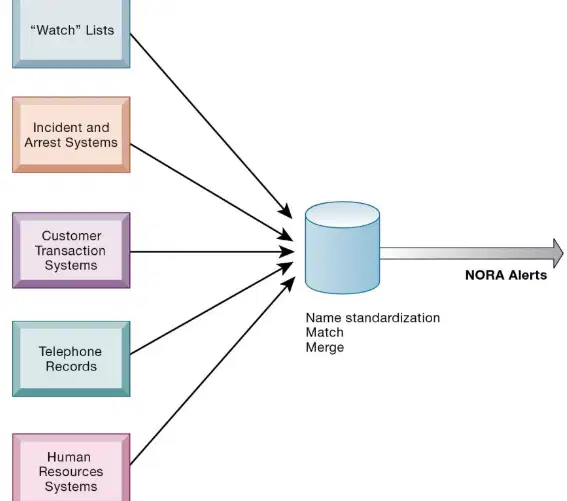
In the diagram, which step occurs immediately before NORA generates alerts?
Name standardization, match, merge
Data encryption and archival
Policy approval by compliance team
Risk scoring and visualization
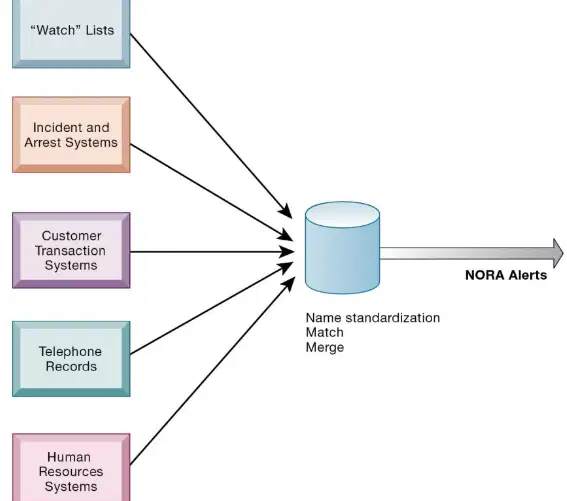
Which data sources are shown feeding into the NORA system in the diagram? Select all that apply.
Human resources systems
Social media profiles
Customer transaction systems
Incident and arrest systems
Watch lists
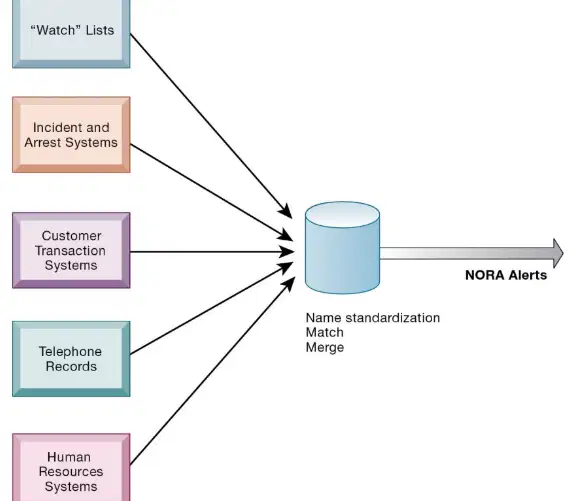
What is the primary purpose of combining data from telephone records and HR systems in NORA?
To anonymize employee identities across systems
To enforce password complexity policies
To replace legacy payroll applications
To reveal nonobvious relationships for alerts
Which statement best defines responsibility in IT decision-making?
Appealing decisions to higher authorities
Recovering damages through legal claims
Tracking actions with audit mechanisms
Accepting potential costs, duties, and obligations
In an information system, accountability primarily refers to:
Publicly posting organizational policies
Acceptance of duties and obligations
Legal rights to claim compensation
Mechanisms for identifying responsible parties
Which option correctly matches the concept of liability in IT governance?
Ensures decisions can be appealed
Permits individuals to recover damages
Accepts duties and obligations
Identifies responsible parties
Choose all statements that describe due process in the context of IT and law.
There is an ability to appeal to higher authorities
Laws are well-known and understood
Mechanisms exist for identifying responsible parties
Individuals can recover damages for harm
Which action best represents the first step in an ethical analysis for an IT scenario?
Evaluate potential legal penalties first
Survey public opinion on the issue
Select the most convenient option available
Identify and clearly describe the facts
In an ethical analysis, what is the primary purpose of defining the conflict or dilemma?
To list all technical constraints
To choose stakeholders to prioritize
To identify higher-order values involved
To draft a communication plan
Which combination lists steps that occur before deciding on an action in the five-step ethical analysis process?
Draft implementation timelines
Identify potential consequences
Identify stakeholders affected
Define the conflict or dilemma
A security engineer faces a dilemma about disclosing a vulnerability. Which stakeholders should be identified during analysis?
Competitors with unrelated products
Regulators overseeing compliance
The engineer's pet and family
End users relying on the system
Professional codes of conduct from ACM and IEEE primarily serve which role within the IT profession?
Technical standards for hardware connectors
Promises to self-regulate for society's interest
Marketing strategies to attract new members
Legal statutes enforced by government courts
Which statement best distinguishes ACM and IEEE codes from personal moral preferences?
They are crowd-sourced social media polls
They are criminal laws with punishments
They are private beliefs kept confidential
They are promulgated by professional associations
Which scenario best illustrates conflicting interests in employee monitoring within an IT workplace?
Company tracks keystrokes to boost output
Workers use breaks for lengthy gaming sessions
Employees block ads with personal browser plugins
Team adopts agile to improve sprint velocity
In social media platforms, which practices raise privacy and data monetization concerns? Select all that apply.
Selling aggregated user data to partners
Restricting third-party app access via audits
Encrypting messages end-to-end by default
Profiling behavior to target advertisements
A company argues it must monitor internet usage to maximize productivity, while employees want limited oversight for short personal tasks. What is the core ethical tension?
Data accuracy versus system availability
Market competition versus open-source collaboration
Legal compliance versus technical feasibility
Organizational efficiency versus individual autonomy
Which statement best defines privacy in the context of information rights?
Right to be left alone and control information
Right to unrestricted access to all public data
Right to anonymity for all online activities
Right to government-provided cybersecurity services
Which U.S. Constitutional amendment primarily protects against unreasonable searches and seizures, supporting privacy?
Fifth Amendment due process protections
Fourth Amendment protections against unreasonable searches
First Amendment protections of speech and association
Tenth Amendment reserving powers to the states
Which combination correctly lists federal measures that protect privacy in the United States?
Privacy Act of 1974
Fourth Amendment constraints
First Amendment freedoms
Sherman Antitrust Act
Fair Information Practices (FIP) are best described as what?
Set of principles for collecting and using information
Federal agency enforcing consumer protection laws
Statute exclusively governing children’s online privacy
Technical standard for encrypting personal data
Which laws are commonly associated with implementing FIP in the United States?
Gramm–Leach–Bliley Act (GLBA)
Children’s Online Privacy Protection Act (COPPA)
Digital Millennium Copyright Act (DMCA)
Health Insurance Portability and Accountability Act (HIPAA)
Which statement about FIP’s influence is accurate?
Focuses solely on data security and breach notification
Applies only to paper records in government agencies
Forms the basis for most U.S. and European privacy laws
Eliminates the need for sector-specific privacy statutes
Which are core FTC FIP principles focused on consumer control and transparency?
Choice and consent
Data monetization
Notice and awareness
Access and participation
Which principle emphasizes allowing individuals to review and correct their personal information held by an organization?
Notice/awareness describing collection practices
Security safeguarding data against unauthorized access
Choice/consent selecting data sharing preferences
Access/participation correcting personal information
Which element of the FTC FIP framework is most directly concerned with technical and administrative safeguards for personal data?
Notice/awareness explaining data practices
Choice/consent enabling opt-in or opt-out
Security protecting data from unauthorized access
Enforcement through accountability mechanisms
An online service posts a clear privacy notice, allows opt-in for sharing, lets users edit profiles, encrypts data, and undergoes audits. Which FTC FIP elements does this scenario illustrate?
Data exclusivity and ownership
Enforcement through audits
Access/participation and security
Notice/awareness and choice/consent
Which statement best describes GDPR consent for processing personal data?
Unambiguous explicit informed consent by the individual
Implied consent through continued website use
Consent granted permanently unless revoked by the regulator
Automatic consent for EU residents using online services
A company in an EU member state wants to transfer customer data to a foreign partner. Under GDPR, when is this permitted?
When customers have accounts in both jurisdictions
Only if the partner offers similar privacy protection
Whenever the partner is a multinational corporation
If the data are anonymized for marketing analytics
Which entities must comply with GDPR requirements?
Only EU-headquartered firms processing EU data
Any firm operating in the EU or processing EU residents' data
Only data processors that store data within EU borders
Government agencies within EU member states only
Select all measures strengthened or mandated by GDPR.
Privacy Shield conformity for processing EU data
Right to be forgotten
Mandatory data transfers to non-EU partners
Maximum fines set at 4% of global daily revenue
What is a potential penalty under GDPR for serious violations?
Mandatory public apology to affected users
A fixed fine of €10,000 per incident
Revocation of EU operating licenses only
Fines up to 4% of global annual revenue
Which statement best describes cookies in web browsing?
Small files identifying a browser for site visits
Standalone programs that replace operating systems
Encrypted emails protecting messages from interception
Large images improving website loading speed
What is the primary purpose of web beacons (web bugs)?
Track who reads emails or visits pages
Store user passwords on the device
Block pop-up advertisements automatically
Provide end-to-end message encryption
Which behavior is most characteristic of spyware?
Only improves graphics performance
Secretly installs and transmits keystrokes
Requires explicit consent before installation
Deletes all tracking cookies automatically
Which practice exemplifies behavioral targeting by online services?
Personalized ads based on browsing history
Randomized ads regardless of past activity
Blocking all ads at the network perimeter
Ads chosen solely by page color scheme
In an opt-out model, what must a user do to stop data collection for marketing?
Actively decline participation
Enable anonymous browsing mode
Install a hardware firewall
Explicitly grant permission
Which statements are accurate about online privacy approaches in the United States?
Privacy statements can be complex or ambiguous
Opt-in models are more commonly selected than opt-out
Industry often favors self-regulation over legislation
Businesses may use transaction data for marketing
What is a common criticism of online privacy statements and seals?
They primarily describe encryption algorithms
They guarantee strict government enforcement
They are complex and ambiguous for users
They eliminate all tracking technologies
According to the diagram, what is the server’s first action when a user visits a site?
Sends targeted ads immediately
Creates a user account automatically
Reads browser and system details
Downloads files to the user’s device

Which sequence correctly describes the cookie lifecycle shown: creation, storage, retrieval, and use?
Server requests cookie, browser creates, server stores, browser identifies
Browser creates cookie, server stores, browser requests, server identifies
Browser stores cookie, server sends ads, browser retrieves, server deletes
Server sends cookie, browser stores, server requests, server identifies
When a returning visitor arrives, what does the server request to recognize the user?
Contents of previously deposited cookies
Encrypted session logs from browser
User’s email inbox messages
Operating system license information
Which statements are true about the role of cookies in visitor identification in the diagram?
Cookies are tiny text files stored by the browser
Servers read cookies to call up user data
Cookies are created only by the browser itself
Cookies replace authentication for every website
Which option best describes the main goal of email encryption in privacy protection?
Prevent malware from installing on devices
Hide message contents from unintended readers
Block all tracking across unrelated websites
Mask a user’s IP address on the network
Select ALL solutions that primarily aim to limit web tracking across sites rather than encrypt content.
Private browsing mode in browsers
Browser “Do Not Track” signals
Email end-to-end encryption
Anonymity tools like Tor routing
Which statement is most accurate about the effectiveness of technical solutions in stopping cross-site tracking?
Overall, they have not fully prevented tracking
They completely block all third-party trackers
They eliminate the need for organizational policies
They make tracking illegal in all countries

