
 Worksheets
Binder test
Total questions: 117
Worksheet time: 1hrs 6mins

Which of the following should replace the question mark in this diagram? (PG.21,22)
Direct democracy
Great Compromise
Checks and Balances
Missouri Compromise

Which right best completes the diagram? (PG. 24-26)
The right to bear arms
Freedom to speak without fear of punishment
Protection from cruel and unusual punishment
Freedom to the press to report on court proceedings
After the end of the Revolutionary War, states were eager to expand into newly available territory. The states of New York, Connecticut, Massachusetts, and Virginia argued over competing claims to land west of the Appalachian Mountains. This conflict was addressed by the- (PG. 18)
Missouri Compromise
Wilmot Proviso
Northwest Ordinance
Kansas-Nebraska Act
Patrick Henry opposed ratifying the U.S. Constitution because he believed that under it- (PG.23)
the states would surrender too much power to the federal government
alliances could not be formed with other countries
the courts would not be able to hold government officials accountable
individuals would exercise too much power over the federal government

Which principle of U.S. government is most clearly reflected in the amendment above? (PG.27-33)
Checks and balances
Federalism
Separation of powers
Due process

This event best demonstrates which feature of the American way of life? (PG. 24-26)
The First Amendment guarantees personal freedoms
The Declaration of Independence asserts the principle of popular sovereignty
The U.S. Constitution establishes the structure of the federal government
The Fifth Amendment protects the rights of the accused
George Mason refused to sign the Constitution and opposed its ratification because he believed that it- (PG.23)
did not adequately protect individuals from potential government abuse
did not give the executive branch enough power to oversee the military
prevented the legislative branch from effectively governing the states
prevented the judicial branch from using judicial review to overturn acts of the legislature
Why did the Anti-Federalists demand that a bill of rights be added to the U.S. Constitution? (PG.23)
To strengthen the authority of the federal government
To improve the organization of the judiciary
To give each state an equal amount of power
To protect individual freedoms from the federal government
With which of the following arguments would the authors of The Federalist Papers most likely have agreed? (PG.23)
A bill of rights should be included in the Constitution before it is ratified
Having a stronger central government will make the country more stable and prosperous
The Three-Fifths Compromise will result in fair and equal representation
Universal suffrage should be constitutionally guaranteed
The Northwest Ordinance is considered a historical milestone because it- (PG. 18)
more that doubled the size of the United States
established a method for admitting new states to the Union
encouraged state legislatures to ratify the Constitution
proposed treaties with American Indians to allow the peaceful settlement of new territories

The constitutional amendment excerpted above protects people in the United States from- (PG. 24-26)
excessive fines for traffic violations
imprisonment for life without a jury trial
excessive surveillance by the government
conscription by the armed forces
Which headline provides the best example of a First Amendment guarantee in action? (PG. 24-26)
"Religious University Forced to Close by State"
"Mormons Hold State Convention Downtown"
"Congress Declares a National Day of Remembrance"
"Protesters Arrested at Antiwar Rally"

Those in favor of ratifying the Constitution would most likely respond to this concern by pointing out that- (PG.27-33)
elected representatives are accountable to individual voters
courts have the right to resolve disputes between states
each branch of government can serve as a check on the other branches
power is divided between the federal government and state governments
Which of the following correctly describes the Three-Fifths Compromise? (PG.21,22)
A portion of the slave population was counted for legislative representation
A federal law enforcing the return of fugitive slaves was passed
The census bureau was established to help apportion representation
The election of senators was delegated to state legislatures

This excerpt provides one example of which constitutional principle? (PG.27-33)
Federalism
Checks and balances
Popular sovereignty
Individual rights
In the debate over the ratification of the U.S. Constitution, which point would have been made by a Federalist? (PG.23)
"The existing national government lacks the ability to add new states to the union"
"The states are in danger of losing the ability to raise revenue"
"The existing national government lacks the power to perform essential functions"
"The states are unable to protect the rights of the people"

Patrick Henry was criticizing which aspect of the Constitution in this excerpt? (PG.23)
The eligibility requirements for congressional office
The power granted to the central government
The establishment of a separate judicial branch
The difficulty of the amendment process
During the Constitutional Convention of 1787, George Mason argued- (PG.23)
against increased power for the national government
for the dissolution of state governments
against the passage of a bill of rights
for the creating of a strong executive branch

Which document was the focus of this presentation? (PG. 18)
The Mayflower Compact
The Articles of Confederation
The Virginia Declaration of Rights
The Declaration of Independence

Which amendment provides for the protections described in this list? (PG. 24-26)
First Amendment
Fourth Amendment
Fifth Amendment
Tenth Amendment

Which political idea was influenced by this provision of the Magna Carta? (PG. 24-26)
Federalism
Due process
A bicameral legislature
The social contract

Which speaker is in favor of ratifying the Constitution? (PG.23)
Speaker 1
Speaker 2
Speaker 3
Speaker 4
Which of these is a guarantee in the First Amendment?(PG. 24-26)
States have the power to regulate public education
People can choose whether and how to participate in religious services
Persons accused of a crime are presumed innocent until proven guilty
Citizens have the right to be judged by a jury of their peers

Which sentence completes this diagram? (PG. 24-26)
People cannot be forced to be witnesses against themselves
Cruel and unusual punishment cannot be inflicted
Warrants cannot be issued unless probable cause is established
A defendant cannot be denied a speedy and public trial
Which argument would a Federalist make to support ratification of the Constitution? (PG.23)
The Constitution will enable states to nullify laws that are harmful to citizens
A strong federal government will be more stable than a loose confederation of states
The Constitution will allow states to establish banks to stabilize the national economy
A republican system of government will better represent large states

What assurance did this argument give to those who opposed ratifying the Constitution? (PG.23)
The amendment process would allow state governments to nullify federal law
Making the federal government superior to state governments would ensure greater stability
The rights of citizens would be better protected by having both federal and state levels of government
Giving greater power to the federal government would allow it to assist states in times of crisis
Why were southern delegates to the Constitutional Convention willing to accept the Three-Fifths Compromise? (PG.21,22)
It increased the political influence of the South
It allowed indentured servants in the South to become citizens
It decreased the federal tax on property in the South
It allowed the South to expand its industrial output

What does this list suggest about the drafters of the Articles of Confederation? (PG. 18, 19)
They did not want a judicial system based upon that of Great Britain
They feared that a strong central government would abuse its power
They were uncertain that democracy would continue to be the best type of government
They did not think that state governments could provide for the general welfare

Those who agreed with this point of view were known as- (PG.23)
Minutemen
Loyalists
Federalists
Patriots

Why was this congressional structure created by the framers of the Constitution? (PG.21,22)
To follow the plan outlined in the Articles of Confederation
To reach a compromise between large and small states
To reach a compromise between slave states and non-slave states
To implement the outcome of a popular vote

What was the purpose of this amendment? (PG. 24-26)
To encourage citizens to monitor the federal government
To prevent conflicts between state and local governments
To limit the authority of the federal government
To increase the participation of citizens in state government
Which chart correctly identifies reasons for and against ratification of the proposed U.S. Constitution? (PG.23)


Why is this type of interaction important in U.S. society?(PG. 24-26)
Free speech allows people to help create a better government
Due process laws are guaranteed by the Fifth Amendment
Individual protections are guaranteed by the Fourteenth Amendment
Freedom of the press helps the government respond to public opinion

Which group would have made these arguments in 1787? (PG.23)
Free-Soilers
Anti-Federalists
Loyalists
Federalists
The Great Compromise addressed disagreements over federal representation by — (PG.21,22)
creating a bicameral legislature
enumerating the powers of the central government
giving veto power to the executive
establishing three branches of government

Which government principle is illustrated in this diagram?(PG.27-33)
Federalism
Popular sovereignty
Republicanism
Separation of powers

Which idea correctly replaces the question mark in this diagram? (PG. 24-26)
Due Process
Eminent Domain
Free Speech
Federalism
Why did the Constitutional Convention agree to the Three-Fifths Compromise?(PG.21,22)
To settle debates over the issue of counting the enslaved population for representation
To settle the debate over the issue of abolishing the importation of enslaved people
To create a government based on the principle of federalism
To create a government with a bicameral legislature

Based on the excerpt, how did the Great Compromise help create this government structure?(PG.21,22)
By settling the issues over voting rights in the North
By settling the issues between the Federalists and the Anti-Federalists
By settling the issues over taxation
By settling the issues between large and small states
Which weaknesses are associated with the Articles of Confederation?
Select TWO correct answers (PG. 18,19)
All states had to approve amendments
The one-house legislature was based on population
The central government held too much power
States coined their own money
Slavery was banned in the Northwest Territory
Match the powers given by the U.S. Constitution with each branch of government? (PG.27-33)
Declares wars
Makes the laws
Enforces the laws
Commands armed forces
Interprets the laws
Declares laws unconstitutional

Why did Jefferson believe this freedom was significant?(PG.24-26)
To prevent political parties from sharing information about opponents
To allow governmental review of information prior to publication
To allow different points of view to be shared with the public
To prevent criticism of elected officials who pass laws
Which examples reflect the constitutional principles of either limited government, separation of powers, or federalism?
Move the correct answer to each box in the table. Not all answers will be used.
(PG.27-33)
People governed by state + national laws
No Cruel punishments and excessive fines
Only Congress can make laws
People can serve in the military
How did the First Amendment protection of religious freedom affect U.S. society in the early history of the country? (PG. 24-26)
It prevented conflict between individuals who were members of different religions
If prevented the government from making laws prohibiting the practice of certain religious beliefs
It allowed for state governments to unify their citizens under one common religion
It allowed for the preservation of many religious places through government support
Which amendment BEST applies to each circumstance described in the table?
Move the correct answer to each box in the table. Not all answers will be used.
(PG. 24-26)

Based on this list, which statement would John Jay have MOST supported? (PG.23)
Promotion of sectionalism is a priority of government
State laws should carry more weight than national laws
Liberty is best protected by a strong central government
Popular sovereignty allows states the right to legalize slavery

Based on the excerpt, which statement explains Thomas Jefferson’s view on religious freedom in the colonies? (24-26)
Religious freedom was already protected by the colonies
Although colonists left England to escape religious persecution, religious freedom was restricted by some colonies
Due to religious persecution in England, religious freedom was valued above all other rights in the colonies
Religious freedom was considered unimportant by the colonies
Which statement explains why delegates from smaller states opposed parts of the Virginia Plan? (PG. 21,22)
There were concerns that free states would have too much power
There were concerns that the federal government would become too strong
There were concerns that the legislature would be able to control the judicial branch
There were concerns that some states would be able to easily control the government
British colonists objected to the Proclamation of 1763 because they- (PG.8)
feared it would provoke attacks from American Indians
did not want to share control of the fur trade with France
resented the limits it imposed on westward expansion
wanted to be able to trade freely with foreign nations

The Continental Congress issued this commission to- (PG.12,14)
Benedict Arnold
Alexander Hamilton
John Hancock
George Washington

This excerpt refers to rights that people- (PG.13,14)
earn by demonstrating loyalty to their government
receive by becoming citizens of a country
have as a result of being human
are granted after enlistment in the military
In 1787, Congress awarded John Paul Jones the Congressional Gold Medal in honor of his "valor and brilliant services" during the Revolutionary War. Which accomplishment was Congress recognizing? (PG.17)
Leading the evacuation of Washington, D.C., during the British invasion
Preparing the strategy for the American victory at Yorktown
Persuading France to provide military assistance to the Continental army
Commanding a victory at sea against the British navy

The excerpt above reflects the dissatisfaction of American colonists with the- (PG.8)
political debates that took place at the Albany Convention
interference of Great Britain in the slave trade
economic consequences of the Great Awakening
economic policies imposed by Great Britain following the French and Indian War

To which of the following is Abigail Adams referring in this excerpt? (PG.16)
The American victory at the Battle of Yorktown
The negotiation of the Treaty of Paris by American diplomats
The bravery of American soldiers at Valley Forge
The arrival of French aid after the Battle of Saratoga

The rights listed above were- (PG.13,14)
established by a series of Supreme Court decisions
defined by Thomas Jefferson in the Declaration of Independence
established by the ratification of the U.S. Constitution
defined by President George Washington in his Farewell Address

Which of these completes this graphic organizer? (PG.10)
Parliament repeals the Stamp and Sugar Acts
King George III allows colonists to petition Parliament for tax relief
Parliament passes the Intolerable Acts
King George III appoints colonial representatives to Parliament

Which of the following best completes this excerpt? (PG.15,16)
Saratoga
Concord
Trenton
Yorktown
Which excerpt from the Declaration of Independence best explains why colonists were unhappy about their lack of representation in the British parliament?
"He has refused to pass other Laws for the accommodation of large districts of people"
"For imposing Taxes on us without our Consent"
"He has refused his Assent to Laws, the most wholesome and necessary for the public good"
"For transporting us beyond Seas to be tried for pretended offences"
What was one result of the Treaty of Paris of 1783? (PG16)
Great Britain recognized the United States as an independent country
Competing Seminole and Spanish claims in West Florida were resolved
The British navy agreed to stop pressing American sailors into service
British territory in eastern Canada was ceded to France

Which of the following best completes this diagram?
Colonists sought military support from France
Colonists organized boycotts of British goods
Colonists signed the Declaration of Independence
Colonists dumped tea into Boston Harbor

In this excerpt, the authors of the Virginia Declaration of Rights are describing rights they consider-
granted to citizens by their government
natural and possessed at birth
protected under religious doctrine
defined by the courts

This list includes rights that are considered-
transferable
legislated
unalienable
inherited
Why is the Battle of Saratoga considered a turning point in the Revolutionary War?
The British victory extended the fighting for another year
The American defeat led many soldiers to desert the Continental army
The British defeat marked the beginning of a steady decline in British military superiority
The American victory convinced France to ally with the United States

The actions described in this excerpt were carried out in order to- (PG.10)
encourage the outbreak of war between England and France
protest British taxation policies
end trade disagreements between colonists and French traders
protest a ban on selling beverages in the colonies
Which event occurred as a result of General Cornwallis's surrender at the Battle of Yorktown?
France recognized American independence and declared war against Great Britain
The Second Continental Congress agreed to the Articles of Confederation
Great Britain and the United States signed the Treaty of Paris
The Second Continental Congress sent the Olive Branch Petition to King George III

Which of the following prompted General Washington to write this letter?
A shortage of Continental soldiers to maintain the siege of Yorktown
The high number of casualties suffered during the Battle of Bunker Hill
Low morale after the British army captured New York City
Concern for the Continental troops during the winter at Valley Forge
How did American colonies react to enforcement of the Intolerable Acts? (PG.11,12)
By collecting funds to pay for the tea destroyed in Boston Harbor
By sending ambassadors to France to request military aid
By placing a tax on all goods imported from Great Britain
By holding the First Continental Congress to discuss unified resistance

In the early days of the colonies, a belief in these rights helped lead to--
the establishment of royal courts
the growth of representative government
the implementation of the mercantile system
the abolishment of indentured servitude
Why was the victory at Saratoga a turning point in U.S. History?
It convinced France to support the American cause
The battle led to the signing of the Declaration of Independence
The battle represented the end of the American Revolution
It marked a major change in the leadership of the Continental Army

Which right completes the diagram?
Justice
Privilege
Property
Education

Which description of the battle correctly completes the list?
If was the second battle in the fight for independence
It was the first battle fought with the help of foreign forces
If was the last major battle of the war
It was the battle that helped prolong the war

This diagram describes events in colonial America that are related to-
the eventual adoption of the U.S. Constitution
the formation of a government controlled by religious officials
the creation of a national system of checks and balances
the establishment of the principle of religious freedom
Catholics immigrated to the Maryland colony in the seventeenth century primarily to-
profit from natural resources
avoid crop failures and famine
produce cash crops to pay off debts
escape persecution
Which statement best explains the significance of the Mayflower Compact?
It limited the power of future colonial governments
It weakened the influence of religion in government
It established a form of self-government based on a social contract
It guaranteed liberties for colonists through local government

Which feature of colonial self-government does this charter establish?
Direct democracy
An elected legislature
Separation of powers
Checks and balances

Which of the following best replaces the question mark in the diagram above?
Created a general council to manage the colonies
Experienced strict control by Parliament
Established their own representative institutions
Appointed governors who reported to the king
Which of the following was a primary reason France sought to colonize North America?
To reduce overpopulation in Europe
To create communities founded on religious tolerance
To profit from trading in furs and other goods
To create joint ventures with other European powers

Which characteristic is correctly matched with a number in the table?
1: Indigo
2: Moderate
3: Rocky soil
4: Ships

Which factor most encouraged the growth of this trade?
The invention of the steam engine
The profitability of cash-crop agriculture
The development of the factory system
The establishment of protective tariffs

The factors listed above contributed most to the-
creation of alliances between British settlers and American Indians
election of British colonists to Parliament
growth of representative government in British colonies
expansion of British trade in the Americas
Which group was among the first to call for an end to slavery?
American Indians, because they viewed the plight of slaves a similar to their own
Quakers, because slavery contradicted their religious beliefs
British loyalists, because Great Britain had ended the slave trade
Puritans, because the New England economy did not rely on slavery

Which sentence best completes this diagram?
The Puritans allowed women to participate in government
The Puritans refused to obey the appointed governor
The Puritans outlawed slavery in Massachusetts
The Puritans developed a form of representative self-government
Which of the following was an argument made against slavery in the Thirteen Colonies?
Manufacturers argued that slavery discouraged the development of industry
Farmers argued that using slave labor was expensive and inefficient
Quakers argued that slavery violated Christian principles
Puritans argued that the slave trade encouraged materialism

Which colony correctly completes this diagram?
Maryland
Virginia
South Carolina
Georgia

Which of following was a major reason for the flow of the transatlantic slave trade shown on the map?
The economic demands of the plantation system
The construction needs of the railroad
Increased textile manufacturing
Increased western migration

Which motive best completes the diagram?
To promote free enterprise
To extend democracy
To expand empires
To found utopian communities

Which physical characteristic made these economic activities possible?
Tall mountains, a long shoreline, and fertile soil
A temperate climate, vast grasslands, and plentiful lakes
Dense forests, natural harbors, and swift rivers
Natural harbors, and arid climate, and rocky soil

Which statement best describes the influence of this document?
It helped establish the tradition of self-government
It was the first attempt to combine political and religious laws
It established the concept of unalienable righs
It outlined a plan for independence from British rule
How did mercantilist policies create tension between Great Britain and the colonies?
By introducing indentured servitude to the middle colonies
By requiring colonist to enlist in the military
By limiting the amount of farmland each colonist could have
By preventing colonists from trading with most other foreign countries

The colonies in this list were founded primarily to offer settlers a greater degree of-
freedom from debts
religious freedom
economic freedom
freedom of speech
Which of the following contributed most to the expansion of the transatlantic slave trade during the 1700s?
A lack of skilled labor in the American colonies
Demand for slaves in the American colonies that produced cash crops
A lack of protective tariffs in the American colonies
Demand for slaves in the industrialized American colonies

The names on this map best reflect which of the following?
Family names of early pioneers in the West
The impact of American Indian culture on southwestern states
The influence of Spanish colonial heritage on the United States
Religious beliefs brought by immigrants to the United States

Which pair of actions best completes this graphic?
1-Enslaved native populations
2-Organized utopian societies
1-Established Catholic missions
2-Focused primarily on fur trading
1-Promoted political freedom
2-Participated in the triangular trade
1-Became commercial shipbuilders
2-Created an early system of public schools

The geographic factors in this table led primarily to the-
founding of trade schools in some colonies
development of different economies in the two regions
establishment of import taxes in some colonies
pattern of religious differences in the two regions

Which phrase BEST completes this diagram?
Development of labor unions
Increased enlistment in the military
Construction of roads and railroads
Increased profits for plantation owners
Which geographic feature allowed the Mid-Atlantic colonies to have a longer growing season than the New England colonies?
Thick forests
Navigable rivers
Flat land and rocky soil
Mild climate
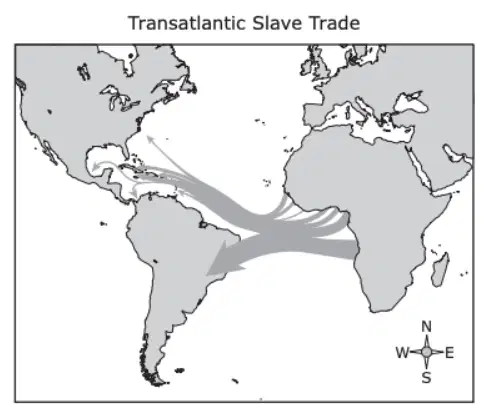
Which factor was a reason for the trade system illustrated on this map?
Labor demands of the factory system
Invention of the steamboat
Labor demands of the plantation system
Invention of the mechanical loom

How did these characteristics influence life in the colonies?
The New England colonies supported financial growth through high-paying industrial work
The Southern colonies supported the plantation production of cash crops because of long growing seasons
The Southern colonies developed large urban centers in order to support increasing manufacturing businesses
The New England colonies developed large rural populations in order to support increasing agricultural production

Which reason correctly replaces the question mark in this list?
Influence of John Locke and other Enlightenment philosophers
Ideas of John Smith and other English soldiers
Need to establish trading forts
Interest in growing cash crops
How did the First Great Awakening contribute to the rise of representative government in the British North American colonies?
The rise of religious participation led to people focusing less on politics
The focus on equality in religion caused people to question authority
Church leaders preached about creating a state ruled by religion
Church officials taught about the virtues of manarchy
Which problem did George Washington encounter when he became president?
Southern states were threatening to secede from the Union
The United States had large debts from the American Revolution
Great Britain was refusing to trade with the United States
The Articles of Confederation needed to be replaced with a stronger constitution
The first political parties in the United States were established in the 1790s largely because of political differences between -
John Adams and Benjamin Franklin
Alexander Hamilton and Thomas Paine
George Washington and James Madison
Thomas Jefferson and Alexander Hamilton
According to Alexander Hamilton, which action was necessary to ensure the stability of the nation's economy?
The passage of a trade embargo against Great Britain
The abolition of consumption taxes
The creation of a trade alliance with France
The establishment of a national bank

Disagreements between these two cabinet members led to -
the creation of reservations for American Indians
a struggle to ratify the Bill of Rights
the establishment of the first U.S. political parties
a compromise over slavery in western territories
The first political parties in the United States formed mainly in response to disagreements over -
taxation without representation
the doctrine of judicial review
territorial expansion to the west
the extent of federal power

Which phrase completes this excerpt?
colonial Settlements
protective Tariffs
permanent Alliances
territorial Disputes

Which action completes this diagram?
oversee state government agencies
regulate the creation of new businesses
establish a national bank
eliminate protective tariffs
The Whiskey Rebellion challenged the idea that -
the federal government had the power to pass and enforce tax laws
a national military was needed for dealing with foreign threats
the federal government could raise tariffs to protect industries
a national court system was needed for resolving disputes between states
The organization of the first U.S. political parties resulted in large part from disagreements over which issue?
The purchase of the Louisiana Territory from France
The election of George Washington to a second term as president
The establishment of the First Bank of the United States
The attack on the Port of Tripoli in North Africa

Which of the following is the source of this statement on foreign policy?
George Washington's Farewell Address
The Monroe Doctrine
Abraham Lincoln's first inaugural address
The Federalist Papers

The idea expressed in this quote is that the United States should avoid -
becoming involved in the political affairs of other countries
being a part of a global trade network
establishing U.S. territories overseas
allowing U.S. citizens to emigrate
Why did many farmers, artisans, and former Anti-Federalists support the Democratic-Republican Party?
The Democratic-Republicans favored the expansion of a strong national government
The Democratic-Republicans supported strict restrictions on immigration
The Democratic-Republicans supported the use of tariffs
The Democratic-Republicans favored states' rights and the rights of the common man
Why did Alexander Hamilton think a national bank would strengthen the central government?
The bank would help provide stability for the U.S. economy
The bank would create a monopoly that would eliminate state banks
The bank would encourage foreign competition for manufactured goods
The bank would have the power to regulate interstate commerce

Why did President Washington give this advice about the future of U.S. foreign policy?
To end European colonization in the Western Hemisphere
To avoid being drawn into European wars
To use trade embargoes to stay neutral
To encourage growth through the transatlantic slave trade

Which president established these traditions for the executive branch?
John Adams
Thomas Jefferson
James Madison
George Washington
Which views were argued by either Alexander Hamilton or Thomas Jefferson while debating the establishment of a national bank?
Move the correct answer to each column
A national bank would help maintain public credit
The Constitution does not give the government the power to set up a national bank
Holding public funds and paying government debts requires a national bank
A national bank would favor manufacturing at the expense of agriculture
Why did Alexander Hamilton want to create a national bank?
Select TWO correct answers.
To encourage trade with Great Britain
To manage the country's debt
To discourage the creation of plantations
To centralize the collection of federal taxes
To replace the states' banks

