
Font size
 Worksheets
8R Unit 2 (Lessons 1-4) Test Review
Total questions: 50
Worksheet time: 45mins
What is the name for the process by which water falls from the atmosphere to the Earth's surface?
Condensation
Transpiration
Evaporation
Precipitation
Which of the following is a measure of the average kinetic energy of air molecules?
Temperature
Humidity
Wind speed
Pressure
Which of the following is NOT a type of precipitation?
Rain
Snow
Hail
Steam
What is the term for the condition of the atmosphere at a specific place and time?
Climate
Weather
Biosphere
Ecosystem
What is necessary for water to freeze before falling as precipitation?
It must evaporate completely
It must mix with other substances
It must reach a low enough temperature
It must reach a high enough temperature
How are clouds related to hail events?
Clouds have no relation to hail events
Clouds are only present after hail events
Clouds can be seen moving during hail events
Clouds are never present during hail events
What instrument is used to measure temperature?
Anemometer
Thermometer
Barometer
Psychrometer
How are the particles in a gas different from those in a solid or liquid?
Gas particles have no space between them
Solid and liquid particles are packed close together
Gas particles are packed close together
Solid and liquid particles are spread far apart
How do particles of a substance behave at different temperatures?
They do not move at any temperature
They move slower at higher temperatures
They move faster at lower temperatures
They move faster at higher temperatures
What are hailstones made of?
Water, in a liquid state
Ice, usually in layers
Rocks, covered in ice
Snowflakes, compacted together
Which season is least likely for hail to occur?
Winter
Summer
Spring
Fall
How long do hailstorms typically last?
Several minutes
Several hours
Several weeks
Several days
What weather conditions are usually present at Earth's surface when hail occurs?
High air temperatures and high humidity
Low air temperatures and low humidity
High air temperatures and low humidity
Low air temperatures and high humidity
What is the primary source of energy that drives Earth's weather patterns?
The Sun
The Moon
Fossil fuels
Nuclear energy
In which layer of the Earth's atmosphere does weather primarily occur?
Stratosphere
Mesosphere
Troposphere
Thermosphere
Why do some days have ice falling from the sky even when the temperature remains above freezing?
The ice is formed high up in the atmosphere where it is cold.
The ice is being produced by a nearby industrial facility.
The temperature readings are inaccurate.
The ice is actually melting as it falls.
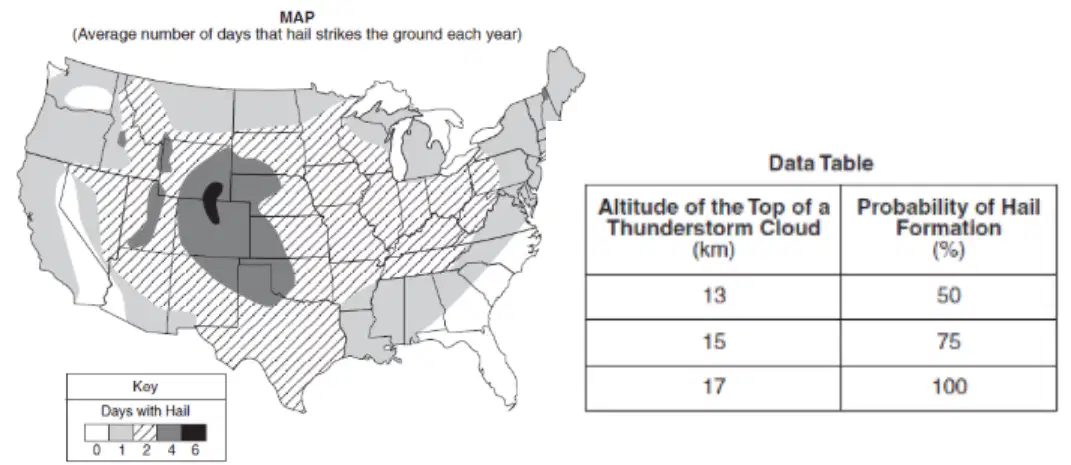
Use the map of the United States that shows the average number of days hail strikes the ground each year. Which claim is best supported by this map?
Texas gets 1 day of hail a year.
California gets 6 days of hail a year.
New York gets the most hail days per year.
Florida is least likely to experience hail.
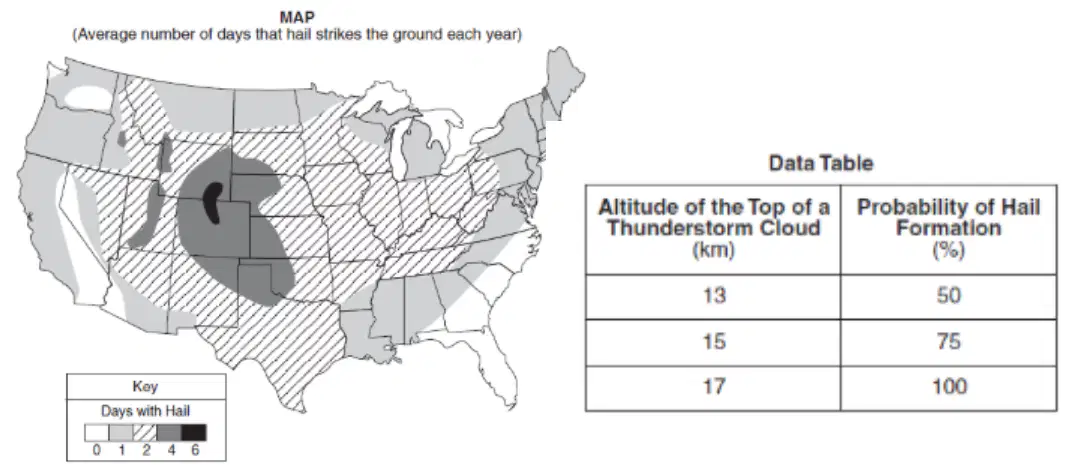
Use the data table showing the relationship between the altitude of the top of a thunderstorm cloud and the probability of hail formation . Which claim is best supported by these diagrams?
It is more likely that hail will form at lower altitudes.
At an altitude of 14 km, the probability of hail is about 62%.
At an altitude of 10 km, the probability of hail is 75%.
At an altitude of 16 km, the probability of hail is 70%.
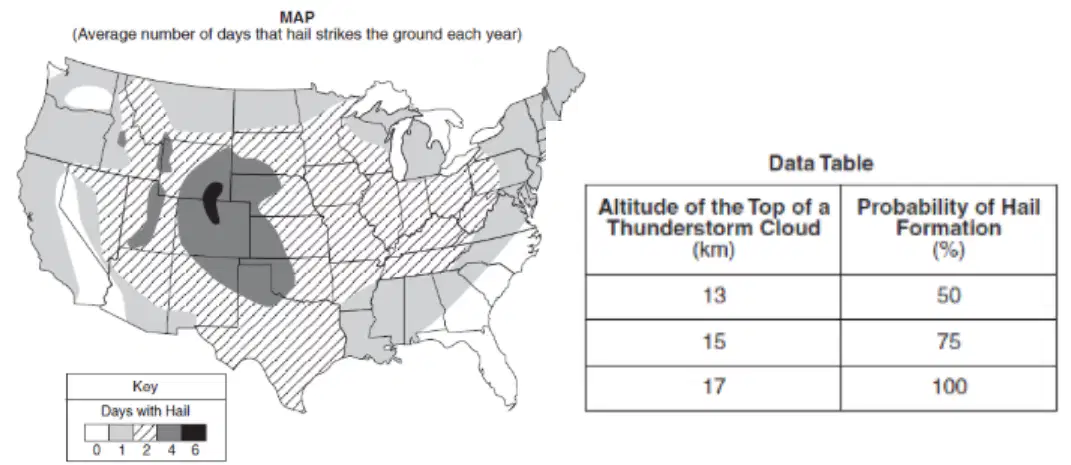
According to the map of the United States showing the average number of days hail strikes the ground each year, where are hailstorms more common in the United States?
Central United States
Western United States
Eastern United States
Southern United States
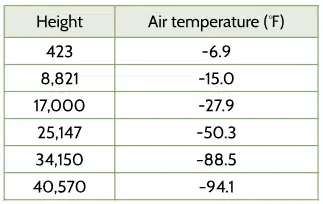
Use the data table of heights (in feet) and corresponding air temperatures (in °F) recorded at midnight in Saratoga, New York on December 21, 2020 (Saratoga is approximately 423 feet above sea level) to determine the relationship between altitude and air temperature. What claim best describes this relationship?
As altitude increases, air temperature decreases.
As altitude increases, air temperature increases.
Air temperature stays approximately constant with altitude.
There is no consistent relationship between altitude and air temperature.
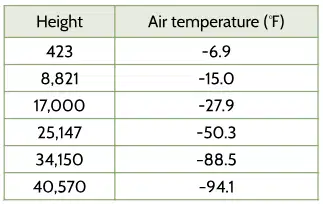
Which quantitative evidence from the Saratoga data table best supports the claim that air temperature decreases as altitude increases?
Air temperature is −6.9°F at 423 ft and −94.1°F at 40,570 ft, showing much colder air at higher altitude.
Air temperature is −15.0°F at 8,821 ft and −27.9°F at 17,000 ft, showing warmer air at higher altitude.
Air temperature is −27.9°F at 17,000 ft and −50.3°F at 25,147 ft, showing temperatures rise with altitude.
Temperatures at 34,150 ft (−88.5°F) and 40,570 ft (−94.1°F) are nearly the same, proving no trend.
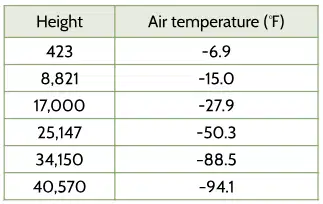
Compared with the kinetic energy of air molecules at 423 feet above sea level (−6.9°F), the kinetic energy of the air molecules at 40,570 feet where the temperature is −94.1°F would be:
Less
More
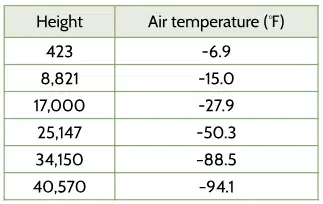
Using the trend in the Saratoga data table, what is a reasonable predicted air temperature at 20,000 feet above sea level?
−12°F
−28°F
−36°F
−52°F
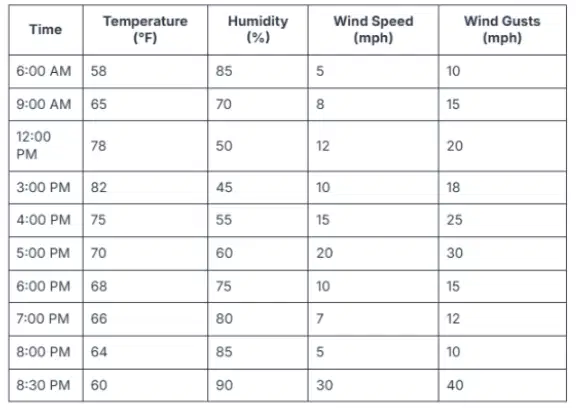
The data table shows various weather conditions on a day that a hailstorm occurred. Based on the data, which time did the hailstorm most likely occur?
12:00 PM
4:00 PM
5:00 PM
8:30 PM
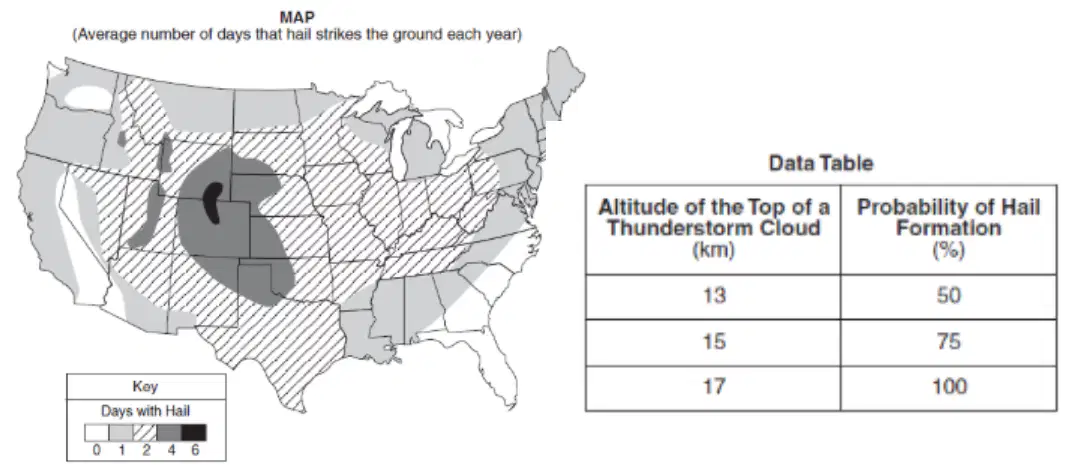
Use the information below to answer. Which claim is best supported by the diagrams showing (1) a U.S. hail-days map and (2) a table that lists cloud-top altitude (13, 15, and 17 km) with corresponding probabilities of hail formation (50%, 75%, and 100%)?
It is more likely that hail will form at lower altitudes.
At an altitude of 14 km, the probability of hail is about 62%.
At an altitude of 10 km, the probability of hail is 75%.
At an altitude of 16 km, the probability of hail is 70%.
What is the term for the condition of the atmosphere at a specific place and time?
Climate
Biosphere
Weather
Ecosystem
How are clouds related to hail events?
Clouds have no relation to hail events
Clouds are only present after hail events
Clouds can be seen moving during hail events
Clouds are never present during hail events
How are the particles in a gas different from those in a solid or liquid?
Gas particles have no space between them
Solid and liquid particles are packed closer together
Gas particles are packed close together
Solid and liquid particles are spread far apart
What weather conditions are usually present when hail occurs?
High air temperatures and high humidity
Low air temperatures and low humidity
High air temperatures and low humidity
Low air temperatures and high humidity
In which layer of the Earth's atmosphere does weather primarily occur?
Stratosphere
Troposphere
Mesosphere
Thermosphere
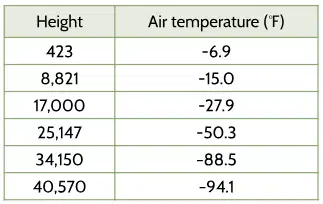
Use quantitative evidence from the same Saratoga data table to support the claim that air temperature changes with altitude. Select all statements that provide correct quantitative evidence that temperature decreases as altitude increases.
From 423 ft (−6.9 °F) to 8,821 ft (−15.0 °F), the temperature dropped by 8.1 °F.
From 17,000 ft (−27.9 °F) to 25,147 ft (−50.3 °F), the temperature decreased by 22.4 °F.
From 34,150 ft (−88.5 °F) to 40,570 ft (−94.1 °F), the temperature increased by 5.6 °F.
At 8,821 ft, the air was warmer than at 423 ft.
From 25,147 ft (−50.3 °F) to 34,150 ft (−88.5 °F), the temperature dropped by 38.2 °F.

Which layer of the atmosphere contains the ozone?
Troposphere
Stratosphere
Mesosphere
Thermosphere
Which of the following best explains why hailstones can grow to large sizes before falling to the ground?
Strong updrafts in thunderstorms keep hailstones suspended, allowing them to collect more layers of ice.
Hailstones form only in small clouds with weak winds.
Hailstones grow larger because they absorb sunlight.
Hailstones are made from melted snowflakes that refreeze instantly.
What is the main difference between hail and sleet? (Pick two)
Hail is made of liquid water, while sleet is made of ice.
Hail forms in strong thunderstorms, while sleet forms during winter storms.
Hail falls slowly, while sleet falls quickly.
Hail forms in warm weather, while sleet forms in cold weather.
Which atmospheric condition is most important for the formation of hail?
Strong upward movement of air within a thunderstorm
Rapid cooling of air near the surface
Calm and clear skies
High humidity at ground level


Temperature is a measure of what?
The total energy in an object
The average kinetic energy of the particles that make up an object or material
The amount of matter in an object
The flow of thermal energy
How does heat affect objects and materials?
It changes their color
It causes changes in the temperature of objects and materials
It increases their mass
It makes them solid
Which type of cloud is associated with thunderstorms and hail?
a. Stratus
c. Cumulus
b. Fog
d. Cumulonimbus
As water droplet size increases, what happens to the chance of precipitation?
a. Increases
b. Decreases
c. remains the same
What are conditions like outside on days that it hails?
cold and dry
warm and humid
cold and humid
warm and dry
How are updrafts and the size of hail related?
Stronger updraft, bigger hail
Stronger updraft, smaller hail
Stronger updraft, no hail
Weaker updraft, smaller hail
What do we know about the temperature of the air at different heights of a cloud?
The temperature throughout the cloud is the same
The temperature gets colder as the altitude increases
The temperature gets colder closer to the surface of the earth
It is impossible to predict
What is necessary for hail formation?
Light rainfall
A sunny day
A thunderstorm cloud with specific conditions
A rainbow in the sky
Hailstones are made of ______, often in layers.
Water
Clouds
Ice
Onions
Where do particles have the most kinetic energy?
near the ground
in the sky
the energy is the same near the ground and in the sky
in space

