
 Worksheets
ch9 review
Total questions: 52
Worksheet time: 26mins
What was the Industrial Revolution?
increased purchases of land by wealthy landowners to cultivate larger fields
increased output of machine-made goods that began in England during the 18th-century
a widespread use of teenagers as factory laborers who worked 14 hour days, 6 days a week
increased populations of urban areas during the 1800s
Which of the following was a result of the agricultural revolution?
Many small farmers became tenant farmers or moved to cities.
Enclosures became landmarks of wealthy landowners.
Landowners experimented with new agricultural methods.
All of the above are true.
What were the three factors of production required to drive the industrial revolution?
land, labor, capital
government, military, colonies
raw materials, natural resources, man-made goods
road, railway, and water transport
What was the main cause of the process of urbanization that occurred in 19th-century Britain and elsewhere in western Europe?
poor crop yields
industrialization
improved living conditions in cities
more efficient transportation systems
How did landowners and aristocrats view wealthy members of the middle class?
regarded highly
looked down upon
as equals
as outcasts
What did Britain do in order to keep industrial secrets from the United States?
blockaded the United States from engaging in international trade
sent messengers with misleading information to the United States
forbade engineers, mechanics, and toolmakers from leaving the country
charged impossible fees for the secrets to industrialization
What is the laissez-faire policy?
a policy that allowed labor to set working conditions based on votes on issues relevant to their industry
a policy where labor created a committee to set working standards without interference from industry owners
a policy that taught owners of industry how to set working conditions based on government standards
a policy that let owners of industry set working conditions without government interference
What is the name for the voluntary associations of workers seeking labor reforms?
unions
strikes
collective bargaining
utilitarianism
Which of the following is an example of a reform movement?
abolition of slavery
women's rights
public education
all of the above
21. Drawing Conclusions: The Industrial Revolution occurred in Great Britain before it occurred elsewhere in Europe because:
Great Britain had abundant natural resources and a stable political environment.
Great Britain had the largest population in Europe.
Great Britain was isolated from the rest of Europe.
Great Britain had the strongest military in Europe.
Which of the following describes one economic, one social, and one political effect of the Industrial Revolution on Great Britain?
Economic growth, urbanization, and increased political reforms
Decline in trade, rural population growth, and monarchy strengthening
Decrease in factory production, improved rural living, and reduced political participation
Economic stagnation, social equality, and political isolation
In what way did the Agricultural Revolution pave the way for the Industrial Revolution?
It led to population growth.
It increased food supplies.
It caused farmers to lose land and seek other work.
All of the above are true.
How did Britain's economy affect the process of industrialization?
positively, by Britain's highly developed banking system, availability of loans, and climate of progress
positively, by Britain allowing women and children to work long hours and grow wealthy
negatively, by Britain's decision to forbid engineers, mechanics, and toolmakers to leave the country
negatively, by Britain's overseas expansion, which took jobs away from the British citizens
What was the impact of the steam engine on the production of British goods?
It enabled the mining industry to work more efficiently without the need for workers.
It allowed small ferries to monopolize the transport of raw materials through English canals.
It launched the railway age that brought the transportation of people and materials to a new level.
All of the above are true.
How did the Industrial Revolution affect cities?
It created technology to clean them.
It made them lose valuable sources of food.
It made the population grow faster than the housing supply.
It made the crime rate drop.
Which of the following factors MOST contributed to the shorter life span of those living in cities as opposed to those in the country?
long working hours
illness caused by unhealthy living conditions
inadequate housing
excessive garbage
In what way did the new middle class change British society?
The power structure in London shifted from the city to the country.
The middle class became the new ruling class in society.
Aristocrats and wealthy landowners looked down on the middle class.
Some members of the middle class achieved top positions in society.
Which of the following was a key idea in the free-market system?
protect the nation's industries from foreign competition
establish minimum wages and maximum working hours
give government complete control of the means of production
refuse to interfere in either domestic or international economic matters
Which of the following was NOT a legislative reform in the 1800s?
In England, it became illegal to hire children under the age of nine.
The Mines Act prevented women and children from working underground.
The Ten Hour Act set limits on women and children's working hours
The Supreme Court created social security to support retired workers.
What did William Wilberforce fight for in the 1800s?
to establish public schools.
to limit the length of the workday.
to abolish child labor in factories.
to abolish slavery and the slave trade.
What made 18th-century Great Britain ideal for rapid and revolutionary industrialization?
Abundant natural resources and a stable political environment
Lack of access to international markets
Scarcity of labor and raw materials
Frequent wars and political instability
Drawing Conclusions: The philosophy of communism might have appealed to many 19th-century factory workers because:
It promised equal distribution of wealth and better working conditions.
It encouraged workers to work longer hours for higher pay.
It supported the idea of private ownership of factories.
It promoted strict government control over all aspects of life.
How might small farmers of the agricultural revolution be compared to the working class of the Industrial Revolution?
Both endured long working hours.
Both suffered job losses due to progress.
Both lived in climates of social restructuring.
All of the above are true.
What impact did technological advances have on industry?
Production of goods was increased.
Quality of products was decreased.
Number of factory workers decreased.
All of the above are true.
What was a benefit of the railroad in Britain?
It encouraged people to emigrate to other countries.
It eliminated hundreds of thousands of jobs.
It displaced England's agricultural and fishing industries.
It offered cheap transportation for materials and goods.
Which of the following was NOT a positive aspect of industrialization?
It created jobs for workers.
It increased a nation's wealth.
It improved living conditions in cities.
It increased the production of goods.
How did the philosophy of laissez-faire economics influence early industrialists?
with ideas of a free-market economy governed by natural laws, not government regulations
with ideas of an economy supported by tariffs on foreign goods
with ideas that the elite had a responsibility to give to charities
all of the above
What were the long-term effects of Marx and Engels's The Communist Manifesto?
Working classes worldwide demanded a "dictatorship of the proletariat."
Marx and Engels's predictions proved correct as economic forces alone ruled society.
In the 1900s, Marxism inspired revolutionaries such as Russia's Lenin.
During 1848 and 1849 revolts shook Europe but were suppressed.
Which of the following statements are true of socialism and communism?
Socialism and communism are two words for the same ideology.
Socialism and communism are two completely different and unrelated ideologies.
Communism is a form of complete socialism in which the people own all production and property.
Communism gives control of a country to its people and socialism gives control of industry to the people.
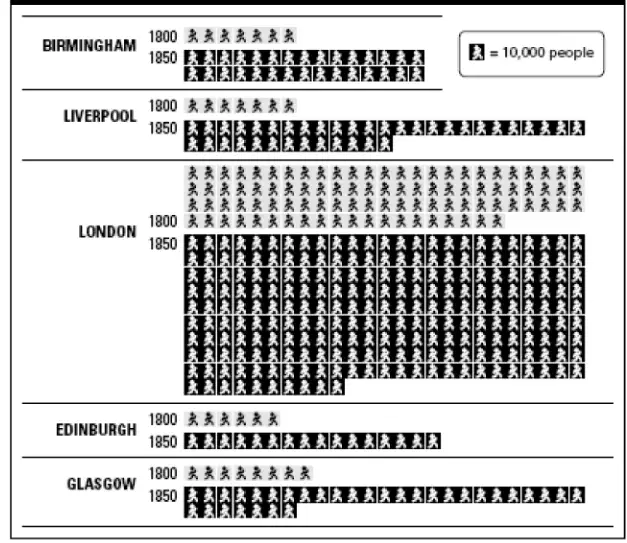
Which of the following cities showed the smallest percentage increase in population?
Liverpool
London
Edinburgh
Glasgow
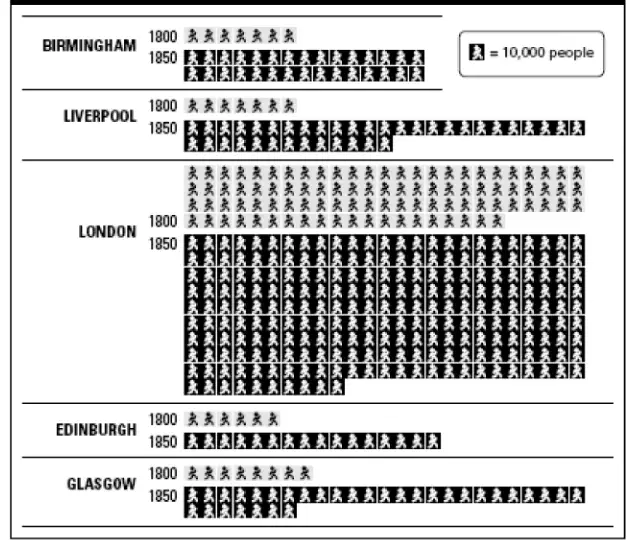
Which three cities more than tripled in population?
a. London, Edinburgh, Glasgow
b. Birmingham, Liverpool, Glasgow
c. Liverpool, London, Edinburgh
d. Edinburgh, Liverpool, Birmingham
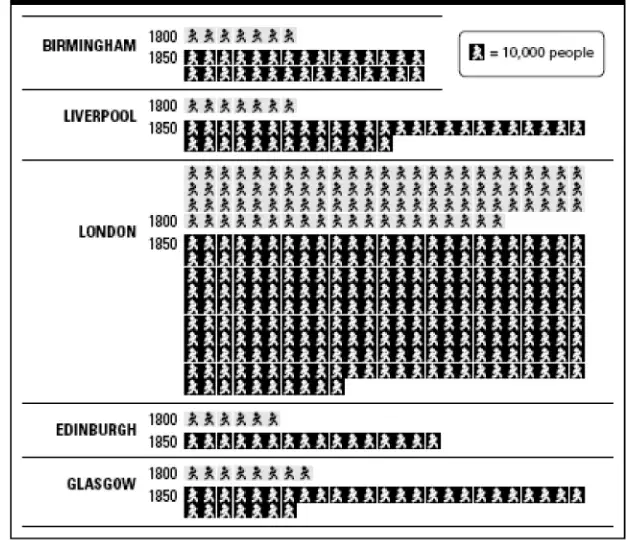
Which city would be ranked with the SECOND largest population in 1850?
Birmingham
Liverpool
Edinburgh
Glasgow
Analyzing Motives: What are some likely reasons that many middle-class British believed in the theories of laissez-faire capitalism and the free-market system in the 1800s?
They believed these theories would allow them to prosper economically and increase their social mobility.
They wanted to maintain strict government control over all industries.
They thought these theories would lead to the abolition of private property.
They believed these theories would result in a return to feudalism.
In the 1700s, the process of enclosure tended to increase
farming efficiency.
farmers' reliance on a single cash crop.
the use of the broadcast method of seeding.
the amount of common land available for grazing.
How did the crop rotation system that developed in Britain during the agricultural revolution increase crop yields?
by allowing more land to rest
by increasing nutrients in the soil
by ensuring that more of the seeds that were planted actually sprouted
by decreasing the amount of land used to grow nutrient-depleting crops
All of the following were results of the agricultural revolution in Britain EXCEPT that
food prices decreased.
population increased.
the number of farmers increased.
the average size of farms increased.
Which of the following was the first area to undergo major industrialization?
banking
railroads
coal mining
textile production
By the late 1700s, the best place to find a water frame and a spinning mule was in
a barn.
a factory.
a farm house.
an urban home.
An entrepreneur is a type of
scientist.
inventor.
business person.
personal secretary.
Identify some of the factors of production present in Britain that encouraged the Industrial Revolution.
Abundant natural resources, a large labor force, and access to capital
Scarcity of raw materials and limited labor
Lack of technological innovation and poor transportation
Absence of financial institutions and weak government support
Which of the following did NOT improve as an early result of the Industrial Revolution?
factory working conditions
the quality of clothing
the average person's diet
transportation
Which of the following did NOT increase as an early result of the Industrial Revolution?
urbanization
the size of the middle class
the length of the average work day
the life expectancy of the average worker
Which of the following did NOT improve as a result of the Industrial Revolution?
living conditions for the average worker
educational opportunities
preservation of the environment
affordability of consumer goods
The group that benefitted the most from the Industrial Revolution in the short term was:
Factory owners and industrial capitalists
Farmers
Artisans and craftsmen
Unskilled laborers
Some of the factors that discouraged the growth of industrialization in certain European countries include:
Lack of natural resources
Abundance of skilled labor
Advanced transportation networks
Strong government support for industry
Who defended the free-market system of capitalism in the book, The Wealth of Nations?
Adam Smith
John Stuart Mill
Jeremy Bentham
William Wilberforce
Nineteenth-century socialists argued that government should
leave the economy alone.
actively plan the economy.
destroy the economy.
allow the economy to be controlled by the bourgeoisie.
With which of the following is Karl Marx most closely associated?
socialism
communism
utilitarianism
trade unionism
In the 19th century, collective bargaining was carried out between
government and unions.
employers and employees.
communists and capitalists.
political and financial leaders.
In the 19th century, some of the main differences between the beliefs of laissez-faire capitalists and communists included:
Laissez-faire capitalists supported minimal government intervention in the economy, while communists advocated for collective ownership and government control of resources.
Both groups supported private property and free markets.
Communists believed in individual entrepreneurship, while laissez-faire capitalists promoted state-run businesses.
Laissez-faire capitalists wanted government control of all industries, while communists preferred no government involvement.
Factors that allowed Great Britain to industrialize before other European nations include:
Abundant natural resources and access to capital
Lack of navigable rivers and poor transportation
Limited access to overseas markets
Scarcity of coal and iron
Which of the following best explains the factors that contributed to Britain's industrialization?
Economic, political, and social factors
Only economic factors
Only political factors
Only social factors

