
 Worksheets
Reproduction Quiz
Total questions: 35
Worksheet time: 12mins
What is the main function of the ovaries in the female reproductive system?
Site of fertilization
Oogenesis and hormone production
Fetal development
Production of sperm
Which hormone stimulates the release of an ovum every 28 days?
FSH
LH
Estrogen
Progesterone
What is the site of fertilization in the female reproductive system?
Ovaries
Uterus
Fallopian tubes
Mammary glands
Without fertilization, what happens to progesterone levels and the endometrium?
Progesterone increases and endometrium thickens
Progesterone decreases and endometrium sheds
Progesterone stays the same and endometrium remains
Progesterone increases and endometrium sheds
Which of the following is NOT part of the external genitalia (vulva)?
Labia majora
Labia minora
Clitoris
Uterus
Spermatogenesis starts at puberty and is constant rather than cyclical.
True
False
What are the two main products of the testes?
sperm and testosterone
sperm and estrogen
testosterone and insulin
sperm and adrenaline
What is a common change in the male reproductive system with aging?
prostate enlargement
testicular hypertrophy
increased sperm production
penile lengthening
seminal vesicle shrinkage
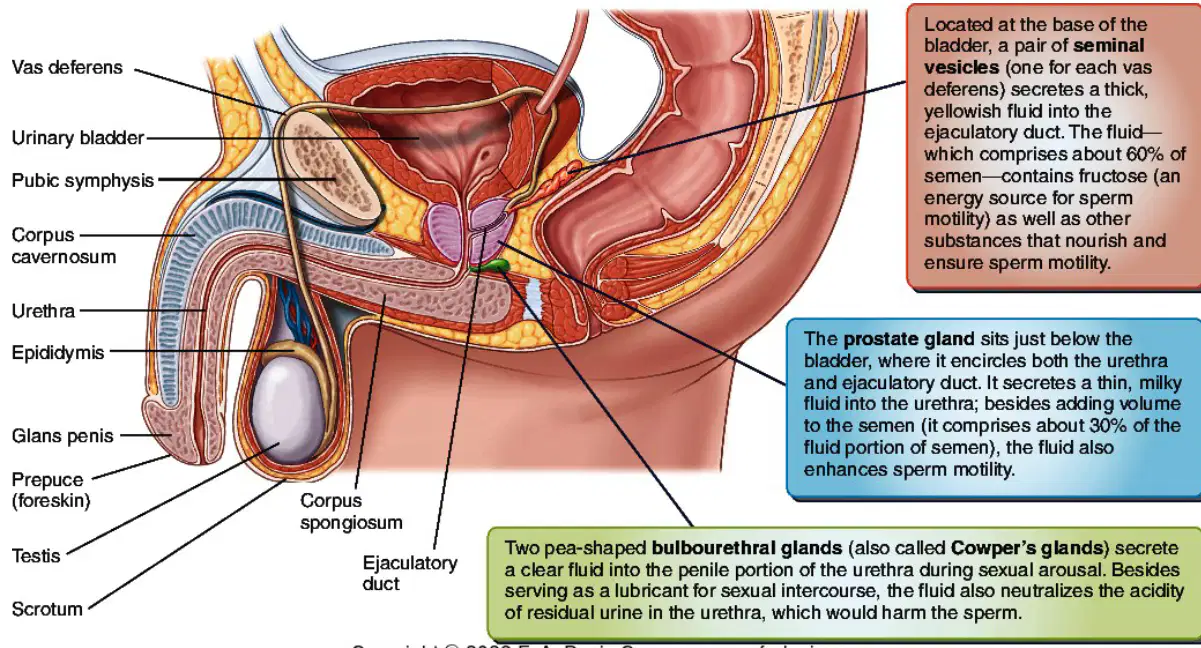
Which structure is responsible for storing and maturing sperm in the male reproductive system?
Epididymis
Seminiferous tubules
Vas deferens
Prostate gland

Which gland contributes about 30% of the fluid portion of semen and enhances sperm motility?
Seminal vesicles
Prostate gland
Bulbourethral glands
Testis
At what age range does menopause, marking the definite end to reproductive capability in women, typically occur?
35-45 years
45-55 years
55-65 years
65-75 years
What hormone decreases in women as they age, leading to increased bone loss, atrophy of urinary meatus, urethral tone, and vaginal epithelium, and increased cholesterol?
Estrogen
Progesterone
Testosterone
Insulin
Which of the following is a risk associated with decreased estrogen in women?
Increased muscle mass
Increased risk for osteoporosis
Decreased cholesterol
Improved urinary tone
Decreased estrogen in women can lead to atrophy of which of the following?
Urinary meatus
Urethral tone
Vaginal epithelium
All of the above
Increased cholesterol due to decreased estrogen increases the risk for ______ in women.
CAD (Coronary Artery Disease)
Osteoporosis
Asthma
Hypothyroidism
According to the information on age-related changes in men, what happens to testosterone secretion as men age?
It increases
It stays the same
It decreases
It stops completely
Which of the following is a common problem with older age in men, as mentioned in the information?
Diabetes
Enlargement of prostate gland (benign prostatic hyperplasia)
Heart attack
Memory loss
The increase in bone loss with age is greater in men than in women.
True
False
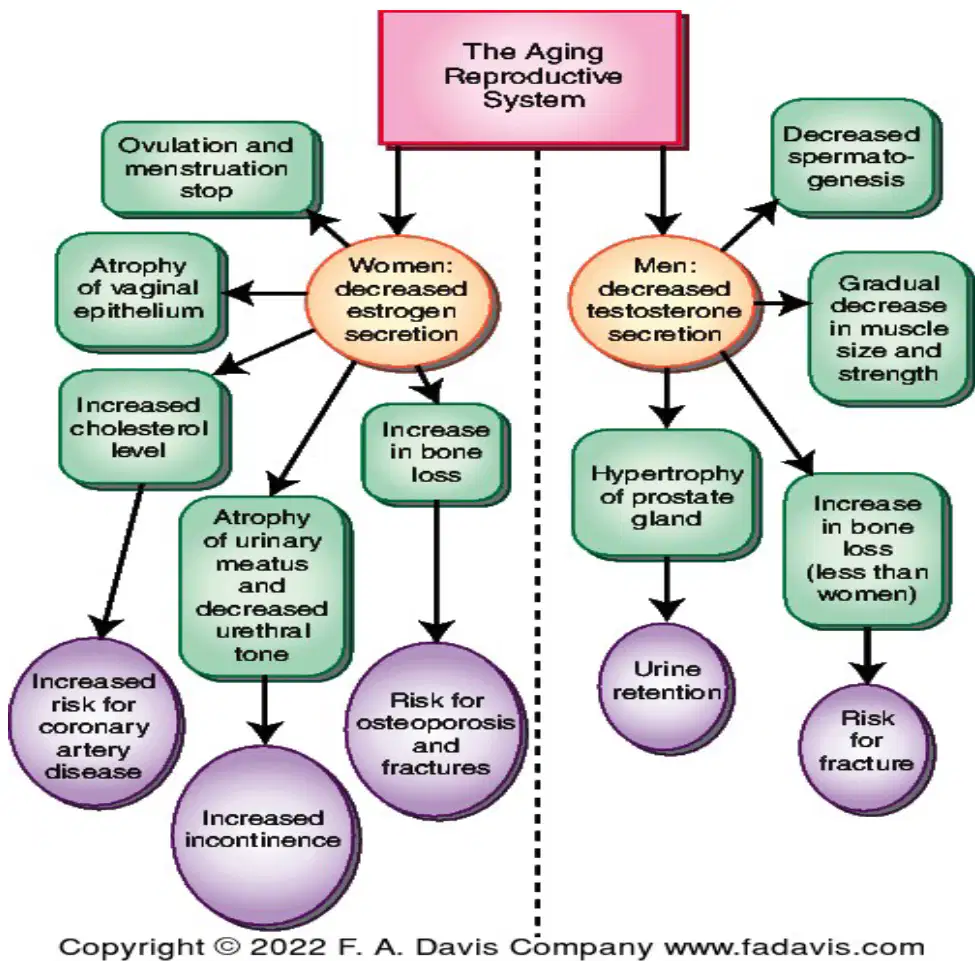
Hypertrophy of prostate gland in men leads to ________.
Urine retention
Increased appetite
Hair loss
Improved vision
What does Gravida (G) represent in the context of pregnancy health history (GTPAL)?
Number of pregnancies
Number of pregnancies to term (37 wks)
Births whether alive or stillborn (after 20 weeks gestation)
Born alive (not stillbirth)
Para (P) in the GTPAL system refers to births whether alive or stillborn after how many weeks of gestation?
20 weeks
24 weeks
28 weeks
18 weeks
What does gynecomastia refer to?
Excess breast tissue
Lack of libido
Urethra on underside of shaft
Urethra on dorsum of shaft
Epispadias is a condition where the urethra opens on the ________ of the shaft.
dorsum
ventral side
lateral side
base
Which diagnostic procedure is used to distinguish fluid from a tumor in the breasts?
Mammography
Ultrasound
BRCA-1 genetic testing
Pelvic exam
At what age does the ACS recommend starting annual mammography?
30-34 years
35-39 years
40-44 years
45-49 years
BRCA-1 or BRCA-2 genetic testing is used for detecting which type of cancer?
Cervical cancer
Ovarian cancer
Breast cancer
Lung cancer
What does a Salpingostomy visualize?
Inside of fallopian tubes
Inside of the uterus
Inside of the bladder
Inside of the ovaries
Which of the following should be checked before an endoscopic examination?
If patient is fasting
Blood pressure
Heart rate
Temperature
What is the purpose of insufflation during some endoscopic (or laparoscopic) procedures?
Carbon dioxide gas is pumped into abdominal wall for visualization
Oxygen is injected to increase blood flow
Saline solution is used to sterilize the area
Nitrogen gas is used to numb the tissue
Postoperatively, what should be observed in the patient after endoscopic procedures?
Observe for bleeding and monitor patient for pain in neck, shoulders, upper back from carbon dioxide
Monitor for fever and chills only
Check for skin rashes and itching
Observe for changes in vision and hearing
According to the key diagnostics for males, how often is it best to perform a testicular self-examination?
Once a week
Once a month
Once a year
Every day
During a testicular self-examination, the left scrotum usually hangs slightly ______ than the right side.
lower
higher
tighter
lighter
According to the key diagnostics for males, how should the spermatic cord feel during a testicular self-examination?
Firm, smooth, and moveable
Hard, irregular, and fixed
Soft, lumpy, and immobile
Tender, swollen, and rigid
What diagnostic methods are used for fibrocystic breast disease?
Mammogram or ultrasound
Blood test
MRI only
X-ray only
What are the treatment options for breast cancer?
Surgery, radiation, chemo, hormones
Only antibiotics
Only warm packs
Only supportive bra

