
Font size
 Worksheets
physics
Total questions: 62
Worksheet time: 55mins

Branch of physics that deals with the characteristics of fluids at rest, particularly with the pressure in a fluid or exerted by a fluid (gas or liquid) on an immersed body.
Hydrodynamics
Buoyancy
Hydrostatics
Fluid

In applications, the principles of __________ are used for problems relating to pressure in deep water (pressure increases with depth) and high in the atmosphere (pressure lessens with altitude).
Fluid
Hydrostatics
Hydrodynamics
Buoyancy

Branch of physics that deals with the characteristics of fluids at motion, particularly with the ocean currents, wave patterns, and the flow of water through pipes.
Hydrostatics
Fluid
Viscosity
Hydrodynamics

Refers to the mass per unit volume of a fluid. It is an important property of a fluid, as it affects its behavior in a variety of ways.
Density
Pressure
Buoyancy
Depth

Scalar quantity that describes the force per unit area exerted by a fluid. It is expressed in units of force per unit area, such as N/m2
Buoyancy
Density
Depth
Pressure

In hydrostatic the weight of the fluid divided by the area supporting it. This definition highlights the relationship between pressure and the weight of the fluid, as well as the role of the area over which the pressure is exerted.
Density
Depth
Pressure
Buoyancy

This principle describes the behavior of fluids under pressure. It states that the pressure at any point in a fluid at rest is transmitted equally in all directions and is independent of the shape of the container. In other words, the pressure at a given point in a fluid is the same in all directions and is not affected by the shape or size of the container.
Pascal
Bernoulli
Archimedes
Poiseuille

This principle describes the behavior of objects immersed in a fluid. It states that the buoyant force exerted on an object submerged in a fluid is equal to the weight of the fluid that the object displaces. In other words, the buoyant force is proportional to the volume of fluid displaced by the object.
Pascal
Poiseuille
Bernoulli
Archimedes

This principle describes the relationship between pressure and velocity in a fluid flowing through a pipe or over a surface. It states that as the velocity of a fluid increases, its pressure decreases, and vice versa.
Bernoulli
Poiseuille
Pascal
Archimedes

This principle describes the flow of fluid through a circular pipe. It states that the rate of fluid flow through a pipe is directly proportional to the pressure difference across the pipe and inversely proportional to the fluid's viscosity and the length of the pipe, and is proportional to the fourth power of the radius of the pipe.
Pascal
Poiseuille
Archimedes
Bernoulli

Is a force exerted on an object when it is submerged in a fluid. Is the force that opposes the object's weight and is responsible for making the object float or sink. Is equal to the weight of the fluid that the object displaces.
Fluid dynamics
Flow rate
Buoyant force
Cohesive forces

The forces that cause fluids to stick together and resist separation. These forces are the result of intermolecular forces between the fluid molecules and are responsible for the fluid's surface tension. Is the property of a fluid that makes it behave as if its surface is a thin, elastic membrane.
Flow rate
Fluid dynamics
Buoyant force
Cohesive forces

Is a measure of the volume of fluid that passes through a given cross-sectional area of a pipe or channel per unit of time. It is commonly expressed in units of volume per unit of time, such as liters per second (L/s) or cubic meters per hour (m3/h). It provides information about the speed and volume of fluid that is moving through a pipe or channel.
Cohesive forces
Flow rate
Fluid dynamics
Buoyant force

Branch of physics that deals with the study of fluid behavior and the forces that affect it. It is concerned with the behavior of liquids and gases, and the ways in which they flow and interact with solid boundaries and with each other.
Flow rate
Cohesive forces
Buoyant force
Fluid dynamics
As you climb up a mountain what happens to the air pressure?
stays the same
decreases
increases
disappears
What is the hydrostatic pressure due to a liquid of density 2000 kg/m3, at a depth of 50m?
50 Pa
2000 Pa
100 000 Pa
1 000 000 Pa
What is the formula for density (плътност) ?
density = mass x volume
density = mass / volume
density = mass + volume
density = mass - volume

Which liquid is the least dense?
oil
water
syrup
plastic bottle
Joseph weighs 290N and displaces 300N of water as he swims under water in a pool. What is the force FA on Joseph?
10 N upward
300 N upward
290 N downward
590 N downward
Pressure depends on depth
Check all that are considered FLUIDS.
gas
liquid
solid
When you increase your depth under water, the water pressure on your body _____.
increases
decreases
stays the same
Where would you find the largest pressure?
at the bottom of the Pacific Ocean
at the top of Mt. Everest
at sea level
Pressure is the same everywhere on Earth.
Mass is measured in _____, while weight is measured in _____.
kg, N
N, kg
m/s, m/s2
m/s2 , m/s

What is the pressure under a liquid of density 11.35 kg/m3, at a depth (height) of 65m?
7230 Pa
0.175 Pa
737.75 Pa
65 Pa
What is the SI unit use for hydraulic pressure?
Kg/m3
Pa
Litre
Kilometer


Buoyancy is the tendency for objects to float in a fluid. We consider buoyancy the...
Un-gravity force
The upward force
Gravitational pull
Downwards pull on an object
When the weight of an object is greater than the upthrust (buoyant force), the object will ...
Sink
Float
Expand
Shrink

What direction is the buoyant force (upthrust) in?
Downward
Left
Right
Upward
According to Archimedes, the loss in weight when an object placed in a liquid is equal to
weight of liquid
weight of the body
weight of the liquid displaced by the immersed part of the body
density of liquid
How many kPa are in 7,390 atm?
748,607 kPa
748,607,000 kPa
72.95 kPa
7,390 kPa
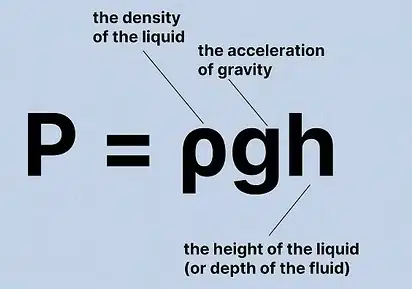
Pressure at a depth h in a liquid is mathematically expressed as ____, where ρ and g are density of the liquid and acceleration due to gravity respectively.
P= mgh
P = ρg/h
P = ρgh
P = ρmg
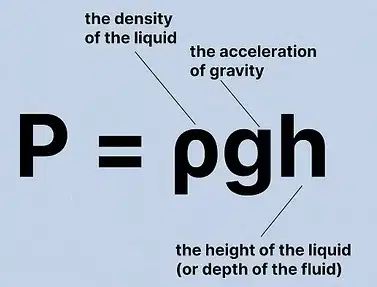
Find the pressure on the bottom of a swimming pool that measures 8.0 m by 15.0 m and has a uniform depth is 2.0 m. Note: the density of water is 1000 kg/m³.
5.6 x 10³ Pa
1.96 x 10⁴ Pa
6.83 x 10⁵ Pa
2.74 x 10² Pa

If an external pressure is exerted at the surface, this must also be taken into account. A SCUBA diver descends 15 m into a lake. If the pressure at the surface of the lake is 101300 Pa calculate the water pressure at a 15 m depth. density of fresh water = 1000 kg/m3
141.3 kPa
1.0813 kPa
591.3 kPa
248.3 kPa
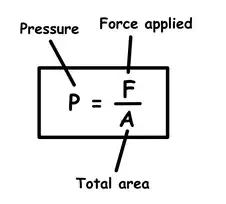
Ouch! You stepped on my foot! That is, you put a force of 550 N in an area of 9 cm² on the tops of my feet! The pressure on my feet was 611111 Pa. What is the ratio of this pressure to atmospheric pressure?
9 cm3 = 0.0009 m3 & 1 atm = 101325 Pa
2.5 atm
8.2 atm
6 atm
4 atm
A brick of gold is 10.0 cm wide, 10.0 cm high and 20.0 cm long. The density of gold is 19.3 g/cm³. What pressure does the brick exert on the table if it is resting on its end?
1890 Pa
3780 Pa
3860 Pa
A brick of gold is 10.0 cm wide, 10.0 cm high and 20.0 cm long. The density of gold is 19.3 g/cm³. What pressure does the brick exert on the table if it is resting on its side?
1890 Pa
3780 Pa
3860 Pa

A rectangular block weighing 150 N is resting on a flat surface. If the area of contact between the block and the surface is 0.25 m², what is the pressure (Pa) exerted by the block on the surface?
(a)

A woman wearing high heels steps onto a soft wooden floor. Each heel has a cross-sectional area of 1.5 cm² and the woman's weight is 600 N. Calculate the pressure (Pa) exerted on the floor by one heel. 1 m2 = 10000 cm2
(a)

A cylindrical piston has a diameter of 8 cm and exerts a force of 400 N on the fluid inside a hydraulic system. Calculate the pressure (Pa) applied by the piston on the fluid. Hint: area of a circle, 1 m2 = 10000 cm2
(a)

A physics book is lying flat on a table. The book weighs 10 N and has dimensions of 20 cm by 30 cm. What is the pressure (Pa) exerted on the table? 1 m2 = 10000 cm2
(a)
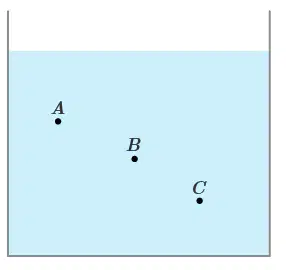
Where is the pressure the greatest?
A
B
C

An oil storage tank is filled with oil to a height of 10.0 meters. The density of the oil is 850 kg/m3. Calculate the pressure (Pa) at the base of the tank due to the oil.
(a)
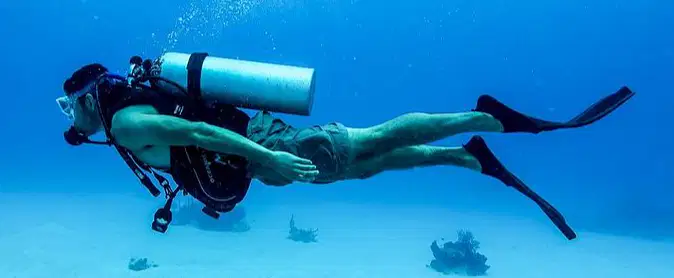
A diver descends to a depth of 5 meters in seawater. If the density of seawater is 1025 kg/m3, what is the pressure (kPa) exerted on the diver at this depth?
(a)
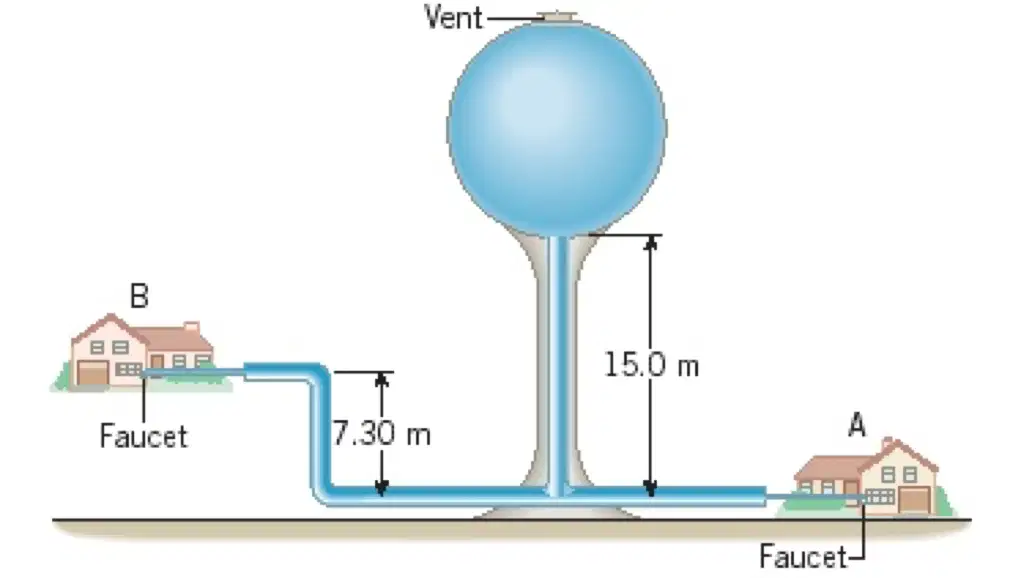
Which house has the highest water pressure if all pipe diameters are equal?
A
B

A water tower is filled to a height of 40 meters above the ground. The water is intended to supply a small town below. Given that the density of water is 1000 kg/m3, calculate the hydrostatic pressure that the water exerts at the base of the tower due to its height. Then convert your answer to pounds per square inch (psi): 1 psi = 6900 Pa
(a)

