
Font size
 Worksheets
Introduction to Immunology
Total questions: 73
Worksheet time: 37mins
Which statement best distinguishes innate from adaptive immunity?
Innate targets unique epitopes with memory
Innate responds broadly without antigen specificity
Adaptive provides barriers without cellular roles
Adaptive acts first with identical responses
Match each immune system type to its defining characteristic.
Innate immune system
Nonspecific, broad defense
Adaptive immune system
Targets specific antigens
Acquired immunity
Targets specific antigens
Which features are characteristic of adaptive (acquired) immunity?
Recognition of specific antigens
Rapid identical response to all microbes
Ability to develop immunologic memory
Broad nonspecific pattern recognition
Which statement best describes the primary role of physical and chemical barriers in innate immunity?
Generate memory against specific antigens
Neutralize toxins using antibodies
Block pathogen entry at body surfaces
Directly lyse infected host cells
Which structure is a physical barrier of the innate immune system?
Liver sinusoids
Bone matrix
B cells
Skin
During the inflammatory response, vasodilation at an infected site most directly enables which outcome?
Enhanced barrier function of keratinocytes
Reduced antigen presentation to lymphocytes
Decreased complement deposition on microbes
Increased neutrophil entry into tissues
Select all classical signs of inflammation.
Swelling
Pain
Heat
Fever
Redness
Match each cell type with its defining feature.
Neutrophils
First to infection, phagocytose
Monocytes
Differentiate to macrophages in tissues
Natural killer cells
Kill infected host cells, no phagocytosis
Which cell type is typically first to arrive at the site of infection and performs phagocytosis?
Monocytes
Natural killer cells
Dendritic cells
Neutrophils
Monocytes most accurately do which of the following after leaving circulation?
Differentiate into plasma cells
Undergo degranulation to kill worms
Release antibodies against pathogens
Differentiate into tissue macrophages
Natural killer (NK) cells primarily target which cells for destruction?
Parasites in the intestinal lumen
Extracellular bacteria in lymph
Virus-infected and cancerous host cells
Dead neutrophils in pus
Which statement about NK cells is correct?
They differentiate into macrophages
They rely on T cell receptors for activation
They secrete antibodies for neutralization
They do not phagocytose pathogens
Interferons released by NK cells have which functional consequence?
Activate phagocytosis by neighboring cells
Form membrane attack complexes directly
Increase keratin production in skin
Induce class-switch recombination in B cells
Which best characterizes interferons within innate immunity?
Enzymes that digest microbial cell walls
Cytokines that help prevent viral replication
Antibodies that opsonize bacterial capsules
Chemokines that cause antibody class switching
The complement system promotes phagocytosis primarily by which mechanism?
Inducing fever through hypothalamic signaling
Opsonization via complement binding to antigens
Direct antigen presentation to T lymphocytes
Neutralization of viral attachment proteins
Which pair correctly links component to effect within innate immunity?
NK cells—phagocytosis of bacteria
Interferons—activate adaptive memory cells
Skin—antibody secretion into blood
Complement—opsonization enhancing uptake
Select all outcomes directly associated with the inflammatory response.
Increased vascular permeability
Formation of memory B cells
Recruitment of neutrophils to tissue
Vasodilation increasing blood flow
Which sequence best reflects early cellular events at an acute bacterial skin infection?
Plasma cell maturation, antibody secretion, basophil migration
Dendritic cell licensing, cytotoxic T expansion, mast cell death
Neutrophil influx, monocyte arrival, macrophage differentiation
NK cell activation, monocyte apoptosis, eosinophil degranulation
Which feature best distinguishes the adaptive immune system from innate defenses?
Broad recognition of many patterns
More sophisticated and specific antigen response
Physical barriers like skin and mucus
Immediate, non-specific inflammatory reactions
Humoral immunity is primarily mediated by which cells and molecules?
T lymphocytes and cytokine receptors
B lymphocytes and immunoglobulins
Natural killer cells and perforins
Macrophages and complement proteins
Cell-mediated immunity is most directly associated with which lymphocyte lineage?
Dendritic cells presenting lipids
Plasma cells secreting complement
T cell lineage targeting infected cells
B cell lineage producing antibodies
Match each component with its primary association.
Humoral immunity
B cells and antibodies
Cell-mediated immunity
T cells and cytotoxic responses
Specific antigens
Unique molecular targets
Adaptive immune system
More sophisticated responses
Where do B lymphocytes primarily mature, and where do they commonly reside after maturation?
Thymus; bone marrow niches
Bone marrow; secondary lymphoid organs
Spleen; peripheral blood circulation
Lymph nodes; primary thymic cortex
Which statement best describes lymphocytes in the adaptive immune system?
They are innate cells lacking antigen specificity
They only function in primary lymphoid organs
They mature into macrophages and dendritic cells
They are primarily responsible for adaptive responses
Select all statements that are accurate about B and T lymphocytes.
Both B and T cells originate and mature in the thymus
Mature B cells relocate to spleen and lymph nodes
T cells mature predominantly in the thymus
B cells produce immunoglobulins as antibodies
Which event directly triggers clonal expansion of B cells during a primary humoral response?
Antigen binding to B cell receptor with T helper costimulation
Eosinophil degranulation against helminth parasites
Random somatic hypermutation during germinal center reactions
Passive transfer of maternal IgG across the placenta
A vaccinated individual is re-exposed to the same antigen months later. Which cell type enables a faster and stronger antibody response?
Naive T cells circulating in peripheral blood
Memory B cells generated after initial activation
Basophils releasing histamine during inflammation
Dendritic cells residing in skin tissue
During B cell activation in the humoral immune response, what is the role of helper T cells?
Release perforin to kill antibody-producing plasma cells
Provide activation signals that induce B cell proliferation
Produce complement proteins that lyse bacterial membranes
Phagocytose antigens and present via MHC class I
Match each immunoglobulin class to its key feature.
IgG
Most abundant, long half-life, crosses placenta
IgA
Mucosal immunity, present in secretions
IgM
First produced in primary response, complement activation
IgE
Immediate hypersensitivity and antiparasite functions
IgD
Very low serum amounts, B cell receptor role
Which immunoglobulin predominates in colostrum and confers passive immunity to the neonate via transfer from the mother?
IgG transferred across placenta and in colostrum
IgE bound to mast cells in tissues
IgA circulating mainly in the bloodstream
IgM confined to lymph node follicles
Which statement best distinguishes primary from secondary humoral responses?
Primary response produces mainly IgG; secondary shifts to IgM production
Primary response has slower kinetics and more IgM; secondary is faster with more IgG
Primary response forms no memory; secondary generates memory cells anew
Primary response requires T cell help; secondary proceeds entirely T independent
Select all features that commonly characterize IgE.
Targets parasites with eosinophil cooperation
Most abundant in serum and crosses placenta
Binds Fc receptors on mast cells and basophils
Mediates immediate hypersensitivity reactions
Plasma cells arise during humoral responses. Which description best captures their function?
Long-lived precursors that maintain B cell receptor diversity
Innate lymphocytes producing cytokines that activate macrophages
Terminally differentiated B cells secreting large amounts of antibodies
Antigen-presenting cells priming naive CD8 T lymphocytes
Which event turns a naïve, antigen-committed T lymphocyte into an activated cell ready to proliferate?
Binding to any antigen-presenting cell nonspecifically
Random cytokine exposure without antigen recognition
Encountering its specific antigen and receiving co-stimulation
Passive diffusion of antibodies into the T cell
Match each T lymphocyte subtype to its primary role.
Memory T cells
Recall previously encountered antigens
Cytolytic T cells
Lyse infected host cells displaying antigen
Helper T cells
Activate macrophages and assist B cell differentiation
Antigen-presenting cell
Phagocytize and display antigen fragments
Which scenario best illustrates the function of memory T cells?
Rapid recognition of a previously encountered viral peptide
Initial recognition of a novel bacterial carbohydrate
Non-specific activation of neutrophils at a wound
Direct lysis of a parasite-infected hepatocyte
Cytolytic T cells most directly contribute to which outcome during a viral infection?
Destruction of virus-infected cells presenting antigen
Endocytosis of free viral particles by macrophages
Class switching of B cells in germinal centers
Secretion of antibodies into the bloodstream
Multiple Select: Which statements describe core functions of helper T cells in adaptive immunity?
Recognize antigen presented by macrophages with MHC
Signal macrophages to enhance phagocytosis of antigen
Differentiate into plasma cells that secrete antibodies
Help B cells mature into antibody-producing cells
During maturation, T lymphocytes become antigen-committed by developing receptors to specific antigens. What is the most immediate consequence after these cells first encounter their antigen?
They undergo clonal expansion to increase specific cells
They switch isotypes to produce high-affinity IgG
They migrate to bone marrow for memory formation
They become neutrophils via transdifferentiation
Which cell is primarily responsible for phagocytizing pathogens and presenting processed antigen to helper T cells?
Endothelial cell lining a blood capillary
Macrophage acting as an antigen-presenting cell
Erythrocyte carrying surface MHC molecules
Fibroblast secreting extracellular matrix proteins
Which statement best describes immunologic tolerance in an animal?
Immune system attacks self cells to clear old tissues
Immune system avoids attacking self while targeting non‑self
Immune system ignores all antigens including pathogens
Immune system destroys all foreign microbes aggressively
Failure of self–non‑self discrimination most directly results in which outcome?
Improved innate barriers like skin and mucus
Enhanced vaccine memory with milder reactions
Increased tolerance to unrelated environmental antigens
Autoimmune destruction of the animal's own tissues
A newborn calf obtains antibodies from colostrum. What kind of immunity is this?
Active immunity from natural infection
Innate immunity from physical barriers
Passive immunity from maternal transfer
Active immunity from vaccination
Receiving preformed antibodies by injection provides which combination of features?
Delayed protection that is lifelong
Immediate protection that is lifelong
Delayed protection that is short lived
Immediate protection that is short lived
Match each immunity type to its defining example.
Passive immunity
Donor antibodies given by shot
Active immunity
Immunity after infection or vaccination
Maternal antibodies
Antibodies from colostrum or placenta
Preformed antibody injection
Any transfer of ready‑made antibodies
Which statements are true about active immunity?
Can be induced by vaccination with microbes
Provides protection only while antibodies are infused
Typically develops memory for future protection
Requires antigen exposure and immune response
Attenuated vaccines are best characterized by which property?
Pathogens are natural and fully virulent
Pathogens are fragments of inert adjuvant
Pathogens are weakened yet still alive
Pathogens are killed and completely nonreplicating
Compared with attenuated vaccines, inactivated vaccines are generally described how?
Killed organisms, often safer overall
Live organisms, longer lasting memory
Weakened organisms, more potent response
Killed organisms, highly replicative in host
Why might an adjuvant be added to a vaccine formulation?
To sterilize the vaccine by killing contaminants
To replace antigens with safer inert materials
To enhance the magnitude of the immune response
To neutralize antibodies immediately after injection
Which scenario most likely yields the longest duration of protection?
Injection of preformed donor antibodies
Maternal antibodies obtained from colostrum
Vaccination with an attenuated microbe
Single exposure to an inactivated adjuvant
Which statement best defines test sensitivity in immunology?
Ability to exclude truly negative cases reliably
Ability to detect truly positive cases accurately
Likelihood of producing no false-positive results
Proportion of all results that are true overall
A test has 90% sensitivity. Which outcome is expected among animals who truly have the disease?
Half test positive while half are true negative
All test positive with zero false-negative cases
Ninety percent test negative while ten percent false-positive
Ninety percent test positive while ten percent false-negative
Which statement best defines test specificity in immunology?
Rate of indeterminate outcomes in uncertain populations
Ability to correctly return positive results for diseased
Ability to correctly return negative results for non-diseased
Probability of detecting every infected animal perfectly
High-specificity tests primarily reduce which type of error?
All errors regardless of population
False-positive results among those without disease
False-negative results among those with disease
Random errors unrelated to prevalence
Match the testing concept to its best description.
Sensitivity
Positive results among truly diseased
Specificity
Negative results among truly non-diseased
True negative
Correctly identified without the disease
False-negative
Has disease but test is negative
False-positive
No disease but test is positive
Nearly all serologic tests require which sample type and collection tube pairing?
Serum in a red top tube is appropriate
Serum in a lavender top tube is preferred
Plasma in a yellow top tube is routine
Plasma in a red top tube is standard
Which tube color is appropriate when plasma is the required sample for serologic testing?
Lavender top tube for plasma samples
Blue top tube for plasma samples
Green top tube for plasma samples
Red top tube for plasma samples
Which statement best describes ELISA use in veterinary practice?
Rarely used with low specificity
Commonly used with high specificity
Only research use with low sensitivity
Used mainly for imaging studies
In an ELISA designed to detect antigen in serum, what initially coats the well or test surface?
A monoclonal antibody specific to antigen
Color substrate pre-mixed with antigen
Purified enzyme without antibody attached
Random serum proteins from the patient
Which combination lists typical veterinary ELISA targets?
Tick counts, flea burden, body condition score
Glucose, electrolytes, liver enzymes, ketones
Canine rabies, equine colic, hip dysplasia, ringworm
Heartworm, feline leukemia, FIV, parvo, progesterone
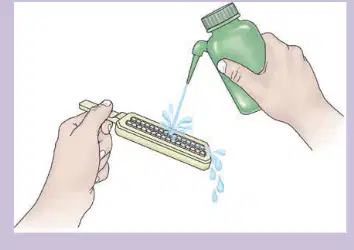
During ELISA, why is a washing step critical after adding the enzyme-labeled antibody?
To denature bound antigen complexes
To increase serum volume added
To remove unbound labeled antibodies
To neutralize the color substrate solution
What produces the detectable signal indicating the presence of antigen in ELISA?
Radioactivity emitted by the plastic wells
Fluorescence from unlabeled antibodies
Heat released during antigen denaturation
Color change from enzyme reacting with substrate
Match each ELISA component to its role.
Monoclonal antibody on well
Capture molecule that binds target
Enzyme-labeled secondary antibody
Provides enzyme for signal generation
Antigen from patient sample
Analyte that binds to capture antibody
Color-producing substrate
Reactant that changes color with enzyme
Which statements about ELISA are accurate? Select all that apply.
It requires an enzyme-labeled antibody for signal
It is most commonly used in veterinary practice
It can test for antibodies or antigens in serum
It detects targets by radioactive tracers only
A clinic runs an ELISA for feline leukemia antigen. Which sequence is correct?
Capture antibody binds plate, antigen binds, enzyme-labeled antibody binds, substrate develops color
Antigen coats plate first, capture antibody binds later, wash removed complexes, substrate bleaches color
Enzyme alone coats plate, antigen reacts spontaneously, color appears without antibody
Patient antibodies bind plate alone, color substrate binds directly, wash step is optional
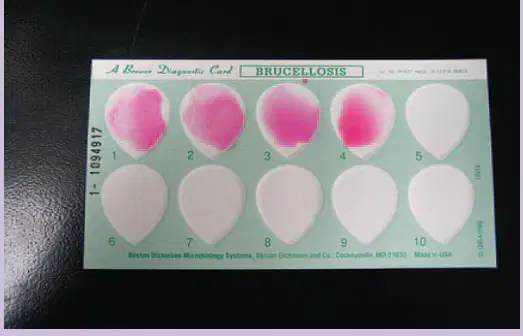
In latex agglutination, what most directly causes visible clumping in the reaction drop shown in the diagram?
Electrostatic attraction between latex beads
Formation of antigen–antibody cross-linked lattices
Sedimentation of uncoated latex particles in water
Evaporation concentrating the suspension over time
Which statement best distinguishes latex agglutination from lateral flow immunoassay when detecting a specific antibody?
Agglutination detects binding by bead clumping in place
Agglutination requires enzymatic signal amplification
Agglutination uses capillary flow along membranes
Agglutination detects binding by color lines only
Match each component to its role in a latex agglutination test.
Latex particle
Carrier surface for immobilization
Coated antigen
Binding target attached to bead
Patient serum antibody
Analyte that bridges particles
Visible clumping
Readout indicating positive result
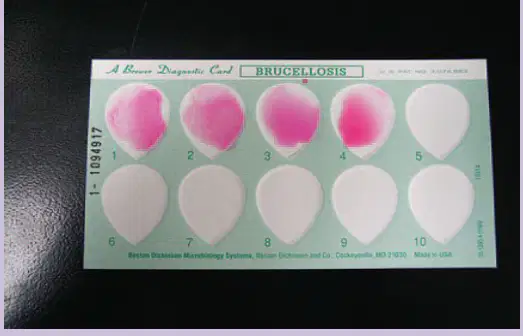
A veterinary lab screens cattle for bovine brucellosis using latex agglutination. Which outcome indicates a positive sample?
Rapid sedimentation with clear supernatant
Uniformly smooth suspension without change
Discrete clumps forming within the drop
Colorless solution with no turbidity
In lateral flow immunoassay test cassettes, why does a control line appear even for negative samples?
It confirms capillary flow occurred correctly
It detects antibodies only in infected samples
It quantifies antigen concentration precisely
It blocks non-specific binding entirely
Select all features shared by latex agglutination and lateral flow immunoassay.
Use of solid-phase particles as part of the assay
Potential for qualitative positive/negative outcomes
Requirement for laboratory centrifugation steps
Use of antigen–antibody specificity for detection
Which change would most likely reduce false positives in latex agglutination for brucellosis?
Including heterophile antibody absorbents
Shortening mixing time to a few seconds
Increasing incubation temperature substantially
Using beads coated with irrelevant proteins
During immunochromatography in a lateral flow strip, what primarily transports the sample from the application pad to the test line?
Capillary action through porous membrane
Electrophoretic migration in an electric field
Thermal convection along the cassette
Active pumping by mechanical components

