Worksheets
LS.Bio.1.2 - Enzymes
Total questions: 24
Worksheet time: 19mins
What are enzymes?
Proteins that speed up reactions by lowering activation energy
Lipids that store energy for reactions
Sugars that are consumed during reactions
Nucleic acids that provide activation energy
Which statement about how enzymes are used in reactions is correct?
They are not consumed (reusable) and are substrate-specific
They are consumed and work on any molecule
They are reused only once per reaction
They change substrates into enzymes after use
How does temperature typically affect enzyme activity?
High heat can denature enzymes, while low temperature slows reactions
Low temperature denatures enzymes, while high heat speeds reactions without limit
Both high heat and low temperature increase reaction rate indefinitely
Temperature has no effect on enzymes
What happens when an enzyme experiences a pH outside its optimal range?
Its shape changes (denatures) and activity decreases
Its shape remains unchanged and activity increases
It produces more substrates
It becomes permanently more efficient
As substrate concentration increases, what typically happens to the reaction rate?
It increases until reaching a maximum due to saturation
It decreases steadily to zero
It remains constant regardless of concentration
It fluctuates randomly
What best describes enzyme denaturing?
The shape of the active site changes and the enzyme stops working
The enzyme gains additional active sites and works faster
The enzyme dissolves into substrates
The enzyme temporarily pauses and then resumes normal activity
In an investigation of enzyme reaction rate, which factor would be appropriate to vary to test its effect while keeping other conditions controlled?
Temperature
Amount of light
Color of the solution
Container shape
Which best explains why the rate of a biochemical reaction decreases at high temperatures?
The activation energy increases.
The shape of the enzyme changes.
The enzyme-substrate complex forms.
The bonds between substrates are broken.
A student is investigating how substrate concentration affects the rate of an enzyme-catalyzed reaction.
Which three variables should be kept constant in the setup of the student’s investigation?
temperature of the reaction
amount of enzyme
amount of substrate
amount of product
pH of the reaction
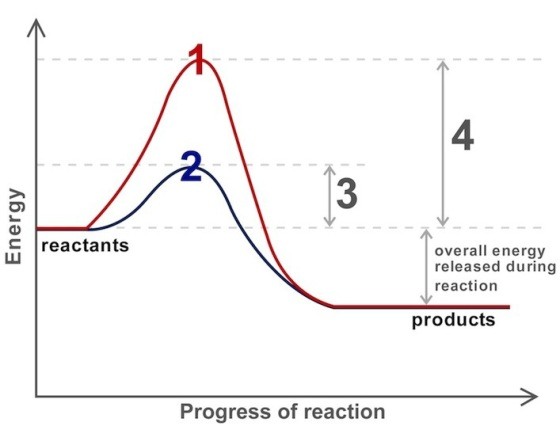
Which color line represent a reaction with an enzyme present?
Blue
Red
Both
Neither

Which of the following would most likely decrease the activity of an enzyme?
Maintaining the pH at the enzyme's optimum
Increasing the temperature beyond the enzyme's optimal range
Adding more substrate to the reaction
Using a buffer to stabilize pH
What is the role of the active site in an enzyme?
It produces new enzymes
It transports molecules across membranes
It stores energy for the cell
It binds to specific substrates and facilitates the reaction
Which statement best describes how enzymes affect activation energy?
Enzymes do not change the activation energy
Enzymes eliminate the need for activation energy
Enzymes lower the activation energy required for a reaction
Enzymes increase the activation energy needed for a reaction
What would most likely happen to an enzyme if it is exposed to extremely acidic conditions?
It would denature and lose its function
It would become more efficient
It would double in size
It would convert into a substrate
Which statement best describes the specificity of enzymes?
Each enzyme acts on a specific substrate due to the shape of its active site
All enzymes perform the same reaction
Enzymes can act on any molecule in the cell
Enzymes are only specific to temperature, not substrates
What is the effect of increasing enzyme concentration when substrate is limited?
The enzyme is consumed in the reaction
The reaction rate remains unchanged
The reaction rate decreases steadily
The reaction rate increases and then levels off

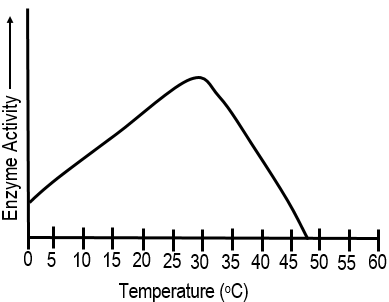
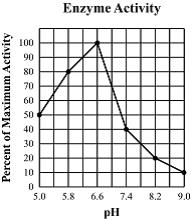
Based on these data, this enzyme functions best at what temperature and pH?
Temperature of 27°C and a pH of 4
Temperature of 37°C and a pH of 6
Temperature of 40°C and a pH of 8
Temperature of 50°C and a pH of 10
Meat tenderizer contains an enzyme that interacts with meat. If meat is coated with the tenderizer and then placed in a refrigerator for a short time, how would the enzyme be affected?
It would get broken down
Its activity would slow down
Its shape would change
It would no longer act as an enzyme