
 Worksheets
Biology I Post Test
Total questions: 40
Worksheet time: 20mins
Name
Class
Date
1.
All living things are made up of _____.
a)
cells
b)
cork
c)
wastes
d)
cellulose
2.
Enzymes are molecules that are made up of long strands of amino acids. Using this information, how would you classify an enzyme?
a)
lipids
b)
carbohydrates
c)
nucleotides
d)
proteins
3.
If a cell contains a nucleus, it must be a(n) _____________.
a)
plant cell
b)
prokaryotic cell
c)
animal cell
d)
eukaryotic cell
4.
The building of proteins is a very important function of the cell. Which of the following is the site of protein synthesis?
a)
nucleus
b)
ribosome
c)
vacuole
d)
chloroplast
5.
During which phase of the cell cycle does DNA replicate?
a)
telophase
b)
metaphase
c)
anaphase
d)
interphase
6.
Which organelle is the site of photosynthesis?
a)
ribosome
b)
chloroplast
c)
Golgi Apparatus
d)
vacuole
7.
In what process does a cell’s nucleus divide into two nuclei?
a)
mitosis
b)
osmosis
c)
diffusion
d)
transport
8.
Lipids and oils belong to which group of macromolecules?
a)
proteins
b)
carbohydrates
c)
nucleic acids
d)
lipids
9.
Amino acids are the building blocks of which of the following?
a)
proteins
b)
carbohydrates
c)
nucleic acids
d)
lipids
10.
What is an enzyme?
a)
a protein that speeds up the rate of a chemical reaction
b)
a sac-like organelle that stores material for a cell
c)
a thin barrier at the outer edge of a cell
d)
the site of photosynthesis
11.

The following equation is the general equation for which cellular process?
a)
photosynthesis
b)
cellular respiration
c)
active transport
d)
protein synthesis
12.
In which organelle would the following reaction take place? Sugar + Oxygen --> Carbon Dioxide + Water
a)
nucleus
b)
ribosome
c)
mitochondria
d)
chloroplast
13.
Which of the following belongs in the blank to complete the following equation representing cellular respiration? Sugar + Oxygen --> Carbon Dioxide + Water + __________
a)
DNA
b)
protein
c)
mitosis
d)
energy
14.
The backbone, or “sides of the ladder”, of a DNA molecule is made of which two components?
a)
phosphate molecules and ribose sugars
b)
deoxyphosphate molecules and ribose sugars
c)
phosphate molecules and deoxyribose sugars
d)
ribose molecules and deoxyribose sugars
15.
Which of the following statements about DNA and RNA is true?
a)
RNA is arranged in a double helix, while DNA is not
b)
The kinds of sugar in the nucleotides of DNA and RNA differ
c)
Both DNA and RNA are single-stranded
d)
DNA contains uracil, while RNA does not
16.
Which two nitrogenous bases can form a pair in DNA?
a)
adenine and thymine
b)
adenine and cytosine
c)
thymine and cytosine
d)
adenine and guanine
17.
An organism’s genetic information is stored in which type of macromolecule?
a)
DNA
b)
carbohydrate
c)
lipid
d)
protein
18.
If one strand of a DNA molecule reads TATCGAT, what does the complementary side read?
a)
GCGATCG
b)
ATAGCTA
c)
CGCATCG
d)
TATCGAT
19.
Which of the following best describes a DNA molecule?
a)
complementary double strands
b)
identical double strands
c)
one strand folded back onto itself
d)
two strands joined at one nucleotide
20.
The process of making an identical copy of DNA is called ____________.
a)
cloning
b)
DNA copying
c)
DNA replication
d)
fertilization
21.
If the sequence of bases in a gene reads TAGCC, what is the sequence in the mRNA strand formed during transcription?
a)
ATCGG
b)
AUCGG
c)
UAGCC
d)
GUACC
22.
Messenger RNA is formed in the process of _________.
a)
transcription
b)
fertilization
c)
replication
d)
mutation
23.
A cell has 12 chromosomes. How many chromosomes will each daughter cell have after mitosis?
a)
4
b)
6
c)
12
d)
24
24.
How does meiosis differ from mitosis?
a)
Meiosis leads to cells with the same number of chromosomes as there are in a body cell of an organism
b)
Meiosis leads to cells with twice the number of chromosomes as there are in a body cell of an organism
c)
Meiosis leads to cells with half the number of chromosomes as there are in a body cell of an organism
d)
Meiosis leads to cells with the same number of chromosomes as there are in a gamete of an organism
25.
Which event during meiosis leads to a reduction in chromosome number from 2n to n?
a)
Pairs of homologous chromosomes line up at the equator
b)
DNA undergoes replication.
c)
Homologous chromosomes travel to opposite sides of the cell.
d)
Sister chromatids are pulled apart at the centromere
26.
In mink, brown fur color is dominant to silver-blue fur color. If a homozygous brown mink is mated with a silver-blue mink and 8 offspring are produced, how many would be expected to be silver blue?
a)
0
b)
3
c)
6
d)
8
27.

The table below shows the Punnett square results of a cross between 2 heterozygous parents. What percentage of the offspring will have the Bb genotype?
a)
25%
b)
50%
c)
75%
d)
100%
28.
A gene that is sex-linked is BEST described as which of the following?
a)
It results in all male offspring
b)
It results in all female offspring
c)
It is located on the X chromosome
d)
It is located inside the mitochondria
29.
Which of the following shows how information is transformed to make a protein?
a)
DNA --> RNA --> protein
b)
gene --> chromosome --> protein
c)
cell respiration --> ATP --> protein
d)
ATP --> amino acid --> protein
30.
When an organism has two different alleles for a trait, it is said to be
a)
recessive
b)
dominant
c)
homozygous
d)
heterozygous
31.
As energy flows through an ecosystem, at each trophic level it
a)
increases
b)
decreases
c)
fluctuates
d)
remains the same
32.
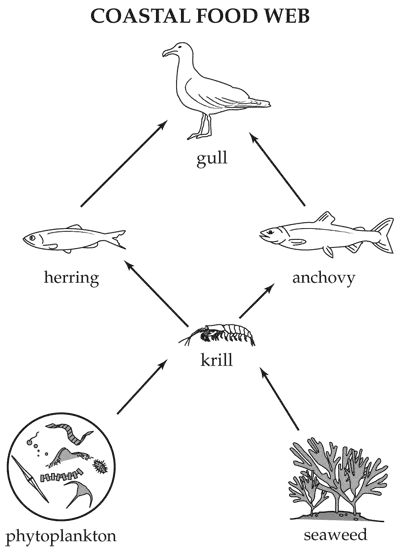
The diagram below represents a Coastal Food Web. Global warming causes an increase in coastal water temperatures. Increased coastal water temperature causes a decrease in reproduction of krill. Which of these would most likely experience an increase in population?
a)
gull
b)
herring
c)
anchovy
d)
phytoplankton
33.
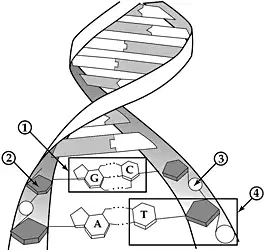
Use the diagram below to answer the following item. Which of these is a nucleotide?
a)
1
b)
2
c)
3
d)
4
34.
A group of students measured the volume of air they exhaled during three different activities: sitting, walking, and running. The volume of exhaled air is directly related to the amount of carbon dioxide produced. The data the students collected are summarized a graph. Which of these processes produces carbon dioxide?
a)
mitosis
b)
diffusion
c)
cellular respiration
d)
photosynthesis
35.
What is one role of transfer RNA in the cell?
a)
preparing the genes for messenger RNA
b)
changing nitrogen bases into amino acids
c)
preparing messenger RNA for the ribosomes
d)
transferring amino acids to the ribosomes
36.
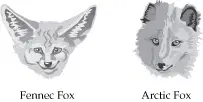
The ears of foxes help to regulate body heat. The fennec fox lives in the North African desert and has large ears that release body heat. The Arctic fox lives in cold climates and has small ears that conserve body heat. Which of these processes led to the development of different ear sizes in foxes?
a)
selective breeding
b)
succession
c)
natural selection
d)
mutualism
37.
Which of these does not occur during meiosis
a)
production of identical daughter cells
b)
production of 4 daughter cells
c)
crossing-over of homologous chromosomes
d)
reduction of chromosome number by one-half
38.

Catalase is an enzyme found in plant and animal cells. Hydrogen peroxide is a harmful substance found in cells. Catalase causes hydrogen peroxide to break down into water and oxygen.A student conducted an experiment to determine whether plant and animal cells have the same amount of catalase. She used liver and potato tissues in the experiment. The graph below shows the results from the experiment. The student conducted a second experiment. She boiled the liver tissue completely and added it to the hydrogen peroxide solution. She observed that little to no oxygen was released in the second experiment.Which of these statements best supports the student’s observations?
a)
Exposing catalase to high temperatures makes it inactive
b)
Exposing catalase to high temperatures changes it into a different enzyme
c)
Boiling liver breaks down hydrogen peroxide faster
d)
Boiling removes oxygen from the liver
39.
How many nucleotides are needed to code for one amino acid?
a)
1
b)
3
c)
4
d)
6
40.
An ecosystem has a stable population of white-tailed deer. What is the most likely outcome if a new species of deer that competed for the same resources were introduced?
a)
The white-tailed deer population would increase
b)
The producer (things the deer population eats) population would decrease
c)
The white-tailed deer population would not be affected
d)
The predator population would decrease
100 %

